
Updated August 2026 · 11-min read · by the Brainrich Kids team
Every homeschool parent eventually discovers the same trade: you can spend twenty minutes pushing a wiggly child through a worksheet, or five minutes letting the same child jump the answers instead—and get better recall by Friday. This is the second half of our kinesthetic learning pair. The first half, What Is Kinesthetic Learning? A Parent's Guide, covers the science: why movement, gesture, and hands-on work are linked to better learning and attention in essentially all children, and why the "one fixed learning style" idea didn't survive testing. This half is the toolbox—35 kinesthetic learning activities, sorted by subject, ready to run today with things you already own.
The quick answer: a kinesthetic learning activity is any lesson where the body carries part of the thinking—hopping between letter sounds, stomping skip-counts, air-writing spelling words, acting out the water cycle. The recipe is always the same: take the fact you want practiced, attach it to a movement, and repeat until the movement isn't needed anymore. Research links gesture to better retention, physically active lessons to stronger math and literacy gains in young children, and short whole-body breaks to markedly better attention—with the biggest gains in the kids who find sitting hardest. All activities below suit ages 3+ with an adult nearby, scaled to your child.
Jump to: How to use this list · Reading & phonics · Math · Spelling · Science · Whole-body breaks · FAQ
How to use this list
Three ground rules make every activity below work harder:
Say the learning out loud while the body moves. The point is pairing, not exercise with math nearby. The child jumps as they say "five, ten, fifteen"—the voice and the movement land together. That pairing is what the gesture and active-lesson research kept finding: children who moved while learning held onto the material longer than children who only said it.
Keep rounds short and end early. Five focused minutes beats twenty draggy ones. Stop while it's still fun and the game keeps its power for tomorrow.
Safety first, always. Everything here suits ages 3 and up with an adult nearby. On climbing equipment: mats under landing zones, bare feet or grippy socks, and the golden rule from our controlled risky play guide—children climb to heights they reached themselves, never heights they were lifted to. And none of this replaces outdoor play; it guarantees the movement happens on the days weather, dark, or schedule cancel the outdoors.
Reading & phonics activities
1. 🐸 Letter hopscotch
Chalk or painter's-tape a hopscotch grid, but write letters in the squares instead of numbers. The child hops square to square saying each letter's sound, not its name—"buh, buh, B!" For pre-readers, call out a sound and have them find and jump to it. Later, lay out a whole word and let them hop it left to right, blending as they land: c-a-t, cat.
2. ✍️ Air writing
Letters drawn with the whole arm, huge, in the air—"skywriting"—while saying the sound. Big-muscle letter formation builds the same motor memory as pencil work with none of the fine-motor frustration, and the handwriting research suggests forming letters physically is associated with activating the brain's reading circuitry. Progress from air to sand tray to shaving cream on the table—messier is stickier.
3. 🧗 Alphabet climb
Tape letter cards up a climbing net or ladder rungs. The child climbs to collect the letters of today's word, then arranges them on the mat below in order. Climbing meters the pace so each letter gets a beat of attention—and the reward for decoding is another climb.
4. 🦶 Tape-line letters
Make one giant letter on the floor from painter's tape and have your child walk it heel-to-toe like a balance beam, saying words that start with its sound. Walking the letter's shape teaches its strokes with the whole body—especially useful for the b/d flippers.
5. 👏 Syllable jumps
Say a word; the child jumps once per syllable—"wa-ter-mel-on" is four jumps. Syllable awareness is a core pre-reading skill, and counting with the legs beats counting with claps for kids who need bigger input.
6. 🎭 Act the story
After a read-aloud, replay the story with the child as the main character—three scenes, beginning, middle, end. Retelling is one of the strongest comprehension checks there is, and acting it out gives the retelling a body. Costumes optional, commitment mandatory.
7. 🔍 Sound scavenger hunt
"Bring me three things that start with /m/." The child runs the house hunting. Sorting real objects by initial sound is phonemic awareness with legs—and it burns energy while you drink your coffee.
8. 🪢 Sight-word swing
Hold up a sight-word card each time the swing comes toward you; the child reads it before the next pass. Rhythmic, vestibular movement keeps many children in exactly the alert-calm state where sight words finally stick—the same principle behind our sensory gym guide.
Math activities
9. 🦵 Skip-count stomps
Count by 2s, 5s, or 10s with a stomp per number, around the room like a marching band. When the sequence is solid, switch to whisper-stomps, then silent stomps with only the landmark numbers spoken. Preschool research found children taught numeracy through physically active lessons outperformed peers taught the same content seated—both right away and weeks later.
10. 🧗 Climb-and-count
One number per rung, spoken on the move—up the ladder counting by ones, down counting backward. Backward counting from a rung ladder is sneaky subtraction practice, and the height progression makes the number line literal: bigger number, higher up.
11. 🐒 Monkey-bar math facts
One multiplication or addition fact per bar: the child answers as they grab each rung. Eight bars, eight facts, then a rest—the grip does the pacing, and the facts get attached to a full-body rhythm. House favorite: the times table your child hates most, every crossing, for a week. Watch it become the one they know cold.
12. 📏 Measure everything day
Hand over a tape measure and a clipboard: measure the couch, the hallway, the dog (good luck), the height of the play gym. Compare, order, record. Measurement is the math topic most naturally learned through the hands, and the clipboard makes it feel official.
13. 🎲 Movement dice
Two dice: one numbered, one with movements written on tape (jump, spin, squat, bear crawl). Roll both—"6 + spin" means six spins while counting. Add a third die and make it addition: roll 4 and 3, do 7 jumps. The child is doing sums to find out how much to move, which is the correct order of motivation.
14. 🦘 Number-line leaps
A masking-tape number line, 0 to 20, on the floor. The child stands on 5, you say "add 3," they leap forward three, announcing where they land. Subtraction leaps backward. Negative numbers someday, if the hallway is long enough. The child is the cursor—addition becomes a direction, not a rule.
15. 🫘 Beanbag place value
Three buckets labeled ones, tens, hundreds. The child tosses beanbags, then builds the number they made: two in hundreds, one in tens, three in ones—231, said aloud, then written. Toss again, build a bigger number, compare.
16. 🔺 Shape hunt tag
Call a shape; the child races to touch something that shape in the room—triangle, rectangle, circle, cylinder for the advanced class. Geometry vocabulary attaches to real objects at a run.
Spelling activities
17. 🏃 Spelling relay
Letter cards scattered at one end of the room, child at the other. Call the word; they run, grab letters one trip at a time, and build the word at home base. The running spaces out the letters so each one gets its own moment—which is exactly what a rushed speller needs.
18. 🤸 Body letters
Spell short words one letter at a time with the whole body—arms curved for C, star jump for X, a partner for M. Photograph the word and let them decode their own picture tomorrow. Ridiculous, memorable, and the ridiculousness is the mnemonic.
19. 🪜 Rung-by-rung spelling
One letter per rung, spoken on the move, up the ladder or across the monkey bars—"F... R... I... E... N... D"—then the whole word from the top. The steady climbing rhythm meters the spelling so no letter gets skipped, and tricky words earn a second crossing.
20. 🎨 Giant rainbow writing
Write the week's words in huge letters on butcher paper taped to the wall; the child traces each word three times in three colors, standing, with the whole arm. Wall-scale writing recruits the shoulder and core—far more body, far more memory, than pencil-scale.
21. 🫧 Squat spell
Vowels are squats, consonants are claps: "h-o-u-s-e" becomes clap-squat-squat-clap-squat... wait, which was U? Exactly—the child has to hold the word's structure in mind while moving, which is the workout. Start with three-letter words; laugh often.
22. 🎯 Beanbag letter toss
Letter cards face-up on the floor; the child tosses a beanbag onto each letter of the word in order, hopping to collect after the last one. Aim, sequence, spell—three practices in one game.
Science activities
23. 🪐 Living solar system
One child is the sun (arms out, radiating smugly); the other orbits while spinning slowly—a year and a day, both at once. Add a moon orbiting the child if a sibling or parent is available. Orbital mechanics taught in fifteen dizzy minutes, remembered for years.
24. 🧊 States-of-matter freeze dance
Music on: "solid!"—children freeze rigid, molecules packed tight. "Liquid!"—slow flowing walks around the furniture. "Gas!"—fast bouncing everywhere, maximum spacing. You are watching molecular behavior theater, and after three rounds they will explain condensation to you.
25. ⚖️ Balance-scale body
Arms out, a stuffed animal in each hand: which is heavier? The heavy side dips, the body tips—the child is the balance scale. Then verify on a real kitchen scale and compare predictions. Estimation, measurement, and proprioception in one bit.
26. 🚗 Ramp lab
Prop a board against the couch and race toy cars down it at different angles: steeper means faster, carpet beats hardwood for stopping. Change one variable at a time and have the child call the result before each run—that call is a hypothesis, and now you are doing physics.
27. 🦋 Life-cycle yoga
Butterfly life cycle as four poses: curled-tight egg, crawling caterpillar, hanging chrysalis (arms wrapped, very still, very dramatic), then wings. Call the stages out of order and watch them re-sequence. Works for frogs, seeds, and—on brave days—the water cycle.
28. 🍂 Collector's walk
Outside, with a bag: five leaves, three seeds, one interesting rock. Home again, sort by any rule the child invents—size, color, alive-once versus never-alive—then re-sort by a different rule. Classification is the deep skill under all of biology, and it starts with pockets full of acorns. (Told you we weren't anti-outdoors.)
Whole-body break activities
These seven aren't tied to a subject—they are the engine maintenance between lessons. Classroom research links short activity breaks to better on-task behavior, with a roughly 20% improvement among the least on-task students in the Energizers study, and a 2017 meta-analysis associated classroom movement programs with improved academic-related outcomes overall. The homeschool translation: 10–20 minutes of work, then 3–5 minutes of real movement, before the wheels come off, not after. Full scheduling logic in our homeschool PE guide—and for why this matters double for ADHD learners, see homeschooling a child with ADHD.
29. 🙃 Hang time
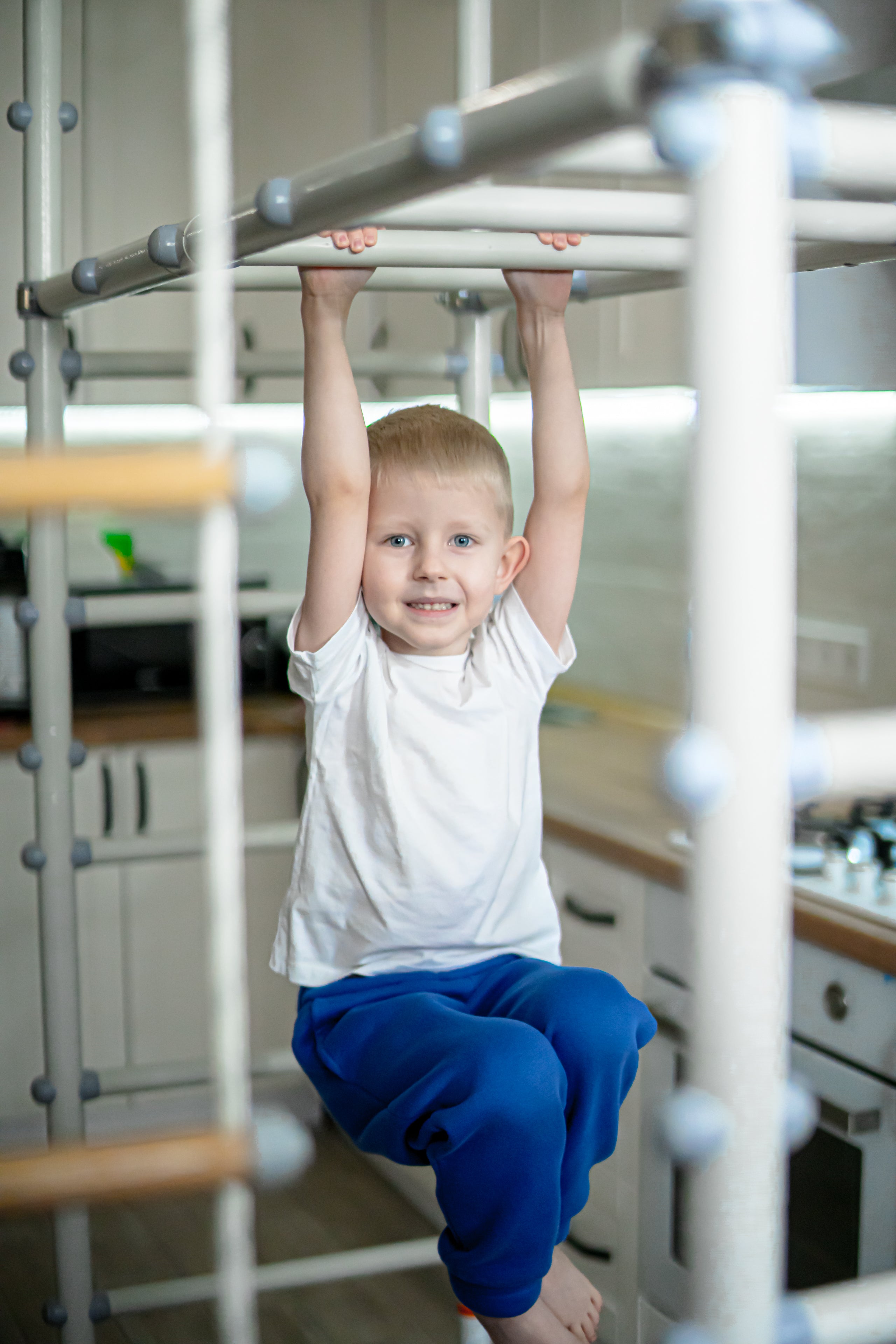
Thirty seconds hanging from a bar or rings—arms straight, feet off the ground, maybe knees up, maybe (earned, supervised) upside down. Hanging decompresses the spine, loads the grip and shoulders, and delivers the deep-pressure input that shows up throughout our heavy work guide. It is the fastest reset we know that fits between two math problems.
30. 🐒 Brachiation laps
Monkey-bar crossings—hand over hand, both directions, count the crossings across the week and watch the number grow. Brachiating is bilateral coordination, rhythm, grip endurance, and core control in one movement, which is why it has anchored children's gymnastics equipment since the Swedish gymnastics tradition our gyms descend from.
31. 🧗 Climbing circuit
Up the net, across the top rung, down the ladder, tag the wall, again—three rounds, timed if your child runs on competition. A fixed circuit on familiar equipment builds the route-planning and body-confidence described in our review of what climbing does for kids—and it reliably burns exactly the fidget that was about to derail the read-aloud.
32. 🪺 Swing reset
Five minutes of swinging between lesson blocks—belly-down "superman" for deep pressure, or seated with a story tape running. Rhythmic vestibular input is the classic downshift for a revved-up nervous system; many families schedule it before the hardest subject of the day, not after.
33. 🐻 Animal-walk hallway
Bear crawl to the kitchen, crab walk back, frog jumps for the last stretch. No equipment, huge muscle recruitment, and a three-year-old will do it purely because you called it a bear crawl.
34. 🧱 Wall-push countdown
Ten seconds pushing the wall as hard as possible ("help me move the house"), rest, repeat three times. Isometric heavy work—maximum effort, zero space, zero noise—for apartments, waiting rooms, and the minute before handwriting practice.
35. 🎪 Build-your-own obstacle course
The graduation exercise: the child designs the course—couch cushions, tape lines, under the table, up the net, three rungs across, land on the mat—then teaches it to you. Designing the course is planning and sequencing; running it is PE; revising it when the crab-walk section is too easy is engineering. This one activity is the whole list in miniature.
The pattern across all seven: hanging, climbing, swinging, and pushing beat aimless running around because they load the proprioceptive and vestibular systems—the input most associated with the settled, ready-to-focus state you want the next lesson to start from. A movement zone in the homeschool room (see our homeschool room ideas) makes the break a thirty-second transition instead of a production—and this is the job a home gym does all school year:


One structure, activities 3, 8, 10, 11, 19, 29–32, and 35
Every gym assembles in an afternoon and is covered by a 30-day money-back guarantee.
Frequently asked questions
What are kinesthetic learning activities? Lessons where movement carries part of the thinking: hopping between letter sounds, stomping skip-counts, air-writing spelling words, acting out science concepts, or drilling math facts across monkey bars. The formula is fact + movement + repetition, with the learning spoken aloud as the body moves.
Do these activities only help "kinesthetic learners"? No—and that is good news. Research does not support sorting children into fixed learning styles, but it does link movement, gesture, and hands-on practice to better learning and attention across children generally. The full evidence picture is in our kinesthetic learning guide. Movement-hungry kids simply enjoy these the most.
What ages are these for? Everything here suits ages 3 and up with an adult nearby, scaled to the child—three-year-olds hop letter sounds, eight-year-olds spell across monkey bars. Brainrich gyms are rated for independent climbing at 3+; younger siblings join hands-on, at floor height, with you spotting.
How often should we do movement breaks during homeschool? The rhythm that mirrors the classroom research: a short whole-body break every 10–20 minutes of seated work for young children, stretching longer as attention matures. Schedule breaks before focus collapses—a child mid-meltdown can't use one, a child starting to squirm can.
What if we don't have climbing equipment? Twenty-six of the 35 activities need nothing but tape, chalk, beanbags, and furniture—start today. The gym-based versions add the hanging, climbing, and swinging input that no floor game fully replaces, which is why we recommend a movement zone to every homeschool family who can make the space. The 60-second quiz matches gyms to rooms as small as a corner.
Are kinesthetic activities enough, or does my child still need seated work? Both. Reading, writing, and listening are skills every child must practice in their ordinary form—movement is the amplifier and the recovery system around that work, not the replacement for it. The strongest homeschool days alternate: focused seated block, whole-body break, repeat.
📚 Keep reading in the Decision Guide
What Is Kinesthetic Learning? A Parent's Guide · Heavy Work Activities for Kids · The Homeschool Hub
Sources
Cook, S.W., Mitchell, Z. & Goldin-Meadow, S. (2008). Gesturing makes learning last. Cognition. · James, K.H. & Engelhardt, L. (2012). The effects of handwriting experience on functional brain development in pre-literate children. Trends in Neuroscience and Education. · Mavilidi, M.F. et al. (2018). Immediate and delayed effects of integrating physical activity into preschool children's learning of numeracy skills. Journal of Experimental Child Psychology. · Mahar, M.T. et al. (2006). Effects of a classroom-based program on physical activity and on-task behavior. Medicine & Science in Sports & Exercise. · Watson, A. et al. (2017). Effect of classroom-based physical activity interventions on academic and physical activity outcomes: a systematic review and meta-analysis. Int. Journal of Behavioral Nutrition and Physical Activity. · de Greeff, J.W. et al. (2018). Effects of physical activity on executive functions, attention and academic performance in preadolescent children: a meta-analysis. Journal of Science and Medicine in Sport. · Kontra, C., Lyons, D.J., Fischer, S.M. & Beilock, S.L. (2015). Physical experience enhances science learning. Psychological Science.
Share: