

Updated August 2026 · 11-min read · by the Brainrich Kids team
Somewhere right now, a parent is sitting across the table from a 5-year-old, forty minutes into a phonics lesson that was supposed to take fifteen, wondering if they are cut out for homeschooling. They are. The schedule isn't. Kindergarten at home is the year most families over-build—six subjects, a school-length morning, a laminated timetable—for a child whose attention system is still under construction. Here is the number that changes everything: a complete homeschool kindergarten runs on 60–90 minutes of seat work a day. Total. The rest of the day is play, movement, and read-alouds—and that is not the compromise version. That is the well-designed version.
The quick answer: a kindergarten homeschool schedule needs 60–90 minutes of formal learning per day, broken into 10–20 minute chunks, separated by real movement blocks and stitched together with read-alouds and free play. Five-year-olds sustain focused attention for minutes, not hours—attention research shows the ability to concentrate is still developing rapidly at this age—so short, frequent lessons beat long ones on every measure that matters. Anchor the day to a rhythm (move, table time, move, read) instead of clock times, keep the strongest subject first, and end every lesson while it is still going well. If your kindergartner finishes the day with tired legs and a favorite book read aloud, you did it correctly.
Jump to: How long is enough · Attention at age 5 · The daily rhythm · 3 sample days · Gross-motor blocks · What to skip · FAQ
How much seat work does a kindergartner actually need?
Start with what a classroom kindergarten really delivers. A public school kindergarten day looks like six hours, but subtract arrival, snack, lunch, recess, specials, transitions, lining up, waiting for 22 other children, and rest time, and the direct one-on-one instruction any single child receives is a small slice of the day. At home, you deliver that slice with zero waiting—which is why a daily homeschool schedule for kindergarten fits comfortably inside 60–90 minutes of actual table time:
15–20 min
Reading & phonics—letters, sounds, early decoding, a little every day
15–20 min
Math—counting, patterns, shapes, played more than written
10–15 min
Handwriting or fine-motor work—short on purpose; small hands tire fast
20–30 min
Read-alouds—the heavyweight of kindergarten, done on the couch
Everything else a kindergartner needs—science, social skills, vocabulary, art, problem-solving—arrives through play, conversation, and books. That is not a homeschool cope; it is the mainstream pediatric position. The American Academy of Pediatrics' clinical report on play concludes that play builds the executive-function, language, and self-regulation skills that formal academics later stand on—pediatricians now literally prescribe play at checkups. A kindergarten schedule that protects three hours of play is not a light schedule. It is a complete one.
The 5-year-old attention span, by the numbers
Why 15-minute lessons? Because that is roughly the size of the container you are pouring into. The classic developmental research on this comes from Ruff and Lawson, who observed children across the first five years and documented how sustained, focused attention develops gradually with age—growing measurably year over year, but still counted in minutes, not hours, across the preschool and kindergarten window. A widely used classroom rule of thumb puts a child's focused attention for adult-directed work at very roughly two to five minutes per year of age—call it 10–25 minutes at age five, on a good morning, for a task they didn't choose.
Three design consequences fall straight out of that:
1. THE LESSON FITS THE ATTENTION, NOT THE CURRICULUM
If the workbook chapter takes 40 minutes, the workbook is wrong for a 5-year-old—split it across two days rather than stretching one sitting.
2. STOP AT THE PEAK
End table time while it's still going well. The last two minutes of a lesson are what a child remembers about school tomorrow morning.
3. MOVEMENT REFILLS THE TANK
Studies of classroom activity breaks associate movement with better on-task behavior afterward—the reset button between chunks is physical, not verbal.
That third point deserves its own numbers, because it is the difference between a schedule that works in September and one that still works in February:
When researchers added short physical activity breaks (called Energizers) to elementary classrooms, on-task behavior during the academic time that followed improved by about 8% on average—and by about 20% among the students who struggled most to stay on task. The wiggliest kids benefited most from moving. If you are homeschooling one of the wiggly ones, the movement block is not a break from the plan. It is the plan.
MAHAR ET AL., MEDICINE & SCIENCE IN SPORTS & EXERCISE, 2006 · READ THE STUDY
Rhythm beats clock: the kindergarten day skeleton
Five-year-olds cannot read a clock, but they are superb at sequences. So the schedule that works is a rhythm—a repeating order of events—rather than a timetable. The skeleton underneath every sample day below is the same: move → table time → move → table time → read-aloud → done. Body first, letters second, and never two table blocks back to back.
Why body first? Because a kindergartner arrives at the table either regulated or not, and the sensory systems that do the regulating—the vestibular sense (balance and motion) and proprioception (body position and effort)—are fed by exactly the things kindergartners beg to do anyway: climbing, swinging, hanging, jumping, pushing, carrying. We cover the mechanics in our guides to heavy work activities and building a sensory gym at home, but the schedule-level takeaway is simple: twenty minutes of hard physical play before phonics is not a delay to the school day. It is the on-ramp.
Three sample days you can copy tomorrow
Three kindergarten homeschool schedule examples, one skeleton. Times are approximate anchors—follow the order, not the minutes.
Sample day 1: the classic morning
| Rhythm | Block | Notes |
|---|---|---|
| ~8:30 | Breakfast + morning jobs | Feed the cat, water the plant. Responsibility counts as curriculum at 5. |
| ~9:00 | Movement block #1 (20–30 min) | Climbing, swinging, a walk, backyard time. Hard play, not screens. |
| ~9:30 | Table time #1: phonics (15–20 min) | The most important subject gets the freshest brain. |
| ~9:50 | Movement block #2 + snack (30 min) | This is recess. Schools defend it for a reason; so should you. |
| ~10:30 | Table time #2: math (15–20 min) | Count real things—blocks, snacks, rungs climbed. Games over worksheets. |
| ~11:00 | Free play (45–60 min) | Unstructured and child-led. This is where the morning's learning gets digested. |
| ~12:00 | Lunch + read-aloud (20–30 min) | Chapter books they can't read yet—vocabulary years above their decoding level. |
| Afternoon | Quiet rest, outside time, free play | School is over. Total seat work: ~50 minutes. It was enough. |
Sample day 2: the high-energy child
Some kindergartners need the dial turned further toward movement—shorter table chunks, more frequent resets. (If this describes your child every single day, our movement-first ADHD homeschool guide goes deeper.)
| Rhythm | Block | Notes |
|---|---|---|
| ~9:00 | Big movement (30–40 min) | Obstacle course, monkey-bar challenge, "climb it 10 times." Real exertion. |
| ~9:40 | Phonics burst (10 min) | One skill, then stop. Ten focused minutes beat thirty contested ones. |
| ~9:50 | Movement snack (10 min) | Ten swings, ten hangs, ten jumps—a quick sensory reset, then back. |
| ~10:00 | Math burst (10–15 min) | Movement-built math: count rungs, measure jumps, sort by size. |
| ~10:15 | Free play + snack (45 min) | Child-led. You are off duty. |
| ~11:00 | Handwriting or craft (10 min) | Fine-motor work lands better after the big muscles have worked. |
| ~12:00 | Lunch + read-aloud | Wiggling while listening is allowed—hanging upside down while listening is too. |
Sample day 3: the working-parent kindergarten
| Rhythm | Block | Notes |
|---|---|---|
| ~7:45 | Table time #1 with parent (20 min) | Phonics before the workday—the one block that most needs you. |
| ~8:15 | Movement block, solo | A safe, engaging place to burn energy without hands-on supervision is the hinge of this whole day. |
| Mid-morning | Independent play + audiobook basket | Rotate a small shelf weekly so it stays novel. |
| Lunch | Table time #2 with parent (15–20 min) | Math over lunch break, then back to work. |
| Afternoon | Free play, outside time, rest | Grandparent, partner, or sitter shifts work fine here—nothing academic is scheduled. |
| Evening | Read-aloud at bedtime (20–30 min) | Already in your routine—now it's also the literature block. |
A note on pre-K: if you found this article with a 3- or 4-year-old, take the skeleton above and shrink the table time further—a pre-k homeschool schedule is 15–30 total minutes of letters-and-numbers play, and everything else is movement, read-alouds, and open-ended play. At that age there is no "behind."
The gross-motor block: kindergarten's other curriculum
The CDC's activity guidance for young children is blunt: preschool-aged children (3 through 5) should be physically active throughout the day, not in a single scheduled hour—and children 6 and up need at least 60 minutes daily. Kindergarten sits exactly on that boundary, which makes the movement blocks in the schedules above load-bearing twice over: they reset attention for the next table chunk, and they are the physical development curriculum—balance, coordination, grip strength, spatial judgment—in its natural form. (The evidence on what daily climbing does for a developing body is its own article: Does a home climbing gym actually help kids?)
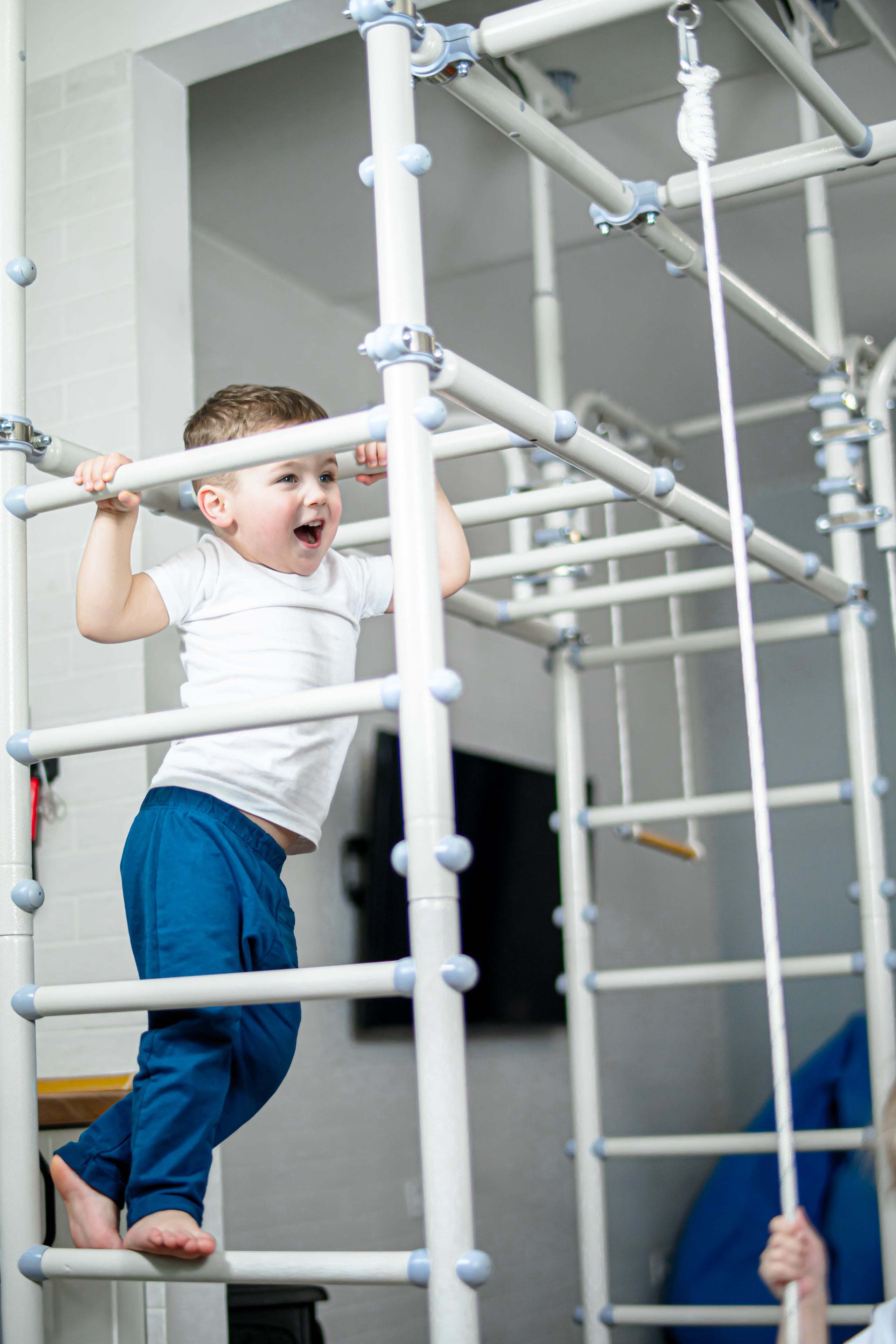
Outdoors is the first-choice venue, and nothing here argues otherwise—park mornings, backyard time, and nature walks belong in every kindergarten week. But a schedule is only as strong as its worst-weather day. The movement block that exists "when we can get outside" is the first block to quietly disappear in November, and with it goes the attention it was buying. The families who hold the rhythm year-round have an indoor default that needs no setup, no driving, and no adult animation: a climbing gym, a doorway bar with a swing, a sensory corner. For a kindergartner, self-directed climbing also carries its own quiet curriculum—risk judgment, persistence, "I did it myself"—which is the subject of our controlled risky play guide.
Which gym fits your kindergartner? Take the 60-Second Quiz →
What you can skip in kindergarten (really)
| Keep | Skip without guilt |
|---|---|
| Daily phonics, in minutes-long doses. Small and consistent wins the year. | The 6-subject rotation. Science and social studies at 5 are puddles, bugs, maps on the wall, and questions at lunch. |
| Read-alouds every single day. The single highest-leverage block on the schedule. | Worksheet stacks. One page that gets finished beats five that end in tears. Output is not the metric; warmth toward learning is. |
| Movement before and between table times. The attention research is on your side. | The 8:30 start. A rested kindergartner at 9:45 outperforms a dragged-to-the-table one at 8:30, every time. |
| Ending lessons on a win. Stop at the peak, even mid-page. | Keeping pace with the neighbor kid. Kindergarten readers spread across a two-year range and converge; the schedule's job is to protect the relationship until they do. |
One structure, four jobs on this schedule
Look back at the three sample days: the same movement block appears eleven times—wake-up climb, between-lessons reset, solo block for the working-parent day, free-play anchor. That is the job we build for. A gym rated for ages 3 and up covers the kindergarten year and then keeps pace through elementary, with adjustable challenges that start low and rise only as the child is ready—safety-first, every day, in any weather.


Build the recess your kindergarten runs on
Every gym assembles in an afternoon and is covered by a 30-day money-back guarantee.
Frequently asked questions
How many hours a day should I homeschool my kindergartner? Plan on 60–90 minutes of formal learning, delivered in 10–20 minute chunks across the morning—never in one sitting. Add read-alouds, free play, and daily movement and you have a full kindergarten education. Families are routinely surprised it's enough; remember that a classroom kindergartner receives only a small slice of direct instruction inside the six-hour building day.
What does a typical kindergarten homeschool day look like? A repeating rhythm: movement, then 15–20 minutes at the table, then movement again, then a second short table block, then free play and a read-aloud over lunch. Formal school is finished by noon in every sample schedule above, and afternoons stay open for rest, outside time, and play.
What subjects should a kindergarten schedule include? Daily: phonics/reading (15–20 min), math (15–20 min), and read-alouds. A few times a week: handwriting or fine-motor practice. Everything else—science, art, social learning—happens through play, conversation, and books at this age, a position backed by the American Academy of Pediatrics' report on play and development.
How long can a 5-year-old actually focus? For adult-directed table work, expect roughly 10–20 productive minutes per sitting—attention research shows sustained focus is still developing rapidly across the preschool years and grows year over year. Focus during self-chosen play runs much longer, which is why a child who "can't sit for phonics" can build one puzzle for forty minutes. Design the schedule around the first number and protect time for the second.
Do kindergartners need PE in homeschool? They need daily movement, however you label it: the CDC recommends young children be physically active throughout the day. Three or four movement blocks—climbing, swinging, park trips, obstacle courses—clear that bar easily, and double as the attention resets that make table time work. For state requirements and a structured program, see Homeschool PE at Home.
My kindergartner refuses table time. What now? First shrink the lesson—ten minutes, one skill, done. Second, put a real movement block directly before it; the activity-break research associates movement with better on-task behavior in the block that follows, with the biggest gains among the least-focused kids. Third, end on a win, even mid-worksheet. If resistance stays high every day for weeks, the material may simply be early—kindergarten readiness spreads across a wide, normal range.
Is a pre-K schedule different from kindergarten? Same skeleton, smaller doses: 15–30 total minutes of playful letters-and-numbers work for a 3- or 4-year-old, with movement, read-alouds, and free play filling the day. Formal seat work can wait; the developmental heavy lifting at pre-K age is happening on the climbing frame and the living-room floor.
📚 Keep reading in the Homeschool Hub
The Homeschool Schedule That Actually Works · Homeschool Room Ideas · Homeschool Grants & Funding · The Homeschool Hub
Sources
Ruff, H.A. & Lawson, K.R. (1990). Development of sustained, focused attention in young children during free play. Developmental Psychology. · Yogman, M. et al. (2018). The Power of Play: A Pediatric Role in Enhancing Development in Young Children. Pediatrics (American Academy of Pediatrics clinical report). · Mahar, M.T. et al. (2006). Effects of a classroom-based program on physical activity and on-task behavior. Medicine & Science in Sports & Exercise. · Centers for Disease Control and Prevention. Physical Activity Recommendations for Children and Teens. · American Academy of Pediatrics, Council on School Health (2013). The Crucial Role of Recess in School. Pediatrics.
Share: