

Updated September 2026 · 11-minute read · by Yegor Nadvornyy, founder of Brainrich Kids
Search "indoor playset" and you get two completely different objects wearing the same name: a molded plastic slide-and-climber for toddlers, and a floor-to-ceiling climbing frame for school-age kids. They cost different money, take different space, and solve different problems for different years of childhood. Most families end up owning one of each, in the wrong order. Here is how to tell them apart, which one your house needs right now, and the one question (the slide) that decides most of it.
The quick answer: an indoor playset is a low, self-contained unit, usually plastic or wood, built around a slide and a short climb for ages roughly 1 to 4; it is quick to set up, quick to outgrow, and takes a lot of floor for what it does. An indoor play gym is a vertical steel frame (ladders, monkey bars, rings, ropes, a swing point) for ages 3 to 12+, braced floor to ceiling, so it uses a corner instead of a room and grows by adding pieces instead of being replaced. Under 3 with a slide obsession: playset. Three and up, or any child who climbs the furniture, or any home short on floor space: play gym. Buying a gym at 3 is the move that skips the second playset.
Jump to: The two objects, defined · Side by side · When a playset is right · When a play gym is right · The slide question · Buying checklist · Plastic, wood, or steel · FAQ
The two objects, defined
Indoor playset. A freestanding, low unit that sits on the floor: a short slide, a few steps or a small climbing wall, often a tunnel or a basketball hoop. Molded plastic in the toddler versions, wood in the playroom-furniture versions. Nothing attaches to the ceiling or wall. Height tops out around a child's own height, which is exactly right at 18 months and exactly the problem at 4.
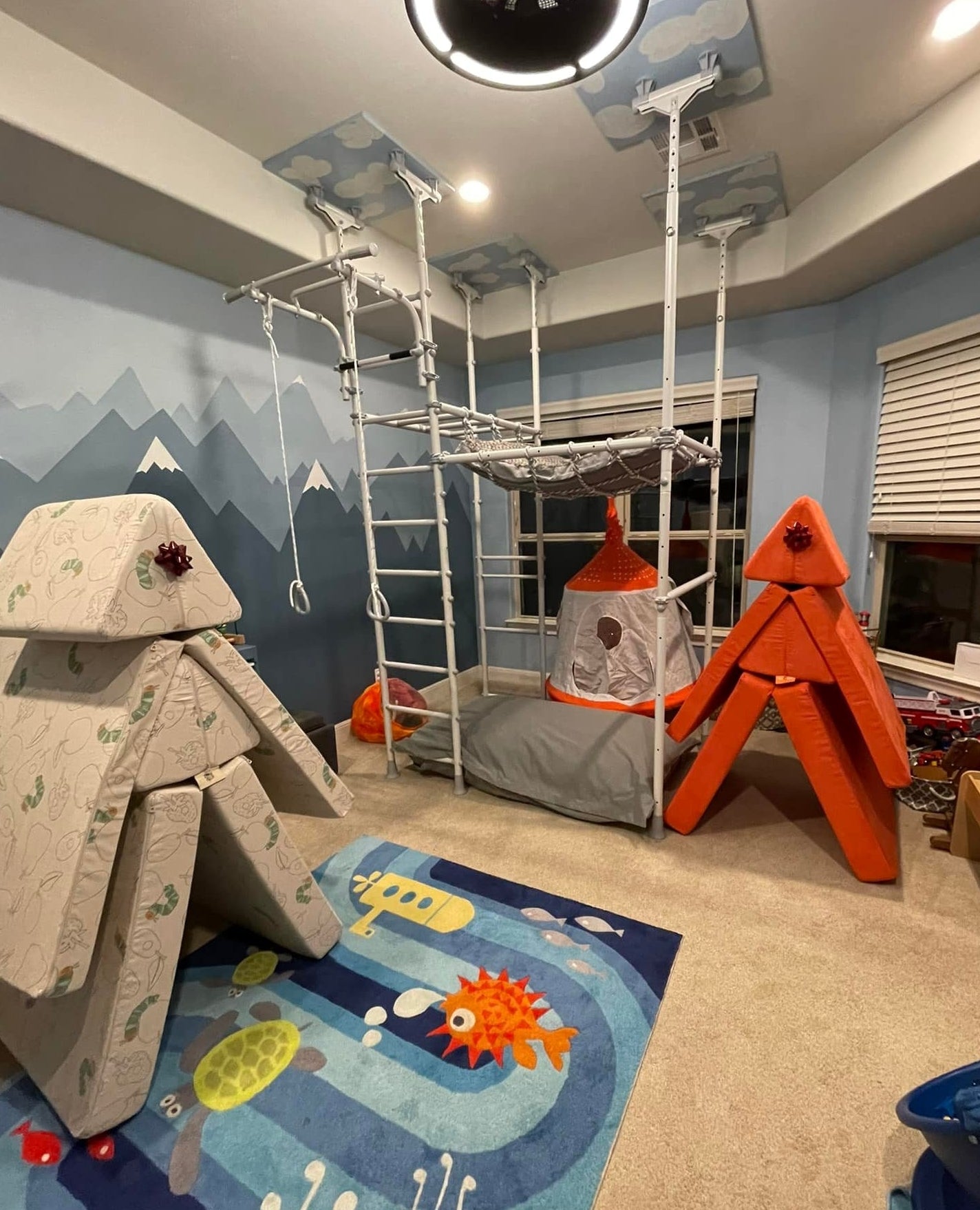
Indoor play gym. A vertical frame. Ours are steel ladders that brace between floor and ceiling with telescopic poles (no drilling) or mount to a wall, joined by crossbars that carry monkey bars, a climbing net, a rope, rings, a trapeze, and a swing. The child climbs up, not over, and the equipment is rated for adult loads: a 220 lb working rating, safety-tested to 440. Independent climbing starts at age 3 and up, with a parent in the room.
Side by side
| Indoor playset | Indoor play gym | |
|---|---|---|
| Age span | About 1 to 4; most are outgrown in 18-24 months | 3 to 12+; the same frame from preschool to pull-ups |
| Footprint | Large relative to play value; a slide needs run-out room | A corner; wall-mounted versions protrude 9 inches |
| Load rating | Typically 50-100 lb, often unpublished | 220 lb working load, tested to 440 (ours) |
| What it trains | Stepping, sliding, crawling: early mechanics | Climbing, hanging, swinging, brachiation: strength plus sensory input |
| Installation | Snap together, minutes | An afternoon; tension-mounted, no drilling |
| Growth path | None; replace it | Modular: add monkey bars, nets, rings, a second swing |
| Price band | Roughly $80-400 | $850-2,400, once, and it resells |
When an indoor playset is the right call
- The child is under 3. Full-height frames are for 3 and up; a toddler needs low, soft, and reachable, and a small playset or foam climber is the honest match. Our by-age guide to climbing toys by age covers this stretch in detail.
- The slide is the point. If the thing your child asks for is the slide, a playset delivers it and a play gym does not (more on why below).
- You need something for eighteen months, not nine years. A grandparent's house, a rental you are leaving, a playroom that will become an office.
When an indoor play gym is the right call
- The child is 3 or older and climbs everything. The furniture-climbing years are the play-gym years; the playset was outgrown the day the couch became more interesting. Why the climbing happens and where to point it: my toddler climbs everything.
- Floor space is scarce. A frame uses a corner and the air above it. Apartments, small playrooms, and shared bedrooms are where vertical wins outright; the wall-mounted Model W3 sits 9 inches off the wall.
- Sensory needs are part of the picture. Climbing, hanging, and swinging deliver the proprioceptive and vestibular input occupational therapists prescribe; a slide delivers a few seconds of it. This is the whole subject of our sensory gym equipment collection and the sensory gym at home guide.
- You want to buy once. A modular frame bought at 3 is the same frame doing pull-ups at 12, with add-ons instead of replacements. That is the entire economic argument, and it is why grandparents pooling a gift so often land here.
The slide question
It is the most common question we get about our gyms and the reason some families choose a playset, so here is the full answer. We tried to design a slide. Built to the home playground equipment standard (ASTM F1148), a compliant slide needs side walls of about 12 inches or more, a regulated exit region, a rounded exit lip, and roughly 6 feet of clear fall zone at the bottom. That much floor is incompatible with the customers we build for, who do not have unlimited room, so we shelved it rather than ship something that did not meet the standard.
The practical advice: if a slide matters, buy one that publishes its ASTM F1148 compliance and check the three things yourself (side walls, exit region, a 6-foot clear zone). Some owners attach third-party slides to their frames; we do not endorse it, and if you do, run the same checks. For everything except the slide, the frame does more per square foot than any playset made: here is the evidence on what daily climbing does.
Indoor playset buying checklist
Whichever side you land on, and whichever label the seller uses (many steel frames are still listed as an indoor playset), check these five things before you pay.
| What to check | Indoor playset (ages 1-4) | Steel play gym (ages 3-12+) |
|---|---|---|
| Published load rating | Insist on a number; many toddler playsets do not publish one | 220 lb working load, tested to 440 (ours) |
| Safety standard | ASTM F1148 for any slide: side walls, exit region, 6 ft clear zone | Mats under the frame and a clear fall zone around it, per the CPSC handbook guidance |
| Footprint | Unit size plus the slide run-out | A corner; the wall-mounted W3 sits 9 in off the wall |
| Ceiling and floor | Nothing needed | Tension-mounted models fit ceilings from about 6 ft 9 in to 10 ft 6 in across the size options; wall-mounted models need studs |
| Growth path | Replace it at 4 | Add monkey bars, nets, rings, a rope, a second swing to the same frame |
One more test that settles most indoor playset decisions: picture the same child two years from now. If the unit still fits, buy it. If it does not, the frame that grows is the cheaper purchase even at the higher price.
Plastic, wood, or steel
Playsets are mostly plastic (light, quick, low load, short life) or wood (heavier, handsome, load depends entirely on joinery). Play gyms come in wood and steel. We build in steel for reasons we lay out fully in steel vs wood climbing gyms: a steel frame does not loosen at the joints over years of dynamic load, powder-coated tube is easy to wipe down, and rubber-coated rungs give small hands the grip a bare dowel does not. None of our gyms are wooden, and we say so because "wooden jungle gym" is a different product with a different lifespan. A full material comparison is in metal vs plastic vs wood jungle gyms.


Skip the second playset
One steel frame from age 3 to 12+, in a corner, with no drilling. Backed by a 30-day money-back guarantee.
Frequently asked questions
What is the difference between an indoor playset and an indoor play gym? A playset is a low, freestanding unit built around a slide and a short climb, usually plastic or wood, for roughly ages 1 to 4. A play gym is a vertical steel frame braced floor to ceiling or mounted to a wall, carrying ladders, monkey bars, rings, ropes, and a swing, for ages 3 to 12 and up. The playset is over in a season; the gym grows by adding pieces.
What age is an indoor playset for? Most indoor playsets suit children from about 1 to 4 and are outgrown within 18 to 24 months, because their height tops out near the child's own. From 3, children are ready for vertical climbing on a rated frame.
Is an indoor play gym worth it for a small apartment? It is usually the better fit for small spaces precisely because it goes up, not out. A tension-mounted frame uses a corner and the air above it; a wall-mounted model protrudes about 9 inches. A playset with a slide needs run-out room a small apartment rarely has.
Do Brainrich play gyms have a slide? No. We designed one to the ASTM F1148 home playground standard and found that a compliant slide (12-inch side walls, a regulated exit region, about 6 feet of clear fall zone) needs more floor than our customers have, so we did not ship it. If a slide matters, buy one that publishes its compliance and check side walls, exit region, and clear zone yourself.
Which is safer, a playset or a play gym? Both are safe when used at the right age with a mat and supervision. The difference is load: playsets are typically rated 50 to 100 lb, if rated at all, while a steel play gym like ours carries a 220 lb working rating, tested to 440, which matters once two school-age kids are on it at once.
📚 Keep reading in the Decision Guide
Best Climbing Toys by Age · Steel vs Wood Climbing Gyms · The Home Play Gym Decision Guide · What Is a Jungle Gym?
Sources
ASTM International. ASTM F1148, Standard Consumer Safety Performance Specification for Home Playground Equipment. · CDC. Physical Activity Guidelines for Children and Adolescents. · Brainrich Kids engineering specification: frame working load 220 lb, safety-tested to 440 lb.
Share: