

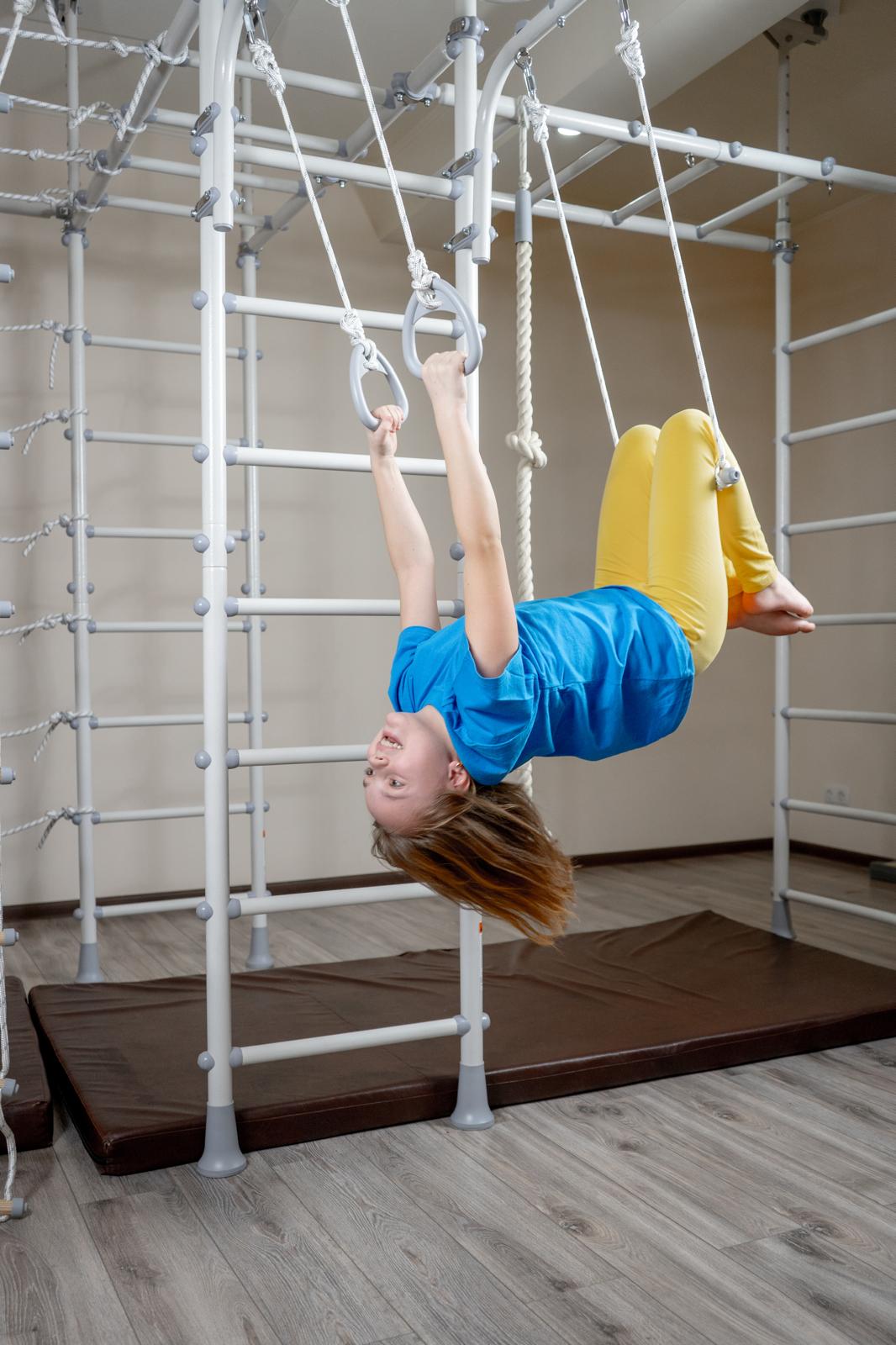
Published September 2026 · 10-minute read · by Yegor Nadvornyy, founder of Brainrich Kids
"Jungle gym" is a word everyone uses and nobody defines. It covers the dome at the park, the wooden tower in a backyard, the steel frame in a playroom, and, confusingly, the padded arch a newborn lies under. This guide sorts it out: definition, history, the five types, sizing by room, safety standards, and a buying checklist. We make the indoor steel kind, so the examples lean that way; the checklist is neutral.
The quick answer: a jungle gym is a rigid, open frame of bars that children climb through in every direction: up, across, and hanging underneath. The name and the first patent belong to Sebastian Hinton, a Chicago lawyer, in 1920. Today the word covers five things: outdoor wood playsets, outdoor metal climbers, geodesic domes, indoor floor-to-ceiling steel frames, and wall-mounted bars. An infant jungle gym is a different product (a play mat with a toy arch), not a climbing structure. For a home, look for a published load rating (ours: 220 lb working, tested to 440) and put a mat under every dismount point. Independent climbing starts at age 3, with a parent in the same room.
Jump to: Definition · History · Types · Infant "jungle gyms" · Jungle gym vs playset vs play gym · Sizing by room · Safety standards · For adults · What to look for · FAQ
What is a jungle gym? The definition
A jungle gym is a climbing structure made of bars, with open space between them, that a child can move through in three dimensions. That last part separates it from a ladder (one direction), a slide (one direction, down), or a climbing wall (one plane). The meaning has stretched since 1920, but the core has not: bars, gaps, and freedom of route. In the UK the same object is a climbing frame; indoors it is a play gym.
History: the 1920 Hinton patent
The jungle gym has a birthday and an inventor. Sebastian Hinton, a lawyer in Chicago, filed a patent for a "climbing structure" in 1920; it was granted in 1923 as U.S. Patent 1,471,465. The first one went up at a school in Winnetka, Illinois, and Hinton trademarked the name.
The idea was older than a playground. Hinton's father, the mathematician Charles Howard Hinton, had built a bamboo lattice in Japan so his children could learn three-dimensional coordinates by climbing to a called-out position. Sebastian kept the lattice, dropped the math, and noticed that children climbed it anyway, for hours. His patent argues that a child's instinct to climb needs a safe structure to run on.
Hinton's original was a cube of steel pipe. Wood arrived with the backyard playset boom of the 1980s, plastic followed, and the indoor version went back to steel for Hinton's reason: a bar that never flexes, splinters, or loosens is the part of a jungle gym that keeps a child safe.
U.S. PATENT 1,471,465 · FILED 1920, GRANTED 1923
The five types of jungle gym
| Type | Where | Strengths | Watch for |
|---|---|---|---|
| Outdoor wood playset | Backyard | Big, fort-like, swings and slide included, 8 to 12 feet tall | Splinters and rot within a few seasons; 6-foot clear zones; idle in rain, heat, and mosquito season |
| Outdoor metal climber | Backyard, school | The classic Hinton lattice; durable; many routes | Hot bars in summer; rust at welds; needs 9 inches of loose-fill or rubber tiles underneath |
| Geodesic dome | Backyard, park | Freestanding, no anchors, kids climb inside and out | Takes a 10-foot circle of lawn; limited hanging; thin tube dents |
| Indoor steel frame (tension-mounted) | Bedroom, basement, playroom | Ladders, monkey bars, nets, rings, rope, swing on one frame; no drilling; used year-round | Needs a flat ceiling between about 6 ft 9 in and 10 ft, plus a corner of floor |
| Wall-mounted bars (Swedish ladder) | Any wall with studs | Stands 9 inches off the wall; works under slanted or very tall ceilings; the smallest footprint | Needs drilling into studs; linear swinging only, no nest swing |
The first three live outside, and we love them for the hours they get used. The indoor types exist for the other hours: a Florida July, a Minnesota January, a week of rain, dusk at 4:30 p.m. Ours are the last two rows: the floor-to-ceiling frames and the wall-mounted models. Material trade-offs are in metal vs plastic vs wood jungle gyms.
"Jungle gym for infants" is a different product
Search for an infant jungle gym and you will find a padded mat with a fabric arch and three dangling toys. That is an activity gym, for a baby lying on their back in the first six months. It is not a climbing structure, and no baby belongs on one. The toddler stages, a foam climber, then a Pikler triangle, then a real frame at 3, are in climbing gyms for babies and toddlers and what comes after the Pikler triangle.
Jungle gym vs playset vs play gym
Jungle gym
The climbing structure itself: bars and gaps, outdoor or indoor. The thing you climb.
Playset
An outdoor tower with a slide, swings, and often a fort deck; climbing is one feature among several. Indoors, a low toddler slide-and-climber.
Play gym
The indoor term: vertical ladders, a monkey-bar span, and hanging points for a net, rings, a rope, and a swing.
A playset is a place to be, a jungle gym is a thing to climb, and a play gym is a jungle gym that fits through a bedroom door. The rest is in the indoor jungle gym buyer's guide.
Sizing a home jungle gym by room
Bedroom jungle gym. A single-ladder-pair frame like the Model T3 takes a corner about the size of a dresser and adds a rope and a swing point; a wall-mounted Model W3 takes 9 inches of wall depth and no floor. Never put the bed under it.
Basement jungle gym. Tension-mounted frames come in a Short version for ceilings from 6 ft 9 in (the bottom ladder section is one rung shorter) and a Standard version from 7 ft 8 in to just under 10 ft. The telescopic pole needs a flat patch of ceiling clear of ducts and beams, so map the joists before you order.
Playroom or living room. The best case: a monkey-bar span (the Spider V3 comes with the monkey bars built in), nets on both sides on the Spider Max V3, and a mat zone along the full length. Can a child swing without touching a wall, and is there a mat under every place they let go? Those two questions settle most layouts.
Tall or slanted ceilings. An extension ladder adds about 21 inches for tall flat ceilings; slanted ceilings send you to the wall-mounted W3 or W3 Max. Our 60-second quiz takes ceiling height and room size and returns the model.
Safety standards: ASTM F1148 and CPSC surfacing
ASTM F1148 is the consumer safety specification for home playground equipment. It sets rules for entrapment openings, protrusions, sharp edges, and fall height, which drives how much protective surfacing the equipment needs. It also specifies slides: side-wall heights, an exit region of set height and length, and a clear zone at the bottom. That clause is why Brainrich gyms have no slide: we designed one to the standard, measured the 6 feet of clear floor it demanded at the exit, and did not ship it, because the families we build for do not have that floor. If you add a third-party slide, check the side walls, exit region, and clear zone yourself.
CPSC surfacing guidance, in the Public Playground Safety Handbook and the Outdoor Home Playground Safety Handbook, treats the ground as part of the equipment: outdoors, loose-fill such as wood chips or rubber mulch about 9 inches deep, or tested rubber tiles, extending 6 feet beyond the equipment. Indoors, the equivalent is an impact mat under every dismount point. A rug is not surfacing. A play mat sized to the frame is.
220 / 440
Working load and tested load, in pounds, on every Brainrich frame. Ask any maker for their number.
Age 3+
Independent climbing starts at three, with a parent in the same room. Never lift a child to a height they did not climb to.
0 slides
An ASTM F1148 slide needs about 6 feet of clear exit floor. We built one, measured it, and left it out.
1 mat
Under every dismount point from day one. The floor is part of the equipment.
The American Academy of Pediatrics' 2018 clinical report on play describes physical, self-directed play as associated with executive function, self-regulation, and physical health, and the CDC asks for 60 minutes of daily activity from age 6, including muscle- and bone-strengthening movement 3 days a week. The evidence that daily climbing on a familiar frame builds the balance, grip, and judgment that prevent falls is in the science of controlled risky play.
Jungle gym for adults: briefly
An adult jungle gym search mostly means an outdoor calisthenics rig. A home play gym overlaps more than you would guess. The pull-up bar add-on mounts on any Brainrich frame, the 220 lb working load covers most adults for hanging and pull-ups, the wall-mounted W3 anchors TRX-style straps, and the rings in the accessories set hang at adult height. The adult rule: keep the load static, not swinging, and stay under the rating.
What to look for in a home jungle gym
1. A published load rating. A working load and a test load, in pounds, on the product page. A maker who will not publish a number is telling you the number.
2. Rigid, bolted joints. Push the assembled frame at the top. A frame that sways under a hand will sway under a swinging child.
3. A mounting method that fits your home. Studs for wall-mounted, a flat ceiling for tension-mounted, a wide base for freestanding. Decide this first.
4. Materials you can name. Powder-coated steel, rubber-coated rungs, non-toxic paint, plastic parts free of phthalates and other substances prohibited by child safety standards. "Premium" is not a material.
5. Rung size and spacing for small hands. About 1.25 to 1.6 inches in diameter, close enough for a 3-year-old and far enough apart for a 12-year-old.
6. A growth path. A frame bought at 3 should accept monkey bars at 5 and a pull-up bar at 10 without being replaced. A T3 plus a monkey-bar add-on becomes a Spider V3.
7. A price that does not move. We do not run sales, so the price in October is the price in December. Steel frames run $850 to $2,399. With a qualifying diagnosis and a Letter of Medical Necessity, a play gym may be eligible for HSA/FSA funds.


A jungle gym that fits through the bedroom door
Steel indoor jungle gyms for ages 3 to 12+. No drilling, ships in 5-7 days, 30-day money-back guarantee, even assembled.
Frequently asked questions
What is a jungle gym? A rigid, open frame of bars that children climb through in every direction: up, across, and hanging underneath. The word covers outdoor wood and metal climbers, geodesic domes, indoor floor-to-ceiling steel frames, and wall-mounted bars. What they share is bars, gaps, and freedom of route.
Who invented the jungle gym? Sebastian Hinton, a Chicago lawyer, filed the first patent for a "climbing structure" in 1920; it was granted in 1923 as U.S. Patent 1,471,465. The design came from a bamboo lattice his mathematician father built to teach children three-dimensional coordinates. The first one was installed at a school in Winnetka, Illinois.
Is an infant jungle gym the same thing? No. An infant "jungle gym" or activity gym is a padded mat with a fabric arch and hanging toys for a baby lying on their back, used in roughly the first six months. It is not a climbing structure. Climbing frames start with low foam climbers and Pikler triangles in the toddler years and a real frame at about age 3.
Can you put a jungle gym in a bedroom or basement? Yes. A bedroom usually takes a single-ladder-pair frame in a corner or a wall-mounted model that stands 9 inches off the wall. A basement takes the larger monkey-bar frames; tension-mounted versions come in a Short height for ceilings from 6 ft 9 in and a Standard height for ceilings from 7 ft 8 in to just under 10 ft. The telescopic pole needs a flat patch of ceiling clear of ducts and beams.
What safety standard applies to a home jungle gym? ASTM F1148, the consumer safety specification for home playground equipment, which covers entrapment openings, protrusions, fall height, and slide design. The CPSC's playground safety handbooks add surfacing guidance: protective material under and around equipment sized to the fall height, which indoors means an impact mat under every dismount point.
What is the difference between a jungle gym, a playset, and a play gym? A jungle gym is the climbing structure itself, bars and gaps, indoors or out. A playset is an outdoor tower with a slide and swings where climbing is one feature among several. A play gym is the indoor version of a jungle gym: ladders, a monkey-bar span, and hanging points for a net, rings, a rope, and a swing, rebuilt to fit a room.
📚 Keep reading in the Decision Guide
Indoor Jungle Gym Buyer's Guide · Monkey Bar Sets for Home · Home vs. Commercial Indoor Playground · Climbing Toys by Age
New: comparing a geodesic climber to a vertical gym? Read Climbing Dome for Kids vs Indoor Climbing Gym, with sizes, weight ratings and the age-out curve.
The big picture: Jungle Gym Guide covers every type, sizes by age and room, safety standards, and what each kind costs.
Sources
Hinton, S. (1923). Climbing structure. U.S. Patent 1,471,465, filed 1920. · ASTM International. ASTM F1148, Standard Consumer Safety Performance Specification for Home Playground Equipment. · U.S. Consumer Product Safety Commission. Public Playground Safety Handbook (Publication 325) and Outdoor Home Playground Safety Handbook (Publication 324). · Yogman, M. et al. (2018). The Power of Play: A Pediatric Role in Enhancing Development in Young Children. Pediatrics, American Academy of Pediatrics clinical report. · CDC. Physical Activity Guidelines for Children and Adolescents. · Brainrich Kids engineering specification: frame working load 220 lb, safety-tested to 440 lb; ladder height versions per product documentation.
Share: