

Published September 2026 · 11-minute read · by Yegor Nadvornyy, founder of Brainrich Kids
Here's a quiet unfairness: the kids who may benefit most from daily movement are often the ones the standard delivery systems fit worst. Team sports run on verbal instructions, unwritten social rules, whistles, and crowded gyms, and so many autistic kids get filtered out of exactly the thing their nervous systems are asking for. The fix is not to push harder on the systems that don't fit. It's to move the movement home. Here's what the research actually shows, why the usual channels fail, and a weekly program families run in their own living rooms.
The quick answer: reviews and meta-analyses of exercise studies in autistic children and teens report associations with improved motor skills, physical fitness, regulation, and sleep, with individual and small-group formats generally outperforming team settings. The CDC's guideline of 60 minutes of daily activity applies to autistic kids exactly as it does to everyone, yet research consistently finds they get less of it, and the gap widens with age. The formats that work share three traits: predictable, visual, and individually paced. Climbing, swinging, hanging, swimming, and biking fit; a home setup removes the sensory and social barriers entirely. A realistic weekly program is below.
Jump to: What the research shows · Why mainstream formats fail · What works instead · The home program · Making it stick · FAQ
📥 Free printable: The Home Movement Program
This article’s program as a 5-page kit: the wall-poster week, three skill ladders with rungs to color, the personal-best graph, and six cut-out movement break cards.
What the research shows (stated carefully)
The evidence base has grown steadily for two decades, and it points one direction, with the usual caveats about small studies and varied methods:
- Motor skills and fitness: a 2018 meta-analysis by Healy and colleagues covering 29 studies of physical activity interventions in autistic youth found moderate positive effects, with the largest gains in motor skills and muscular strength and endurance. Motor differences are common in autism, and they respond to practice.
- Regulation and repetitive movement: multiple reviews report that vigorous exercise is followed by periods of calmer regulation, and some studies note temporary reductions in repetitive movements after aerobic activity. Our read, consistent with the affirming lens of our stimming guide: exercise doesn't suppress the need for movement, it feeds it generously, so the nervous system arrives at the rest of the day already regulated.
- Sleep: physically active days are associated with easier sleep onset in autistic children, a finding most parents can replicate at home in a week.
- The activity gap: studies consistently find autistic children get less daily physical activity than non-autistic peers, and the gap widens through adolescence as organized sports become more social and competitive. This is the problem worth attacking, and it's a delivery problem, not a motivation problem.
The honest boundary: these are associations from intervention studies of varying quality, not guarantees for any one child. Exercise is a support with an unusually strong risk-to-benefit profile, not a treatment.
Why the mainstream delivery systems fail
| Barrier | What it looks like |
|---|---|
| Sensory load | Echoing gymnasiums, whistles, buzzers, fluorescent lights, uniforms with tags: the environment costs regulation before the activity starts |
| Verbal-first coaching | Rapid spoken instructions, sarcasm, implied expectations; little visual demonstration or written structure |
| Social rules inside the game | Team sports are social contracts with a ball attached; the hidden curriculum excludes before the skills do |
| Motor planning demands | Multi-step, externally paced sequences (dribble, look, pass, move) stack difficulty; failure is public |
None of this means autistic kids can't do sports; plenty do and love them. It means when sports don't work, the movement need doesn't disappear. It just needs a channel with the barriers removed.
What works: predictable, visual, individually paced
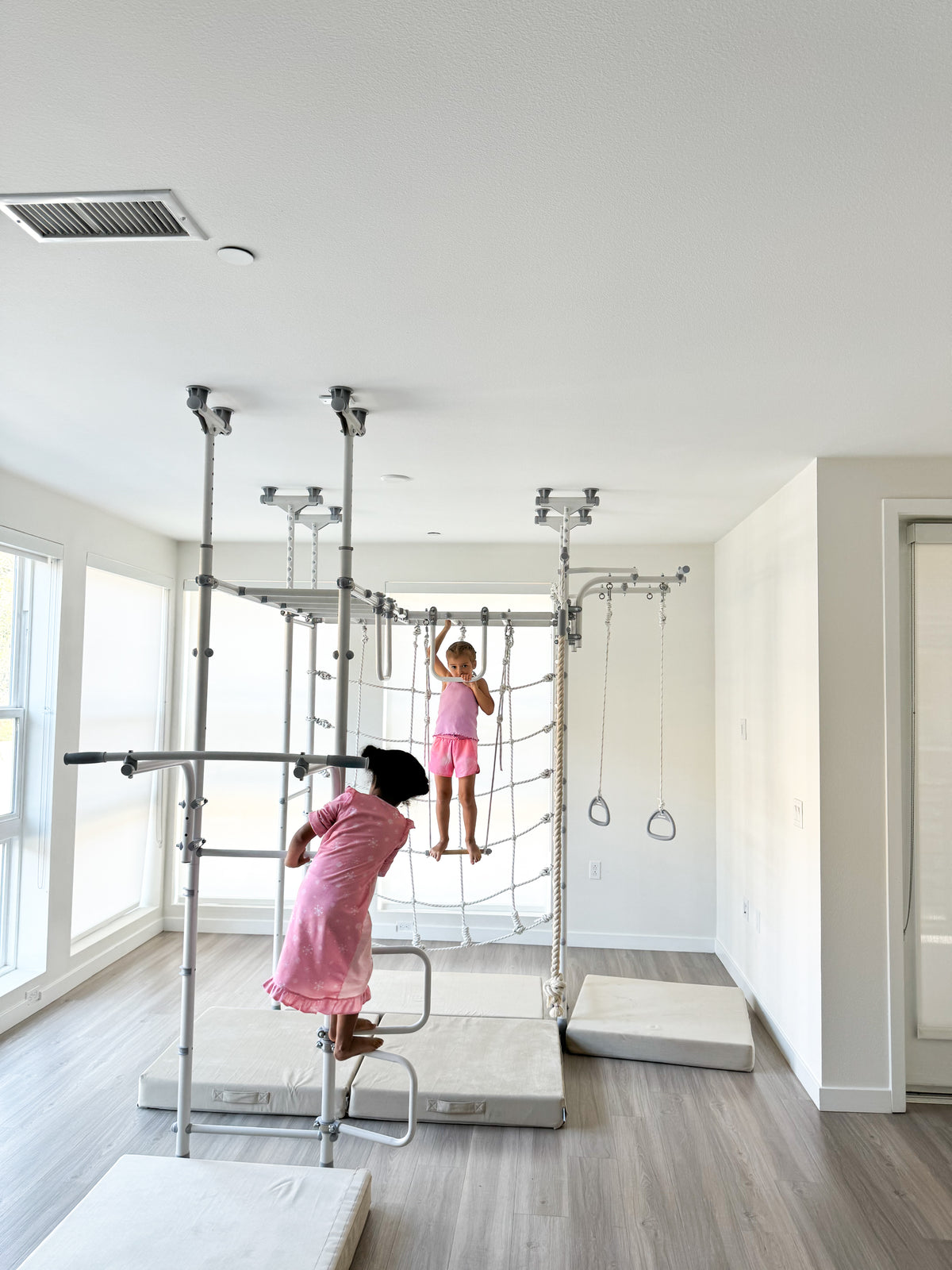
The activities that consistently succeed share a shape. They can be done alone or beside (not against) others, progress is self-evident rather than judged, and the movement itself delivers rich sensory input. The repeat winners: swimming, biking, hiking, martial arts (individually paced), trampoline, and climbing, hanging, and swinging. Climbing deserves special mention because it doubles as sensory work: every reach loads muscles and joints (proprioception, the organizing input) while height and tilt feed the vestibular system. A home setup removes the last barriers: no travel transition, no audience, no schedule, sensory conditions fully controlled, available at 6:45 a.m. and during the 4 p.m. crash alike.
The home movement program (a realistic week)
Built for a school-age autistic child with a home climbing-and-swinging setup; scale times to your child. The structure matters more than the minutes: same blocks, same order, every day, posted visually where the child can see it.
| Block | Daily core (every day) | Rotating add-on |
|---|---|---|
| Morning starter (5 min) | Bar hang count, 3 ladder climbs, 10 swing pumps | Mon/Wed/Fri: add 5 animal walks across the room |
| After-school session (20-30 min) | Free climbing, swinging, and crashing: child-led, parent nearby | Tue/Thu: skill focus, one new move (a higher rung, a longer hang, one more monkey-bar rung) tracked on a visible chart |
| Movement breaks (2 min each) | Before homework and between subjects: hangs or wall push-ups | The research case for breaks: movement breaks guide |
| Weekend big move (60+ min) | The family activity that fits: swimming, hiking, biking | Rotate a 2-week trial of one structured option (individual swim lessons, sensory-friendly gymnastics) with a clear exit if it's not working |
| Evening downshift (10 min) | Slow linear swinging or rocking, deep-pressure cushion squeeze, then bath | Full bedtime sequence: sensory diet sample day |
Making it stick
- Visual schedule, not verbal reminders. A picture card sequence or checklist by the gym beats "go do your exercises" every time. Pair it with the visual-routine approach in our autism schedules guide.
- Track visibly, compete with nobody. A dot chart of hang seconds or rungs reached shows progress against yesterday's self, the only comparison that helps.
- Special interests are fuel. The dinosaur kid does dino stomps; the space kid climbs to the space station. Folding the interest in is not a gimmick, it's the on-ramp.
- Safety canon: independent climbing from age 3+, parent in the room for younger kids, mats under everything, and equipment rated for real forces: our steel frames carry a 220 lb working load, safety-tested to 440.
- Homeschooling? The program above slots straight into a homeschool day; our autism homeschooling guide builds the whole environment around it.
On equipment funding: for a child with a qualifying diagnosis, sensory and exercise equipment may be HSA/FSA eligible with a Letter of Medical Necessity, and some state waiver programs fund it directly.
The gym that fits the kid, instead of the reverse
Predictable, self-paced, sensory-rich movement in your own living room: climbing, hanging, swinging, and monkey bars on one steel frame. No drilling, 30-day money-back guarantee.
Frequently asked questions
Does exercise help kids with autism? Research reviews report associations between regular physical activity and improved motor skills, strength, regulation, and sleep in autistic children and teens, with a 2018 meta-analysis of 29 studies finding moderate positive effects overall. Exercise is a low-risk support with a strong evidence trend, not a treatment, and individual responses vary.
What is the best exercise for an autistic child? The best exercise is the one that's predictable, visual, and individually paced, because those are the traits that remove the usual barriers. Repeat winners across studies and families: swimming, biking, hiking, individually paced martial arts, trampoline, and climbing, hanging, and swinging, which add rich proprioceptive and vestibular input on top of the fitness.
How much exercise does an autistic child need? The CDC guideline is the same for all kids: 60+ minutes of daily activity for ages 6-17, including muscle-strengthening play like climbing at least 3 days a week. Research finds autistic kids tend to get less than peers, so the practical goal is building movement into the daily structure rather than treating it as an extra.
Why does my autistic child refuse sports but move constantly at home? Because the movement need and the sports package are different things. Team settings bundle movement with sensory load, rapid verbal instructions, and social rules, and any of the three can make the whole package unaffordable. Constant movement at home is the need showing itself in a place where the barriers are gone. Serve it there: it counts just as much.
Can exercise reduce stimming? Some studies note fewer repetitive movements for a period after vigorous exercise. The affirming way to read that: exercise generously feeds the same sensory needs that movement stims serve, so the urgency eases for a while. The goal is never to eliminate stimming, which is a healthy regulation tool; it's a regulated, well-fed nervous system.
📚 Keep reading in the Decision Guide
Homeschooling an Autistic Child · Movement Breaks: What the Research Shows · Sensory Seekers: How to Feed the Need
Sources
Healy, S., Nacario, A., Braithwaite, R.E. & Hopper, C. (2018). The effect of physical activity interventions on youth with autism spectrum disorder: A meta-analysis. Autism Research, 11(6). · CDC. Physical Activity Guidelines for Children and Adolescents. · Ayres, A.J. (1972). Sensory Integration and Learning Disorders. Western Psychological Services. · Brainrich Kids engineering specification: frame working load 220 lb, safety-tested to 440 lb.
Share: