

Published September 2026 · 11-minute read · by Yegor Nadvornyy, founder of Brainrich Kids
Maybe you noticed the rocking first. Or the hand flapping when the tablet does something wonderful, the spinning in the kitchen, the humming that runs under homework like a motor. You searched "what is stimming" and landed in a swamp of clinical jargon and, worse, advice about making it go away. This guide is different. It explains what stimming is, why it happens, and how to support it, written for parents who want to understand their child, not sand them down.
The quick answer: stimming (short for self-stimulatory behavior) is repetitive movement or sound that regulates the nervous system: rocking, spinning, jumping, hand flapping, humming, finger flicking, watching spinning objects. Everyone stims. Autistic and ADHD kids typically stim more often and more visibly because their nervous systems process sensory input differently, so they need more regulation, more often. Stimming is a tool, not a symptom to eliminate: research with autistic adults describes it as a calming, joyful, and useful self-regulation mechanism. The job for parents is not to stop stimming. It is to understand what each stim does, make room for it, and offer safe, satisfying outlets for the big-movement kind.
Jump to: What stimming is · Why kids stim · The six types · Is it normal? · Stimming vs tics · The "how do I stop it" question · Movement stims at home · When to bring in an OT · FAQ
📥 Free printable: The Sensory Diet Starter Kit
The practical companion to this guide: a 5-page kit that schedules the swinging, hanging, and deep pressure movement stims are asking for, with a checkbox Dose Menu, a fridge-door day, and a dot tracker your child colors. Nothing about stopping stims, everything about feeding them well.
What stimming actually is
Stimming is any repetitive action a person does because of how it feels: the movement or sound itself delivers sensory input that the nervous system wants. The clinical term is self-stimulatory behavior, and the first thing worth knowing is that it is universal. Pen clicking, leg bouncing, hair twirling, knuckle cracking, pacing during phone calls: adult offices run on stimming. Nobody schedules an intervention for the coworker who jiggles their leg through every meeting.
The difference in autistic children is one of degree and centrality, not kind. When the brain processes sensory information differently, a framework occupational therapists trace back to Dr. A. Jean Ayres and her work on sensory integration, the nervous system needs stronger, more frequent input to stay regulated. Stimming supplies it on demand, from the person's own body, with no equipment and no waiting. Seen clearly, stimming is a highly efficient self-regulation technology.
Why kids stim: the four jobs
⚖️ REGULATION
Too much input (a loud cafeteria) or too little (a waiting room)? Stimming turns the volume down or up until the nervous system sits comfortably in the middle.
💛 EXPRESSION
Flapping at a birthday cake is joy leaving the body. Parents of autistic kids often learn to read stims the way other parents read facial expressions.
🎯 FOCUS
A steady background stim (humming, rocking, chewing) can occupy the restless part of the brain so the thinking part can work. ADHD kids use this constantly.
🛟 COPING
In overwhelming moments, a familiar stim is a handrail: predictable input from their own body when everything else is unpredictable.
The strongest evidence for this framing comes from autistic people themselves. In a 2019 study in the journal Autism, Kapp and colleagues interviewed autistic adults about stimming: participants described it as a calming mechanism for coping with overwhelming environments and intense emotions, and objected to interventions aimed at suppressing it. Suppressing a stim doesn't remove the need; it removes the tool.
The six types of stimming (and what each one feeds)
| Type | What it looks like | The sense it feeds |
|---|---|---|
| Vestibular | Rocking back and forth, spinning, jumping, hanging upside down, head swaying | The inner-ear motion sense. Our deepest subject: here's why kids crave spinning and swinging |
| Proprioceptive | Crashing into cushions, squeezing into tight spots, toe walking, chair tipping, hard hugs | The muscle-and-joint body sense: the great calmer. Full explainer: proprioception for parents |
| Tactile | Rubbing fabric, hair twirling, skin tapping, holding a specific texture | Touch |
| Visual | Watching spinning wheels or fans, finger flicking near the eyes, lining objects up, side-eye gazing at edges | Sight |
| Auditory / vocal | Humming, repeating phrases or scripts, throat sounds, playing one sound clip on loop | Hearing (and the feel of the sound in the body) |
| Oral | Chewing shirt collars, pencils, and sleeves; tongue clicking; teeth grinding | The mouth's touch-and-pressure system |
Notice something about the first two rows: movement stims are vestibular and proprioceptive seeking. Rocking is a self-made swing. Jumping and crashing are self-made heavy work. That matters practically, because those two senses are exactly the ones a family can feed deliberately, at home, with the right outlets, which is the subject of the second half of this guide.
Is stimming normal?
Yes. Stimming appears across every brain type at every age. Toddlers rock and flap as standard equipment; most adults keep a portfolio of socially camouflaged stims. There is also nothing wrong with the visible kind: happy stimming, the flapping-jumping-squealing burst when something is wonderful, is one of the most direct expressions of joy a child can produce. Many autistic adults describe learning to un-suppress their stims as a milestone of well-being, not a regression.
Frequency is not the alarm bell either. An autistic child may stim through most of the day, and that can simply be what their regulation costs. The questions that actually matter: is the child hurting themselves, is the stim blocking things they want to do, and are they distressed? Those three questions, not visibility, are the ones worth bringing to a professional, and we cover them below.
Stimming vs tics: how to tell them apart
| Stimming | Tics | |
|---|---|---|
| Feels like | Something the child does because it feels good or steadying | Something that happens to the child, often preceded by an urge like a sneeze building |
| Rhythm | Rhythmic, sustained, often relaxed-looking | Sudden, brief, jerky; the same movement fired in bursts |
| Interruption | Can usually pause if truly needed (though it costs regulation to do so) | Suppressible only briefly and uncomfortably; the urge rebounds |
| Typical context | Excitement, stress, concentration, boredom: tied to regulation needs | Can fire regardless of context; often worse with fatigue or stress |
The two can coexist, and parents don't need to diagnose from a table: if movements look sudden, involuntary, and distressing rather than rhythmic and self-directed, that observation belongs in a pediatrician conversation. Describe what you see, when it happens, and how your child talks about it.
"How do I stop my child from stimming?" is the wrong question
Thousands of parents search some version of it every month, almost always out of love: worry about playground stares, about school, about what it means. So it deserves a direct answer. Stimming is not a behavior problem, and suppressing it has a cost. A child forced to hold in their stims spends their regulation budget on the holding, which tends to show up later as exhaustion, meltdowns, or anxiety. The autistic adults in the research above are unambiguous on this point: what they needed wasn't suppression, it was acceptance plus safe conditions.
The productive questions, and what each one leads to:
- "Is this stim hurting my child?" Head banging, hard biting, and skin picking are the cases where you act, and the goal is still not "less stimming": it is meeting the same sensory need a safer way, with an occupational therapist's help. A child who bangs their head is often seeking intense pressure and motion input; safer heavy-pressure and movement channels can carry that load.
- "Is the environment demanding too much?" A spike in stimming is information. It often means the setting (noise, crowding, transitions, demands) is costing more regulation than usual. Adjusting the environment usually does more than addressing the child.
- "Does my child have enough sensory input in their day?" A nervous system running on empty stims to fill the tank. A day with real swinging, climbing, hanging, and crashing built in gives the movement stims a bigger, richer channel. That's the next section.
Feeding movement stims at home: bigger, better input
You cannot out-supply a child's need for vestibular and proprioceptive input, but you can offer outlets that deliver it in deeper doses than rocking on the couch, and kids reliably choose the deeper dose when it's available. The pattern OTs describe, and the one we hear from hundreds of families: dedicated movement outlets don't eliminate stimming (nothing should), but the furniture-climbing, couch-crashing, wall-bouncing versions ease when a better channel exists.
- For the rockers and spinners (vestibular seekers): a swing at home is the direct upgrade. Slow linear swinging tends to calm; spinning delivers the strongest input there is. Our sensory swing guide covers types and safe indoor hanging, and our autism swing guide matches swing types to sensory profiles.
- For the crashers and squeezers (proprioceptive seekers): hanging, climbing, and pulling are the OT-favorite delivery systems, because working muscles against gravity is the input. Our list of heavy work activities starts free, with couch-cushion mountains and laundry-basket hauling.
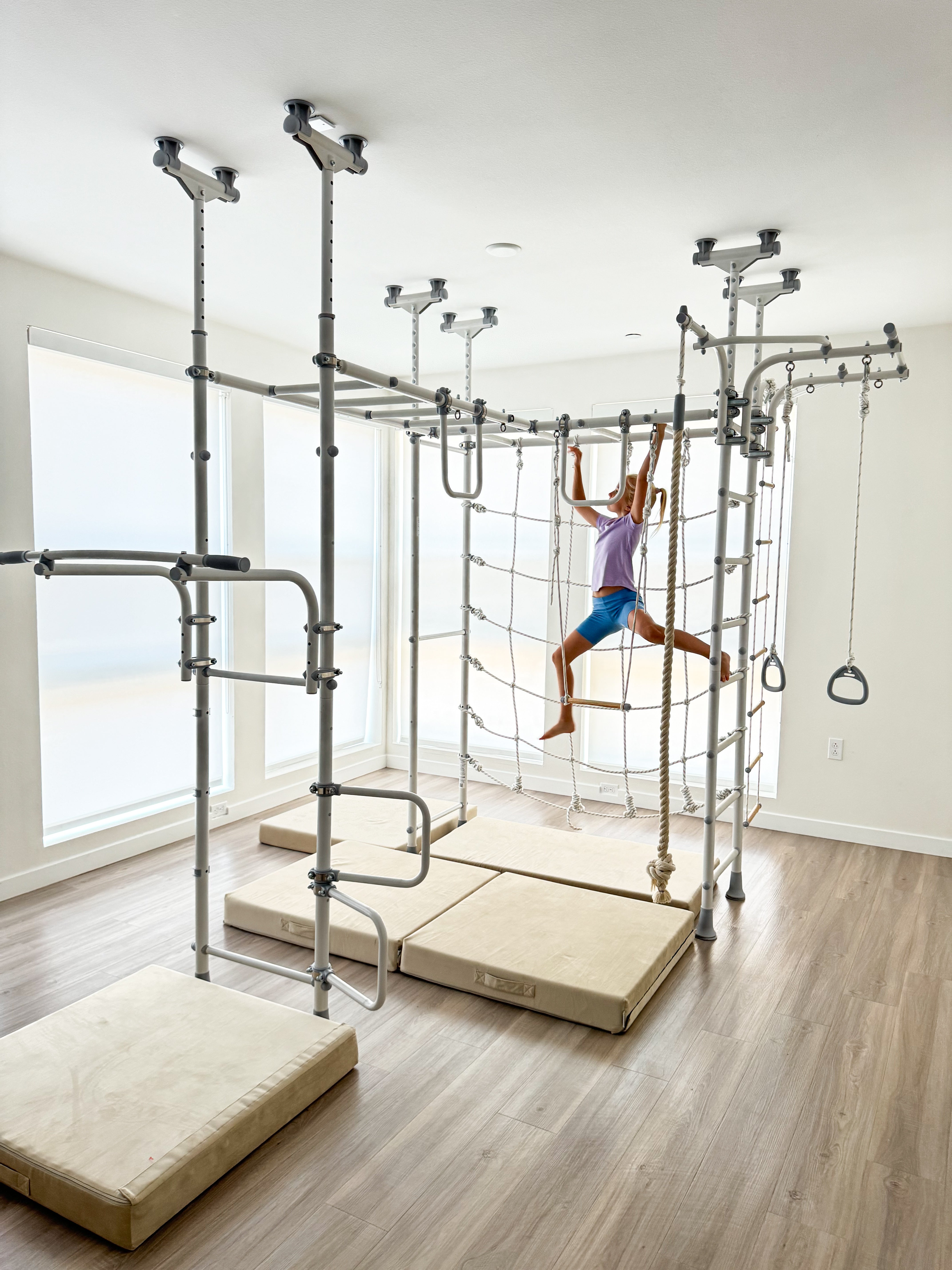
- For both at once: a floor-to-ceiling climbing frame with rings, a rope, and a swing point covers the full movement-stim menu in one corner: climb, hang, swing, drop, repeat. Ours are steel, rated for 220 lb of working load and safety-tested to 440, designed for independent climbing at age 3 and up with a parent in the room for younger kids. The full logic lives in our guide to building a sensory gym at home.
When to bring in an occupational therapist
An OT trained in sensory integration is the right professional for stimming questions, and the referral conversation is worth having when any of these is true: the stim causes injury (head banging, biting, skin damage); it consistently blocks things your child wants to do (can't stay at the table long enough to eat, can't ride in the car); the child themselves seems distressed by it; or you simply want a map of your child's sensory profile so home life can be built around it. What a good OT will not do is treat stimming itself as the target. If a provider's plan is centered on making your child look stiller, keep looking: organizations like the STAR Institute maintain provider directories and parent education grounded in the affirming, regulation-first approach.
Give the movement stims a bigger channel
Steel indoor gyms built for exactly the input rockers, spinners, and crashers are asking for: climb, hang, swing, and crash in one corner of home. No drilling and a 30-day money-back guarantee.
Frequently asked questions
What is stimming in autism? Stimming is repetitive movement or sound (rocking, spinning, hand flapping, humming, finger flicking) that delivers sensory input the nervous system uses to regulate itself. Autistic people typically stim more often and more visibly than others because their sensory systems need stronger, more frequent input to stay comfortable. Research with autistic adults describes stimming as a calming, useful self-regulation tool, not a symptom to eliminate.
Is rocking back and forth stimming? Yes, rocking is one of the most common stims. It feeds the vestibular sense, the inner-ear motion system, and works like a self-made swing: rhythmic, predictable motion that steadies the nervous system. Slow rocking usually calms; vigorous rocking usually alerts. A real swing at home offers the same input in a deeper dose.
What does hand flapping mean? Hand flapping is a common motor stim, and in young children it most often spikes with big emotion: excitement, joy, overwhelm. It delivers fast proprioceptive and visual input. Flapping is not harmful and needs no correction; many parents learn to read it as their child's most reliable emotional signal.
What is visual stimming? Visual stimming is seeking input through the eyes: watching spinning wheels or ceiling fans, flicking fingers near the eyes, lining objects into rows, or gazing at edges and lights from particular angles. Like all stimming it serves regulation, focus, or simple enjoyment.
Do kids with ADHD stim too? Constantly. Leg bouncing, pen clicking, chair tipping, humming, and fidgeting are stimming, and for ADHD brains the steady background input often supports focus rather than competing with it. This is why movement breaks and "fidget-friendly" setups tend to help ADHD kids concentrate.
Should I try to stop my child's stimming? No. Suppressing stims removes a regulation tool without removing the need, and autistic adults consistently report that forced suppression cost them well-being. Act on the underlying need instead: if a stim is self-injurious, work with an occupational therapist to meet the same sensory need safely, and for movement stims, provide richer outlets like swinging, climbing, and heavy work at home.
📚 Keep reading in the Decision Guide
Vestibular Input: Why Kids Crave Spinning and Swinging · Sensory Seekers: Signs, Science, and How to Feed the Need · Heavy Work Activities for Kids
Sources
Kapp, S.K., Steward, R., Crane, L., Elliott, D., Elphick, C., Pellicano, E. & Russell, G. (2019). 'People should be allowed to do what they like': Autistic adults' views and experiences of stimming. Autism, 23(7). · Ayres, A.J. (1972). Sensory Integration and Learning Disorders. Western Psychological Services. · Kranowitz, C. (2005). The Out-of-Sync Child. Perigee. · STAR Institute for Sensory Processing. sensoryhealth.org. · Brainrich Kids engineering specification: frame working load 220 lb, safety-tested to 440 lb.
Share: