

Published September 2026 · 10-minute read · by Yegor Nadvornyy, founder of Brainrich Kids
"Monkey bar set" is one of those phrases that sounds like a product and is actually a question. A set of what? Bolted to what? The span itself is the easy part; the two things holding it up are the set. This guide takes apart what a complete monkey bar set is, indoors and in the yard, why the indoor version has quietly become the more useful one, and how to buy one that fits your ceiling, your room, and the kid who has been traversing the kitchen counters.
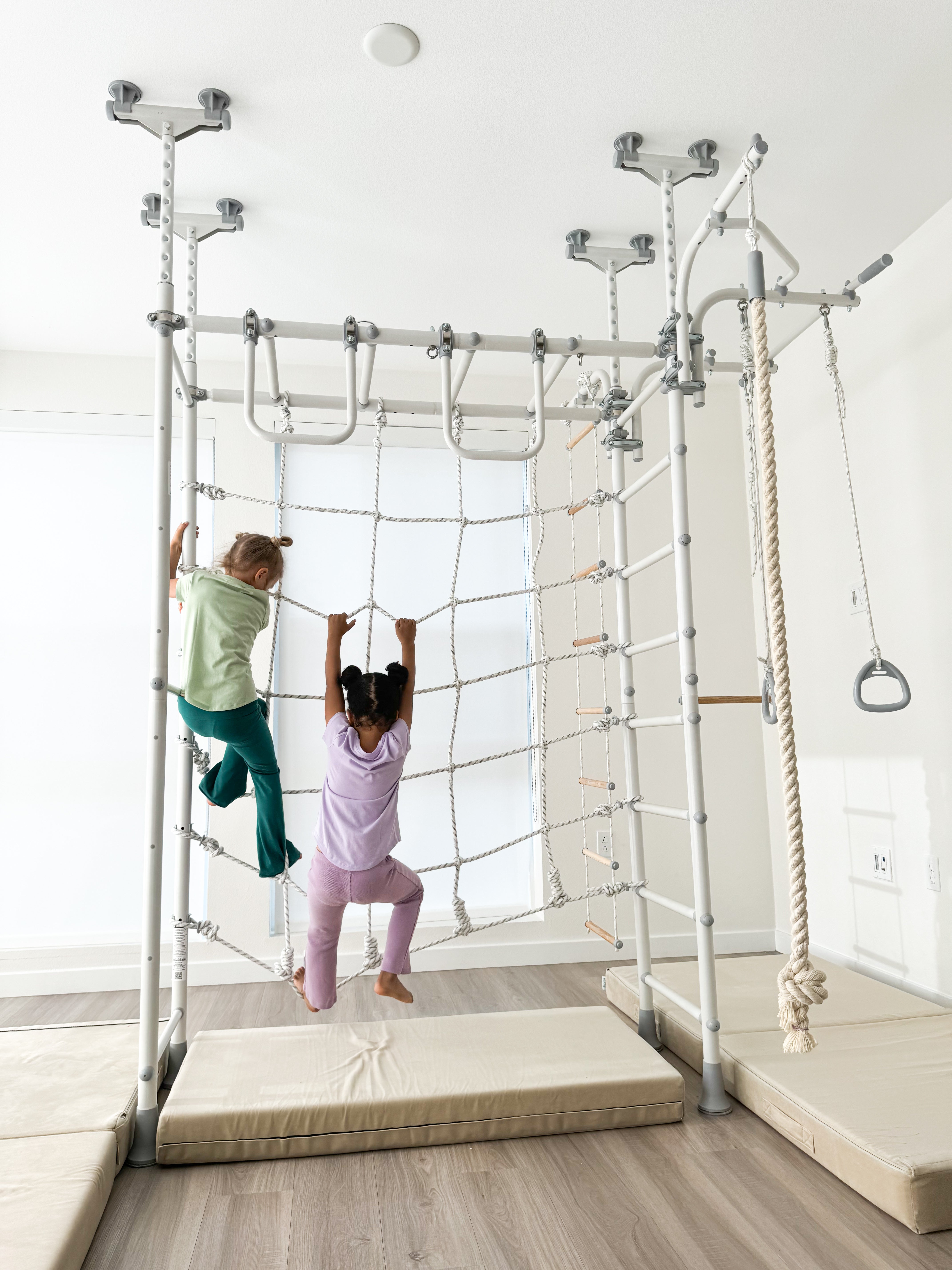
The quick answer: a complete monkey bar set is two supports plus a horizontal span: outdoors, two posts or towers with a ladder-style bar between them; indoors, two vertical ladders braced floor to ceiling (or a wall-mounted frame) with a crossbar set spanning them. The span alone is not a set, and on modular systems like ours it is an add-on for families who already own a frame, not a stand-alone product. For a first purchase, buy the frame that comes with the monkey bars built in (our Spider V3); for a frame you already own, add the span. Indoor sets win on year-round use and load rating (ours: 220 lb working, tested to 440); backyard sets win on height and weather-rated materials. Kids traverse from about 5; a set bought then is still a pull-up bar at 12.
Jump to: The anatomy of a set · Indoor vs backyard · Wall-mounted vs floor-to-ceiling · How to buy one · By age · FAQ
The anatomy of a monkey bar set
Every monkey bar set, whatever it is made of, is the same three parts:
1. Two supports
Outdoors, posts or towers set in the ground. Indoors, two vertical ladders, each braced between floor and ceiling with a telescopic pole, or a frame bolted to wall studs. The supports carry every pound; they are the set.
2. The span
The horizontal ladder the child traverses: crossbars at hand spacing, ideally rubber-coated for grip. On our V3 system the span is about a foot longer than the V2 and has an extra rung, so two kids share it and a swing fits beneath.
3. What hangs from it
A climbing net, rings, a trapeze, a rope, a swing. The span doubles as the hanging beam, which is why an indoor set becomes the whole play gym.
The mistake to avoid: buying the span and assuming it stands up. On modular systems, the monkey-bar add-on ships as one vertical ladder plus the crossbar set and uses your existing gym's ladder as the other support. On its own it is one leg short. Families starting from zero should buy the frame that includes the span; families with a frame add it. This is exactly how our Monkey Bars V3 add-on works: it turns a Model T3 into a Spider V3, and it is for owners, not first-timers.
Indoor vs backyard monkey bars
| Indoor set | Backyard set | |
|---|---|---|
| Days per year in use | All of them: January, rain, heat, 7 a.m. before school | Weather-dependent; long gaps in most climates |
| Height | Ceiling-limited; the span sits at the crossbar, reached from ladder rungs | Taller; bigger drops, needs deeper landing surfaces |
| Materials | Powder-coated steel, rubber-coated rungs; not weather-rated | Galvanized steel or treated lumber; upkeep every season |
| Load rating | 220 lb working, tested to 440 (ours) | Varies widely; check for a published number |
| Installation | An afternoon, no drilling for tension-mounted frames | Post holes, concrete or anchors, a weekend |
| Renters and moves | Comes down and goes with you | Stays with the house |
We love outdoor play and would never talk a family out of a backyard set. The indoor set is the answer to a different question: what does the child do with that need on the 150 days a year the yard is not an option? The evidence for what daily hanging and climbing does is in does a home climbing gym help kids?, and the sensory case for monkey bars specifically is in indoor monkey bars are sensory equipment.
Wall-mounted vs floor-to-ceiling monkey bars
Floor-to-ceiling (tension-mounted). Two ladders brace between floor and ceiling with telescopic poles, the span runs between them, and nothing is drilled. This is the configuration of our Spider V3, Spider Max V3, and Mega Max V3, and it is the one most families end up with: full-circle swinging under the span, a net on one side, room for two kids at once. Height versions handle basements (a short bottom section) and tall rooms (an extension ladder adds about 21 inches).
Wall-mounted. A frame bolted into studs, standing about 9 inches off the wall. Our W3 and W3 Max are wall bars in the Swedish-ladder tradition with hanging points rather than a full traverse span, which makes them the answer for slanted ceilings, very tall ceilings, and narrow rooms, and the wrong answer for a kid whose whole goal is the hand-over-hand traverse. The comparison is in our indoor jungle gym buyer's guide.
How to buy a monkey bar set that fits
- Measure the ceiling. It decides the height version before anything else does. Slanted or vaulted: wall-mounted.
- Walk the span. The traverse plus swing clearance along it, plus a mat zone underneath. Our 60-second quiz turns ceiling and room size into a model.
- Ask for the load number. Two kids racing across a span generate forces a toddler toy never sees. Ours: 220 lb working, tested to 440.
- Check the rungs. Rubber-coated, at a spacing a five-year-old's hands can bridge.
- Decide frame-first or add-on. No frame yet: buy the Spider V3 with the span built in. Own a T3 or a Spider: add the Monkey Bars V3. Own a V2 frame: a Cross Bar V3 set converts it, because V2 frames accept V3 spans.
Monkey bars by age
- 3 to 4: hangs from the span with a parent close, swings beneath it, climbs the ladders. The traverse is not here yet and does not need to be.
- 5 to 6: the traverse arrives, usually in a single week after months of hanging. This is the age the set earns its keep; hand-over-hand is the most-used skill in our owner community for ages 6 to 12.
- 7 to 9: skipping rungs, traversing backward, hanging by the knees, the first pull-ups on the same bars. Our pull-up progression lives on this equipment.
- 10 to 12: timed courses, strength work, a bar rated for an adult holding a kid plus a friend plus momentum.


The set that stands up
Two steel ladders, one span, and everything that hangs from it. 220 lb working load tested to 440, no drilling, ships in 5-7 days, 30-day money-back guarantee.
Frequently asked questions
What is included in a monkey bar set? Two supports and a horizontal span. Outdoors that means two posts or towers with a ladder-style bar between them; indoors it means two vertical ladders braced floor to ceiling, or a wall-mounted frame, with a crossbar set spanning them. Accessories that hang from the span (net, rings, trapeze, swing) are usually sold with the frame or as add-ons.
Can you buy just the monkey bars? Only as an add-on for a frame you already own. A span needs two supports; on modular systems like Brainrich's, the Monkey Bars V3 add-on supplies one ladder plus the crossbar set and uses your existing gym's ladder as the other support. Families starting from zero should buy a frame that comes with the monkey bars built in, such as the Spider V3.
Are indoor monkey bars safe? Yes, on a frame with a published load rating, rigid floor-to-ceiling or wall bracing, rubber-coated rungs, and a mat underneath, with independent use from age 3 and a parent in the room. Brainrich frames carry a 220 lb working load, tested to 440.
What age are monkey bars for? Kids hang and swing from the span from about 3 with a parent close, and the hand-over-hand traverse usually arrives between 5 and 6. The same bars serve as pull-up bars through age 12 and beyond, which is why a set bought at five is not outgrown.
How much ceiling height do indoor monkey bars need? Tension-mounted frames come in height versions: a short version for basements and lower ceilings, a standard version for typical ceilings up to just under 10 feet, and an extension ladder that adds about 21 inches for tall rooms. Slanted or vaulted ceilings call for a wall-mounted frame instead.
Are wall-mounted monkey bars a good option? For narrow rooms and slanted or very tall ceilings, a wall-mounted frame is the right answer, and it carries rings, a rope, and a small swing. What it does not offer is a full hand-over-hand traverse span or 360-degree swinging; families whose goal is the traverse should choose a floor-to-ceiling set.
📚 Keep reading in the Decision Guide
Spider Configurations Explained · Why Kids Need Monkey Bars · The Indoor Jungle Gym Buyer's Guide · Monkey Bars for Kids: The Complete Guide
The set itself: the Brainrich monkey bars set is the extension that turns a Model T3 into a Spider V3, in three ceiling sizes.
New: buying for a 2-to-4-year-old? Read Safest Monkey Bars for Toddlers first.
New: short on floor space? See Monkey Bars That Fit a Compact Space.
New: want monkey bars and a swing in one footprint? See Monkey Bars With Swings.
Start here: Monkey Bars: The Complete Guide maps every type, a bar-height chart by age, the safety standards, and cost ranges.
Sources
CDC. Physical Activity Guidelines for Children and Adolescents. · Brainrich Kids engineering specification: frame working load 220 lb, safety-tested to 440 lb; V3 span length and rung count per product documentation.
Share: