

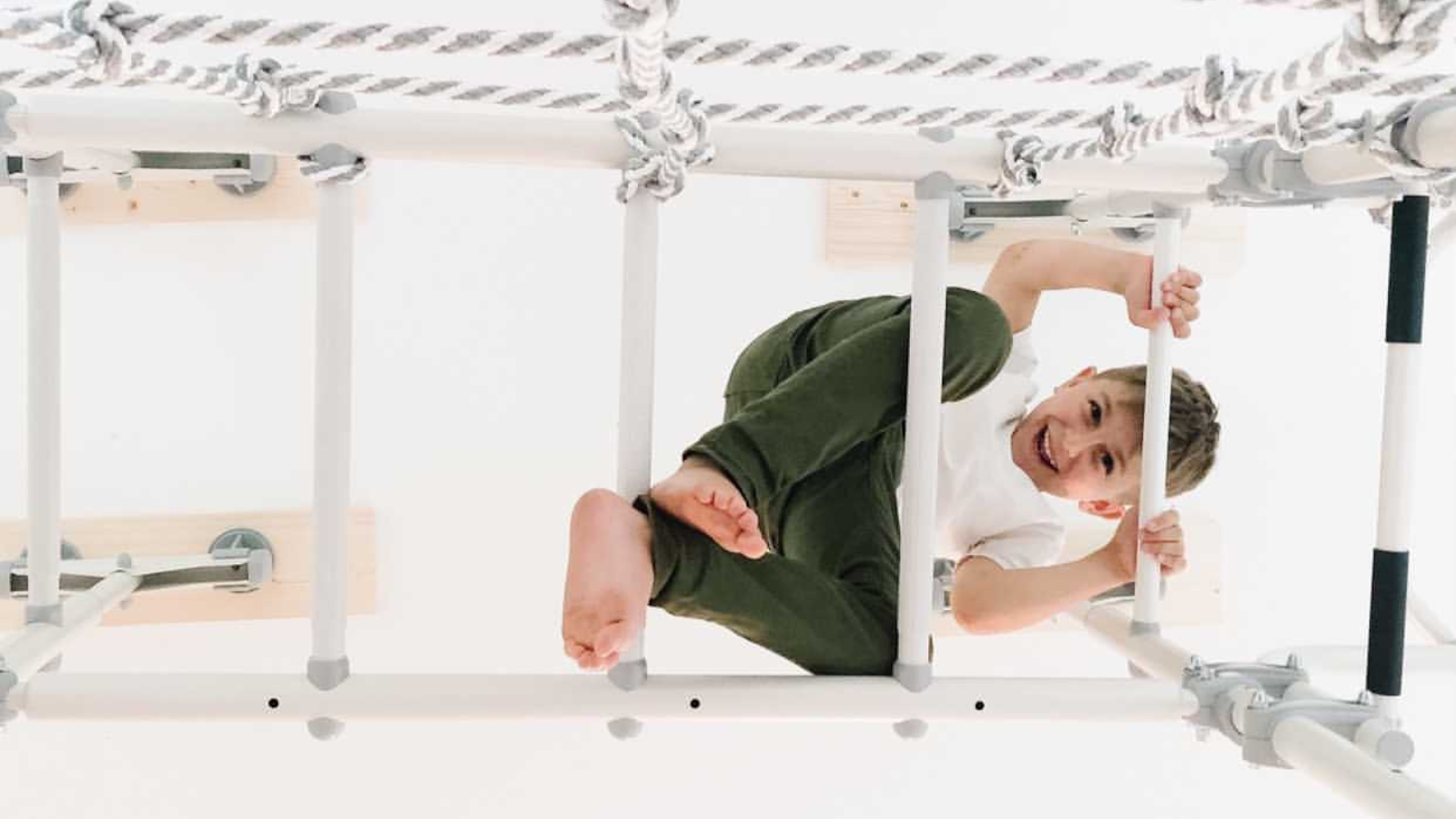
Updated August 2026 · 10-minute read · by the Brainrich Kids team · Canadian edition, prices in CAD
Watch a kid who has just figured out monkey bars. They do not cross once and move on: they cross, drop, shake out their hands, and climb back up until their palms give out. An occupational therapist watching the same scene sees something specific happening, because monkey bars are one of the densest pieces of sensory equipment ever put in front of a child, and the child's body knows it. Here is what the bars are actually delivering, how to spot a kid who needs more of it, and every way to get a set indoors.
The quick answer: monkey bars deliver two kinds of sensory input at once. Gripping and hanging load the muscles and joints against a child's full body weight, which is proprioceptive input, the "heavy work" OTs describe as calming and organizing. Swinging rung to rung moves the head through space in arcs, which is vestibular input, the balance sense. Almost nothing else a child does voluntarily combines both at this intensity, which is why hanging equipment shows up in nearly every OT clinic. A home set turns that clinic staple into a daily habit.
Ordering from Canada: Brainrich prices on this page are in Canadian dollars. Every gym component is stocked in our Vancouver, BC warehouse, so your order ships from inside Canada: no duties, no customs paperwork, no cross-border delays. GST/HST is calculated at checkout.
Jump to: What the bars actually do · The pedigree · Signs your child is asking for them · Indoor options compared · Setting up for safe falls · The 10-minute circuit · FAQ
What monkey bars actually do to a child's nervous system
The technical name for monkey-bar travel is brachiating: swinging hand over hand while the body hangs. It looks like one skill. It is at least five running at once:
Grip and forearm strength. The whole trip happens through the hands. Grip is one of the first things to weaken in kids who spend the day on screens, and one of the fastest to come back with bar time.
Shoulder traction. Hanging gently decompresses the shoulder joints under body weight. This is the input OTs specifically prize about hanging equipment, and it is the reason dead hangs appear on every heavy work list ever written.
Core control. A hanging body swings, and stopping that swing from taking over is continuous core work, the same muscles a child needs to sit upright at a desk without draping over it.
Motor planning. Every rung is a small decision: release, reach, re-grip, timed against the swing. OTs call this sequencing motor planning, and the bars drill it on repeat.
Bilateral coordination. Alternating hands across the midline of the body, left-right-left, is the same cross-body patterning that shows up later in handwriting and sports.
And underneath the skills sit the two sensory channels from the quick answer: muscles and joints working against resistance (proprioception, the input that settles most kids), and the head moving through swinging arcs (vestibular input, the one that builds balance). That combination is why a child who just spent twenty minutes on the bars often comes down more regulated than they went up, the effect owners of our gyms consistently describe as calmer evenings.
Monkey bars have a pedigree
Bars did not become therapy-room furniture by accident. Several traditions that parents still look up, from very different starting points, arrived at the same piece of equipment:
Ayres and the OT canon. The vocabulary this article uses, vestibular, proprioceptive, sensory integration, comes from A. Jean Ayres, the occupational therapist and neuropsychologist who built sensory integration theory across the 1950s to 1970s. Her parent-facing classic Sensory Integration and the Child is still the book OTs hand families, and the hanging-and-swinging equipment in every SI clinic descends from her practice.
The Doman brachiation ladder. Glenn Doman's Institutes for the Achievement of Human Potential, founded in 1955, made the overhead ladder a centrepiece of their physical development program, and the book How to Teach Your Baby to Be Physically Superb taught a generation of parents the word "brachiation." Families following Doman-style programs have been building brachiation ladders into hallways and basements for decades; a frame-mounted or wall-mounted set is the engineered version of the same idea, minus the carpentry.
Montessori and Pikler. Maria Montessori treated movement as inseparable from learning, and Hungarian pediatrician Emmi Pikler built her whole philosophy on self-directed climbing, which is why the Pikler triangle became the default first climber. Monkey bars are the natural next chapter of that same progression, and we mapped the whole arc in What Comes After the Pikler Triangle.
The parent bookshelf. Carol Stock Kranowitz's The Out-of-Sync Child put hanging and swinging on the map for a generation of sensory-aware parents, pediatric OT Angela Hanscom's Balanced and Barefoot argues kids need far more climbing and hanging than modern childhood provides, and the "sensory diet" idea, scheduled doses of movement input across the day, belongs to OT Patricia Wilbarger. Different authors, different decades, one conclusion: hanging equipment earns its floor space.
Signs your child is asking for bar time
DOES YOUR CHILD...
✓ Hang from doorframes, towel bars, or the top of the fridge door
✓ Dangle upside down off the couch as a resting position
✓ Swing on anything that will hold still long enough
✓ Refuse to leave the playground until their hands are red
✓ Lean, flop, and crash instead of sitting
✓ Ramp up in the evening instead of winding down
This is a conversation starter, not a clinical tool. But the pattern behind it is the one OTs teach: the behaviour is the need, pointed at the wrong furniture. A doorframe hanger is a child self-prescribing traction and heavy work. Give the need its own equipment and a schedule, and the doorframes get a break. (Under three and climbing the bookshelf instead? That phase has its own article.)
Indoor monkey bars: the four ways to get them at home
The playground is still great, and nothing here argues otherwise. The problem the indoor set solves is dosage: sensory input works best little and often, daily, and the playground is subject to weather, daylight, and the drive. Here are the real options, with the limits stated plainly.
| Option | What it is good at | The limits |
|---|---|---|
| Playground bars | Free, social, tall, and outdoors, which carries its own benefits. | Weather, daylight, the drive, and the line behind your kid. Hard to make daily. |
| Doorway pull-up bars | Cheap dead hangs in a rental. | One bar is hanging, not brachiating: no traverse, no rung-to-rung motor planning, and doorway clamps carry their own weight-rating fine print. |
| Wall-mounted gym (Model W3 / W3 Max) | Steel frame that anchors to wall studs and sits just 9 inches (23 cm) off the wall, certified to 220 lb (100 kg). Fits narrow rooms, slanted ceilings, and very tall ceilings. Takes TRX-style bands and a small hammock swing. | Fixed height by design, and swinging is one-direction only: no nest swing, no 360° spinning. |
| Floor-to-ceiling gym with monkey bars (Spider V3, Spider Max V3, Mega Max V3) | The full setup: these gyms come with a monkey-bar span built in, adjustable from chest height for beginners upward, on a tension-mounted steel frame with no drilling into ceiling joists. V3 spans are about a foot longer than V2 with an added rung, so two kids can share. Already own a Model T2 or T3? The Monkey Bars V3 attachment (one vertical ladder plus one horizontal crossbar) adds the span to your existing gym. Rings, trapeze, rope, and a swing hang from the same frame. | Needs ceiling height between 6'9" (206 cm) and 10'6" (320 cm) to brace, and more floor space than a wall unit. |
Set up for confident falls, not zero falls
Kids fall off monkey bars. That is not a flaw in the equipment, it is how grip strength and judgment get calibrated, and the research on controlled risky play is clear that the answer is managing the landing, not banning the climb. The home advantage is that you control the landing zone completely:
Put real padding under the span. A 4.5-inch (11 cm) play mat under the bars turns a drop into a bounce. Couch cushions slide; purpose-built mats stay put.
Start at chest height. Adjustable bars let a beginner traverse with feet inches off the mat, then earn altitude. Confidence first, height second.
Respect the ratings. Every Brainrich frame is steel with non-toxic powder coating and rubber-coated rungs, and the wall-mounted line is certified to 220 lb, which is the number that lets a parent demonstrate without checking over their shoulder.
Hands under five, bars over five. Supervised hanging suits most kids from 3+; full traverses typically click around five, when grip and shoulder strength catch up to ambition.
The 10-minute bar circuit
Sensory input works like snacks, not meals: short and repeated beats long and rare. A circuit that OTs would recognize, run before homework or before the bedtime routine:
1. Dead hang, as long as the hands allow. Rest. Twice more.
2. Traverse, one direction, drop, shake out, return trip.
3. Knee tucks, three to five hanging knee raises.
4. Crash finish, one big deliberate drop onto the mat, stuck landing optional.
Ten minutes, twice a day, beats an hour on Saturday. The full menu of frame-based input, swings included, lives in our home sensory gym guide.
FAQ
Are monkey bars good for autistic kids or kids with ADHD?
Many autistic and ADHD kids seek exactly the input bars provide, which is why hanging equipment is a fixture in OT clinics, and families tell us the daily access is what changes evenings. Monkey bars are play equipment, not a treatment, and if daily regulation is genuinely hard, an OT who knows your child is the right partner. If an OT does recommend home equipment, our Canadian funding guide covers how families fund it through provincial autism funding and Jordan's Principle.
What age can kids start monkey bars?
Supervised hanging from 3+, full traverses typically around five. Adjustable-height bars bridge the gap: set the span at chest height and let them traverse with feet just off the mat.
Can I put monkey bars in an apartment or a room with a slanted ceiling?
Yes. The wall-mounted W3 and W3 Max anchor to wall studs, sit 9 inches off the wall, and do not touch the ceiling at all, which is exactly what slanted-ceiling rooms, very tall rooms, and narrow playrooms need. Tension-mounted gyms need a ceiling between 6'9" and 10'6" and no drilling.
How much weight do they hold?
The wall-mounted line is certified to 220 lb. Frames are steel throughout, which is also why a parent can demo the traverse first, the fastest way to get a hesitant kid to try it.
Share: