

Updated August 2026 · 11-min read · by the Brainrich Kids team
Somewhere around February, or week six of a hard curriculum, or year three of doing everything for everyone, most homeschool parents hit a wall that has a specific feeling: you still love your kids, and you cannot face the school table. If that sentence made your shoulders drop, this article is for you. Nothing in it will tell you to try harder, wake up earlier, or be more grateful. Burnout is not a character flaw or a sign you should quit. It is a predictable response to a workload, and workloads can be redesigned.
The quick answer: homeschool burnout is the parenting version of a documented syndrome researchers call parental burnout: exhaustion, emotional distancing, and the feeling you are no longer good at this. It builds through over-scheduling, curriculum overload, and the fact that a homeschool parent never leaves the workplace. Recovery is subtraction, not effort: cut to the core subjects for a season, hand the movement and energy-burning part of the day to a dedicated space instead of your own supervision, switch to year-round pacing with built-in off weeks, and when the signs are loud, take a full week off without guilt. Homeschooling is a marathon; the families who last build rest into the design.
Jump to: Signs in you · Signs in your kids · What causes it · The reset plan · When to take a week off · FAQ
The signs in you (the parent)
Researchers who study exhausted parents describe burnout with three markers, first mapped in a 2017 validation study by Isabelle Roskam and Moïra Mikolajczak's team: deep exhaustion in the parenting role, emotional distancing from your children, and a collapsed sense of being effective. Their later work across 42 countries found the syndrome shows up most in cultures with high-pressure, high-involvement parenting norms, which is a fair description of homeschooling: you signed up for the most involved version of parenting there is.
Translated out of the journals and into a homeschool kitchen, the markers sound like this:
EXHAUSTION
You wake up tired on school days. Sunday night carries dread. Planning, which you used to enjoy, now feels like homework you assign yourself. Coffee stops working.
DISTANCING
You catch yourself teaching on autopilot, going through the checklist without really being in the room. Patience runs out by 10 a.m. You snap at the math mistake, not the child, but it lands on the child.
"I'M FAILING THEM"
The gap between the homeschool you imagined and the one you are running feels like evidence against you. You rehearse the re-enrollment conversation in the shower. Every curriculum ad reads like an accusation.
Two things worth saying plainly. First, none of this means you are a bad teacher or a bad parent; in the research, burnout hits the most conscientious, most invested parents hardest, because they are the ones spending the most of themselves. Second, this is common enough that researchers built assessment scales for it and the American Psychological Association writes cover stories about it. You are not the only one at the wall. The wall has a queue.
The signs in your kids
Children burn out too, and because a burned-out child rarely says "I am experiencing curriculum overload," it comes out sideways:
The work gets worse, not harder. A child who could do long division in October suddenly "can't" in February. Skills don't vanish; effort budgets do. Rising errors on mastered material is one of the most reliable overload signals there is.
Everything is a negotiation. Stalling, bathroom trips, sharpening pencils for ten minutes, tears over a worksheet that would have taken four minutes to just do. Resistance this consistent is not defiance; it is a child telling you the current pace costs more than they have.
The spark goes out. The subject they used to race to (the dinosaur unit, the read-aloud, the science kit) gets a shrug. Anhedonia about formerly loved things is worth taking seriously at any age.
The body gets loud. More meltdowns, more sibling fights, headaches and stomachaches on school mornings, restlessness that no amount of "sit still, we're almost done" fixes. Young children express overload physically first. This is also the sign with the most direct fix, because very often the child is not overworked in total; they are over-stilled: too many seat-hours, too few movement-hours. Pediatric guidance is consistent that children need active play daily and at least an hour of real physical activity, and the AAP's Power of Play report ties active play directly to the self-regulation skills that make lessons possible in the first place. A schedule that quietly deleted movement will produce a child who looks burned out and is actually just caged.
What actually causes it
Over-scheduling. Homeschool culture has a maximalist streak: five subjects daily, plus co-op, plus two sports, plus music, plus the enrichment classes you feel obligated to book because flexibility is the whole point, right? Add it up and many homeschool families are running a longer school day than the school they left, with a staff of one.
No separation. A classroom teacher goes home. A homeschool parent lives at work, sleeps at work, and eats dinner at the school. The kitchen table is the math table; the living room is the reading corner. Without deliberate boundaries (a shutdown time, a physical zone that is school and zones that are not, a weekday that belongs to nobody's curriculum) the job expands to fill every waking hour, and the research on parental burnout points at exactly this kind of unrelieved exposure.
Curriculum overload. Buying a full boxed curriculum for every subject and treating every page as mandatory is the single most common self-inflicted wound in homeschooling. The publisher wrote for a hypothetical average child with a hypothetical inexhaustible parent. You are allowed to skip, compress, and abandon. The curriculum works for you; the arrangement is not reciprocal.
The comparison feed. Instagram homeschools have morning baskets, latin declensions, and sunlight. They do not show the Tuesday meltdown. Measuring your real Wednesday against a stranger's highlight reel manufactures the "contrast with the parent I meant to be" feeling that researchers identify as a core burnout ingredient.
Nobody schedules the parent's recovery. Your children get summer. Who planned yours? In roughly 3.4 million homeschooling households in the US, the teacher, principal, cafeteria, and janitor are frequently the same person, and that person's rest is usually the only line item missing from the beautiful color-coded schedule.
The reset plan: subtract, outsource, repace
Burnout recovery advice usually fails because it adds tasks to an exhausted person's list (journal! exercise! meal prep!). This plan only removes things.
Step 1: Cut to the core
For the next four to six weeks, teach math and reading. That's it. Everything else (history, science, art, the language app) either pauses or converts to its lazy form: documentaries, audiobooks, library grazing, cooking. This is not lowering standards; it is triage, and it is reversible by definition. A calm parent teaching two subjects outperforms a depleted parent grinding through six, and children consolidate rather than regress during a lighter season. When the season ends, you add subjects back one at a time and notice which ones nobody missed. Those were the overload.
Step 2: Outsource the movement to a place, not to yourself
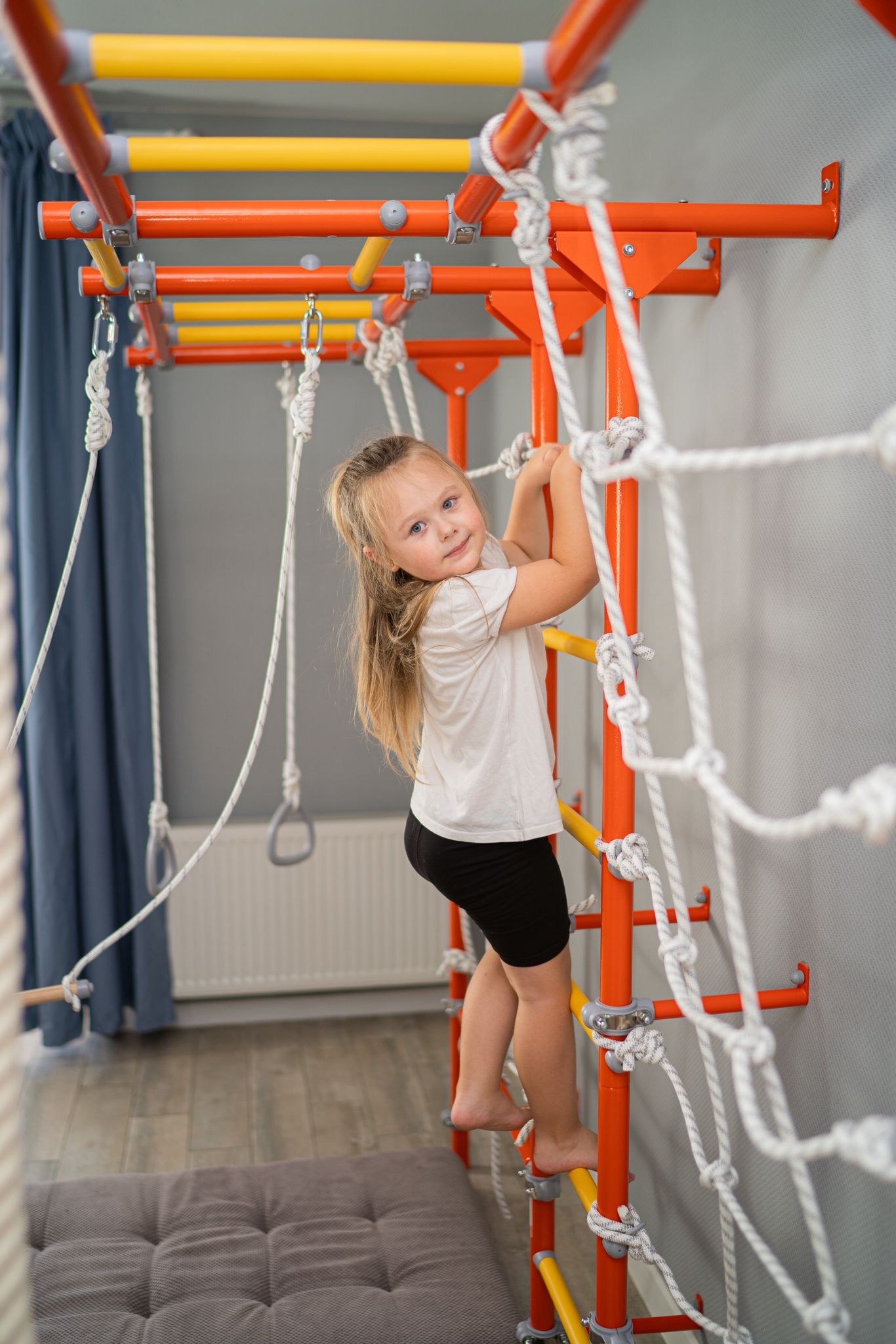
A huge share of homeschool-day exhaustion is not teaching; it is energy management: the between-lessons restlessness, the 3 p.m. zoomies, the winter weeks when everyone is indoors and the walls close in. Supervising that energy is a job. The fix is to give the energy a standing destination that does not require you: a movement corner the kids go to by themselves, on a routine, between every lesson and after lunch. For some families that is a backyard with good fencing and better weather. For everyone else it is an indoor zone: mats, open floor, and something worth climbing (a floor-to-ceiling gym like our Spider Max V3 is the anchor we build for exactly this). The point is structural: when "go move" means a specific place with a specific routine, the child self-serves the reset, the research-documented attention benefits of movement breaks happen without you running a PE class, and you get ten minutes of your own back several times a day. Our guide to movement breaks covers the science and the routines.
Step 3: Repace the year
The traditional nine-months-on, summer-off calendar was built for institutions, and it produces exactly the burnout curve most families report: a strong fall, a grinding late winter, a limping spring. Year-round homeschoolers spread the same instructional days across the calendar with regular planned breaks (the classic pattern is six weeks on, one week off, plus longer holidays). The off weeks arrive before the wall instead of after it, which is the entire trick: rest as scheduled maintenance, not as emergency repair. It also shrinks summer learning loss and makes the February trough survivable, because there is always an off week within sight.
The pattern behind all three steps: stop being the battery for the whole school. Subtract what drains you, build systems that run without you, and schedule the recharge before the empty light comes on.
When to take a full week off
A week off is the strongest tool in the kit, and most burned-out families reach for it a month too late. Take one when the signs are loud: you dread school daily rather than occasionally, a child cries over work more days than not, mastered skills keep "disappearing," or you notice you have stopped enjoying any part of a day you designed. That cluster does not respond to pushing through; pushing through is how it was manufactured.
How to do it without the guilt spiral:
Call it something. "Fall break," "reset week," "half-term." Institutions take breaks constantly and nobody calls it quitting; borrow their vocabulary. Most state homeschool laws count days or hours across a year and leave scheduling entirely to you, so a week off in October is exactly as legal as one in July (check your state's attendance rules and log it however you normally log).
Keep two anchors. A total collapse into screens tends to make everyone feel worse by Thursday. Keep the read-aloud and keep daily movement (the park, the trails, the climbing gym, the pool). Rhythm without curriculum is the recipe; children rest better inside a loose shape, and so do you.
Plan nothing else. The week off is not for catching up on the house, scheduling six appointments, or researching next year's curriculum. If the teacher spends the break doing a different unpaid job, the teacher returns unrested and concludes breaks don't work. They work. Take a real one.
Watch what recovers. By day four or five, most families see the actual child again: the jokes come back, a kid voluntarily picks up a book, somebody asks a science question at dinner. That recovery is diagnostic. It tells you the problem was never the child, the curriculum, or your competence. It was the pace, and pace is yours to set.
Frequently asked questions
Is homeschool burnout normal? It is common enough that researchers study parental burnout as a defined syndrome with validated assessment scales, and homeschooling concentrates the known risk factors: high involvement, high standards, and no off-site hours. Hitting a wall does not mean you are failing or that homeschooling is failing; it means the current design has no rest built in, which is fixable.
Does burnout mean we should put the kids back in school? Not by itself. Burnout is information about workload and pacing, not about the model. Most families who redesign (fewer subjects for a season, self-serve movement routines, year-round pacing with off weeks) recover within weeks. If after a genuine reset the dread remains for months, then a bigger conversation is reasonable, and it is also allowed. Either way, make the decision after the rest, not during the exhaustion.
How long does recovery take? Families who catch it early often feel different after one real week off plus a lighter month. The deeper version (years of over-scheduling) unwinds over a season. The clearest signal is your Sunday night: when the dread fades to ordinary tiredness, the redesign is working.
Can the kids really just do math and reading for a while? A four-to-six-week core season leaves children fine; skills consolidate, and science, history, and art survive as documentaries, audiobooks, and library stacks until you add them back. Schools run review weeks, half days, and field-trip stretches constantly. You are allowed the same slack you'd extend to any school you respected.
My kids bounce off the walls by noon. Is that burnout? Often it is the opposite problem wearing the same costume: not too much work but too little movement. Children need daily vigorous activity, and a schedule of back-to-back seat-work reliably produces meltdowns that look like overload. Before cutting curriculum, try a week of real movement breaks between every lesson and see how much "burnout" evaporates. If the restlessness persists alongside dread and tears, treat it as the real thing.
What age can kids use a climbing gym for independent resets? Brainrich gyms are rated for independent climbing at age 3 and up, with impact mats under the landing zones. Younger children join with hands-on supervision. The self-serve break routine (climb, hang, swing, back to the table) is what takes the energy-management job off the parent.
📚 Keep reading in the Decision Guide
Movement Breaks for Kids: What the Research Actually Shows · The Homeschool Schedule That Works · Homeschooling a Child With ADHD · The Homeschool Hub
Sources
Roskam, I., Raes, M.-E. & Mikolajczak, M. (2017). Exhausted Parents: Development and Preliminary Validation of the Parental Burnout Inventory. Frontiers in Psychology. · Roskam, I. et al. (2021). Parental Burnout Around the Globe: a 42-Country Study. Affective Science. · Abramson, A. (2021). The impact of parental burnout. APA Monitor on Psychology. · Yogman, M. et al. (2018). The Power of Play: A Pediatric Role in Enhancing Development in Young Children. Pediatrics. · Watson, A. et al. (2017). Effect of classroom-based physical activity interventions on academic and physical activity outcomes. International Journal of Behavioral Nutrition and Physical Activity. · CDC. Classroom Physical Activity. · NHERI. How many homeschool students are there in the United States?
Share: