

Published September 2026 · 11-minute read · by Yegor Nadvornyy, founder of Brainrich Kids
Every parent knows the arc. The box is torn open, the new toy is the center of the universe for a week, and by February it lives at the bottom of a bin with the rest of last year's universe. If you're reading this, someone in your family (maybe you) has decided to get off that ride. Good news: the gifts kids remember at thirty are almost never the plastic ones, and the research on how children actually play backs you up. Here is the whole playbook, organized by age.
The quick answer: a non-toy gift is anything that gives a child an experience, a skill, or a capability instead of another object for the bin: memberships and passes, lessons and classes, subscriptions that arrive all year, open-ended art and building supplies, books, and the one category that works every single day: gear that moves their body, from a bike or scooter to an indoor climbing gym. The by-age lists below cover ages 3 to 12, with a toddler note for younger siblings, budget tiers from under $30 to family-pooled big gifts, and a copy-paste message for organizing relatives around one great gift instead of eight forgettable ones.
Jump to: Why non-toy gifts win · The five categories · Ages 3-4 · Ages 5-6 · Ages 7-9 · Ages 10-12 · The pooling strategy · By budget · FAQ
Why non-toy gifts win (there's actual research)
This isn't just minimalist aesthetics. In a 2018 study at the University of Toledo, researchers gave toddlers a playroom with either four toys or sixteen. With fewer toys, the children played longer and more deeply with each one, exploring more uses and sustaining attention better. More stuff didn't mean more play. It meant shallower play, spread thinner.
Meanwhile, the gifts that aren't objects keep paying out. A zoo membership gets used twelve times a year. Swim lessons become a skill that never leaves. And equipment that moves a child's body gets used daily, which matters more than ever: the CDC's activity guidelines call for 60+ minutes of daily activity for school-age kids, including muscle- and bone-strengthening play at least 3 days a week, with climbing named as a muscle-strengthening activity. A gift that helps a family hit that number is doing a different kind of work than a gift that beeps.
One thing this article is not: anti-toy, or anti-fun. Kids need open-ended play things. The problem the non-toy movement solves is the pile: the eleventh stuffed animal, the fourth toy that does the playing for them. The test for every idea below: will this still be in weekly use in March?
The five categories of non-toy gifts
🎫 EXPERIENCES & PASSES
Zoo, aquarium, children's museum, or science-center memberships; trampoline park or climbing gym passes; tickets to a show. One card, a year of outings.
🏊 LESSONS & CLASSES
Swim, gymnastics, dance, martial arts, music, art. A season of lessons is a skill that compounds for life.
📦 SUBSCRIPTIONS
A kids' magazine, a monthly craft or science crate, an audiobook credit plan. Twelve small deliveries beat one big unwrapping.
🎨 OPEN-ENDED SUPPLIES
Real art materials, building sets, a library of great books, a kid-size tool set used on real projects with a parent.
🧗 ACTIVE GEAR
Bikes, scooters, helmets, skates for outdoors; a climbing gym, swing, or monkey bars for the hours indoors. The only category used every single day, in every season. It's our lane, and we'll be upfront about that where it comes up below.
A note on toddlers (ages 1-2), for the younger sibling
The searches for non-toy toddler gifts are exploding, and the answer at this age is beautifully cheap: toddlers want your world, not the toy aisle. Winning gifts: a season of parent-and-me swim lessons, a hardcover book stack, a play-silk set, a sturdy helper stool for the kitchen, and a climbing triangle sized to their reach. One caution from our own rulebook: full-size play gyms are for independent climbing at age 3 and up. A younger sibling joins earlier only with a parent's hands close by, and there's a swing seat for exactly that. If a triangle is already conquered, here's what comes after the Pikler triangle.
Non-toy gifts for 3 and 4 year olds
The graduation age. Bodies are ready for real climbing, minds are ready for real materials, and the toy pile is at its historical maximum. What lands:
- A children's museum or zoo membership. At this age every visit is new again. Choose the one closest to home; frequency beats prestige.
- Swim lessons. The classic first lesson gift, and the one with a safety payoff.
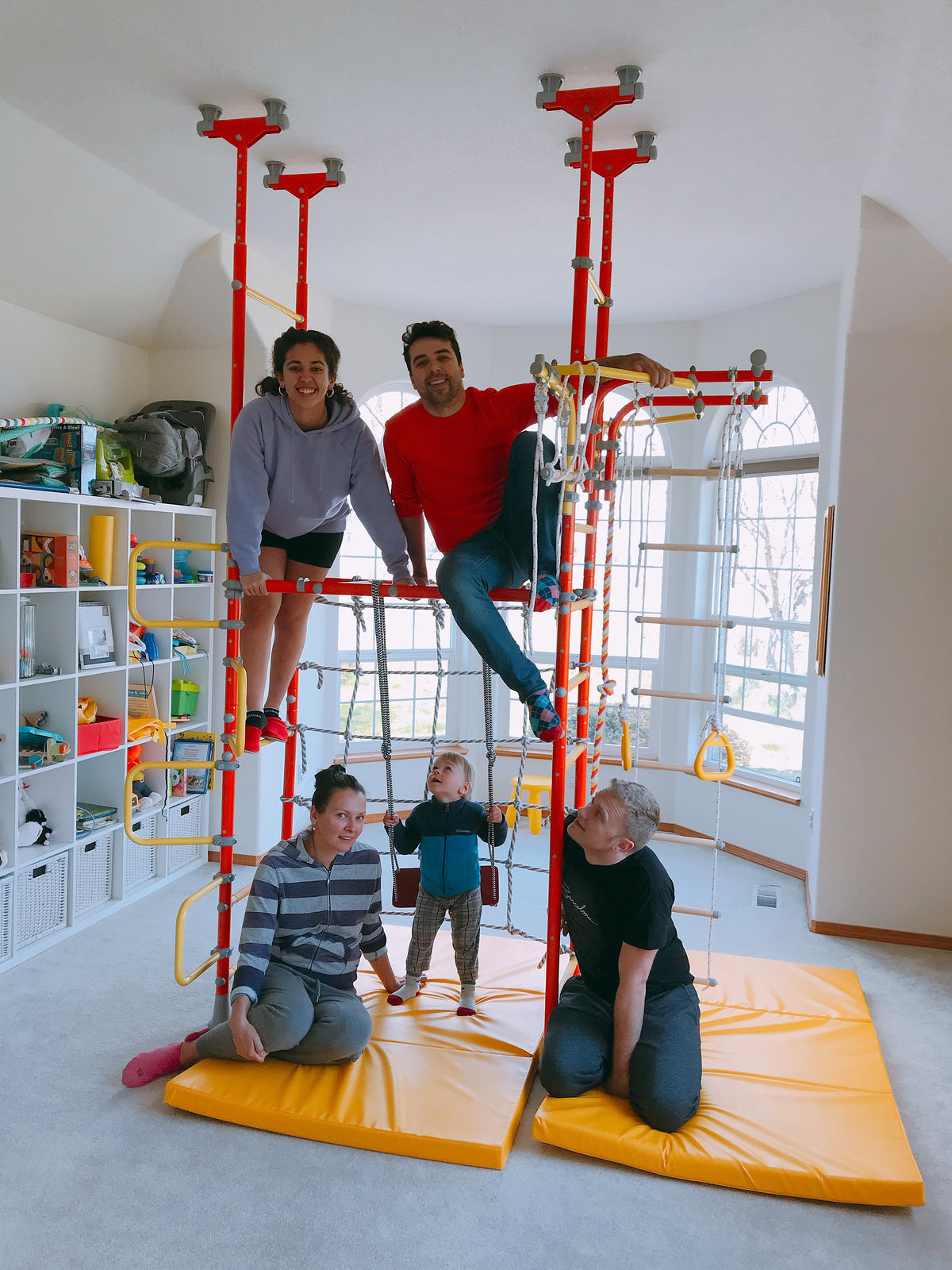
- A first full climbing gym. This is the age our Model T3 was built for: rated for independent climbing at 3+, steel, no drilling, and sized so the same frame still fits at twelve. If relatives are pooling on one big gift this year (more on that below), this is the category where pooling makes the most sense.
- Real art supplies. Washable tempera, fat brushes, a roll of butcher paper, an easel. Real materials get used; "craft kits" get done once.
- A magazine subscription in their name. Getting mail is half the gift.
- A balance bike or first scooter with a helmet. The outdoor half of the movement diet. We love outdoor play; the gym covers the hours when dark, rain, heat, or mosquito season win.
Non-toy gifts for 5 and 6 year olds
School age arrives, and with it the after-school energy spike that every parent of a 5-year-old knows at 4 p.m. The list shifts toward skill and challenge:
- A season of the sport they keep asking about. Gymnastics and martial arts are especially good fits for climbers and wigglers.
- Monkey bars. If a play gym frame already stands in the house, the Monkey Bars V3 extension is the classic upgrade gift: it turns a Model T3 into a Spider V3, and hand-over-hand traverses are the signature 5-to-8 skill. In our owner community's own ranking, monkey bars are the most-used feature for ages 6-12.
- A monthly science or craft crate. The good ones arrive with everything included and a real build inside.
- An audiobook subscription. Long car rides, quiet time, and the bridge years before independent reading.
- Ice skates, a bike upgrade, or ski passes where geography cooperates.
- A sensory swing. For the kid who winds up tight after school, a pod or hammock swing is the wind-down corner. Our indoor swing guide covers which type fits which kid, and the $27 Classic Wood Swing is a genuine stocking-level present for a family with a frame to hang it on.
Non-toy gifts for 7 to 9 year olds
The years when interests become identities. The gift job here is fuel for whatever the identity is:
- Lessons that level up: a real instrument with a starter course, a climbing-gym punch pass, a diving or parkour class.
- A serious building set or robotics kit for the engineer-in-residence.
- Gym expansions with real challenge: gymnastic rings, a trapeze, a climbing rope. Our Accessories Set 2 bundles the rotation so one set of hanging points serves a whole season of new tricks. The CDC's strength-play prescription (3+ days a week, ages 6-17) lands exactly on these years, and this is the equipment that makes it automatic.
- A national or state parks pass plus a real headlamp and daypack. Hiking gear says "you're one of us now."
- A cooking class or a real chef's knife lesson with a parent. Capability is the gift.
- Magazine or comic subscriptions pitched at their actual obsessions.
Non-toy gifts for 10 to 12 year olds
The hardest age to buy for, and the age where the searches spike hardest every December. The secret: at 10-12, the winning gift treats them as more capable than the adults usually admit:
- Experience upgrades: concert or game tickets with a parent, an escape room for their friend group, a season pass they choose.
- A pull-up bar era begins. Kids this age start training like athletes. A steel gym rated for adults holds a 12-year-old plus a friend plus momentum: our frames carry a 220 lb working rating, safety-tested to 440, which is why a structure bought at age 3 is still the yes-place at twelve. For a household without one, this is the last best window to buy; for one with a frame, a rope, rings, or hammock expansion keeps the challenge curve rising.
- A camera, drawing tablet, or beginner coding course for the maker kid, paired with a project, not just the device.
- Real sports equipment in their actual size: a proper basketball hoop, a real tennis racket, boxing gloves and a class.
- A weekend trip promise, in writing. A printed "ticket" for a one-on-one trip with a parent outranks almost any object at this age.
- A starter bank account with a matched-savings deal. Capability, again.
The pooling strategy: one great gift instead of eight small ones
Here's the move that makes the big-ticket ideas above realistic. Most kids receive gifts from four to eight adults every holiday. Individually, that's eight $30-60 objects. Pooled, it's a $250-500 gift that changes how the year goes. Grandparents, in our experience, are usually relieved to be asked: they want to give the memorable gift, not the seventh puzzle.
Copy-paste for the family group chat:
"Hi all! This year, instead of separate gifts for [child], we're trying something different: one big shared gift. We've picked [the gift]. If you'd like in, any amount toward it counts as your gift, and we'll put everyone's name on the tag. If you'd rather do your own thing, books and lessons are always winners. Thank you for spoiling this kid either way!"
The pooled-gift category where families most often land is the one that gets daily use across the widest age span: a climbing gym works for the 4-year-old and the 11-year-old on the same afternoon, which no single-age gift can claim. If that's the direction, our 60-second quiz matches ceiling height and space to the right model, and for families with a qualifying diagnosis, HSA/FSA funds may apply.
The whole guide, by budget
| Budget | Best non-toy picks |
|---|---|
| Under $30 | A great hardcover, a magazine subscription, real art supplies, a wooden swing seat for an existing frame, a "trip ticket" promise |
| $30-100 | A museum or zoo membership, a craft or science crate subscription, a helmet plus scooter, rings or a trapeze for the gym, one month of lessons |
| $100-500 | A season of lessons, a bike, a monkey-bar expansion, an accessories bundle, a family parks-pass-plus-gear kit |
| Pooled ($500+) | The full climbing gym, an instrument plus a year of lessons, the once-a-childhood trip |


Spider Max V3 ★
The pooled-gift favorite · two nets, monkey bars
$1,899 · from $171.40/mo
See Spider Max
The gift still in daily use next December
Every gym installs without drilling and carries a 30-day money-back guarantee.
Frequently asked questions
What counts as a non-toy gift? Anything that gives a child an experience, a skill, or a capability rather than another object for the toy bin: memberships and passes, lessons and classes, subscriptions, open-ended supplies like art materials and books, and active gear from bikes to climbing equipment. The working test: will it still be in weekly use three months after the wrapping paper is gone?
What is the best non-toy gift for a 5 or 6 year old? A season of lessons in the sport they keep asking about, a monthly science or craft crate, or, for a family with a play gym frame, a monkey-bar expansion: hand-over-hand traverses are the signature skill of exactly this age, and monkey bars rank as the most-used gym feature for ages 6-12 in our owner community.
What is a good non-toy gift for a 10 year old? Treat them as more capable than adults usually admit: concert or game tickets with a parent, real sports equipment in their actual size, a camera or coding course paired with a project, or strength equipment. Kids this age start training like athletes, which is why an adult-rated pull-up frame keeps earning use through the teen years.
How do I ask relatives for non-toy gifts without offending anyone? Offer a specific alternative rather than a ban. A short note works: name one big pooled gift people can chip into, plus an always-welcome fallback like books or lessons for anyone who prefers to choose their own. Most relatives are relieved: they want to give the memorable gift, not the seventh puzzle.
Are non-toy gifts better for child development? The research points that way for the pile problem specifically: a 2018 University of Toledo study found toddlers played longer and more deeply when fewer toys were available. And activity-enabling gifts help families meet the CDC's daily movement guidelines, which call for muscle-strengthening play like climbing at least 3 days a week for ages 6-17. Framed carefully: fewer, better things are associated with deeper play, not guaranteed outcomes.
Can a play gym gift be covered by HSA/FSA funds? Sometimes. When a child has a qualifying diagnosed condition and a licensed provider writes a Letter of Medical Necessity, Brainrich gyms can be HSA/FSA eligible, and December is when unspent FSA balances expire in most plans. The rules, the process, and the December 31 timing details are in our complete HSA/FSA guide.
📚 Keep reading in the Decision Guide
What Comes After the Pikler Triangle? · Best Indoor Swings for Kids · Is a Play Gym HSA/FSA Eligible? · Gifts for Autistic Kids Who Love to Move · Best Climbing Toys by Age · Indoor Playset vs Indoor Play Gym · Christmas Gifts for Kids Who Love to Climb
New: shopping for a homeschooler? See Homeschool Gift Ideas That Get Used Every Day, sorted by budget, room, and age.
Sources
Dauch, C., Imwalle, M., Ocasio, B. & Metz, A.E. (2018). The influence of the number of toys in the environment on toddlers' play. Infant Behavior and Development. · CDC. Physical Activity Guidelines for Children and Adolescents. · WHO (2019). Guidelines on physical activity, sedentary behaviour and sleep for children under 5 years of age. · Brainrich Kids engineering specification: frame working load 220 lb, safety-tested to 440 lb.
Share: