

Updated July 2026 · 9-minute read · by the Brainrich Kids team
Ask most parents why kids need exercise and you'll hear "so they burn off energy" or "so they sleep." Both are true, and both wildly undersell what's actually happening. When a child climbs, swings, and hangs, they aren't just tiring themselves out. They are building the brain, the body, and the emotional wiring that the rest of childhood is constructed on. Here is what the research actually credits to a moving child — and how much movement the world's leading health authorities say they need.
The quick answer: daily physical activity delivers three big benefits that compound over years — a sharper brain (movement fires the same cerebellar-prefrontal loops behind attention and self-control), a stronger, more capable body (the CDC names climbing a muscle-strengthening activity, and motor skills are the foundation for everything from handwriting to sports), and steadier emotions (movement regulates arousal, and mastering physical challenges is linked to lower anxiety). The global guideline: about 3 hours of movement a day for toddlers and preschoolers, and at least 60 minutes of the get-sweaty kind for school-age kids — plus muscle- and bone-loading play at least 3 days a week. Outdoor play is the gold standard for all of it. The problem is the days heat, cold, rain, or a glowing screen make outside a no-go.
Jump to: Benefit 1: the brain · Benefit 2: the body · Benefit 3: emotions · How much is enough · The real obstacle · Making it happen daily · FAQ
Benefit 1 — Movement builds the brain, not just the body
The old picture split the child in two: a brain that thinks and a body that moves. Modern neuroscience has erased that line. The structures that plan and correct movement are the same structures that run attention, memory, and self-control. For a young child, moving is thinking practice.
The clearest example is the cerebellum. Long dismissed as a pure coordination center, it's now understood to drive both motor control and higher cognition through two-way loops with the prefrontal cortex — the brain's planning-and-self-control hub. Every time a child misjudges a rung and corrects, that error-correction machinery fires. Those are the same circuits a child later leans on to sit still, hold a set of instructions in mind, and switch between tasks.
🌱 EXERCISE FEEDS NEUROPLASTICITY
Physical activity is associated with higher BDNF — a molecule that supports the growth and wiring of neurons. A 2025 systematic review of five randomized trials found structured exercise may enhance BDNF in healthy children, with neuromotor and skill-based activity showing particular promise.
🎯 THE ATTENTION PAYOFF IS IMMEDIATE
You don't wait months. In one study of ~9-year-olds, a single bout of activity improved inhibitory control — the foundation of classroom focus — raising accuracy on an attention test by 5.67% within the hour.
And it isn't only the sweaty part that helps. Among preschoolers, motor coordination, physical fitness, and cognition rise together as a package — more-coordinated 3-to-6-year-olds tend to score better across cognitive flexibility, working memory, and impulse control. Researchers are careful to call this a correlation, not proof of cause, but the mechanism is real and well-mapped: a child who climbs daily is running the exact machinery that thinking is built from. (We go deeper on the neuroscience in The Science Behind the Play Gym.)
Benefit 2 — A stronger, more capable body (and the CDC agrees)
This is the benefit everyone expects, and it's still underrated. Active kids have higher fitness, lower body fat, and stronger bones and muscles than inactive peers. But the deeper prize is motor competence — the broad movement vocabulary that lets a child join in, keep up, and stay active for life.
Here's the part worth its weight in gold: the U.S. Physical Activity Guidelines for Americans explicitly name climbing, monkey bars, and rope climbing as muscle-strengthening activities for children, and jumping and running as bone-strengthening. In other words, a climbing structure isn't a vague "good for them" — by the CDC's own definition, it hits two of the three activity types kids are supposed to get.
Why climbing punches above its weight
Motor development runs from the center of the body outward — core and shoulder stability come first, and hand control is built on top of them. It's why occupational therapists so often treat handwriting struggles by first building upper-body strength. Hanging, climbing, and swinging build exactly that foundation: grip, shoulder stability, and a strong core — the postural base a child later needs to sit upright at a desk and hold a pencil.
Real parents describe the same thing in plainer language — the way physical mastery quietly spills into everything else:
"My son's confidence has increased so much since having the gym — the more comfortable he becomes with climbing, the more comfortable he seems in other aspects of life!"
– RACHEL G., BRAINRICH OWNER
There's a sobering flip side that makes the case louder. When Japan redesigned its urban parks and removed iron bars and climbing frames, a six-decade study found that children's motor skills, which had peaked in the 1980s, went into decline — and researchers link the two. Movement withheld isn't neutral; it's a developmental input quietly taken away.
Benefit 3 — Movement is emotional regulation in disguise
This is the benefit that surprises parents most, and it may be the one they feel first. Physical play is one of a child's most reliable tools for managing big feelings.
Part of it is physiological. The vestibular system — the inner-ear sense of balance and head position, trained by swinging, hanging, and spinning — helps set a child's arousal level. Fast, unpredictable movement tends to energize; slow, rhythmic movement (a gentle swing, rocking) tends to calm. A child who feels wound-up and a child who feels overwhelmed can both self-correct on the same swing, used two different ways.
Part of it is practice. Facing a manageable, self-chosen challenge — "how high do I go today?" — and mastering it is how children build the belief "I can handle scary things." A landmark line of research on risky play describes it as nature's own exposure therapy: children denied age-appropriate physical challenge may carry more anxiety forward, not less. (More on doing that safely in our guide to controlled risky play.)
This is why so many families with sensory-seeking and neurodivergent kids describe the same thing: movement isn't a reward or a distraction, it's a release valve. As one mom in our community put it: "My son behaves so much better when he has an outlet for his sensory needs and heavy work." The child who can climb, swing, and hang on demand is a child with a built-in way to reset.
– BRIANNA W., BRAINRICH OWNER
Layer on imaginative play — a climbing frame that becomes a pirate ship, a rocket, a mountain — and you add another regulation engine. Pretend play is where a child first chooses to follow the rules of a role, subordinating impulse to the story. Developmental psychologists have long argued that's the seed of self-control. Movement and make-believe fused together is a child practicing both at once.
So how much movement is "enough"?
Parents ask a simple question, and the world's health authorities have converged on strikingly similar answers. Here's the complete picture, by age:
| Age | Daily movement target | Screen guidance |
|---|---|---|
| 1–2 years | At least 180 min of activity of any intensity, spread through the day | None (age 1); ≤1 hr (age 2) |
| 3–4 years | At least 180 min, of which ≥60 min is energetic (moderate-to-vigorous) | ≤1 hr — less is better |
| 5–17 years | ≥60 min/day of moderate-to-vigorous activity, plus muscle- & bone-strengthening play ≥3 days/week | Keep recreational screens in check |
Targets per WHO (2019 & 2020) and the U.S. Physical Activity Guidelines (2nd ed.). "Muscle-strengthening" is where climbing, monkey bars, and rope climbing officially count.
Notice how kids are meant to hit these numbers: not in one scheduled block, but in short bursts all day long. A toddler banks activity in five-minute installments, over and over. That's a crucial clue for what actually works at home — and it's exactly what one mom captured when she told her group, "Kids need the big movement throughout the day, not just an hour block at the park. You can't go to the park several times a day."
The real obstacle isn't the couch — it's the weather and the screen
Let's be clear about something, because it matters: outdoor play is the gold standard. Fresh air, sunshine, uneven terrain, big open space — nothing beats it, and no home setup is trying to. The countries raising the world's most active kids — Denmark, Finland, Japan — all do the same thing: they build daily, self-directed movement into ordinary life, much of it outside.
But most families can't relocate to a Danish forest, and every parent knows the days that defeat outdoor play: the 95° August afternoon, the sub-zero January week, the endless stretch of rain, the packed weekday schedule — and the screen that's always right there, ready to fill the gap. Those are the real enemies of a moving childhood. Our community says it better than we can:
"Great when it's 20° out — or when it's 90° out."
– CARMEL G.
"They choose this over their iPads."
– KELLY S.
"10-minute school breaks aren't enough time to bundle up — but they're enough for the gym."
– SARAH R.
Every hour on a screen is an hour not climbing, pretending, moving, or sleeping. That displacement — not the couch itself — is the quiet cost. The goal isn't to replace the park. It's to make sure that when the park is off the table, the fallback is movement, not a tablet.
Making daily movement the easy default
Here's the through-line of everything above: the benefits — brain, body, emotions — only compound if the movement actually happens, every day, in short bursts, on the child's own initiative. That's a design problem more than a willpower problem.
Environment beats willpower.
Proximity and availability are among the biggest predictors of whether kids actually use active equipment. A climbing structure in the living space makes movement the default choice — especially on the bad-weather, packed-schedule days when outdoor play collapses. It invites the twenty five-minute climbs a day that the guidelines are really asking for.
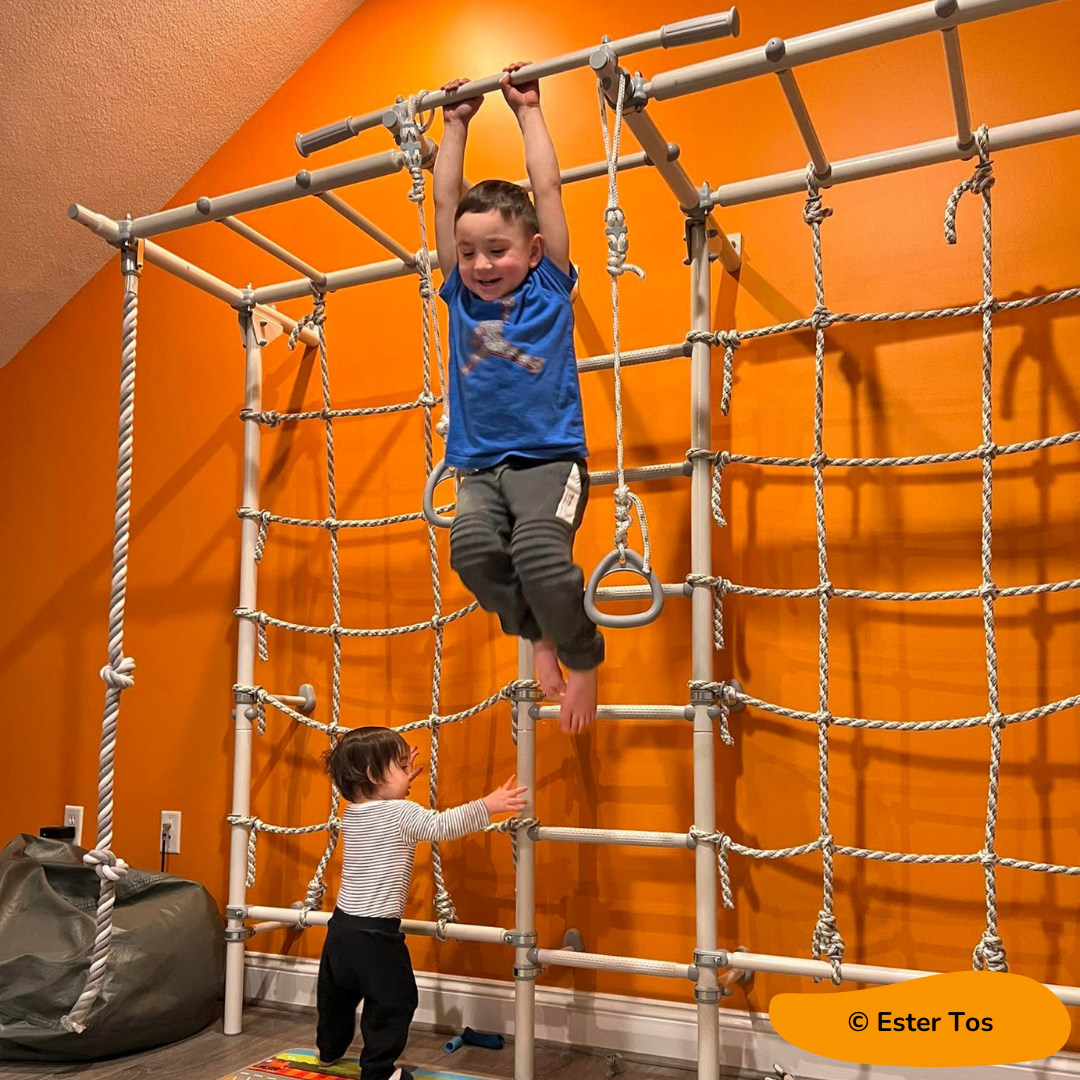
That's the entire idea behind an indoor home play gym: bring the one active ingredient — daily, self-directed climbing, swinging, and hanging — into your home, so it's there before breakfast, between homeschool blocks, and at 8 p.m. in January. It doesn't compete with the playground. It covers the 200-odd days a year the playground can't.
Which gym fits your family? Take the 60-Second Quiz →


Give your kids a reason to move every single day.
Fits ceilings from 6'9" to 10'5", no drilling required. Every gym ships in 5–7 days, assembles in an afternoon, and is covered by a 30-day money-back guarantee — even assembled, even used.
Frequently asked questions
What are the main benefits of exercise for kids? Research groups them into three: brain and cognition (movement fires the cerebellar-prefrontal circuits behind attention and self-control, and is linked to better inhibitory control and executive function), body (stronger muscles and bones, better motor skills — the CDC names climbing a muscle-strengthening activity), and emotional regulation (movement helps set arousal level, and mastering physical challenges is associated with lower anxiety). They compound with daily practice.
How much physical activity does my child actually need? Per WHO and the U.S. guidelines: toddlers and preschoolers need about 180 minutes of movement a day (with at least 60 of those minutes energetic for ages 3–4), and school-age kids (5–17) need at least 60 minutes of moderate-to-vigorous activity daily, plus muscle- and bone-strengthening play on at least 3 days a week. Kids bank this in short bursts throughout the day, not one long session.
Does exercise really help with focus and behavior? The evidence points that way. A single bout of activity has been shown to improve children's inhibitory control — the foundation of classroom attention — within the hour, and more-coordinated, fitter preschoolers tend to score better across executive functions. It's an association, not a guarantee of grades, but the mechanism is real and well-mapped.
Isn't outdoor play better than an indoor gym? Yes — outdoor play is the gold standard, and nothing replaces it. An indoor gym isn't meant to. It exists for the many days heat, cold, rain, or schedule make outside impractical, so the fallback on those days is movement instead of a screen. Think of it as covering the gaps, not competing with the park.
What kinds of movement matter most? Climbing, hanging, and swinging are high-value because they bundle several benefits at once: grip and core strength, balance (vestibular input), body awareness (proprioception), and motor planning. Development runs from the core outward, so the core and shoulder strength climbing builds is also the foundation for later skills like sitting upright at a desk and handwriting.
My child is sensory-seeking or neurodivergent — is active play especially helpful? Many families report that on-demand climbing, swinging, and hanging give their child a reliable outlet for heavy work and sensory input, which supports self-regulation. A home gym is play equipment, not a therapy device or medical treatment — but the everyday movement it invites is exactly the kind these families tell us helps most.
Sources
World Health Organization. Physical activity fact sheet and Guidelines on physical activity, sedentary behaviour and sleep for children under 5 (2019). · U.S. Dept. of Health & Human Services / CDC. Physical Activity Basics: Children (6–17) — names climbing and rope climbing as muscle-strengthening activities. · Cerebellum & cognition: IBRO Neuroscience Reports. · BDNF & exercise in children (systematic review, 5 RCTs): Life, 2025. · Acute activity & inhibitory control: PMC9139511. · Preschool motor–fitness–cognition: Frontiers in Public Health, 2026. · Vestibular system & arousal/cognition: Children (Basel), 2024. · Risky play & health: Brussoni et al., 2015. · Six-decade decline in Japanese children's motor skills (linked to removal of climbing frames): Yogi, Sports (Basel), 2025. · Most-active-nations ranking: Aubert et al., Global Matrix 4.0, 2022. Language throughout is intentionally associational ("linked to," "associated with"); a home play gym is play equipment, not a medical or therapeutic device.
Share: