

Updated August 2026 · 11-min read · by the Brainrich Kids team · Canadian edition, prices in CAD
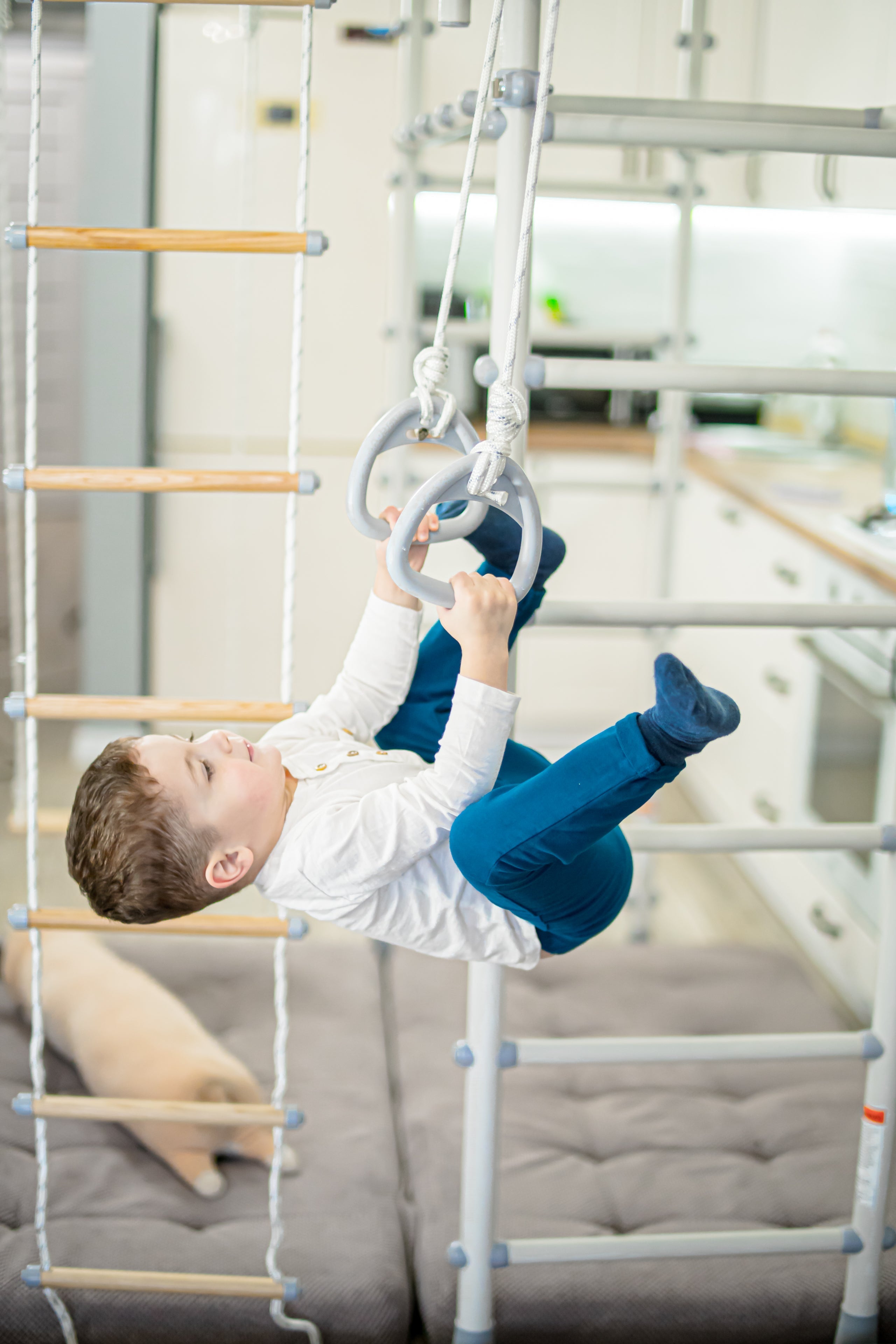
A playroom without a jungle gym is a room that works for about forty minutes at a time. The toys rotate, and the energy still ends up on the sofa cushions. A playroom with a jungle gym is a different machine entirely: it gives the biggest, loudest kind of play, climbing, swinging, hanging upside down, a permanent address inside your house. This guide covers everything that decision actually involves: footprint, ceiling fit, noise, mounting, materials, and which gym fits which size of room.
The quick answer: the best playroom jungle gym is the one your room can hold and your kids can grow into. Measure ceiling height first (tension-mounted frames fit ceilings from roughly 6'9" to 10'6" (206–320 cm) depending on size, and wall-mounted models from $967 CAD handle everything else), then match the footprint to the room: a corner unit like the Model T3 ($1,022 CAD) for small playrooms, a Spider V3 ($1,704 CAD) along one wall, a Spider Max V3 ($2,159 CAD) in an L around a corner, or a Mega Max V3 ($2,727 CAD) when the gym is the playroom. Prioritize a steel frame with a real weight rating (Brainrich gyms are rated to 220 lb (100 kg) and safety-tested to 440 lb (200 kg)), adjustable bars, and non-toxic finishes. In Canada, provincial autism funding or Jordan's Principle can sometimes help cover it.
Ordering from Canada: Brainrich prices on this page are in Canadian dollars. Every gym component is stocked in our Vancouver, BC warehouse, so your order ships from inside Canada: no duties, no customs paperwork, no cross-border delays. GST/HST is calculated at checkout.
Jump to: What makes a gym playroom-worthy · Buying criteria · Placing it in the room · Options by playroom size · Wood vs. steel · FAQ
What makes a jungle gym playroom-worthy
Backyard playsets and daycare structures are designed for one job: maximum play value on unlimited space. A playroom gym has four extra jobs, and they are the ones that decide whether the purchase works.
1. Footprint that leaves a playroom behind. The gym should anchor the room, not consume it. A good playroom keeps floor area for the other kinds of play, blocks, art, pretend, so the target is a gym that uses a corner, a wall, or an L-shape and leaves the middle open. As a rule of thumb, plan the gym's own footprint plus a clear landing zone in front of anything kids swing or jump from, then see what is left. If the answer is "nothing," size down one model rather than filling the room edge to edge.
2. Ceiling fit, measured before anything else. Tension-mounted gyms brace between the floor and the ceiling, so ceiling height is not a detail, it is the first gate. Brainrich frames come in three heights: Short fits ceilings from 6'9" to 9'1" (206–277 cm), Standard fits 7'8" to 9'11" (234–302 cm), and Tall fits 9'4" to 10'6" (284–320 cm). Between them, that covers almost every basement, bedroom, and dedicated playroom in America. For the ceilings outside those ranges, vaulted, slanted, or higher than 10'6" (320 cm), the wall-mounted Model W3 line (from $967 CAD) anchors to studs instead of the ceiling and does not care what happens above it.
3. Noise you can live with. Steel is the quiet option here: a properly tensioned steel frame does not creak or groan the way wooden joints do as they age, and rubber-coated rungs take the clang out of hands and feet on metal. The loud part of a playroom gym is the landing, which is what impact mats are for, and the kids themselves, which no manufacturer can help you with. If the playroom sits over a bedroom, put mats under every landing zone and the soundtrack becomes thumps and giggles rather than structure noise.
4. Mounting that matches your ownership situation. Renters, movers, and commitment-averse buyers should look at tension-mounted frames: no drilling, no holes, no landlord conversation, and the whole gym can move to another room, or another house, and set up again. Homeowners with tricky ceilings should look at wall-mounted. Both are legitimate; the wrong choice is buying a drilled-in structure for an apartment you leave in a year.
The buying criteria that separate gyms from furniture-shaped toys
Once a gym passes the four playroom tests, evaluate it the way you would evaluate any piece of equipment your child will hang from. Here is the checklist we would use shopping in this category, including against ourselves:
| Criterion | What to look for | Why it matters |
|---|---|---|
| Weight rating | A published number, with a stated test margin. Brainrich gyms are rated to 220 lb and safety-tested to 440 lb. | The rating is really a headcount: two kids plus a climbing parent. A gym rated for one toddler is a gym your family outgrows by spring. |
| Adjustability | Bars and accessories that move in height, and a modular frame that accepts add-ons later. | Monkey bars at chest height for a 3-year-old become full-height bars for an 8-year-old on the same frame. Fixed equipment has a shelf life; adjustable equipment has a childhood. |
| Materials & finishes | Steel frame, non-toxic powder coat, non-toxic rubber-coated rungs, phthalate-free plastics. | Kids grip this thing with bare hands and occasionally their teeth. Indoor equipment should meet indoor standards, not backyard ones. |
| Mounting type | Tension-mounted (no drilling) for standard ceilings; wall-mounted for vaulted, slanted, or 10'6"+ ceilings. | Match the mount to the room and the lease, not the marketing. Both, done right, are rock solid. |
| Shipping & assembly reality | A straight answer about boxes and build time. Brainrich gyms arrive in multiple boxes, like a Lego set, and assemble in an afternoon. | Any company shipping a real steel structure "in one box" is describing a smaller structure. Multiple boxes also mean the gym disassembles and moves. |
| The guarantee's fine print | A clear return window. Brainrich offers a 30-day money-back guarantee. | Read the return terms before you buy; on a large steel product they matter more than on a toy. |
One criterion deliberately missing from that table: theme. Slides shaped like castles and panels shaped like rockets photograph well and play short. The equipment that holds attention for years is the open-ended kind, bars, nets, rings, and rope, that a child reinvents daily, which is the same reason we build gyms without slides and rate them for ages 3 and up.
How to place a jungle gym in a playroom
Where the gym goes shapes how it gets used. Three placements cover nearly every playroom:
The corner is the default for a reason: two walls of the clearance problem disappear, the room's centre stays open, and a corner-format gym like the T3 turns otherwise dead space into the busiest square yard in the house. Along one wall suits long, narrow playrooms; a straight run like the Spider V3 keeps a full lane of floor open beside it. Mid-room or L-shaped placement is the luxury option for bigger rooms, and it unlocks something wall placement cannot: swinging in any direction, with the gym reachable from all sides when three kids want on at once.
Wherever it lands, keep the landing zones clear of furniture and hard-edged toys, and put impact mats under anything kids drop from. We keep this section short on purpose, because we have already written the long version: our kids' playroom ideas guide is the safety-and-setup companion to this article, with zone-by-zone layouts, mat coverage, and the clearance rules worth actually following. And if you are designing the whole room from scratch, shelving, storage, zones, and all, start with the ultimate open-ended playroom guide and slot the gym in as its anchor.
One placement myth worth retiring: the gym does not need to be quarantined from the rest of the playroom. In practice it becomes the room's social centre, the reading nook ends up under the net, the stuffed animals commute up the ladder, and the pretend games absorb the structure into their plots. Design for that gravity instead of against it.
Brainrich options by playroom size
We build one family of modular steel gyms, so the sizing question is simply how much room you have. Here is the ladder, small to large:
| Your playroom | The fit | Price |
|---|---|---|
| A shared bedroom, a small den, one free corner | Model T3: the corner unit. Climb, swing, and hang in the smallest real footprint we make. | $1,022 CAD |
| A standard playroom with one good wall | Spider V3: a straight wall run with net, bars, and hanging accessories, leaving the floor lane open. | $1,704 CAD |
| A generous playroom with a free corner and two walls | Spider Max V3: the best seller, wrapped in an L around a corner. Two nets, monkey bars, room for siblings to climb in parallel. | $2,159 CAD |
| A dedicated play space, basement, or bonus room | Mega Max V3: the full build, with every station our frame supports. The gym is the playroom. | $2,727 CAD |
Because the frames are modular, these are starting points rather than boxes you are locked into: a Spider V3 can grow accessories over time, and the larger models can be reconfigured as the room or the family changes. For a visual tour of what the bigger frames can become, wall runs, corner Ls, and full-room layouts, see our Spider and Spider Max configuration guide.
Three practical notes that apply across the range. First, every gym ships as a multi-box kit, think Lego set rather than furniture crate, which is what lets a 220 lb-rated steel structure come through a normal front door and later move houses with you. Second, a playroom gym is one of the purchases Canadian families sometimes cover with provincial autism funding or Jordan's Principle; our Canadian funding guide explains how each route works. Third, every gym carries a 30-day money-back guarantee. And if you want to see how other families actually set theirs up, our owners' Facebook group is 12,500 members of exactly that.
Which gym fits your playroom? Take the 60-Second Quiz →
Wood vs. steel, in numbers
Most of what sells in this category is wood: Pikler triangles, arches, and climbing frames, usually beautiful, usually light. The relevant difference for a playroom is not aesthetics but capacity. Typical wooden climbers in this category publish weight limits in the 60 to 130 lb (27–59 kg) range, which is a real number for one preschooler and a problem for everything after that: the second sibling, the visiting cousin, the eight-year-old the preschooler becomes, and the parent who wants to demonstrate the monkey bars. A steel frame rated to 220 lb and safety-tested to 440 lb is playing a different sport: multiple kids at once, adults included, with margin left over.
Capacity also changes how a gym ages in the room. Wooden joints work loose and finishes wear with daily indoor use; a powder-coated steel frame keeps the identical geometry in year five that it had in month one, which matters because a structure kids have fully memorized is a structure that stops surprising them. Wood still wins on some counts, price at the low end, warmth of the material, and for the crawler-to-toddler window a small wooden triangle is a fine first climber. For the full comparison, materials, longevity, safety records, and where wood genuinely is the better buy, we wrote a dedicated steel vs. wood guide.
Whichever material you choose, the developmental case for choosing something is well documented: researchers reviewing the literature on active, challenging play, including a 2015 systematic review led by Dr. Mariana Brussoni at the University of British Columbia, link it to physical health, social behaviour, creativity, and resilience, and pediatric bodies including the Canadian Paediatric Society now formally endorse this kind of play for healthy development. A playroom gym's contribution is availability: the climbing is twenty steps away, every day, in January.


Ready to give your playroom its anchor?
Every gym ships as a multi-box kit, assembles in an afternoon, and is covered by a 30-day money-back guarantee.
Frequently asked questions
How much space does a playroom jungle gym need? Less than most parents assume, because the play is vertical. A corner unit like the Model T3 lives in the footprint of an armchair-and-a-half; a wall run like the Spider V3 uses one wall and leaves the floor lane beside it open. The rule that matters more than square footage: keep a clear, mat-covered landing zone in front of anything kids swing or drop from, and keep furniture out of it.
What ceiling height do I need for an indoor jungle gym? Tension-mounted Brainrich frames come in three heights: Short fits ceilings from 6'9" to 9'1", Standard fits 7'8" to 9'11", and Tall fits 9'4" to 10'6". Measure floor to ceiling at the exact spot you want the gym, since older homes vary by inches across a room. For vaulted, slanted, or taller ceilings, the wall-mounted Model W3 line (from $967 CAD) anchors to studs and works under any ceiling.
Will a jungle gym be too loud for the rest of the house? The frame itself is the quiet part: tensioned steel does not creak the way aging wooden joints do, and rubber-coated rungs dampen the contact noise of hands and feet. The sound that carries is landings, which impact mats absorb, and delighted shrieking, which is the product working. Over a bedroom or a shared wall, mat every landing zone and schedule the wildest play accordingly.
What age is a playroom jungle gym for? Brainrich gyms are rated for independent climbing at ages 3 and up, with a 220 lb weight rating (safety-tested to 440 lb) that keeps them relevant deep into elementary school and lets parents join in. Younger siblings grow up alongside the gym with hands-on supervision and low bar settings before their first solo climb, since the adjustable bars let every challenge start low.
Can I use funding to buy a jungle gym in Canada? Sometimes. Canada has no HSA or FSA at checkout. Families most often use provincial autism funding (British Columbia and Ontario both run programs), Jordan's Principle for First Nations children, or tax-time support such as the disability tax credit. No funding route is guaranteed, and we can send an itemized quote in CAD for your request. The routes are laid out on our Canadian funding page.
What if the gym does not work out in our playroom? Every Brainrich gym carries a 30-day money-back guarantee. And because the gym ships as a multi-box modular kit rather than one welded piece, it disassembles the same way it went up, whether for a room change or a move to a new house.
📚 Keep reading
Kids' Playroom Ideas: the Safety & Setup Companion · The Ultimate Open-Ended Playroom Guide · Spider & Spider Max Configuration Layouts · Steel vs. Wood Climbing Gyms
Sources
Brussoni, M. et al. (2015). What is the relationship between risky outdoor play and health in children? A systematic review. International Journal of Environmental Research and Public Health. · Beaulieu, E. & Beno, S. (2024). Healthy childhood development through outdoor risky play. Canadian Paediatric Society position statement. · Weight ratings, ceiling ranges, and pricing: Brainrich Kids product specifications, verified August 2026.
Share: