

Updated September 2026 · 9-minute read · by the Brainrich Kids team
Montessori parenting gets sold as a look: pale wood, low shelves, one basket of felt balls. The look is optional. The method is a handful of habits about how you talk to a child, how you set up a room, and how much you let them do for themselves. This guide covers the ideas Maria Montessori actually wrote about, how to apply them in a normal house with normal furniture, and the part most guides skip: what she said about movement. We make steel climbing frames, so that part is where our experience is. The rest is for any family.
The quick answer: Montessori parenting means treating a child as capable, preparing the home so they can act on that, and getting out of the way. In practice it comes down to four habits: respect (ask before helping, wait before rescuing), a prepared environment (everything they use at their height), freedom within limits (two real choices, not twenty), and real work (pouring, sweeping, dressing, climbing). Movement is not a break from this kind of learning. Montessori wrote that the child's mind develops through movement, and a home that gives a child somewhere to climb, hang, and swing is applying her method, not departing from it.
Jump to: What it is · The four habits · Setting up the home · Where movement fits · By age · Daily routines · Common mistakes · FAQ
What Montessori parenting is, and where it came from
Maria Montessori was an Italian physician who opened her first children's house in a Rome housing block in 1907. She watched what children did when the furniture fit them, the materials were within reach, and the adult stopped interrupting, and she built a method around it. The schools came first; the parenting approach is the same ideas carried home.
The core of it is a belief about children: they want to do real things, and they can do more of them than adults expect. A three-year-old can pour water, carry a plate, put on shoes, and put a toy back on a shelf. A Montessori parent's job is to make those things possible and then let them happen, including the spills.
The evidence base is modest but real. The best-designed study is a 2017 lottery study from Hartford, Connecticut: children who won admission to public Montessori preschools were compared with children who lost the same lottery and went elsewhere. Followed from age 3 to age 6, the Montessori group scored higher on academic achievement, social understanding, and mastery orientation (the habit of sticking with hard tasks). On executive function the two groups did not differ overall, with a Montessori advantage showing at one of the four test points. That is one study of 141 children, so treat it as encouraging rather than settled.
The four habits behind Montessori parenting
1. Respect the child as capable. Ask before you help ("Would you like a hand with that zipper?"). Wait a beat longer than feels comfortable before you step in. Talk to a child the way you would talk to a guest, not a project.
2. Prepare the environment. Montessori called this the "prepared environment." If the cups are on a low shelf, the child gets their own water. If the coat hook is at their shoulder, they hang up their own coat. Every task a child cannot reach is a task an adult has to do for them.
3. Freedom within limits. The child chooses; the parent sets the menu. "Red shirt or blue shirt" is a real choice. "What do you want to wear?" at 7:40 a.m. is a negotiation. Limits are stated once, calmly, and held.
4. Real work over pretend work. Montessori called the household tasks "practical life": pouring, sweeping, washing, buttoning, carrying. Children prefer them to toy versions because the results are real. A three-year-old who wipes a table has changed the world a little, and knows it.
Notice what is missing from that list: a product. Nothing about Montessori parenting requires buying anything. The wooden toys that carry the label are fine, but the method lives in the habits. Our guide to what makes a toy "Montessori" goes through what to look for and what to ignore.
Setting up a Montessori home without redecorating
Lower everything the child uses. A low shelf or the bottom two shelves of a bookcase. Cups, bowls, and a small pitcher on a low kitchen shelf. A step stool at the bathroom sink. Coat hooks at their height. This is the whole "prepared environment" for most families, and it costs almost nothing. A 2018 master's paper hosted by the American Montessori Society, by Koreen Thompson of the University of Wisconsin-River Falls, traces how a prepared primary classroom supports executive function; the same logic scales down to one low shelf at home.
Fewer things, in the open. Six to eight activities out on the shelf, each on its own tray or in its own basket, the rest stored away and rotated every couple of weeks. A child who can see everything can choose; a child looking at a toy bin can only dig.
Child-sized tools that work. A small broom that sweeps, a pitcher a three-year-old can lift when it is half full, scissors that cut. Toy versions that do not work teach that their work does not count.
A place to move. This is the one most Montessori guides leave out, and Montessori herself did not. A clear patch of floor, and if you can manage it, something to climb. More on that next.
If you are setting up a whole room, our Montessori playroom guide walks through the layout, and the Montessori case for a play gym covers the climbing corner in detail.
Where movement fits in the Montessori method
Montessori was a physician before she was an educator, and she was blunt about the body. In The Absorbent Mind she argued that movement and thought develop together, that the hand is the instrument of the intelligence, and that a child who is kept still is being kept from learning. A century later the pediatric literature agrees in its own language: the American Academy of Pediatrics' 2018 report on play describes active, self-directed play as associated with executive function and self-regulation, a 2020 meta-analysis in Frontiers in Public Health found a modest positive association between children's physical activity and academic performance, and a 2025 narrative review in Brain Sciences gathered the evidence linking physical activity to executive functions and brain outcomes in children.
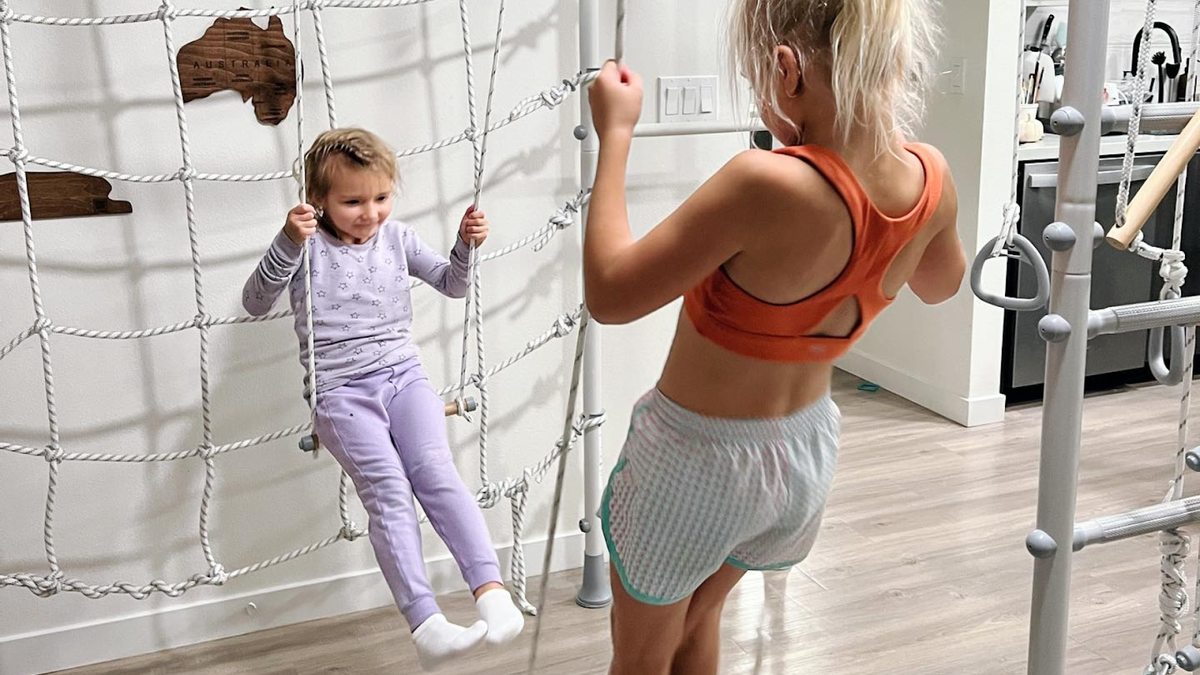
A climbing frame is the most Montessori object in the house once you look at it her way. The child chooses the route, judges the risk, repeats the movement until it is mastered, and nobody hands out a grade. It is practical life for the whole body.
SELF-DIRECTED · REPEATABLE · REAL CONSEQUENCES · NO ADULT REQUIRED TO RUN IT
The Montessori tradition already has a climbing object for the youngest children: the Pikler triangle, named for Emmi Pikler, the Hungarian pediatrician whose work on self-directed movement fits the method so well that most Montessori homes own one. It is the right first climber for a one- or two-year-old, and it is outgrown by about three. What comes next is a frame with rungs the child can reach, bars that adjust as they grow, and a mat underneath: a step we have written about at length, because it is where most families stall.
Three Montessori rules travel onto the frame unchanged:
They climb up on their own
Never lift a child to a height they did not climb to. A child who got there alone can get down alone; a lifted child is at a height their judgment has not earned.
You stay in the same room
Independence is not absence. Independent climbing starts at about age 3 with a parent present, mostly quiet, mostly not saying "be careful."
The environment does the teaching
Rungs at reachable spacing, a firm mat under every dismount point, nothing hidden that can fail. Then the visible risk, height, becomes the lesson.
This is the work our frames were built for. More than 10,000 families use them, occupational and physical therapists in our owner community recommend them for exactly this kind of daily heavy work, and one frame serves a household from the toddler years (with a parent's hands close by) through the teens, with adults using the pull-up bar after bedtime. Why we trust that last point about visible risk is spelled out in the science of controlled risky play: daily climbing on a familiar frame builds the balance, grip, and judgment that prevent falls, which is Montessori's repetition-to-mastery in a different vocabulary.
Montessori parenting by age
| Age | Practical life they can own | Movement that fits | The parent's job |
|---|---|---|---|
| 1 to 2 | Carrying a cup, putting a toy in a basket, wiping with a cloth | Floor time, a low Pikler triangle, cushions to climb over, with hands close by | Slow down. Narrate less. Let them finish. |
| 3 to 4 | Pouring from a small pitcher, dressing with help on fasteners, setting their place, sweeping | The first real frame: low rungs, a rope, a swing seat, two-hand hangs from a low bar. Parent in the room | Offer two choices. Hold the limit. Do not rescue the spill. |
| 5 to 6 | Simple cooking, making a bed, feeding a pet, packing a bag | Monkey bars arrive (hanging at 3, swinging at 4, crossing somewhere between 5 and 7), nets, the rope | Teach the skill once, then step back and let repetition do the work. |
| 7 to 12 | Real chores with real stakes: laundry, a meal a week, managing their own schedule | Pull-ups, rope climbs, inverted hangs, self-set challenges | Consult them. Montessori's older children ran their own classroom; yours can run their own morning. |
The by-age detail for the climbing side is in climbing toys by age, and for the gift-giving side in Montessori gifts by age.
Montessori habits inside an ordinary day
Mornings. Clothes chosen the night before from two options, laid out where the child can reach. A step stool at the sink. Allow ten more minutes than you think you need; the time is the price of independence, and it drops fast once the routine is set.
Meals. The child sets their own place from a low shelf, pours from a small pitcher, clears their plate. Give them a real job in the cooking: washing vegetables, tearing lettuce, stirring. Real knives come later, but a butter knife and a banana is a legitimate first cut.
Transitions. Most meltdowns live in the gaps between activities. A minute of movement bridges them: a few hangs from a bar on the way to the table, a swing before a quiet task, carrying the laundry basket upstairs. Occupational therapists call this heavy work, and it has its own guide.
Cleanup. One activity out at a time, back on its tray before the next. This is easier to hold with six things on a shelf than with a toy bin, which is the practical reason Montessori homes look sparse.
Big feelings. Name it, wait, offer a choice. "You are angry the tower fell. Do you want to build it again or come sit with me?" The structure is the comfort. Montessori did not ask parents to prevent frustration, only to stop rushing in to end it.
Five mistakes that look Montessori and are not
Buying the aesthetic. A beige room with wooden toys and a parent who still zips every zipper is a photo, not a method.
Confusing freedom with no limits. Montessori classrooms are highly ordered. The child chooses within a structure an adult built and holds.
Skipping the body. A shelf of fine-motor work and nowhere to climb is half the method. Montessori's children carried furniture, gardened, and walked lines for balance every day.
Narrating everything. "Good job" after each block and "careful" on every rung break concentration, which is the thing the method exists to protect.
Reading independence as leaving them alone. A three-year-old on a climbing frame is independent with a parent in the same room. That is the arrangement, at every age, on ours.


Practical life, for the whole body
Steel indoor play gyms for ages 3 to 12+. Every bar adjusts as they grow, 220 lb working load tested to 440, no drilling, 30-day money-back guarantee.
Frequently asked questions
What is Montessori parenting? An approach that treats a child as capable, prepares the home so the child can do real things at their own height, offers freedom within clear limits, and favors real household work over pretend versions. It comes from Maria Montessori's schools, which opened in Rome in 1907, and needs no special products to practice.
Do I have to send my child to a Montessori school? No. The habits work in any home regardless of schooling: lowering what the child uses, offering two choices, letting them finish tasks, and giving them real work. The 2017 Hartford lottery study that found higher academic and social outcomes was in public Montessori preschools, and the same principles apply at home.
At what age can you start Montessori parenting? From the first year, with floor time, a low shelf, and slow responsive routines. Practical life tasks like pouring and dressing begin at about 2 to 3. Independent climbing on a real frame starts at about age 3, with a parent in the same room.
How does movement fit into Montessori? Centrally. Montessori wrote that movement and thought develop together and that the hand is the instrument of the intelligence. Her classrooms included carrying, gardening, and balance work every day. At home, a Pikler triangle in the toddler years and an adjustable climbing frame from about age 3 give a child self-directed, repeatable physical work, the same principle as practical life.
Does Montessori parenting work in a small apartment? Yes. It needs a low shelf, a step stool, and a clear patch of floor more than it needs square footage. For climbing, a wall-mounted frame stands about 9 inches off the wall, and a single-ladder-pair floor frame takes a corner about the size of a dresser.
Is Montessori parenting the same as gentle parenting? They overlap in calm, respectful communication, but Montessori adds a specific structure: a prepared environment, freedom within limits, practical life work, and daily movement. Montessori classrooms are highly ordered; the freedom lives inside that order.
📚 Keep reading in the Decision Guide
The Montessori Case for a Play Gym · What Comes After the Pikler Triangle · Pikler Climbing Set vs Play Gym · Montessori Gifts by Age · What Are Montessori Toys? · Montessori Playroom Guide
Sources
Montessori, M. The Absorbent Mind (1949) and The Montessori Method (1912). · Lillard, A. S., Heise, M. J., Richey, E. M., Tong, X., Hart, A., & Bray, P. M. (2017). Montessori Preschool Elevates and Equalizes Child Outcomes: A Longitudinal Study. Frontiers in Psychology, 8, 1783. · Yogman, M. et al. (2018). The Power of Play: A Pediatric Role in Enhancing Development in Young Children. Pediatrics, American Academy of Pediatrics clinical report. · Sember, V., Jurak, G., Kovač, M., Morrison, S. A., & Starc, G. (2020). Children's Physical Activity, Academic Performance, and Cognitive Functioning: A Systematic Review and Meta-Analysis. Frontiers in Public Health, 8, 307. · Guzmán-Muñoz, E., Concha-Cisternas, Y., Jofré-Saldía, E., Castillo-Paredes, A., Molina-Márquez, I., & Yáñez-Sepúlveda, R. (2025). Physical Activity and Its Effects on Executive Functions and Brain Outcomes in Children: A Narrative Review. Brain Sciences, 15(11), 1238. · Thompson, K. (2018). How a Montessori Prepared Environment Builds Executive Function in a Primary Classroom. Master's paper, University of Wisconsin-River Falls, hosted by the American Montessori Society. · Brainrich Kids engineering specification: frame working load 220 lb, safety-tested to 440 lb.
Share: