

Updated August 2026 · 11-min read · by the Brainrich Kids team
Somewhere around the third week of planning a homeschool year, most parents hit the same quiet question: math is covered, reading is covered, but who is teaching PE? At school, physical education came with a gym, a coach, and a bell schedule. At home, it comes with you. The good news: a handful of legitimate homeschool physical education curricula exist, several are inexpensive, one is free, and the option most families end up happiest with doesn't require a curriculum at all. This guide compares them side by side, without a sales pitch attached to the comparison.
The quick answer: you have four real paths for homeschool PE. A packaged curriculum (Family Time Fitness, Horizons PE, or the Home School Family Fitness book) gives you scripted lessons for roughly $20–115. A free curriculum (OPEN) gives you outcomes-based K–12 lesson plans at zero cost. Outsourced classes (YMCA homeschool PE, co-ops) give you a weekly coach-led session. And building your own program—equipment your child uses daily, a simple activity rotation, and a log—is a legitimate PE program in every state, and the one that best fits how homeschool days actually flow. Most families blend two of these.
Jump to: Do you need a curriculum? · The options · Comparison table · Free options · Classes vs. curriculum · Build your own · FAQ
First: do you actually need a PE curriculum?
Legally, it depends on your state. Some states—Pennsylvania and New York among them—list physical education by name as a required homeschool subject. Others, like Texas, require only a short list of academic subjects and never mention PE at all. We walk through the state-by-state picture, with sources, in our companion piece on homeschool PE logs and requirements. The two-sentence version: check your state's law on HSLDA's state pages, and know that even in states that require PE, no state requires you to buy a packaged curriculum. A planned program of physical activity, documented, satisfies the requirement everywhere it exists.
Developmentally, the bar is clearer than the legal one. The Physical Activity Guidelines for Americans call for at least 60 minutes of moderate-to-vigorous activity every day for ages 6–17, including muscle-strengthening and bone-strengthening activity at least 3 days a week—and for ages 3–5, roughly 3 hours of active play spread across the day. A schooled child gets a chunk of that from recess, PE class, and walking a big building. A homeschooled child gets it from whatever you build into the day. That's the actual job of homeschool PE: not replicating gym class, but making sure the movement happens on purpose instead of by accident.
You're not alone in figuring this out. Roughly 3.4 million U.S. children are now homeschooled, and PE is consistently one of the last subjects families solve—usually because the options are scattered across curriculum shops, YMCA schedules, and forum threads. Here they are in one place.
The homeschool PE curricula that actually exist in 2026
We have no curriculum of our own to sell you today (more on that in the build-your-own section), so consider this a neutral tour. Prices are list prices at the time of writing; most of these publishers run frequent sales.
Family Time Fitness (Fitness 4 Homeschool)
The best-known name in the category, and the closest thing to a full "PE in a box." Fitness 4 Homeschool is a Pre-K-through-high-school program built around structured lesson plans—156 lessons per core level (Core 1 covers roughly ages 5–10, Core 2 ages 11–13), each paired with instruction videos, printable workbooks, and progress logs. High-school modules cover strength and conditioning, running, and sport skills. It's sold as multi-year web access, listed at $114 for two years and heavily discounted several times a year. Strengths: genuinely complete, designed for mixed-age siblings to do together, minimal equipment assumed. Watch-outs: it's a subscription to a website, and the lesson-a-day cadence takes real parent commitment to sustain past October.
Horizons PE (Alpha Omega Publications)
Horizons Physical Education is a set of print teacher's guides from a Christian publisher, split into PreK–2, 3–5, 6–8, and 9–12 volumes at roughly $50–60 per guide. Each guide carries multiple grade levels' worth of lessons—game rules, skill techniques, fitness activities—written from an explicitly Christian perspective on the body and character. Strengths: a physical book you own forever, no subscription, solid coverage of team and recreational games in the middle grades. Watch-outs: it's a teacher's guide, not a video program, so you're the one reading, demonstrating, and refereeing; families who want a secular program should look elsewhere on this list.
Home School Family Fitness (Dr. Bruce Whitney)
The budget classic: a single K–12 paperback written by a physical education professor who homeschooled eight children, containing 40 weeks of lesson plans built on indoor and outdoor games. It typically sells for around $20. Strengths: one purchase covers every child you will ever homeschool, and the games-first approach means kids rarely notice they're doing "curriculum." Watch-outs: it's a book from an earlier era of publishing—no videos, no printables, dated formatting—so it suits parents comfortable improvising from a page.
OPEN (Online Physical Education Network)
The one most homeschool parents have never heard of, because it was built for schoolteachers: OPEN is a completely free, outcomes-based K–12 physical education curriculum—downloadable lesson plans, skill modules, and an "Active Home" resource set designed for families. You create a free account and download what you need. Strengths: professional-grade scope and sequence, standards-aligned, genuinely $0. Watch-outs: it's written in teacher language ("outcomes," "assessments"), assumes a class-sized group for some games, and you'll need to translate lessons for one or two kids in a living room.
YMCA homeschool PE and co-op classes
Not a curriculum—a drop-off. Many YMCA branches run dedicated homeschool PE programs during school hours, typically one weekly session from September through May mixing gym games, sport skills, and often swimming. Homeschool co-ops frequently offer the same thing parent-led. Pricing varies by branch and membership status, so call your local Y. Strengths: a coach, a group, team sports you can't replicate with two siblings, and a guaranteed weekly dose. Watch-outs: one session a week is roughly 1/7th of the recommended activity—outsourced classes are a supplement, not the program.
Side by side
| Option | Approach | Ages | Price band | Format |
|---|---|---|---|---|
| Family Time Fitness | Daily scripted lessons + videos | Pre-K–12 | ~$57–114 (multi-year web access; frequent sales) | Online subscription, printables, videos |
| Horizons PE | Teacher's guides, Christian perspective | PreK–12 (4 volumes) | ~$50–60 per guide | Print books |
| Home School Family Fitness | 40 weeks of games-based lessons | K–12 | ~$20 one time | Single paperback |
| OPEN | Outcomes-based lesson library | K–12 | Free | Downloadable plans, free account |
| YMCA / co-op classes | Coach-led weekly group session | K–12 (varies) | Varies by branch/co-op | In person, Sep–May |
| Build your own | Equipment + activity rotation + log | 3+ | $0 + whatever equipment you choose | Yours, daily, at home |
Prices checked August 2026 from each publisher's own listings; all of them change with sales, so treat the bands as orientation, not gospel.
The free-curriculum question
"Free homeschool physical education curriculum" is one of the most-searched phrases in this category, so let's answer it directly: OPEN is the real one. It was built as a free public resource for PE teachers, it covers K–12, and its Active Home materials were written precisely for movement outside a school gym. If your constraint is budget, start there before paying for anything.
Two more free layers stack on top of it. First, your state's own PE standards are public documents—handy as a checklist of what a grade level "should" cover, even where homeschoolers aren't bound by them. Second, the free option nobody labels as one: a written activity rotation you design yourself, which is exactly the build-your-own path below. Free curricula cost time instead of money; the real trade is that packaged programs buy you decision-free days, while free ones make you the planner.
Classes, curriculum, or neither: how families actually combine them
A CURRICULUM IS BEST AT
Structure and coverage—making sure skills progress in order and nothing gets skipped. It answers "what should we do today?" so you don't have to.
A CLASS IS BEST AT
Group dynamics—team sports, taking turns, losing gracefully, a coach's outside voice. The things a living room with two siblings can't simulate.
DAILY EQUIPMENT IS BEST AT
Volume—the actual 60 minutes a day, every day, including February. No curriculum or weekly class supplies the daily dose. Something in your home has to.
Notice that these aren't competitors; they're layers. The most common working setup we see among homeschool families: one weekly outsourced class for the group experience, a light curriculum or rotation for structure, and something climbable in the house that absorbs energy between lessons all day, every day. Which brings us to the layer we know best.
Building your own PE program (it's more legitimate than it sounds)
Here's the part the curriculum shops won't tell you: a homemade PE program—equipment, a rotation, and a log—satisfies every state PE requirement we've reviewed, because states require a program of physical education, not a purchased product. Our flagship guide, Homeschool PE at Home: the complete guide, walks through the whole design; here is the skeleton.
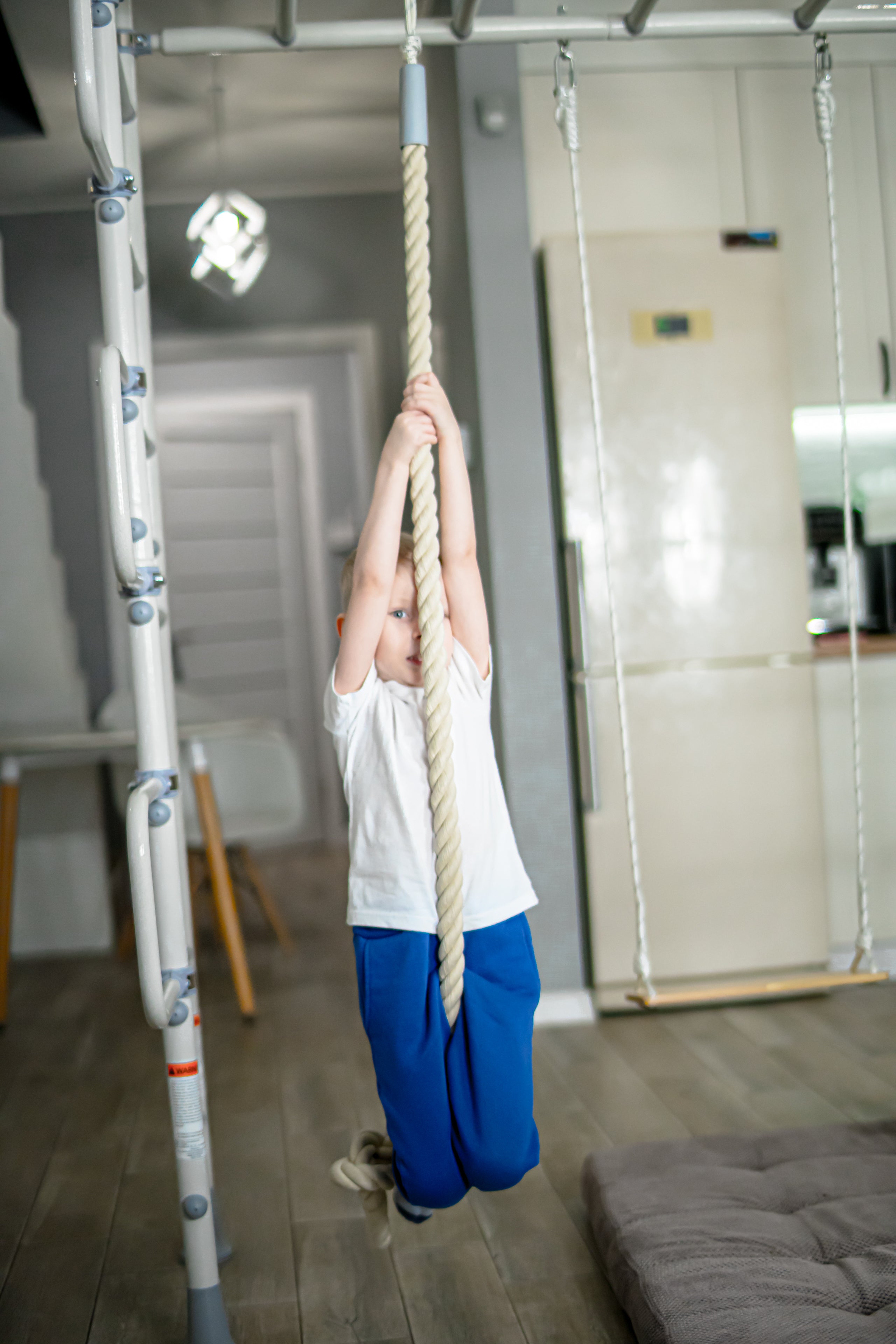
1. An equipment anchor your child uses daily. The single biggest difference between homeschool PE that happens and homeschool PE that fizzles is whether movement requires a car ride. A home climbing gym works as the anchor because it trains the systems PE exists to train—grip, balance, coordination, climbing strength—and because it's standing there at 8 a.m. in January, between math and reading, with no setup. Research links this kind of active, challenge-seeking play to physical activity, social behavior, creativity, and resilience, and we've written elsewhere about what a home climbing gym actually does for kids. It also earns its keep outside PE hours: the between-lessons energy reset is the unadvertised feature homeschool parents mention most.
2. An activity rotation. A rotation is just a repeating weekly menu—say, gym skills Monday, a walk-or-bike day Tuesday, games Wednesday, gym again Thursday, family sport Friday—that mixes your equipment with outdoor time and free play. (Indoor equipment doesn't replace the outdoors; it covers the hours and months the outdoors can't.) We've done the menu-writing for you: 40 homeschool PE ideas and activities by age, organized by age band and by indoor/outdoor, with skill progressions built in. Add our heavy work activities for regulation-focused days.
3. A log. Ten seconds a day: date, activity, minutes. It converts "we played a lot" into a record that satisfies the strictest state and shows you the skill curve. Our homeschool PE log guide includes a sample layout and the weekly system.
One more thing, said plainly: we're building a movement-first homeschool PE program of our own—structured progressions on and around a home gym, designed for ages 3+. It isn't ready yet, and this comparison will stay neutral when it is. If you want to hear when it launches, the fastest way is to be on our list.
– THE BRAINRICH KIDS TEAM
If the build-your-own path fits your family, the equipment anchor is the one decision with a price tag. These are ours:


Worth knowing before you budget: in a growing number of states, ESA education funds can cover PE curriculum and equipment, and HSA/FSA rules cover some purchases with a medical basis. We keep the full money map current in our homeschool grants and funding guide.
Which gym fits your family? Take the 60-Second Quiz →
Frequently asked questions
What is the best homeschool PE curriculum? There's no single winner—it depends on what you're missing. Family Time Fitness is the most complete packaged program; Horizons PE suits families who want a Christian print curriculum; the Home School Family Fitness book is the budget pick; OPEN is the best free option. And a self-built program (daily-use equipment, an activity rotation, a log) is fully legitimate and often outlasts all of them, because it doesn't depend on anyone opening a binder.
Is there a free homeschool PE curriculum? Yes—OPEN (Online Physical Education Network) offers free, professionally written K–12 physical education lesson plans, including Active Home resources for families. It requires a free account and some translation from classroom language to living-room reality.
Do homeschoolers legally need a PE curriculum? No state requires a purchased curriculum. Some states (Pennsylvania and New York, for example) require physical education as a subject, which you can satisfy with any planned, documented program of activity. Check your state on HSLDA and see our PE log and requirements guide for the details.
How much PE should a homeschooled child do? Federal activity guidelines recommend at least 60 minutes of moderate-to-vigorous activity daily for ages 6–17 (with muscle- and bone-strengthening activity at least 3 days a week), and about 3 hours of active play across the day for ages 3–5. Spread through a homeschool day—morning movement, between-lesson breaks, an afternoon block—it's a very reachable number.
Can a home climbing gym count as PE? Yes. Climbing, hanging, swinging, and monkey bars are muscle- and bone-strengthening activity in exactly the sense the federal guidelines use, and a structured progression on home equipment is a program of physical education. Log the minutes and the skills; that's what documentation means in every state we've reviewed.
Can I pay for PE curriculum or equipment with ESA funds? In many ESA states, yes—physical education curriculum and equipment are eligible education expenses, though each state's approved-item list differs. Our funding guide covers the state programs and how to check yours.
📚 Keep reading in the Decision Guide
Homeschool PE at Home: The Complete Guide · 40 Homeschool PE Ideas by Age · The Homeschool PE Log · The Homeschool Hub
Sources
U.S. Department of Health and Human Services. Physical activity guidelines for children (CDC overview). · National Home Education Research Institute. How many homeschool students are there in the United States? · Home School Legal Defense Association. Homeschool laws by state. · Family Time Fitness. Fitness 4 Homeschool physical education curriculum. · Alpha Omega Publications. Horizons PE homeschool curriculum. · Whitney, B. Home School Family Fitness: The Complete Physical Education Curriculum for Grades K–12. · OPEN / Varsity University. OPEN physical education curriculum. · YMCA of the North. YMCA homeschool physical education program. · Brussoni, M. et al. (2015). What is the relationship between risky outdoor play and health in children? A systematic review. Int. Journal of Environmental Research and Public Health.
Share: