

Published September 2026 · 9-minute read · by Yegor Nadvornyy, founder of Brainrich Kids
A ladder is the first climbing equipment most children ever meet and the last one they outgrow, and almost nobody thinks about which kind to buy. There are three: the rigid ladder that builds strength, the rope ladder that builds balance, and the curved ladder that turns a climb into a route. Each one trains something different, arrives at a different age, and, on a home play gym, becomes a different piece of the structure. Here is how to choose, with the anatomy of how a ladder holds a child up in the first place.
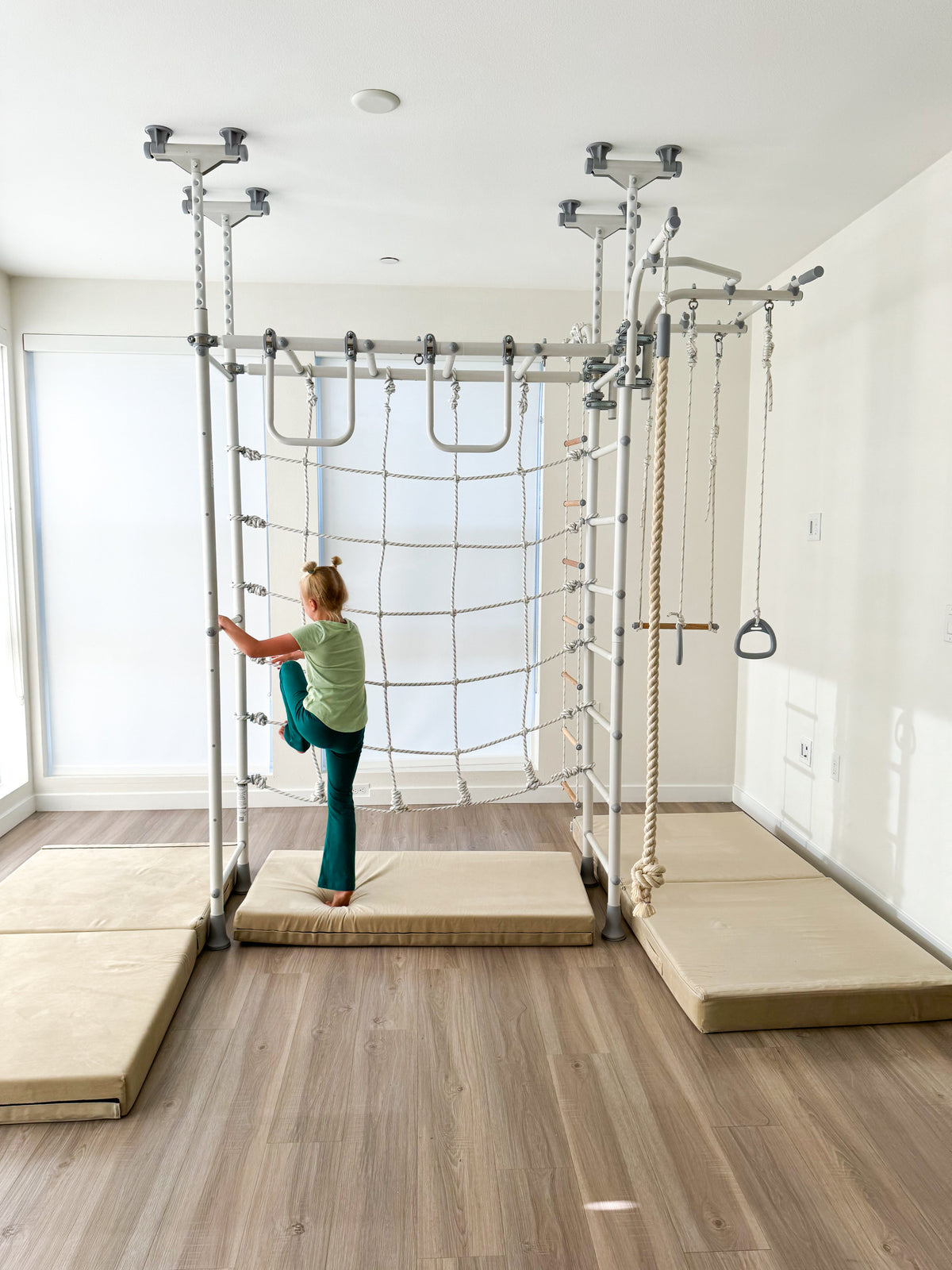
The quick answer: a rigid ladder (steel or wood rungs on fixed rails) is the backbone of any climbing gym: it trains strength and the up-and-down mechanics, and it is what a 3-year-old learns to climb first. A rope ladder hangs free and wobbles on purpose; it trains balance, grip, and motor planning, which is why occupational therapists like it, and it suits kids from about 4 who already climb a rigid ladder well. A curved ladder bends away from the frame so the climb becomes an overhang, the favorite add-on from 5 up. On a floor-to-ceiling gym the rigid ladders are the structure itself: three sections each, braced to the ceiling by a telescopic pole, rated (ours) for 220 lb working load and tested to 440. Buy the rigid ladder as the frame and add the rope and curved ladders as the child grows.
Jump to: Best rope ladder · The three kinds · How a gym ladder holds · By age · Teaching the descent · What to look for · FAQ
Best rope ladder for kids: how to pick one
The best rope ladder for kids is the one that hangs from something already rated to hold a climbing child, has flat rungs that don't spin, and ends just above a mat. Where it will hang decides most of the rest:
| Where it hangs | Best pick | Why | Watch for |
|---|---|---|---|
| An indoor play gym | A rope ladder made for that frame, such as the Brainrich Rope Ladder ($37) on any Brainrich gym | Hangs from a steel crossbar already rated for a climbing child, and comes down in seconds | A mat under the full swing of the ladder |
| A backyard playset | The rope ladder sold for that playset, with the maker's hardware | The beam and hardware were designed together | Rot, rust, and frayed rope every spring |
| A tree or treehouse | A rope ladder with wide flat rungs, kept low | Real outdoor fun when the branch is sound | Branch strength and height: keep the top within the height your child can climb down alone |
| A doorway pull-up bar | Only an accessory the bar's maker approves | Fine for hanging; many doorway bars are not built for a swinging load | The door frame and the bar's stated limit |
| Two or more kids at once | A cargo net instead of a ladder | More holds and room for a sibling | Opening sizes (below) |
Checklist for any kids' rope ladder
✓ Flat, fixed rungs wide enough for both feet, that don't roll under a foot.
✓ Rope thick enough for small hands to wrap around, with no fraying at the knots.
✓ No head-sized gaps. The CPSC treats openings between about 3.5 and 9 inches as a head entrapment risk, so check the space between rungs and around the top fixing.
✓ No loose loops. Keep the free end short, with no slack a child could get tangled in.
✓ A rated top fixing: a play gym crossbar, a playset beam, or a sound branch. Never a curtain rod, a closet rail, or a hook in drywall.
Most children are ready for a rope ladder at about 4, once they climb a rigid ladder with alternating feet and come down feet first on their own. The rest of this guide explains why the rope ladder is the one occupational therapists like, and how it fits with the rigid and curved ladders.
The three kinds of children's climbing ladder
| Ladder | What it trains | Age it arrives | On a Brainrich gym |
|---|---|---|---|
| Rigid ladder | Leg and arm strength, alternating-foot rhythm, the descent | 3, the first climb on a rated frame | The frame itself: every model's vertical ladders, rubber-coated rungs |
| Rope ladder | Balance, grip, motor planning; the body must correct every step | About 4, once the rigid ladder is easy | Rope Ladder add-on, hangs from the crossbar |
| Curved ladder | Overhang climbing, core and grip, route-finding | 5 and up | Curved Ladder add-on, bundled with a classic swing |
The rigid ladder is not optional; it is what the other two hang from. The rope ladder is the piece therapists reach for, because a wobbly climb forces constant small corrections that a rigid climb does not, and those corrections are motor planning in its purest form. The curved ladder is pure challenge: the same rungs, tilted past vertical, so the child climbs an overhang and the route becomes the game.
How a gym ladder actually holds a child up
On a floor-to-ceiling gym, each vertical ladder is three parts: a bottom section, a middle section, and a telescopic pole at the top that braces against the ceiling. Tighten the pole and the ladder is pinned between floor and ceiling with no drilling; the rigidity comes from compression, not fasteners in your drywall. Height versions change only the bottom section (a short version has one fewer rung for basements), the middle section is identical across versions, and an extension ladder inserts between bottom and middle to add about 21 inches for tall rooms. Two ladders joined by crossbars are a monkey-bar frame; the crossbar is where rope ladders, rings, ropes, and swings hang. Ours are powder-coated steel with rubber-coated rungs small hands can grip, rated for a 220 lb working load and safety-tested to 440, which is the number a 12-year-old plus a friend will eventually test.
Ladders by age
- 1 to 2: not a ladder yet. Foam steps and a Pikler-style triangle, within a parent's arm's reach; the sequence is in climbing gyms for babies and toddlers.
- 3 to 4: the rigid ladder on a rated frame, with a parent in the room. Alternating feet on rungs and a feet-first descent are the two skills of the year.
- 4 to 5: the rope ladder arrives. Expect a week of frustration and then a new favorite; the wobble is the point.
- 5 to 7: the curved ladder and monkey-bar traverses. Climbing becomes routes: up the rigid, across the span, down the rope.
- 8 to 12: the ladders become the way to the pull-up bar and the start of every course. The full by-age map is in climbing toys by age.
Teaching the descent (the half of climbing nobody teaches)
Most ladder incidents are dismount incidents. Teach coming down as deliberately as going up: feet first, one rung at a time, look at the rung, not the floor. Practice from the second rung before the child ever climbs higher, and keep a mat under the ladder from day one. On a rope ladder, add one rule: both hands on the rails, not the rungs, on the way down. The confidence a child builds from a reliable descent is what lets a parent say yes to height, and the research on challenging climbing, summarized in our controlled risky play guide, is clear that the yes is worth building toward.
What to look for in any children's ladder
Rung spacing and surface
Spacing a 3-year-old can bridge; a rubber-coated or textured surface small hands grip, wet or dry.
A published load
Rigid ladders carry the whole frame's load; rope and curved ladders carry a swinging child. Ask for both numbers.
How it fixes to the room
Floor-to-ceiling bracing or wall studs. A freestanding ladder relies on base width and tips when a child leans.
A growth path
The rigid ladder you buy at 3 should accept the rope ladder at 4, the curved ladder at 5, and a monkey-bar span at any point.


Start with the ladder that holds everything else
Steel ladders braced floor to ceiling, rated 220 lb working and tested to 440, with rope and curved ladders that clip on as the child grows. No drilling, 30-day money-back guarantee.
Frequently asked questions
What is the best climbing ladder for kids? It depends on the job. A rigid ladder on a rated frame is the backbone and the first climb at age 3. A rope ladder adds balance and motor-planning work from about 4. A curved ladder adds overhang climbing from 5. Most families end up with all three on one gym, added in that order.
What age can a child climb a rope ladder? About 4, once the child climbs a rigid ladder with alternating feet and comes down feet first without prompting. The wobble is the training, so expect a frustrating first week and then a favorite. A mat underneath and a parent in the room, always.
Are rope ladders good for kids? Very. A rope ladder forces constant small corrections a rigid ladder does not, which trains balance, grip, and motor planning; occupational therapists use them for exactly that reason. They also fold away when not in use.
How does a floor-to-ceiling ladder stay up without drilling? Each ladder has a telescopic pole at the top that braces against the ceiling; tightening it pins the ladder between floor and ceiling by compression. The frame is as rigid as a wall-mounted one and comes down for a move.
What is a curved ladder for? Overhang climbing. The rungs tilt past vertical so the child climbs with the body hanging away from the frame, which loads the core and grip and turns a straight climb into a route. It suits kids from about 5 and is usually the second add-on after the rope ladder.
📚 Keep reading in the Decision Guide
Five Things About the Vertical Ladder · Best Climbing Toys by Age · The Indoor Jungle Gym Buyer's Guide · Swedish Ladder for Kids · Climbing Rope for Kids
Sources
Ayres, A.J. (1972). Sensory Integration and Learning Disorders. Western Psychological Services. · Hanscom, A. (2016). Balanced and Barefoot. New Harbinger. · CDC. Physical Activity Guidelines for Children and Adolescents. · Brainrich Kids engineering specification: ladder anatomy, height versions, and frame load (220 lb working, tested to 440 lb) per product documentation.
Share: