

Published September 2026 · 11-minute read · by Yegor Nadvornyy, founder of Brainrich Kids
"Sensory toy" has become a label that sells almost anything with a texture. Most lists of the best sensory toys are lists of things that are fun to squeeze, which is fine, and which is not what an occupational therapist means by the phrase. An OT means a tool that delivers a specific kind of input to a specific system: pressure to the joints, motion to the inner ear, texture to the skin. Sort toys that way and the list changes completely. Some of the best sensory toys are free. The most powerful ones are not toys at all. Here is the OT-informed version, by input, by budget, and by the child.
The quick answer: the best sensory toys are the ones that feed the two senses most parents have never heard of. Proprioceptive toys (anything that makes muscles and joints work: climbing, hanging, pushing, heavy things, chewing) are the great calmers and the hardest to overdo. Vestibular toys (swings, spinners, rockers) are the most powerful and need dosing. Tactile, oral, visual, and auditory toys are the supporting cast. For a sensory seeker, the highest-value "toy" in the house is a climbing frame with a swing, because it delivers the top two inputs on demand; for an easily overwhelmed child, it is an enclosing swing, a weighted item, and headphones. Fidgets and squishies are fine for hands and mouths; they do not regulate a whole nervous system.
Jump to: By input · By budget · By sensory profile · What to skip · FAQ
The best sensory toys, by the input they deliver
| Input | What it does | Toys that deliver it |
|---|---|---|
| Proprioceptive (muscles and joints) | Calms and organizes; nearly impossible to overdose | Climbing frames, rings, a rope, monkey bars, crash pads, weighted blankets and lap pads, resistance bands, a wheelbarrow of anything heavy, therapy putty |
| Vestibular (inner ear) | Slow linear motion calms; spinning alerts; dose with care | Sensory swings (pod, hammock, platform, classic seat), sit-and-spins, rocking boards, mini trampolines, balance beams |
| Tactile (skin) | Feeds touch seekers; desensitizes avoiders gradually | Kinetic sand, water beads, texture bins, play dough, body brushes (with OT guidance), tactile balls |
| Oral (mouth) | Organizing input through the jaw | Chewable necklaces and pencil toppers, crunchy and chewy snacks, straws and water bottles with resistance |
| Visual | Calming or captivating depending on the child | Liquid timers, bubble tubes, light tables, a tent that dims the room |
| Auditory | Protection for avoiders; rhythm for seekers | Noise-canceling headphones, white-noise machines, drums and shakers, music with a steady beat |
The first two rows do most of the work. That is not our opinion, it is the shape of every sensory diet an OT writes, going back to A. Jean Ayres's original sensory integration framework: proprioception and vestibular input are the heavy lifters of regulation, and the rest are supporting players. Our explainers on proprioception and vestibular input cover the why.
The best sensory toys by budget
Free
Couch-cushion crash mountains, wheelbarrow walks, carrying the groceries, a blanket burrito with a firm squeeze, a cardboard-box hideout, a laundry-basket "boat" pulled across the floor. These are the OT classics and they cost nothing; the full menu is in our heavy work guide.
Under $30
Therapy putty, a chewable necklace, a mini balance board, a body sock, a liquid timer, a classic wood swing seat ($27) for a family that already has somewhere to hang it. The swing seat is the single highest-value item under $30 in the category, because it turns any frame into a vestibular tool.
Under $100
Noise-canceling headphones, a weighted lap pad, a pod or hammock swing (which then needs a rated hanging point), gymnastic rings, a rope ladder, a climbing rope. Rings and rope are proprioceptive toys disguised as gym equipment; they deliver more input per minute than anything in a sensory catalog.
The frame
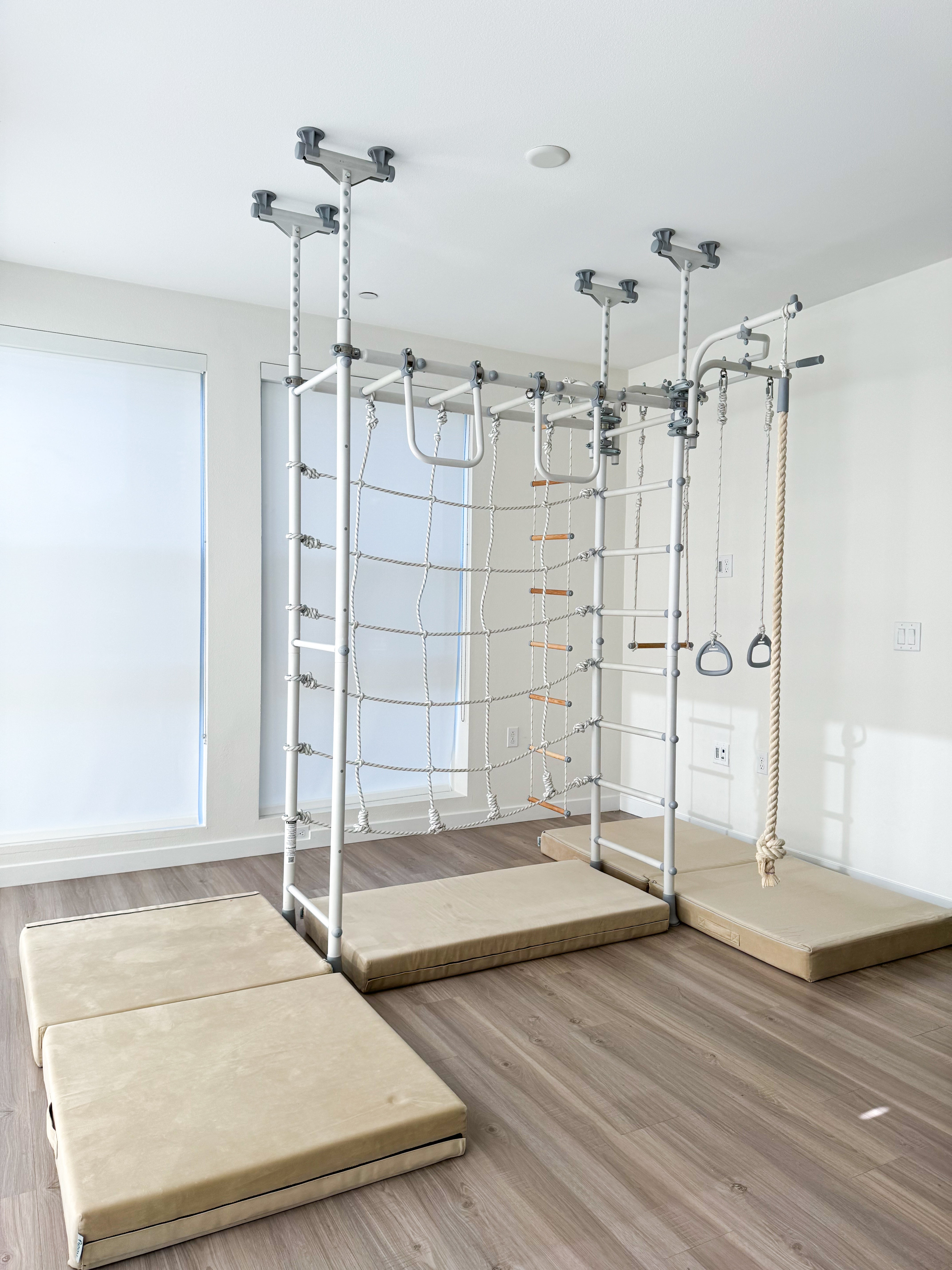
The one purchase that changes the category: a steel climbing frame with a swing point. It is the only "toy" that delivers proprioceptive input (climbing, hanging) and vestibular input (swinging) on demand, in every season, without a parent driving anywhere, and it holds a 220 lb working load (tested to 440) so it is still delivering at twelve. It is the anchor of our sensory gym equipment collection and the subject of building a sensory gym at home. For a child with a qualifying diagnosis, it may be HSA/FSA eligible with a Letter of Medical Necessity.
The best sensory toys by sensory profile
For sensory seekers
Big input, daily: a climbing frame, an open swing (disc, trapeze, classic seat), a crash pad, a mini trampoline, resistance putty, chewy snacks. Seekers chase intensity; the toy that lets them self-dose all day beats any single session. The full profile is in the sensory seeker guide.
For easily overwhelmed kids
Control and enclosure: a pod or cocoon swing moved slowly, a weighted blanket or lap pad, noise-canceling headphones, a tent or canopy, a liquid timer. Pressure is the input avoiders usually still welcome because it is predictable and self-dosed.
Most kids mix profiles, seeking movement while avoiding noise, so most homes end up with both shelves. For gift-giving by profile, the logistics (surprises, wrapping, duplicates) are in gifts for autistic kids who love to move.
What to skip (or at least not expect much from)
- Fidget fads. Pop-its and spinners occupy hands, which is a real and small job. They do not regulate a nervous system, and a bin of them is not a sensory diet.
- "Sensory" plastic that is just plastic. A texture on a toy does not make it therapeutic. Ask what input it delivers, to which system, and how much.
- Unrated swings on unrated hooks. The swing is only as safe as what it hangs from. Our autism swing guide covers mounting.
- Anything that replaces the OT. Toys support a plan; for a child who is struggling, the plan comes from an occupational therapist trained in sensory integration (the STAR Institute keeps directories). The sensory diet guide shows what the plan looks like at home.


The sensory toy that is not a toy
One steel frame delivering proprioceptive and vestibular input every day, in every season. No drilling, 30-day money-back guarantee.
Frequently asked questions
What is a sensory toy? A toy chosen for the sensory input it delivers rather than what it looks like: pressure and resistance for the muscles and joints (proprioceptive), motion for the inner ear (vestibular), or texture, sound, light, and oral input. Occupational therapists organize sensory toys by input and match them to a child's sensory profile.
What are the best sensory toys for autistic kids? It depends on the profile. Seekers usually do best with big-input toys: a climbing frame, open swings, crash pads, trampolines, chewy items. Easily overwhelmed kids do best with control-and-calm toys: enclosing swings, weighted items, noise-canceling headphones, tents. Many autistic kids mix profiles, so both kinds often belong in the same house.
What are good sensory toys for ADHD? Movement and heavy work before and during seated tasks: a swing or trampoline for a pre-homework burst, resistance putty or a chewable for hands and mouth at the table, a wobble cushion or balance board for the chair, and a climbing frame for the after-school reset.
What sensory toys are good for a 2 year old? Low, soft, and supervised: foam climbing blocks, a Pikler-style triangle, texture bins, water play, a low swing seat pushed gently by a parent, cushion crashes. Full-height frames wait for age 3.
Are fidget toys sensory toys? Technically yes, but they are the smallest category: they occupy hands and can help attention at a desk. They do not deliver the proprioceptive or vestibular input that regulates a whole nervous system, so they support a sensory plan rather than replace one.
📚 Keep reading in the Decision Guide
Sensory Seekers: The Signs and the Science · Sensory Diet 101 · Sensory Room Equipment List
Sources
Ayres, A.J. (1972). Sensory Integration and Learning Disorders. Western Psychological Services. · Wilbarger, P. (1984). Planning an adequate sensory diet. Zero to Three. · Kranowitz, C. (2005). The Out-of-Sync Child. Perigee. · STAR Institute for Sensory Processing. sensoryhealth.org. · Brainrich Kids engineering specification: frame working load 220 lb, safety-tested to 440 lb.
Share: