

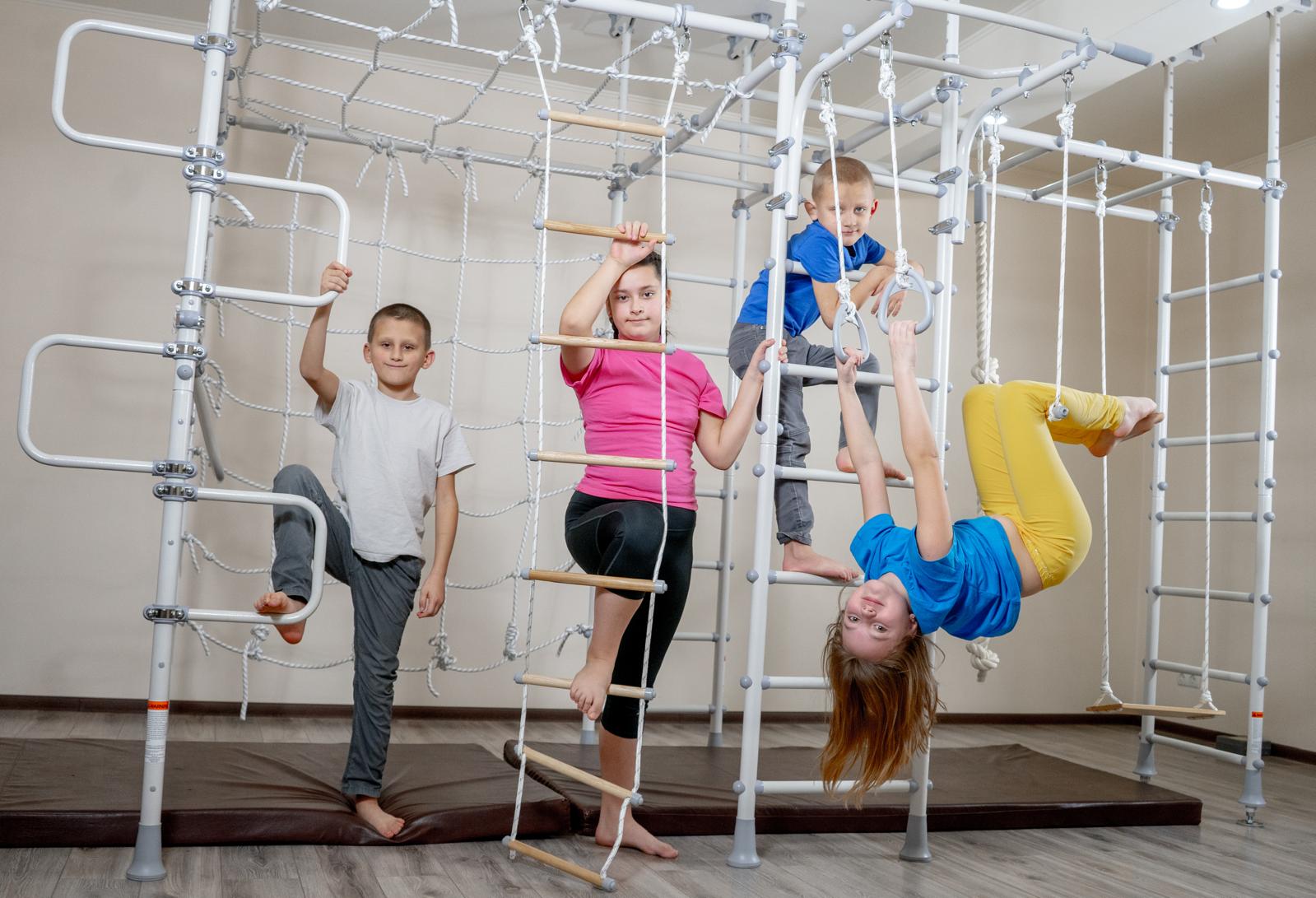
Published September 2026 · 10-minute read · by Yegor Nadvornyy, founder of Brainrich Kids
Monkey bars are the one piece of playground equipment that never got replaced. Slides went plastic, swings got bucket seats, but the horizontal ladder your grandmother crossed is the same ladder your kid is staring at right now, working up the nerve. This guide covers what the bars do for a child's body, when kids cross, how to teach the traverse, rung spacing, yard versus house, why DIY fails, and safety.
The quick answer: monkey bars are a horizontal ladder a child crosses hand over hand, and the crossing itself (brachiation) works grip, forearm, shoulder girdle, core, and the timing between both sides of the body. Most kids hang from 3, swing from 4, and cross somewhere between 5 and 7. They need rungs at hand-reach spacing, a bar the child reaches from a ladder rung rather than a jump, a mat underneath, and a structure with a published load rating. On Brainrich gyms, monkey bars are built into the Spider V3 and Spider Max V3; families who already own a Brainrich frame add the Monkey Bars V3 set.
Jump to: Benefits · By age · How to teach the traverse · Rung spacing and height · Playground, dome, backyard, indoor · Why DIY fails · Safety · The Brainrich answer · FAQ
What monkey bars do for a child's body
The human shoulder still carries the anatomy for brachiation: a shallow socket, a collarbone that lets the arm swing overhead, a grip built to hold body weight. Here is what physiology and research associate with regular hanging and traversing:
💪 Grip and forearm strength
Hanging is a full-body-weight grip hold. A 2011 Acta Paediatrica study of English 10-year-olds found handgrip and bent-arm hang scores had fallen over a decade even as BMI stayed flat.
🦾 Shoulder development
A straight-arm hang loads the shoulder through its full overhead range and trains the small stabilizers around the shoulder blade. That stability shows up later in handwriting posture and throwing.
🔁 Bilateral coordination
The traverse is a timed alternation: one hand reaches while the other holds and the body swings. That cross-body rhythm is associated with the coordination kids use in reading and writing. See our article on the brachiation ladder and the Doman method.
🧠 Proprioception and confidence
Pulling body weight through the arms is heavy work, the deep-pressure input occupational therapists associate with calmer, more organized kids. The sensory case is in indoor monkey bars are sensory equipment.
The CDC's physical activity guidelines ask for muscle-strengthening activity on at least 3 days a week for children 6 to 17 and name climbing and playground equipment as examples. Monkey bars are the one strength activity a child will do without being asked.
Monkey bars by age: when do kids cross?
This is not a milestone question. It is a strength-to-weight question, which is why a lean 4-year-old sometimes crosses before a sturdy 6-year-old.
- Monkey bars for 3-year-olds: hanging. Both hands on the first rung, feet a few inches off the mat, a few seconds, drop, land. Parent within reach.
- Monkey bars for 4-year-olds: longer hangs, swinging the body under the bar, and the first assisted traverses with a parent's hands at the hips.
- Monkey bars for 5-year-olds: the traverse arrives for many, usually in a single week after months of hanging. The missing piece was the one-handed hold; once that is strong enough, the rest is timing.
- 6 to 7: crossing is typical, and kids who have not crossed almost always do in this window once they have daily access to a bar. Weekly playground time alone can add a year.
- 8 to 12: skipping rungs, crossing backward, and the same bars becoming pull-up bars. The pull-up progression lives here.
If your 6-year-old cannot cross yet, the answer is more hanging, not more pushing. A child who hangs for 20 seconds can cross. A child who hangs for 5 cannot, however much they want to.
How to teach the traverse in four steps
- Hang. Both hands on the first rung, thumbs wrapped, body straight, feet off the ground. The goal is 20 seconds; start wherever the child is, even 2. Bar at a height the child reaches from a ladder rung, not a jump.
- Swing. Same hang, now with a gentle front-to-back swing from the hips. Let them drop and land on the mat with bent knees; landing is a skill too.
- One-bar reach. Hang from rung one, swing, and at the top of the forward swing let one hand go and catch rung two. This stage takes longest because it builds the one-handed hold. A parent's hands go lightly at the hips, never under the feet.
- Alternating. Rung one with both hands, rung two with the right, rung three with the left, and keep going. Reach at the top of the swing, never at the bottom.
Two things speed this up: rubber-coated rungs, far easier for small hands than bare steel or wood, and daily access. The child who lives with a bar hangs on it on the way to breakfast, and that is the difference between crossing at 5 and crossing at 7.
Rung spacing and bar height
Spacing. The next rung has to be reachable at the top of a swing by the hand that is letting go. On children's sets that is typically 9 to 12 inches center to center; full-size public playground ladders run wider, which is one reason a 5-year-old crosses at home months before crossing at the park. Diameter matters as much: roughly 1 to 1.25 inches, rubber-coated.
Height. For public playgrounds, the CPSC handbook caps horizontal ladders at 60 inches for preschool-age children and 84 inches for school-age, and does not recommend upper-body equipment for children under 4 at all. At home the rule is simpler: the child reaches the first rung from a ladder rung, with feet clearing the mat by a few inches when hanging.
Playground, dome, backyard, bedroom: the types of monkey bars
Playground monkey bars. The classic horizontal ladder between two platforms, built to ASTM F1487 for public use, over 12 inches of wood chips or rubber. Great for the crossing itself, poor for the daily reps that make crossing possible.
Dome monkey bars. The geodesic climber, a half-sphere of bars. Holds at every height suit 3-to-6-year-olds. Backyard only; residential load ratings vary enormously.
Backyard monkey bars. Two posts or towers with a ladder between, in galvanized steel or treated lumber, often part of a swing set. They need post holes, level ground, and an impact surface matched to the fall height under ASTM F1148, the home playground standard.
Home and bedroom monkey bars (indoor). The span runs between two vertical ladders braced floor to ceiling, or hangs from a wall-mounted frame, reached from ladder rungs, over a mat, in the room the child lives in. What a "set" actually includes is in our monkey bar sets for home guide.
| Indoor monkey bars | Backyard monkey bars | |
|---|---|---|
| Days per year in use | 365: rain, January, 95 degrees, 7 a.m., after dark | Weather-dependent; 150 to 250 usable days in most US climates |
| Height and drop | Ceiling-limited; feet a few inches off a mat when hanging | Taller; bigger drop, needs a deep impact surface |
| Load rating | Brainrich: 220 lb working, safety-tested to 440 lb | Varies widely; ask for the number |
| Installation and moving | An afternoon, no drilling on tension-mounted frames; comes with you | Post holes and concrete, a weekend; stays with the house |
We are not anti-backyard. The indoor set answers a different question: what does the child do on the days the yard is not an option, and how do they get the daily reps that turn hanging into crossing?
Indoor monkey bars DIY: why the homemade version fails the load test
A DIY span looks like a weekend project: two 2x6 rails, a row of wooden dowels or galvanized pipe, lag bolts into ceiling joists. The problem is the physics of a child on a bar.
A swinging, reaching child puts a peak load of two to three times body weight on one hand, and a 60 lb child racing a 70 lb sibling generates forces hardware-store joist hangers were never rated for. Joists sit 16 or 24 inches apart, which rarely matches where the rails want to be, so one rail ends up in drywall. Dowels a child can grip split without warning after a few seasons of dry indoor air. Pipe fittings loosen under the twisting a traverse applies. And no DIY span has a published working load, so nobody knows the margin until it is gone. Under the risk-versus-hazard rule of controlled risky play, a bar that might fail is the one thing a child cannot assess.
The engineered answer: a steel span on two supports that go floor to ceiling or into studs, with a 220 lb working load and a safety test to double that. Not because a child weighs 220 lb, but because two children plus momentum do.
Monkey bar safety at home
In CPSC playground surveillance, climbing equipment is associated with more injuries than any other category, and falls to the surface are the leading mechanism. That is the whole brief: the bar rarely hurts anyone. The landing does.
| Do | Skip |
|---|---|
| A firm impact mat under the entire span. ASTM F1148 ties surfacing to fall height; indoors, feet a few inches off the mat keeps that number small. | Blankets, pillows, or a rug. Loose fabric slides, and carpet alone does not absorb a drop. |
| Set the bar so the child reaches it from a ladder rung, and raise it as they grow. | Lifting the child to a bar they cannot reach. A boosted child is at a height their skill did not earn. |
| One child on the span at a time under 6; hands on the rungs only. | Walking on top of the bars, which turns a 3-inch drop into a 5-foot one. |
| Stay in the same room. Independent use from 3, parent present, especially through the one-bar-reach stage. | Narrating "be careful" on every reach. It breaks concentration at the moment of the catch. |
| Check hardware monthly; on tension-mounted frames, re-check ceiling pressure after any move. | Drawstrings, necklaces, and helmets on the bars. Anything that can catch on a rung comes off first. |
One design note: Brainrich gyms have no slide, because on a frame that reaches the ceiling a slide would create a fall height the ASTM F1148 surfacing logic is built to avoid.
The Brainrich answer: monkey bars come built into the gym
Monkey bars are not a product on their own; a span needs two supports. So we build the bars into the frame. The Spider V3 comes with the monkey bars built in: two floor-to-ceiling steel ladders, the span between them, a climbing net, a rope, and rings, every bar adjustable, the whole frame rated for a 220 lb working load and safety-tested to 440 lb. The Spider Max V3 adds a second net for siblings. Families who already own a Model T3 or another Brainrich frame add the Monkey Bars V3 set, which supplies one more ladder plus the span and uses the existing frame as the other support. It is an add-on for owners, not a first purchase.


Monkey bars that are on the way to breakfast
220 lb working load tested to 440, no drilling, 30-day money-back guarantee.
Frequently asked questions
What age can kids do monkey bars? Kids hang from the first rung at about 3 with a parent within reach, swing from the bar at 4, and cross hand over hand somewhere between 5 and 7. The range is wide because crossing depends on strength relative to body weight, not age.
What are the benefits of monkey bars for kids? Hanging and traversing are associated with grip and forearm strength, shoulder stability, upper-body and core strength, bilateral coordination, and the deep-pressure proprioceptive input occupational therapists use to help kids feel organized.
How do I teach my child to cross the monkey bars? In four stages: hang from one rung for up to 20 seconds, add a front-to-back swing, reach one rung forward at the top of the swing and catch it with both hands, then alternate hands rung by rung. Support at the hips if needed, never under the feet, and keep the bar at a height the child reaches from a ladder rung.
How far apart should monkey bar rungs be? On children's sets, typically 9 to 12 inches center to center, with a rung diameter of about 1 to 1.25 inches so small fingers can close around it. Public playground ladders are spaced wider, which is why kids often cross at home before they cross at the park.
Are indoor monkey bars safe? Yes, on a frame with a published load rating, rigid floor-to-ceiling or stud-mounted bracing, rubber-coated rungs, and a firm impact mat under the whole span, with independent use from age 3 and a parent in the same room. Brainrich frames carry a 220 lb working load and are safety-tested to 440 lb.
Can I build indoor monkey bars myself? You can, but a DIY span has no published working load, and a swinging child puts two to three times body weight on one hand. An engineered steel span with a tested rating removes the one hazard a child cannot assess for themselves.
📚 Keep reading in the Decision Guide
Monkey Bar Sets for Home · Indoor Monkey Bars Are Sensory Equipment · Pull-Up Bar Gymnastics for Kids · The Brachiation Ladder and the Doman Method
The set itself: the Brainrich monkey bars set is the extension that turns a Model T3 into a Spider V3, in three ceiling sizes.
New: comparing a geodesic climber to a vertical gym? Read Climbing Dome for Kids vs Indoor Climbing Gym, with sizes, weight ratings and the age-out curve.
New: buying for a 2-to-4-year-old? Read Safest Monkey Bars for Toddlers first.
New: short on floor space? See Monkey Bars That Fit a Compact Space.
New: want monkey bars and a swing in one footprint? See Monkey Bars With Swings.
Start here: Monkey Bars: The Complete Guide maps every type, a bar-height chart by age, the safety standards, and cost ranges.
Sources
U.S. Consumer Product Safety Commission. Public Playground Safety Handbook (Publication 325). · ASTM International. ASTM F1148, Standard Consumer Safety Performance Specification for Home Playground Equipment; ASTM F1487, Standard Consumer Safety Performance Specification for Playground Equipment for Public Use. · CDC. Physical Activity Guidelines for Children and Adolescents. · Cohen, D.D. et al. (2011). Ten-year secular changes in muscular fitness in English children. Acta Paediatrica. · Brainrich Kids engineering specification: frame working load 220 lb, safety-tested to 440 lb; V3 span length and rung count per product documentation.
Share: