

Updated August 2026 · 11-minute read · by the Brainrich Kids team · Canadian edition, prices in CAD
Every parent knows the scene: a playroom full to the ceiling, and a child in the middle of it announcing there is nothing to do. The problem is almost never the number of toys. It is the kind. Most modern toys do one thing, loudly, and then they are finished. The toys that hold a child for years are the opposite: they do nothing at all until the child brings an idea. Researchers call these open-ended toys, and this is our full list of the ones worth owning, age band by age band.
The quick answer: an open-ended toy has no single right way to use it: blocks, magnetic tiles, play silks, loose parts, art materials, and climbing equipment all qualify, because the child supplies the game. The filter we use is the ten-ways test: before a toy earns shelf space, ask whether your child could plausibly invent ten different ways to play with it. Research backs the approach: a 2018 study by Dauch and colleagues found toddlers given just 4 toys played longer and more inventively with each one than toddlers given 16, and Eastern Connecticut State University's TIMPANI study repeatedly finds that the toys inspiring the most creativity are the flexible, open-ended ones. Below: 20 toy types across four age bands, and the one piece of equipment that passes the ten-ways test more easily than anything else in the house.
Ordering from Canada: Brainrich prices on this page are in Canadian dollars. Every gym component is stocked in our Vancouver, BC warehouse, so your order ships from inside Canada: no duties, no customs paperwork, no cross-border delays. GST/HST is calculated at checkout.
Jump to: The ten-ways test · Why single-outcome toys stall · Ages 1–2 · Ages 3–4 · Ages 5–7 · Ages 8+ · The biggest open-ended toy · FAQ
The ten-ways test: a thirty-second filter for any toy
Here is the entire method. Pick up any toy, in a store or in your own bin, and ask: could my child invent ten genuinely different ways to play with this? A talking robot fails in seconds: it does its routine, the child watches, done. A bin of plain wooden blocks passes before you finish counting: tower, road, castle, phone, sandwich, balance beam for figurines, domino run, cargo for the truck, treasure to bury, drum. The test works because it measures the only thing that matters for longevity: how much of the play comes from the child versus the toy.
One housekeeping note before the list. If you want the full system for organizing these toys, the shelf setup, the toy-rotation schedule, and the playroom design that makes open-ended play the default, that lives in our ultimate open-ended playroom guide. This article is the other half of the equation: the actual shopping list, what to put on those shelves at every age.
Why single-outcome toys stall: what the research found
The case for open-ended toys is not just aesthetic preference. Two lines of research make it concrete.
First, quantity. In a 2018 study in Infant Behavior and Development, Dauch and colleagues observed toddlers playing in a room with either 4 toys or 16 toys. The toddlers with 4 toys played with each toy longer and in a greater variety of ways; the toddlers with 16 flitted. The researchers' conclusion was that fewer toys encourage deeper, more creative engagement, which is exactly the behaviour open-ended play is made of. The practical translation: a small set of flexible toys beats a large set of single-outcome ones, and the rotation system in our playroom guide exists precisely to keep the visible set small.
Second, quality. Eastern Connecticut State University's TIMPANI toy study (Toys that Inspire Mindful Play And Nurture Imagination) has scored toys yearly by observing how preschoolers actually use them. The researchers report that the toys inspiring the most creative, sustained, sophisticated play did not suggest one way to play: they were open-ended and flexible, with plain hardwood blocks as the canonical example, becoming houses, castles, roads, phones, vehicles, and food in a single session. The toys with a single scripted outcome consistently produced shorter, shallower play.
Put the two findings together and you get the rule this whole list is built on: buy fewer toys, and make each one answer to the ten-ways test. A child with six flexible toys has more to do than a child with sixty scripted ones.
Ages 1–2: hands, gravity, and cause-and-effect
Toddlers are running one grand experiment: what does the world do when I act on it? The best toys at this age are simple, sturdy, and consequence-rich.
| Toy type | What it builds |
|---|---|
| 1. Stacking cups | Seriation, hand control, and the physics of towers falling down. Doubles as bath toy, scoop, hat, and hiding spot for treasures. |
| 2. Chunky wooden blocks | Grasp, balance, early spatial reasoning. The toy your child will still be using at 7, which no electronic toy can claim. |
| 3. Balls in several sizes | Rolling, throwing, chasing, tracking: gross motor development plus the first physics lessons in trajectory and bounce. |
| 4. Play silks and scarves | Peekaboo prop, cape, river, roof, baby-doll blanket. The lightest toy in the house and among the most transformed. |
| 5. Containers and posting boxes | In, out, open, shut, dump, refill: the work toddlers assign themselves. Fine motor control and object permanence, no batteries. |
Ages 3–4: the pretend explosion
Around three, symbolic play arrives: a block becomes a phone, a chair becomes a ship. Feed it with props that suggest worlds without scripting them.
| Toy type | What it builds |
|---|---|
| 6. Magnetic tiles | Spatial reasoning and engineering intuition, with a lower frustration floor than blocks: the click is forgiving, so ambition scales fast. |
| 7. Play kitchen props | Pots, spoons, and pretend food power role-play: cooking, serving, running a restaurant. Language, sequencing, and social scripts. |
| 8. Dress-up pieces | Capes, hats, and doctor kits let a child try on identities. Perspective-taking and confidence, one character at a time. |
| 9. Playdough and clay | Infinite outcomes by definition. Hand strength for future pencil grip, plus calm, absorbed sensory work on loud days. |
| 10. Animal and people figurines | The cast for every small world. Narrative building, empathy rehearsal, and endless crossover episodes with the blocks and tiles. |
| 11. Cardboard boxes | Still the champion price-to-play ratio in existence: house, rocket, tunnel, robot suit, puppet theatre. Recycle when the story ends. |
Ages 5–7: builders and world-makers
School-age kids can hold a plan in their head across days. The best toys now are systems: materials with enough depth to carry a project from idea to finished thing.
| Toy type | What it builds |
|---|---|
| 12. Open brick bins | Interlocking bricks as loose bulk rather than boxed sets: the sets script one build, the bin scripts none. Planning, iteration, patience. |
| 13. Building planks | Identical flat planks, no connectors: every structure is pure balance and physics. Failure teaches instantly and painlessly. |
| 14. A real art cart | Paper, tape, scissors, markers, glue, stapler, recyclables. Not an art kit with one project inside: raw supply for a thousand. |
| 15. Loose parts collection | Buttons, shells, stones, corks, spools in a divided tray: sorting, trading, mosaic-making, potion ingredients, shop inventory. |
| 16. Small-world figures and vehicles | The pretend play of age 3 goes long-form: cities, farms, and rescue missions that persist on the floor for a week. |
Ages 8+: makers, not consumers
Open-ended play does not expire at eight; it graduates. The toys become tools, and the games become projects.
| Toy type | What it builds |
|---|---|
| 17. Maker materials | Cardboard, hot glue (supervised), rubber bands, string, dowels: the difference between watching contraption videos and building one. |
| 18. Advanced construction systems | Gears, motors, snap circuits, marble-run pieces in open combination. Mechanical reasoning that a finished kit never demands. |
| 19. Fort kit | Blankets, clips, rope, and clothespins in a labeled bin. The architecture phase of childhood deserves real materials. |
| 20. Board and dice games with house rules | Dice, cards, and tokens become raw material once kids start inventing their own rules: probability, negotiation, and game design. |
The biggest open-ended toy in the house
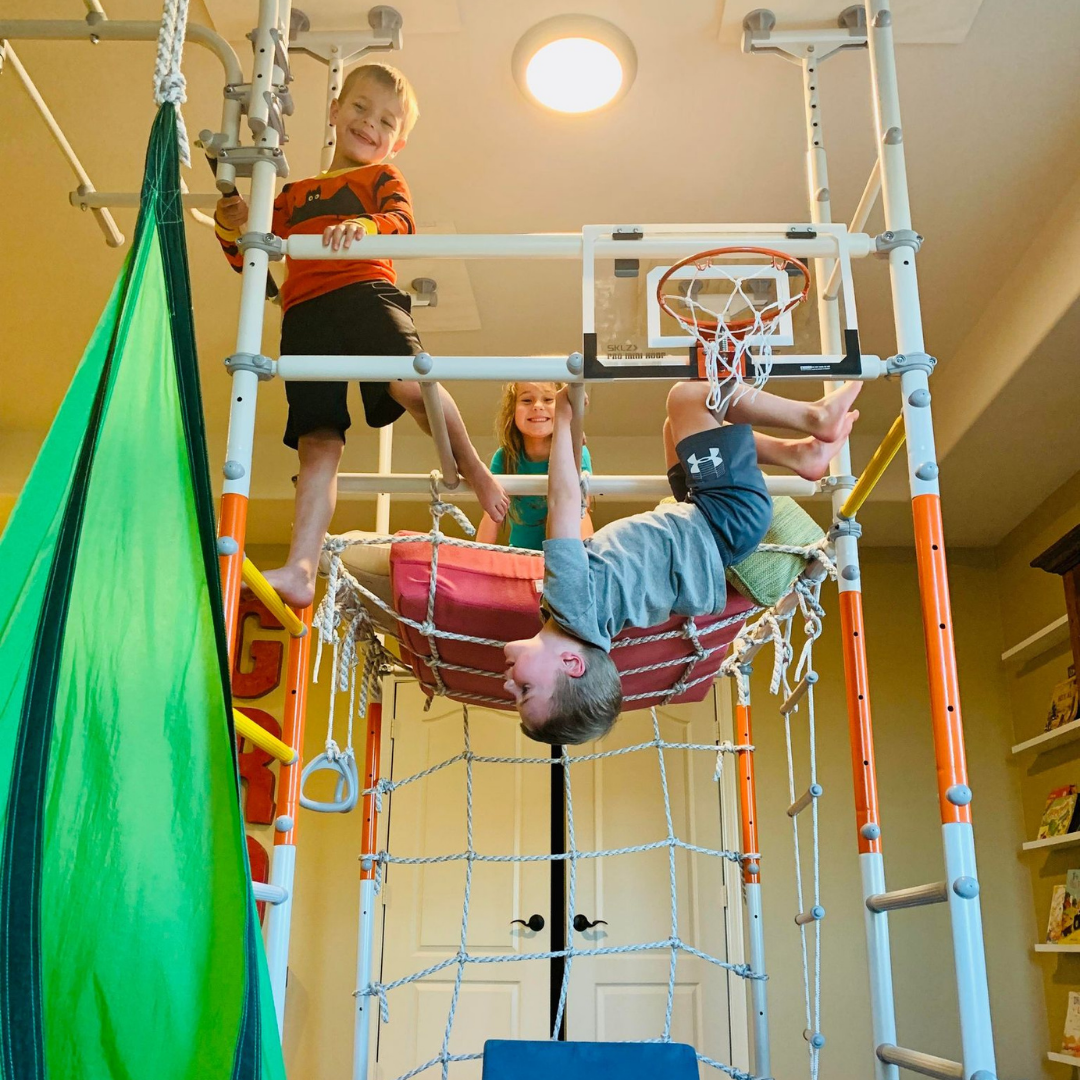
Now run the ten-ways test on the largest plaything a family can own. A tablet fails it. A branded playset mostly fails it. A climbing gym passes it before lunch on the first day: climb the net, cross the monkey bars, swing sitting, swing standing, hang upside down from the trapeze, ring like a gymnast, drape a blanket over the frame and it is a fort, then a pirate ship, then a stage, then a reading nook in the pod swing. That is ten without repeating a muscle group, and no child has ever stopped at ten.
The reason it works is the same reason blocks work: a frame is a structure without a script. Blocks are open-ended for the hands; a climbing gym is open-ended for the whole body, adding the physical development layer (grip, balance, coordination, confidence at height) that tabletop toys cannot reach. It is also the only toy on this page engineered like equipment: Brainrich frames are steel with a non-toxic powder coat and rubber-coated rungs, rated for 220 lb (100 kg) of active load and safety-tested to 440 lb (200 kg), sized for ages 3 and up, with adjustable bars so the challenge grows with the child. And because the accessories swap in minutes, the gym rotates like the rest of the toy shelf: swings one week, rings and trapeze the next, which keeps the ten ways feeling like fifty.
Which gym fits your family? Take the 60-Second Quiz →


Ready to add the biggest one to the shelf?
Every gym assembles in an afternoon and is covered by a 30-day money-back guarantee. No duties, no customs paperwork.
Frequently asked questions
What makes a toy open-ended? An open-ended toy has no single correct outcome: the child decides what it is and what happens next. Blocks, magnetic tiles, play silks, loose parts, art materials, figurines, and climbing equipment all qualify. The opposite is a single-outcome toy, one scripted routine (press the button, watch the routine), which children exhaust quickly because the toy is doing the playing.
What is the ten-ways test? A thirty-second filter before buying any toy: could your child plausibly invent ten genuinely different ways to play with it? Blocks and climbing frames pass easily; most electronic and character-scripted toys do not. It works because it measures how much of the play comes from the child rather than the toy, which is what predicts whether the toy lasts years or weeks.
Do kids really play better with fewer toys? That is what the research indicates. Dauch and colleagues (2018, Infant Behavior and Development) observed toddlers with either 4 or 16 toys available: the 4-toy group played with each toy longer and in more varied ways. Fewer, more flexible toys, kept fresh through rotation, consistently beat sheer quantity.
What is the best open-ended toy for a 1-2 year old? A set of chunky wooden blocks is the strongest single pick: it builds grasp, balance, and spatial reasoning now and remains in use for years. Stacking cups, balls in several sizes, play silks, and simple containers round out a complete toddler shelf, and none of them needs a battery.
Does climbing equipment count as an open-ended toy? It may be the clearest example in the house. A climbing gym passes the ten-ways test on day one (climb, swing, hang, invert, fort, ship, stage, obstacle course, reading nook, and on), and it adds what tabletop toys cannot: whole-body development, from grip strength and balance to confidence at height. Brainrich frames are steel, rated for 220 lb of active load and tested to 440 lb, for ages 3 and up, with swappable accessories that keep the play rotating.
📚 Keep reading
The Ultimate Open-Ended Playroom Guide · Design Your Own Play Gym: Layouts and Configurations for Every Space
Sources
Dauch, C., Imwalle, M., Ocasio, B. & Metz, A.E. (2018). The influence of the number of toys in the environment on toddlers' play. Infant Behavior and Development, 50, 78–87. · Trawick-Smith, J. et al., Center for Early Childhood Education, Eastern Connecticut State University. The TIMPANI Toy Study. · Brainrich Kids engineering specification: frame working load 220 lb, safety-tested to 440 lb.
Share: