

Updated August 2026 · 12-min read · by the Brainrich Kids team
Somewhere on Pinterest there is a homeschool room with a $400 teacher cart, custom wall decals, and a reading nook that looks rented for the photo. You do not need it. Children learned to read at kitchen tables for centuries, and the families we know with the best-used homeschool rooms usually spent the least on them, with one deliberate exception we will get to. Here is the whole budget conversation: what $100 buys, what $500 buys, what should never be bought new, and where the one splurge belongs.
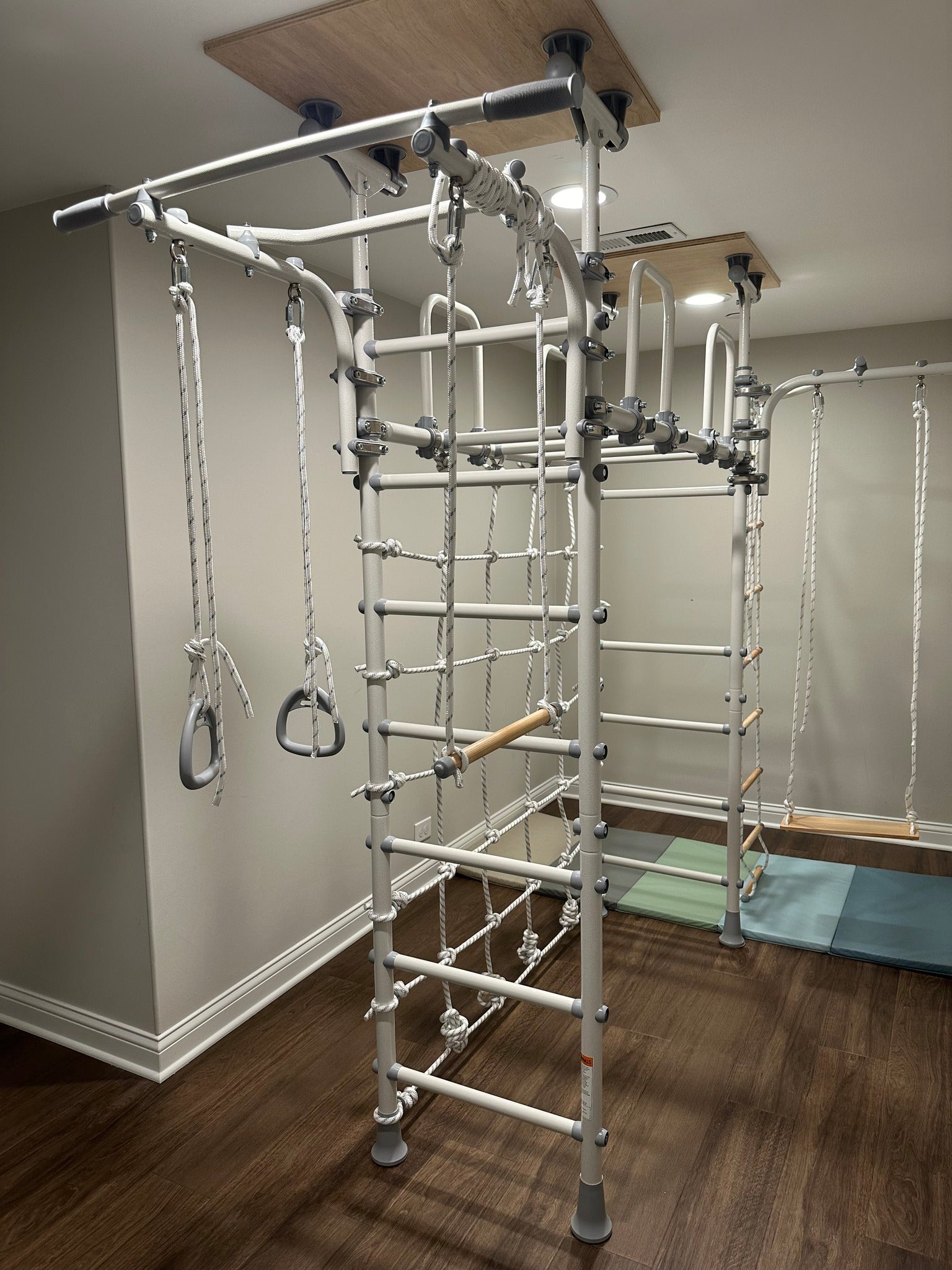
The quick answer: a homeschool room needs exactly four things: a work surface, storage kids can reach, good light, and a place to move. You can cover the first three for about $100 with thrift stores plus three IKEA workhorses (FLISAT, TROFAST, KALLAX), or do it with more comfort and years of headroom for $500. Books, desks, bookcases, and manipulatives should almost never be bought new. If you have one splurge in you, put it on the movement zone: a climbing gym gets used between every lesson, every day, for years, and outlasts five rotations of the toys it replaces.
Jump to: What a room actually needs · The $100 setup · The $500 setup · Never buy new · The one splurge · The free layer · FAQ
What a homeschool room actually needs (a short list)
Before any shopping list, the standard: our full homeschool room ideas guide makes the long case, but the short version is that a functioning room is four jobs, not a look. A surface where writing happens. Storage at child height, because a child who can reach the supplies can start work without you. Light, ideally a window, minimally a decent lamp. And a movement outlet, because the number one thing that derails a homeschool morning is not missing curriculum, it is a child whose body is done sitting. Every dollar below buys one of those four jobs. Anything that does not is decor, and decor can wait.
One more framing tip that saves money everywhere: zones beat furniture. A desk zone, a floor zone, a movement zone, marked out with a rug and some tape if need be. Our room setup checklist walks the zone system step by step, and it works identically in a $100 room and a $5,000 one.
The $100 setup
The rule at this budget: thrift the big things, spend the cash where small hands touch daily. Facebook Marketplace, Goodwill, and curb season will hand you tables, chairs, and bookcases for close to nothing, because adult furniture is the most oversupplied secondhand category in America. Then put your actual dollars into two or three IKEA pieces engineered for children. Prices below are US ikea.com list prices as of August 2026:
| Item | Where | Cost |
|---|---|---|
| FLISAT children's table (solid pine, cutouts fit TROFAST bins) | IKEA | $49.99 |
| KALLAX 2×2 shelf unit, sideways at child height | IKEA | ~$55 |
| Two solid chairs or a small bench | Thrift / Marketplace | $5–15 |
| Desk lamp + a doormat-size rug for the floor zone | Thrift | $10 |
| Pencils, paper, glue, a wall calendar | Dollar store | $15 |
| Total | ~$135, or ~$95 if the table is thrifted too |
Why these three IKEA names keep showing up in every homeschool room roundup: FLISAT is solid pine, sized for ages 3+, and its tabletop cutouts accept TROFAST bins, which turns the table itself into sensory and supply storage. TROFAST is the bin system your kids' co-op and their dentist's waiting room both use, because bins pull out, carry, and go back without adult help. KALLAX is the cheapest per-cubby storage in the store and works lying on its side as a bench-height bookcase little kids can actually reach. (Whatever shelving you choose, anchor it to the wall; IKEA includes the hardware for a reason.)
A timing note that stretches this budget further: thrift prices follow the school calendar. Late May and June, when families purge for summer, and late August, when dorm and classroom castoffs land, are the two gluts. If you can shop your $100 in those windows, the same list routinely comes in under $75, and the leftover money buys the year's glue sticks twice over.
If the room is tiny or shared, our small-space homeschooling guide shows how the same four zones fold into apartments and corners of living rooms.
The $500 setup
At $500 you are not buying different things, you are buying years of headroom and fewer daily frictions. The upgrades that earn their place:
| Item | Why it earns the money | Cost |
|---|---|---|
| FLISAT adjustable children's desk | Three heights and a tilting top: one desk from kindergarten through about 4th grade | $79.99 |
| TROFAST storage combination with boxes | The toy-rotation engine: opaque bins out of sight, one bin out at a time | $80–130 |
| KALLAX 2×4 + a few inserts | Curriculum, library haul, and one cubby per kid for "current work" | ~$90 |
| A genuinely good secondhand adult chair for you | You will sit beside a learner for a thousand hours; your back is infrastructure | $40–60 |
| Magnetic whiteboard, wall maps, a big rug, floor cushions | The floor zone becomes a real teaching station, not leftover carpet | $80–100 |
| Lamp upgrades + art supply restock | Warm light and full glue sticks: morale per dollar is unbeatable | $50 |
| Total | ~$420–510 |
Notice what is missing from both budgets: a teacher desk, a classroom-style pocket chart wall, matching furniture, and anything labeled "homeschool" at a homeschool markup. The room is for the learner. You are allowed to teach from the good chair with coffee.
What NOT to buy new (the secondhand goldmine list)
Some categories are so oversupplied secondhand that paying retail is close to charity. Every August, classroom teachers clear out; every June, families exit homeschooling and sell whole rooms at once. Set alerts on Marketplace and check your local homeschool group's swap thread before you buy any of these new:
📚 BOOKS & CURRICULUM
Used curriculum sites, co-op sales, and library discard sales run 50–90% off retail. Buy consumable workbooks new; buy everything else used.
🪑 DESKS, TABLES, BOOKCASES
The most oversupplied secondhand category there is. A $150 bookcase is a $20 bookcase with patience and a minivan.
🔢 MANIPULATIVES & GAMES
Base-ten blocks, Cuisenaire rods, puzzles, microscopes: families sell complete sets when kids age out. Sanitize and go.
🖼️ DECOR & WHITEBOARDS
Retiring teachers give away laminators, easels, and whiteboards by the carload every summer. Ask once in a local group and watch.
The exception cuts the other way, and it matters: anything that holds your child's weight should not be a mystery-history purchase. Chairs, sure. But climbing equipment, swings, and anything load-bearing is a category where you want known engineering, known weight ratings, all original hardware, and a warranty, because a bargain with a hairline crack is not a bargain. Which brings us to the splurge.
The one-splurge logic: put it on the movement zone
Here is the argument in one sentence: every other purchase in this article gets used during lessons, but the movement zone gets used between every lesson, every day, for years.
Toys churn. Anyone who has parented through a few birthdays knows the cycle: the hot toy arrives, dominates for six weeks, and joins the bin graveyard. Call it $100–200 per rotation, several rotations a year. A climbing gym breaks that cycle because it is not a toy with one trick, it is open-ended equipment that the child's own development keeps renewing: the 4-year-old's mountain becomes the 6-year-old's monkey-bar course and the 9-year-old's upside-down reading perch. Health authorities recommend a full 60 minutes of physical activity daily for school-age kids, and a homeschooled child has no recess bell to hand that hour to you. The gym is where that hour lives on a January morning, a rainy April, an August heat advisory.
There is also a homeschool-specific multiplier that pure playroom math misses. In a homeschool room, the gym is not an after-school toy, it is the pacing mechanism of the school day itself: the between-lesson body break that resets a wiggly learner in ten minutes, the recess that still happens during a January ice week or an August heat advisory. The thrifted desk holds the work; the gym makes the child able to sit at it. Ask any veteran homeschool parent which piece of furniture they would replace first if the house flooded, and it is rarely the desk.
Run the arithmetic on the entry-level gym: $899 over five years of daily use is about 49 cents a day. A $150 toy rotation that holds attention for six weeks costs about $3.57 a day. The gym is the cheaper item on the timescale that actually matters, and it holds resale value the bin graveyard never will.
That is why our advice to budget families has stayed the same for years: thrift the desk, thrift the bookcase, buy the bins at IKEA, and put the one real splurge on the thing that moves the body. If the budget will not stretch this year, funding help exists: ESAs in a growing number of states treat PE and play equipment as an allowable educational expense, HSA/FSA routes apply for some families with a qualifying letter, and our homeschool grants and funding guide maps every option state by state. Financing spreads the entry gym to $81.14/month, which is less than many families spend monthly on the toys it replaces.


Not sure which fits your room and budget? Take the 60-Second Quiz →
The free layer: printables and the library economy
The cheapest homeschool room upgrade is not furniture at all. It is remembering that a library card is a $0 subscription to the most expensive shelf in your room. Rotate 20–30 library books through a KALLAX cubby every few weeks and your book budget approaches zero while the shelf stays permanently novel. Most library systems add free museum passes, maker spaces, and printable-friendly resources on top.
The printable economy works the same way: free planning pages, phonics games, math drills, and unit studies cover most of what teacher-store laminated products sell. One warning from our own testing of lead magnets and printables: kids engage with printables that do something, checklists they mark off, trackers that fill in, challenges with levels, and ignore printables that are just blank forms. Print less, but print the kind with a game inside. Start with the free PE and movement printables in our Homeschool Hub, which were built on exactly that principle.
Frequently asked questions
What does a homeschool room actually need? Four things: a work surface, storage your child can reach without help, decent light, and a movement outlet. Everything else, themed decor included, is optional. A $100 thrift-and-IKEA setup that covers all four beats a $2,000 room that covers three.
What are the best IKEA pieces for a homeschool room? The three workhorses are the FLISAT children's table ($49.99, solid pine, tabletop cutouts fit TROFAST bins), the TROFAST bin system (child-height storage bins kids can pull out and put back themselves), and KALLAX shelving (cheapest per-cubby bookcase, usable on its side at child height). All three are current, verified US products as of August 2026. Anchor any shelving to the wall with the included hardware.
Can I really set up a homeschool room for $100? Yes, if you thrift the adult-scale furniture and spend cash only on child-scale pieces and supplies. Tables, chairs, bookcases, and lamps are the most oversupplied items on the secondhand market. Expect $95–135 all-in depending on how much you thrift.
What should I never buy new? Non-consumable curriculum, desks, tables, bookcases, math manipulatives, games, whiteboards, and decor: all flood the used market every June and August. The reverse rule applies to load-bearing equipment your child climbs or swings on, where known engineering, weight ratings, and a warranty are worth buying properly.
Is a climbing gym really worth it in a budget room? That is the one-splurge logic: the movement zone is the only part of the room used between every lesson, every day, in every season. At $899, the entry-level Model T3 works out to roughly 49 cents a day over five years, replaces several toy-rotation cycles a year, and is rated for independent climbing at ages 3+. Financing from $81.14/month and, in a growing number of states, ESA funds can cover it as PE equipment.
Where do the free printables fit? Use the library as your rotating bookshelf and print materials that gamify (checklists, trackers, challenge ladders) rather than blank record-keeping forms. Free printables plus a library card can replace hundreds of dollars of teacher-store spending in a typical year.
📚 Keep reading in the Decision Guide
Homeschool Room Ideas: 25 Spaces That Actually Get Used · Small-Space Homeschooling · Homeschool Room Setup: The Checklist · Homeschool Grants & Funding
Sources
IKEA US product pages, verified August 2026: FLISAT children's table · FLISAT adjustable desk · TROFAST storage combinations · KALLAX shelving. · CDC. Physical activity guidelines for children and adolescents (60 minutes daily).
Share: