

Updated August 2026 · 12-min read · by the Brainrich Kids team
Every ADHD homeschool schedule on the internet has the same flaw: it is a school schedule with the school crossed out. Forty-five minute subjects. One recess. A child who is expected to arrive at 8:30 and stay in the chair. If that worked for your child, you would not be reading this. Here is the schedule architecture that actually matches an ADHD brain: short lesson blocks alternated with short, physical body breaks, all day long, plus the two visual tools that make the switching painless.
The quick answer: alternate 15-25 minute lesson blocks with 10-minute body breaks, and treat the breaks as part of the curriculum, not a reward. Research associates even a single 20-minute bout of exercise with better attention and task accuracy in children with ADHD, and classroom studies link short activity breaks to more on-task behavior, with the biggest gains in the least focused students. Hardest subject goes first, breaks are physical (hanging, climbing, swinging, heavy work), a first-then board shows what is coming, and a visual timer ends every block instead of your voice. Most families finish seatwork by lunch.
This article is the schedule deep-dive of our full guide, Homeschooling a Child With ADHD: the movement-first guide. Start there if you are still deciding whether and how to homeschool; stay here if you need tomorrow morning planned by tonight.
Jump to: Why standard schedules fail · The lesson/break alternation · Full sample day · The body-break menu · First-then boards & visual timers · FAQ
Why standard schedules fail ADHD kids
A conventional school day is built on an assumption: that a child can sustain attention on adult-chosen work for 45 minutes at a time, six times a day, with stillness in between. For a child with ADHD, that assumption is wrong twice over.
First, the attention math. ADHD is not a shortage of attention; it is inconsistent regulation of attention. The same child who cannot survive minute nine of a worksheet can hyperfocus on Lego for two hours. What drains fastest is exactly what school schedules serve in the largest portions: sustained, low-interest, adult-directed seatwork. Stretch a lesson past the point of real attention and you are no longer teaching the subject. You are teaching your child that lessons are where they fail.
Second, the movement math. The fidgeting, chair-tipping, and under-the-table wandering that standard schedules punish are not the obstacle to focus. For many ADHD kids they are the strategy the body uses to stay alert, and the research keeps landing on the same side: exercise before and between academic work is associated with better attention afterward, not worse. A schedule that spends its willpower suppressing movement is spending it on the wrong enemy.
Homeschooling removes the classroom, but most families keep the classroom's clock out of habit. The fix is not a looser version of school. It is a different architecture:
THE SCHOOL PATTERN
Long lessons, movement as a reward for finishing, one recess, stillness expected in between. Attention runs out mid-lesson, behavior fills the gap, and the day becomes a negotiation.
THE ALTERNATION PATTERN
Short lessons, movement scheduled between them, all day. The lesson ends while attention is still alive, the break refills the tank, and the timer does the arguing.
The 15-25 minute lesson / 10-minute body break alternation
The core unit of an ADHD homeschool schedule is a pair: one lesson block, one body break. Repeat the pair four to six times and the academic day is done, usually before lunch. Here are the numbers that work for most families:
| Element | The number | Why |
|---|---|---|
| Lesson block | 15-25 min (younger or harder subject = shorter) | End the block while attention is still working. Stopping "too early" is the technique, not a compromise. |
| Body break | 10 min, physical, big-muscle | Long enough to actually move the body, short enough that re-entry is easy. Screens do not count as a break; they are a second lesson for the eyes. |
| Daily aerobic session | 20-30 min, once a day | The dose the strongest research points at. Outdoors when the weather allows; the indoor gym is the no-excuses backup, not the replacement for fresh air. |
| Blocks per day | 4-6 | That is 80-120 focused 1:1 minutes, which runs richer than a classroom's six hours. Afternoons are for projects, audiobooks, co-ops, and play. |
The research base for putting movement inside the school day, rather than after it, is unusually consistent:
In a controlled crossover study, children with ADHD who did a single 20-minute bout of moderate exercise showed better response accuracy, better regulation after mistakes, and better reading and arithmetic performance immediately afterward than after 20 minutes of seated reading. One bout. Twenty minutes. That is the size of the lever you schedule between lessons.
PONTIFEX ET AL., THE JOURNAL OF PEDIATRICS, 2013 · READ THE STUDY
Around that single-bout finding sits a wider literature. A meta-analysis of randomized trials associates regular aerobic exercise with moderate to large improvements in attention and related symptoms in children with ADHD (Cerrillo-Urbina et al., 2015). In general-education classrooms, the "Energizers" study found that short activity breaks were followed by measurably more on-task behavior, and the least on-task students improved the most, by about 20% (Mahar et al., 2006). A 2017 systematic review of 39 classroom studies reached the same overall direction: physical activity woven into the school day is associated with improved on-task behavior and selected academic outcomes, not lost learning time (Watson et al., 2017).
None of this research says movement replaces any treatment your child's clinician recommends, and neither do we. It says something more practical for a homeschool parent: the break is not lost instructional time. The break is what makes the instructional time work.
A full sample day, block by block
Here is the whole day, morning through afternoon, for an elementary-age child. Treat it as a starting template: your child's age, attention curve, and medication timing (if any) will move every number, and two weeks of adjusting is normal before it settles.
| Time | Block | Notes |
|---|---|---|
| 8:30 | Wake-up circuit (15 min): hang, climb, swing, animal walks | Big-muscle input before the first worksheet, every day, same order. The body arrives at the table already regulated. |
| 8:45 | Lesson 1 (20 min): the hardest subject | Best attention of the day goes to the heaviest lift. Timer visible from the first minute. |
| 9:05 | Body break (10 min) | Child picks from the break menu below. Parent does not supervise the choice, only the safety. |
| 9:15 | Lesson 2 (20 min): reading | Reading upside down on a swing or draped over a beanbag still counts as reading. Comprehension is the assignment, not posture. |
| 9:35 | Body break (10 min) | Boring and predictable on purpose. The routine does the regulating so you don't have to. |
| 9:45 | Lesson 3 (15 min): writing or spelling | Fine-motor work drains fastest. Keep it the shortest block of the day and end it on time even mid-sentence. |
| 10:00 | The big session (30 min) + snack | The daily aerobic dose: bike, park, backyard, or a gym circuit indoors when it's raining. This one is non-negotiable; everything after it goes better. |
| 10:30 | Lesson 4 (25 min): interest-led unit | Dinosaurs, space, Minecraft economics. Interest is the one condition where ADHD attention runs long, so this block can run longest. |
| 11:00 | Seatwork done | Roughly 80 focused minutes. That is not "behind"; engaged 1:1 minutes run richer than classroom hours. |
| 11:00-12:30 | Free play + lunch | Unstructured, child-led. Free climbing and rough-housing here is development, not killed time. |
| 12:30-14:00 | Project time: science kit, art, building, audiobook | Hands busy, body free to move around the table. Add one 10-min body break in the middle if the wheels come off. |
| 14:00+ | Out of the house: co-op, park, errands, sport | The afternoon belongs to the world, not the worksheet. A tired-in-the-good-way child sleeps, and tomorrow's Lesson 1 starts better. |
Two adaptation notes. Ages 5-7: shrink lessons to 10-15 minutes and cut one block; the pattern matters more than the total. Ages 10+: stretch favorite-subject blocks toward 30 minutes but keep the breaks at 10, and let the child start running the timer themselves; the schedule is also executive-function training in disguise. For the whole-family rhythm this plugs into, see our general homeschool schedule guide.
The body-break menu: post it where they can see it
A break that starts with "what should I do?" is half over before it starts. Fix it with a posted menu of four break types, and let your child pick one per break. The four types are not interchangeable; they pull different levers in the body:
🙌 HANGING
Dead hangs from a bar or rings, 10-30 seconds at a time. Deep pressure through the shoulders and spine, plus grip work. The fastest "reset button" on the menu, and it fits in the smallest break.
🧗 CLIMBING
Ladder, net, or rope laps. Whole-body coordination with a built-in puzzle: every route is a plan executed with arms and legs. Ideal before writing blocks, when the brain needs to arrive organized.
🌀 SWINGING
Linear swinging is organizing for most kids; spinning is powerful and easy to overdo, so keep it brief and child-controlled. Our guide to vestibular input explains the why; the indoor swing guide covers the what.
📦 HEAVY WORK
Pushing, pulling, carrying: laundry baskets, wall pushes, wheelbarrow walks, hauling the library-book bag. The calming workhorse, especially for kids who come out of lessons wound up rather than worn down. Full list in our heavy work guide.
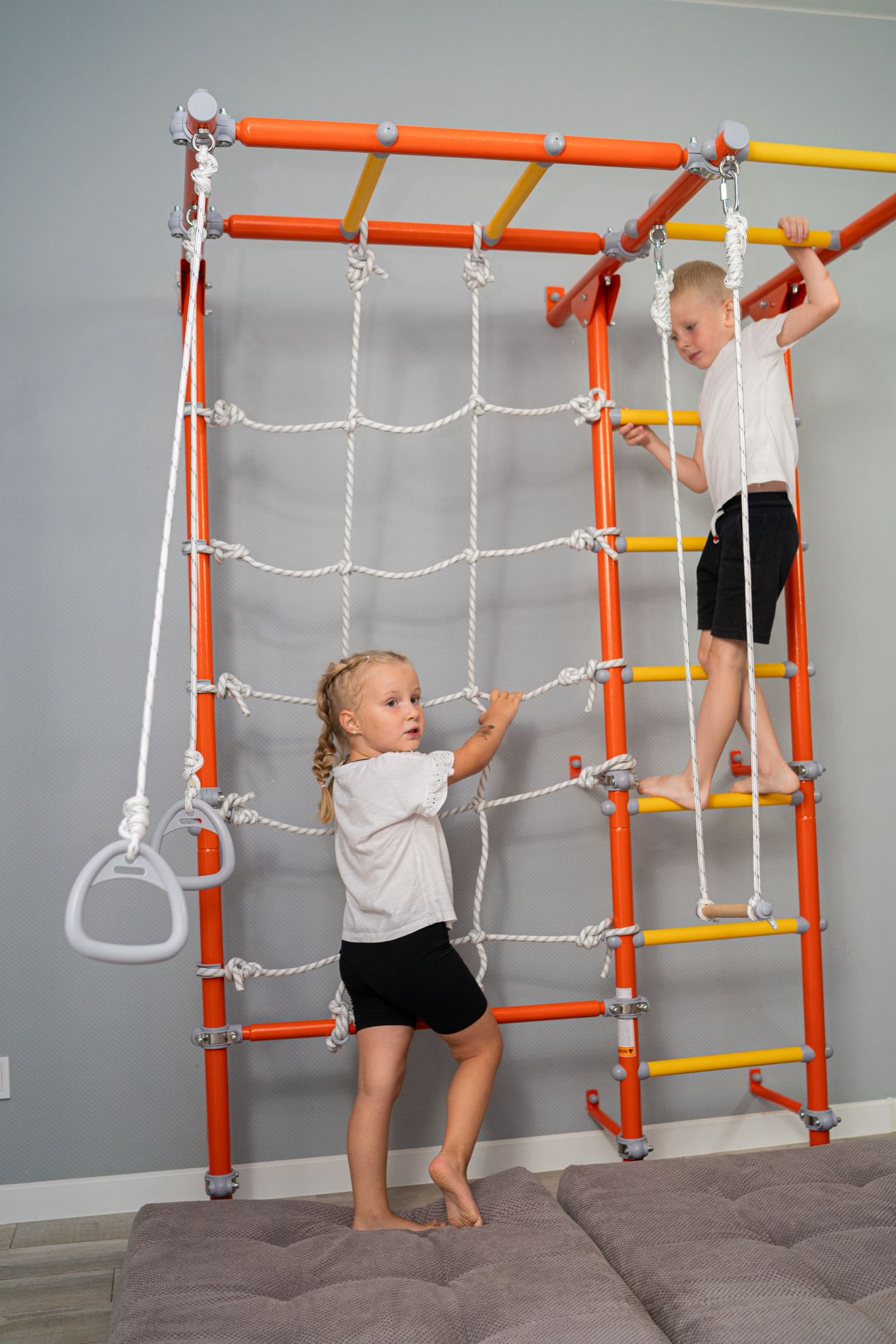
You can run this menu with a doorway bar and a laundry basket. What a home gym changes is friction: the bar, the net, the rings, and the swing live three steps from the school table, permanently set up, rated for daily use, with mats underneath. When the break has to happen now, in minute one of a ten-minute window, equipment you don't have to set up is the difference between a break that happens and a break that gets skipped. That is the argument, in one sentence, for anchoring the movement side of your homeschool in a sensory gym at home.
"Their most used toy by FAR, like by a landslide. They use it every day for hours."
– LEISA L., MOM OF 3, BRAINRICH OWNER
First-then boards and visual timers: the glue of the schedule
The alternation fails at exactly one point: the transitions. Ten switches a day is ten chances for a stand-off, and no schedule survives if every switch costs a negotiation. Two visual tools carry that load.
The first-then board. A strip of card with two frames: First [math], Then [swing]. That's the whole tool. It works because it moves the argument out of the relationship and into the environment: the board says what is happening, the child checks the board, and the parent gets to be the ally instead of the enforcer. It is also external working memory: the next good thing stays visible the whole time the hard thing is happening. Build one with two clothespins and a stack of picture cards, or draw the two frames on a whiteboard each morning. Families homeschooling autistic kids run whole days on this logic; our visual routines guide goes deeper.
The visual timer. Not a phone timer. A timer where time is visible as a shrinking colored disc or a falling sand column, sitting on the table where the child can glance at it. Two rules make it work:
That last pill is the one parents break: ride past the bell when a lesson is finally going well, and the timer becomes a suggestion your child will renegotiate at the end of every break for a month. End on the bell, mid-success, every time. Tomorrow's block opens with yesterday's win still warm.
One more scheduling note that belongs in this section: put the break before the meltdown, not after it. If your child reliably falls apart at minute 22, the lesson block is 20 minutes. The schedule's job is to make the crash structurally impossible, not to respond to it faster.
Which gym fits your family? Take the 60-Second Quiz →
The equipment that runs the schedule
Every body break on the menu above (hanging, climbing, swinging, heavy work) runs on one piece of equipment that lives next to the school table. All three gyms below are rated for ages 3+ and independent climbing, assemble in an afternoon, and hold the same break menu; the difference is room size and how many kids are breaking at once.


Ready to build the break menu into the room?
Every gym assembles in an afternoon and is covered by a 30-day money-back guarantee.
Frequently asked questions
How long should homeschool lessons be for a child with ADHD? Start at 15-25 minutes per lesson block, shorter for younger kids and for the most draining subjects (usually writing). The block should end while attention is still working; if your child reliably melts down at minute 22, the block is 20 minutes. Four to six blocks a day, separated by 10-minute body breaks, covers a full elementary curriculum for most families.
What counts as a body break? Anything physical that uses big muscle groups: hanging from a bar, climbing a net or ladder, swinging, jumping, animal walks, or heavy work like carrying and pushing. Screens do not count, and quiet sitting is a different tool for a different moment. The break's job is input for the body, and ten minutes is enough when the equipment is three steps away.
Do movement breaks actually help ADHD kids focus? The research is associational but consistent: a single 20-minute bout of exercise was followed by better attention and task accuracy in children with ADHD in controlled testing (Pontifex 2013), a meta-analysis of randomized trials links regular aerobic exercise to moderate to large attention improvements (Cerrillo-Urbina 2015), and classroom studies associate short activity breaks with more on-task behavior, with the biggest gains in the least focused students (Mahar 2006; Watson 2017).
Should the break come before or after the hard subject? Both, ideally: a big-muscle warm-up before the first lesson, and a break after every block. The one placement that backfires is movement as a reward that must be earned by finishing. Once the break is contingent on performance, the child who needed it most is the one who never gets it.
What if my child won't come back from the break? Let the timer own both edges: it ends lessons and it ends breaks, and it rings for the parent too. Pair it with a first-then board so the next block is visible before the break starts. Expect two weeks of calibration; re-entry gets dramatically easier once the child trusts that another break is always scheduled and never has to be negotiated.
Is 80 minutes of seatwork a day really enough? For elementary grades, engaged one-on-one instruction covers material far faster than a classroom managing twenty-five children. Short focused blocks also produce better retention than long deteriorating ones. Afternoons still teach: projects, audiobooks, co-ops, and free play all count, they just don't happen in a chair.
Does this schedule work without a home gym? Yes: a doorway pull-up bar, a jump rope, stairs, and a laundry basket will run the break menu. A home gym removes the two failure points, setup time and weather, and adds hanging, climbing, and swinging in one permanent spot next to the school table. Rated ages 3+, with impact mats under the landing zones.
This article is for general information only and is not medical advice. ADHD care decisions, including diagnosis, therapy, and medication, belong with your child's pediatrician or clinician. Movement complements a professional care plan; it does not replace one.
📚 Keep reading in the Decision Guide
Homeschooling a Child With ADHD: The Movement-First Guide · Homeschool PE at Home: The Complete K-6 Guide · The Homeschool Schedule That Works
Sources
Pontifex, M.B. et al. (2013). Exercise improves behavioral, neurocognitive, and scholastic performance in children with attention-deficit/hyperactivity disorder. The Journal of Pediatrics. · Cerrillo-Urbina, A.J. et al. (2015). The effects of physical exercise in children with attention deficit hyperactivity disorder: a systematic review and meta-analysis of randomized control trials. Child: Care, Health and Development. · Mahar, M.T. et al. (2006). Effects of a classroom-based program on physical activity and on-task behavior. Medicine & Science in Sports & Exercise. · Watson, A. et al. (2017). Effect of classroom-based physical activity interventions on academic and physical activity outcomes: a systematic review and meta-analysis. International Journal of Behavioral Nutrition and Physical Activity.
Share: