

Updated August 2026 · 9-minute read · by the Brainrich Kids team
There is a certain kind of family whose living room contains, instead of a second couch, a wooden overhead ladder. If you know, you know: these are Doman families, and the ladder is a brachiation ladder, one of the most devoted home-equipment traditions in all of parenting. This guide covers what the program actually asks for, the classic DIY build and its real-world headaches, and the engineered ways to get a ladder into your home without giving up the living room.
The quick answer: a brachiation ladder is a horizontal overhead ladder a child crosses hand over hand, popularized by Glenn Doman's Institutes for the Achievement of Human Potential (founded 1955) and the books How to Teach Your Baby to Be Physically Superb and Fit Baby, Smart Baby, Your Baby. Families either build one from lumber and dowels (cheap, but fixed in place and hard to adjust) or use engineered monkey-bar equipment (adjustable height, no carpentry, holds adults for spotting). The program itself runs on short, frequent, celebrated sessions, and the ladder's job is simply to be there every day.
Jump to: What the program asks for · The classic DIY build · Where DIY ladders struggle · The engineered route · Brachiation beyond Doman · FAQ
What the Doman program actually asks for
Brachiation, from brachium, Latin for arm, is swinging hand over hand under an overhead ladder. The Institutes made it a centerpiece of their physical development work decades ago, and two generations of parents have learned it from the books: How to Teach Your Baby to Be Physically Superb, and later Fit Baby, Smart Baby, Your Baby by Glenn and Douglas Doman, which lays out the schedule most families follow.
The method behind the ladder is consistent across everything the Doman organizations publish:
The ladder lives at home. The program's first tip is always the same: a ladder in your own house beats a weekly trip to the playground, because the whole system runs on frequency.
Short sessions, many times a day. Single trips, spread across the day, built up gradually to round trips. Not marathon sessions, repetition.
Start low, raise slowly. The ladder starts where the child can succeed and rises in the smallest possible increments as skill grows.
Spot, celebrate, repeat. A parent walks alongside, supports as much as needed, and treats every crossing like a headline event. Doman-program parents will tell you that once a child crosses independently, the problem reverses: you cannot get them off the ladder.
A note on the name: "the Doman Method" is what the world calls it, and it is the phrase people search, but Glenn Doman himself reportedly disliked the term, preferring to credit the whole staff of The Institutes. Today two related organizations carry the work: The Institutes (iahp.org) and Doman International, led by the family's next generation.
The classic DIY build
The traditional route is lumber, hardwood dowels, and a free weekend. Builds shared by Doman families over the years cluster around the same shape:
Rungs: hardwood dowels around 3/4 inch thick, small enough for a child's grip
Spacing: roughly 6 inches apart for beginners, wider as skill grows
Length: a dozen rungs, about 6 feet, with the official guidance favoring longer ladders where the house allows
Frame height: typically 5 to 6 feet, ideally adjustable
Cost and time: families report roughly $100–$200 in materials and one to two weekends of building
Built well, it works, and there is real charm in a ladder your family made. If you have the tools, the space, and a parent who enjoys the project, nothing here argues against it.
Where DIY ladders struggle (by the builders' own accounts)
Read the Doman parent forums and the same frustrations repeat:
It will not fit where you thought. The most common story: the finished ladder is taller or longer than the room, and ends up in a garage or basement, which quietly kills the whole daily-frequency principle. Many builds cannot leave the room they were assembled in.
Height adjustment is the hard part. The program wants the ladder raised in small increments over months. A bolted lumber frame usually offers a few crude positions, or none, and "raise the ladder" becomes "rebuild the ladder."
Short ladders frustrate fast climbers. Grown Doman kids remember running out of rungs in three swings. The program's own answer is round trips and session counts rather than a longer runway, but a span that fits more rungs helps.
It does exactly one thing. A brachiation ladder brachiates. When the session is done, it stands in the living room doing nothing else until the next one.
The engineered route: same principle, no carpentry
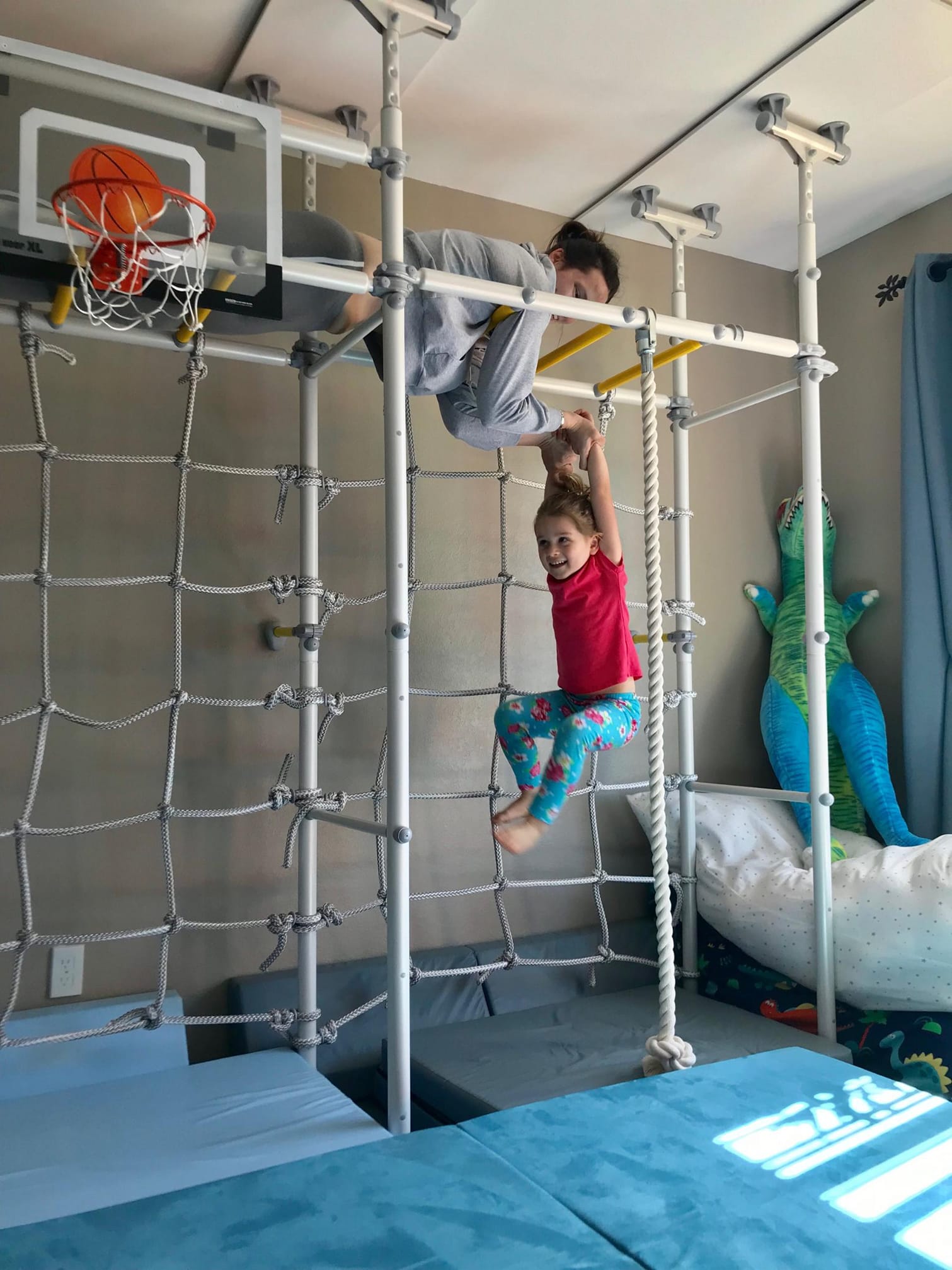
An indoor monkey-bar setup is a brachiation ladder by another name, and the engineered version answers the DIY pain points directly:
| Doman-program need | How the engineered setup answers it |
|---|---|
| Start low, raise in small steps | The Spider V3, Spider Max V3, and Mega Max V3 gyms come with an adjustable monkey-bar span built in: set it at chest height for a beginner and raise it as skill grows, no rebuilding. Owners of a Model T2 or T3 add the same span with the Monkey Bars V3 attachment. |
| Lives in the house, permanently | Tension-mounted frames brace between floor and ceiling (6'9" to 10'6") with no drilling; the wall-mounted W3 and W3 Max sit 9 inches off the wall for small rooms and slanted ceilings. |
| Parent spots every session | Steel frames with rubber-coated rungs; the wall-mounted line is certified to 220 lb, so a parent can hang on to demonstrate, which is how spotting starts. |
| Justify the floor space | Between brachiation sessions the same frame carries rings, a trapeze, a climbing rope, and a swing, so the footprint earns its keep all day. |
| A safe landing every time | A 4.5-inch play mat under the span, the same rule we apply to all monkey-bar setups. |
One age note, stated plainly because we are a safety-first company: Doman programs begin assisted overhead-ladder work younger than our equipment is designed for. Brainrich gyms are built for ages 3 and up. For program specifics with babies and toddlers, the Doman organizations' own materials and courses are the right source; our equipment picks up the story from age three.
Brachiation is not only a Doman idea
The Doman tradition arrived at the overhead ladder through child brain development. Occupational therapy arrived at the same equipment through sensory integration: hanging and swinging deliver the proprioceptive and vestibular input that OTs build sessions around. Playgrounds arrived at it because kids simply will not leave monkey bars alone. Three traditions, one piece of equipment, which is about as strong an endorsement as playroom hardware ever gets. The full sensory case lives in Indoor Monkey Bars Are Sensory Equipment.
FAQ
What is the Doman Method?
The common name for the programs of The Institutes for the Achievement of Human Potential, founded by physical therapist Glenn Doman in 1955, spanning early reading, math, and physical development, with the brachiation ladder at the center of the physical program. Doman himself preferred not to call it a "method" at all.
Is brachiation a treatment?
The Doman organizations use brachiation within their programs for children with a range of diagnoses, and families in those programs should follow their program's guidance. Brainrich sells play equipment, not treatment, and makes no medical claims: what we can say is that monkey bars deliver the input OTs categorize as heavy work, and that daily access is the entire point of having a ladder at home.
Does the ladder need to be 12 feet long?
Longer is nicer, and almost nobody has the room. The program's own progression solves this with round trips: cross, turn, cross back, counted in sessions across the day. What matters more than length is that the ladder is in the house, at the right height, every day.
DIY or buy?
If you have the tools, the ceiling height, and the patience to rebuild as your child grows, a DIY ladder is a lovely project at roughly $100–$200 in materials. If you want adjustable height, a guaranteed fit, a certified frame, and equipment that does more than one job, that is the problem our gyms were built to solve. The same fork in the road applies to play gyms generally, and we wrote the cost math up in DIY vs. Buying an Indoor Play Gym.
Share: