

Updated September 2026 · 9-min read · by Yegor Nadvornyy, founder
Every few weeks a parent writes to ask which monkey bars are safest for a toddler, and the useful answer starts with a correction: most toddlers cannot do monkey bars, and the safest set is the one that does not ask them to. This guide explains what the body needs before it can swing hand over hand, what "safe" means in numbers (bar height, rung spacing, grip diameter, mat, fall zone), what to buy for a 2-to-3-year-old who wants to hang, and how our own steel frames handle the 4-to-6 window. We make monkey bars, so read the last part with that in mind.
The quick answer: the safest monkey bars for a toddler are low practice bars the child can hang from with feet near the floor, not a span to swing across. The CPSC's playground handbook puts 4 as the youngest age generally able to use overhead ladders, and says they should not be used on playgrounds intended for toddlers and 3-year-olds. For a 2-to-3-year-old, choose a low plastic tower such as the Eezy Peezy Monkey Bars Toddler Gym Tower ($179.99, 47 in tall) or a wooden set like the Avenlur Magnolia ($549, 56 in tall), on a mat, with a parent's hands close. At 4 to 5, look for bars no higher than 60 in, rungs no more than 12 in apart, a 6 ft clear zone, and a published load rating. The Brainrich Spider V3 ($1,499) is our answer for that stage: the monkey bars are built in, height-adjustable, rubber-coated, and the frame carries a 220 lb working load.
Jump to: What age · What "safe" means · Practice options for 2 to 3 · Comparison table · The Brainrich path · FAQ
What age can a toddler actually do monkey bars?
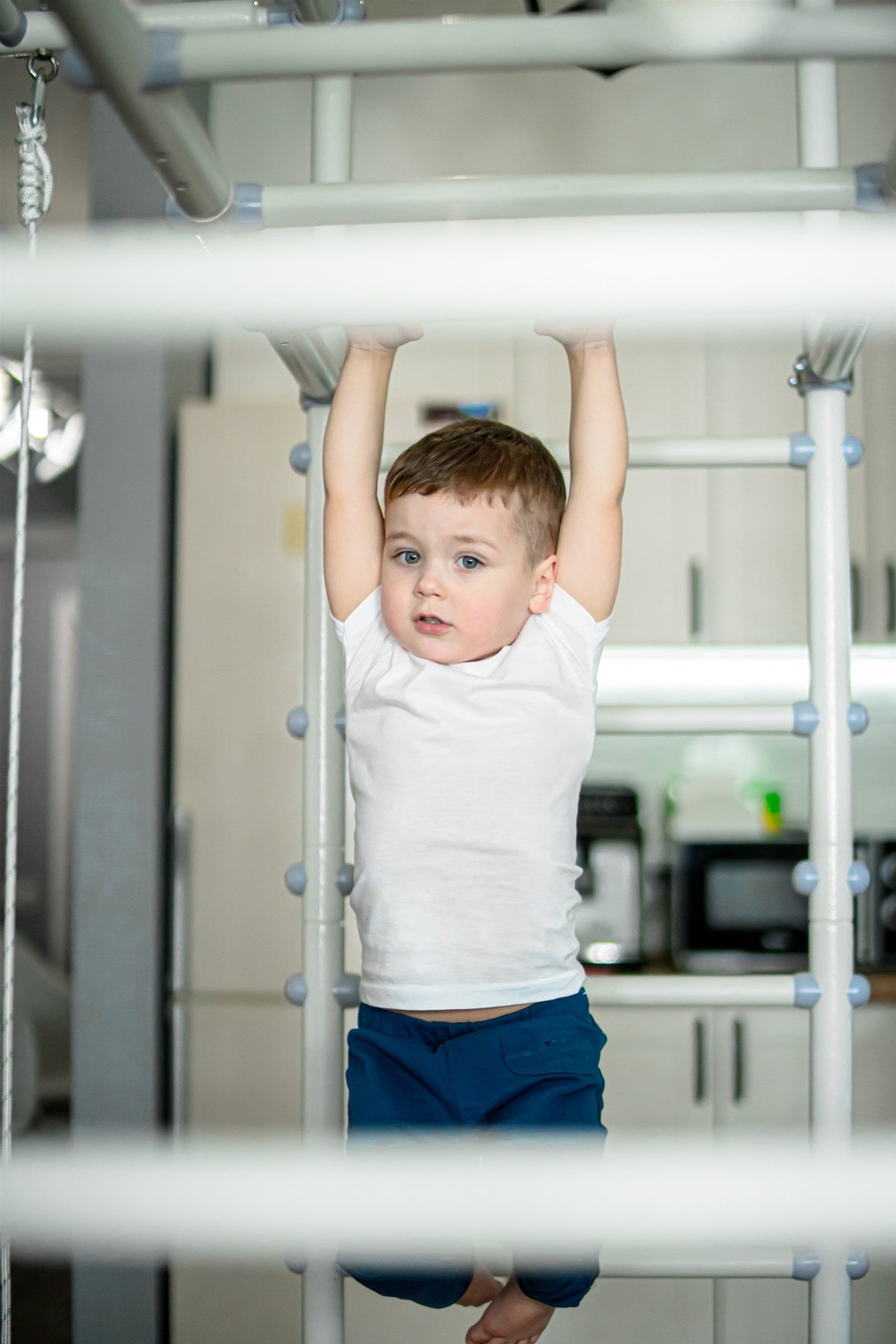
Swinging hand over hand, which physiologists call brachiation, needs three things a toddler is still building: grip strength to hold body weight on one hand for about a second, shoulder stability to keep the joint seated under load, and the motor plan to release one hand while the other holds. Most children assemble those pieces between 4 and 5 and swing a full span with confidence between 5 and 7. Before that, a child hanging from a bar with both hands is doing something valuable, but it is not monkey bars.
The CPSC's Public Playground Safety Handbook is direct about it. Section 5.3.2 says four-year-olds are generally the youngest children able to use upper body devices, and that horizontal ladders should not be used on playgrounds intended for toddlers and 3-year-olds. The rest of that section is written for ages 4 through 12. We follow the same line at home: independent climbing on a Brainrich frame starts at 3, and the monkey-bar span becomes a target around 4 or 5, with a parent in the same room and the bars set low.
The readiness test is not a birthday. Can the child hang from a bar with both hands for ten seconds, then let go and land on her feet on purpose? If yes, she is ready to reach for a second rung with a spotter. If no, she needs more hanging, not a higher bar.
What "safe" means, in numbers
Two documents set the rules for home equipment. ASTM F1148 is the consumer safety specification for home playground equipment; it governs entrapment openings, protrusions, sharp edges, and fall height. The CPSC handbooks (Publication 325 for public playgrounds, Publication 324 for home playgrounds) add dimensions and surfacing. The numbers that matter for monkey bars:
Bar height: 60 in max (ages 4 to 5)
Measured from the center of the rung to the top of the surfacing. School-age bars may go to 84 in. A bar a child can reach from the floor with a small jump is the right starting height.
Rung spacing: 12 in max (ages 4 to 5)
Center to center, evenly spaced and parallel. School-age spacing may go to 15 in. The gap between adjacent rungs should be greater than 9 in to prevent head entrapment.
Grip diameter: 0.95 to 1.55 in
The handbook's range for rungs and hand-gripping components. Round rungs that cannot rotate are easiest to hold; a coating that does not get slick with sweat helps small hands.
Fall zone: 6 ft, on a mat
The use zone extends 6 ft in every direction from a climber. Outdoors that is 9 in of wood chips; indoors it is an impact mat under the full span and past the last rung at each end. Carpet is not surfacing.
Add two things the standards do not measure. First, a published load rating: a working load in pounds on the product page, and ideally a tested load above it. Second, a frame that does not move. Push the assembled unit at the top; a set that sways under one hand will sway under a swinging child, and the sway is what turns a slip into a fall onto the frame.
Low practice options for ages 2 to 3
A toddler who wants to hang needs a bar at about chest-to-chin height, so that letting go means a drop of inches, and a base that does not tip. Two kinds of product do this well, priced from the makers' or retailers' own pages in September 2026:
Eezy Peezy Monkey Bars Toddler Gym Tower, $179.99. A plastic pyramid of interlocking tubes, 70 by 66 by 47 in assembled, 27 lb, rated to 150 lb. Target lists it for ages 3 to 8; the top bar sits at about 47 in, low enough for a 2-to-3-year-old to hang from with feet a few inches off the floor. It is light enough to move onto a mat and out of the way, and the 150 lb rating means an adult should not join in. Source: target.com
Avenlur Magnolia Jungle Gym, $549. A wooden 7-in-1 climber with a short monkey-bar run, a slide, a swing, and a rock wall, 58 by 47 by 56 in, listed for ages 2 to 6 with 110 lb per child on the Amazon listing. The bars are at about 56 in, so a 2-year-old uses them with a parent's hands under her arms. Source: avenlur.com
A doorway trapeze, from $79.97. Not a monkey-bar run, but the best cheap hanging practice. DreamGYM's doorway support bar screws into a wooden door frame 26 to 36 in wide, holds 220 lb, and takes a trapeze or rings you can hang at the child's chin height; the full doorway kit with trapeze, rings, rope ladder, and swing is $247.97. Source: kidsdreamgym.com
What all three share is a low bar and a small footprint. What none of them offer is a path to 6 or 8, which is the argument for the next section. Emmi Pikler's principle applies to every option: the child gets to the bar under her own power and comes down the same way. Lifting a 2-year-old up to hang from a 5-foot rung teaches her hands a height her judgment has not reached.
Comparison table: monkey bars by age and safety spec
| Option | Maker's age range | Bar height | Material and mount | Load rating | Price (Sep 2026) |
|---|---|---|---|---|---|
| DreamGYM doorway bar + trapeze | 3+ | Set by strap length; single bar, no span | Steel bar, screws into a 26 to 36 in door frame | 220 lb | $79.97 bar; $247.97 kit |
| Eezy Peezy Toddler Gym Tower | 3 to 8 | About 47 in, fixed | Plastic, freestanding, 70 x 66 in floor | 150 lb | $179.99 |
| Avenlur Magnolia | 2 to 6 | About 56 in, fixed | Wood, freestanding, 58 x 47 in floor | 110 lb per child (Amazon listing) | $549 |
| Brainrich Spider V3 | 3+ (bars from about 4 to 5) | Height-adjustable on the ladders | Powder-coated steel, tension-mounted, no drilling, ceilings 6 ft 9 in to 10 ft 6 in | 220 lb, tested to 440 | $1,499 |
| Brainrich Monkey Bars V3 (add-on) | Owners of a T2, T3, or Spider frame | Height-adjustable | Steel; attaches to an existing Brainrich frame, not stand-alone | 220 lb, tested to 440 | $699 |
Competitor figures come from each maker's or retailer's own page on the date shown and will change. Brainrich prices do not move because we do not run sales.
The Brainrich path: low at 4, high at 10, the same bars
The problem with a toddler-height monkey bar set is the second birthday after you buy it. A fixed 47-inch bar is right at 3 and a hazard at 7, when the child's feet drag and she starts jumping to reach a swing. Our approach is a span whose height moves with the child.
The Spider V3 comes with the monkey bars built in: two steel ladder pairs, tension-mounted between the floor and a flat ceiling, with the bar run bridging them. The frame ships in three ceiling sizes (Basement 6 ft 9 in to 9 ft 1 in, Standard 7 ft 8 in to 9 ft 11 in, Tall 9 ft 4 in to 10 ft 6 in), and the bars mount at the ladder rung height you choose, so a 4-year-old starts with the span at about her reach and a 10-year-old has it near the ceiling. The rungs are rubber-coated steel, which small sweaty hands hold better than bare metal or varnished wood. The whole frame carries a 220 lb working load and has been safety-tested to 440; the 220 is the number to plan around, and it covers a parent spotting from below.
Families who already own a Model T3 or a Spider reach the same place with the monkey bars set ($699), which attaches between two Brainrich ladders. It is an add-on, not a stand-alone unit; it needs a Brainrich frame to bolt to. The wall-mounted Model W3 ($850) includes a short bar run too, fixed in height and 9 in off the wall, for rooms with slanted ceilings.
The heritage behind the design is Swedish gymnastics and the steel frame I grew up climbing in my parents' apartment in Ukraine: a fixed, rigid structure that a child returns to daily and learns by heart. A. Jean Ayres described why hanging and swinging matter beyond the muscles: they load the proprioceptive and vestibular systems that organize a young child's sense of where her body is. That is the case for a bar at 3, long before a span at 5.
Our house rules for a young child on the bars.
1. A parent in the same room, every time, and within arm's reach until the child can cross alone.
2. Bars set so the child can touch the first rung from the mat with a small jump, never lifted to a height she did not climb to.
3. An impact mat under the full span and past each end, per the CPSC's 6-foot use zone.
4. Hanging first: ten seconds with two hands, then a controlled drop, before any reach for the next rung.
5. Bars are for hands. No walking on top, no hanging by the knees until the child can already cross with her hands.


Bars that start low and grow with the child
Steel indoor play gyms for ages 3 to 12+. No drilling, 30-day money-back guarantee.
Frequently asked questions
Which monkey bars for kids are safest for toddlers? Low practice bars the child can hang from with feet near the floor, on a mat, with a parent's hands close: a plastic tower like the Eezy Peezy Toddler Gym Tower ($179.99, 47 in tall) or a wooden set like the Avenlur Magnolia ($549, 56 in tall). A toddler should not be swinging across a span; the CPSC handbook puts the youngest age generally able to use overhead ladders at 4. For 4 to 5, choose height-adjustable bars such as the Brainrich Spider V3 ($1,499) set at the child's reach.
At what age can a child do monkey bars? Hanging with two hands starts around 3. Reaching for a second rung with a spotter starts around 4 to 5, and most children cross a full span with confidence between 5 and 7. The test is not age but whether the child can hang for ten seconds and drop to her feet on purpose.
How high should monkey bars be for a 4-year-old? The CPSC handbook recommends no more than 60 inches from the center of the rung to the surfacing for preschoolers (4 and 5), with rungs no more than 12 inches apart center to center and a gap of more than 9 inches between adjacent rungs. In practice, set the bar so the child can touch it from the mat with a small jump.
Do I need a mat under indoor monkey bars? Yes. The CPSC treats the surface as part of the equipment and recommends a 6-foot use zone around climbers. Indoors, that means an impact mat under the entire bar run and extending past the last rung at each end. Carpet or a rug does not count as protective surfacing.
Are Brainrich monkey bars sold on their own? No. The Monkey Bars V3 ($699) is an add-on that attaches between two Brainrich ladders on a Model T2, T3, or Spider frame. If you do not own a frame, the Spider V3 ($1,499) comes with the monkey bars built in, height-adjustable, on a steel frame rated to 220 lb and tested to 440.
📚 Keep reading in the Decision Guide
Monkey Bars for Kids: The Complete Guide · Monkey Bar Sets for Home · Climbing Gyms for Babies and Toddlers · Climbing Toys by Age · Best Indoor Play Gym for Kids Under 5
Sources
U.S. Consumer Product Safety Commission. Public Playground Safety Handbook (Publication 325): section 5.3.2 (four-year-olds generally the youngest able to use upper body devices; horizontal ladders not for toddlers and 3-year-olds; preschool maximum height 60 in and rung spacing 12 in; adjacent rung gap greater than 9 in; 6 ft use zone), section 5.2.2 and Table 6 (rung diameter 0.95 to 1.55 in), Table 2 (loose-fill depths). Outdoor Home Playground Safety Handbook (Publication 324). · ASTM International. ASTM F1148, Standard Consumer Safety Performance Specification for Home Playground Equipment. · Target. Eezy Peezy Monkey Bars Toddler Gym Tower, $179.99, accessed September 2026. · Avenlur. Magnolia Jungle Gym, $549, accessed September 2026; per-child rating from the maker's Amazon listing. · DreamGYM. Doorway Gym Kit, $247.97, and Doorway Swing Support Bar, $79.97, accessed September 2026. · Ayres, A. J. (1972). Sensory Integration and Learning Disorders. · Pikler, E. (1940). Peaceful Babies, Contented Mothers. · Brainrich Kids engineering specification: frame working load 220 lb, safety-tested to 440 lb; ceiling ranges per product documentation.
Share: