

How to Choose Your Home Play Gym
How to Choose Your Home Play Gym
You took the quiz, and it handed you two gyms. This page explains why. Not the marketing version. The actual reasoning, the way I'd explain it to a friend at the kitchen table. Read it once and you'll never second-guess the choice again.
The short version
Flat ceiling? Get a tension-mounted gym. Slanted ceiling? Get a wall-mounted one. Pick the height that matches your room. Then pick the size that fits your kids. And if you're stuck between two sizes, start with the smaller one. Every tension-mounted gym grows by adding a Monkey Bar Set later.
First, the part most parents don't know: the gym is modular
We make several models. Parents see the line-up, freeze, and put the whole idea off for another winter. That's decision fatigue. Here's the thing that makes it go away.
Every tension-mounted gym is the same set of parts. Two ladders, pull-up bars, and a number of Monkey Bar Sets. The bigger models simply have more sets. So you can start with a smaller gym today and add a Monkey Bar Set next year. The frame you buy now stays. Nothing gets replaced.
That's why the quiz gives you a Good Start and one step up. Not the whole catalog. If budget or space is tight, take the Good Start and stop overthinking it. If you have the room, take the step up. Either way, you can keep growing it.
Flat ceiling? Then it's a no-brainer: go tension-mounted
A tension-mounted gym presses between your floor and your ceiling. No drilling. No anchors. No marks when you move it or move house. You can put it anywhere in the room, and you can move it later.
Put it in the middle of the room and something great happens. Kids can swing in all four directions. Two kids on two swings, facing different ways, never bumping. That's not possible with anything bolted to a wall.
It's also fully adjustable. Raise the monkey bars as your child grows. Move the pull-up bars to the other side to create two play zones. Reconfigure it in an afternoon when a sibling arrives. Parents in our community rebuild theirs every year or two, and it still looks new.

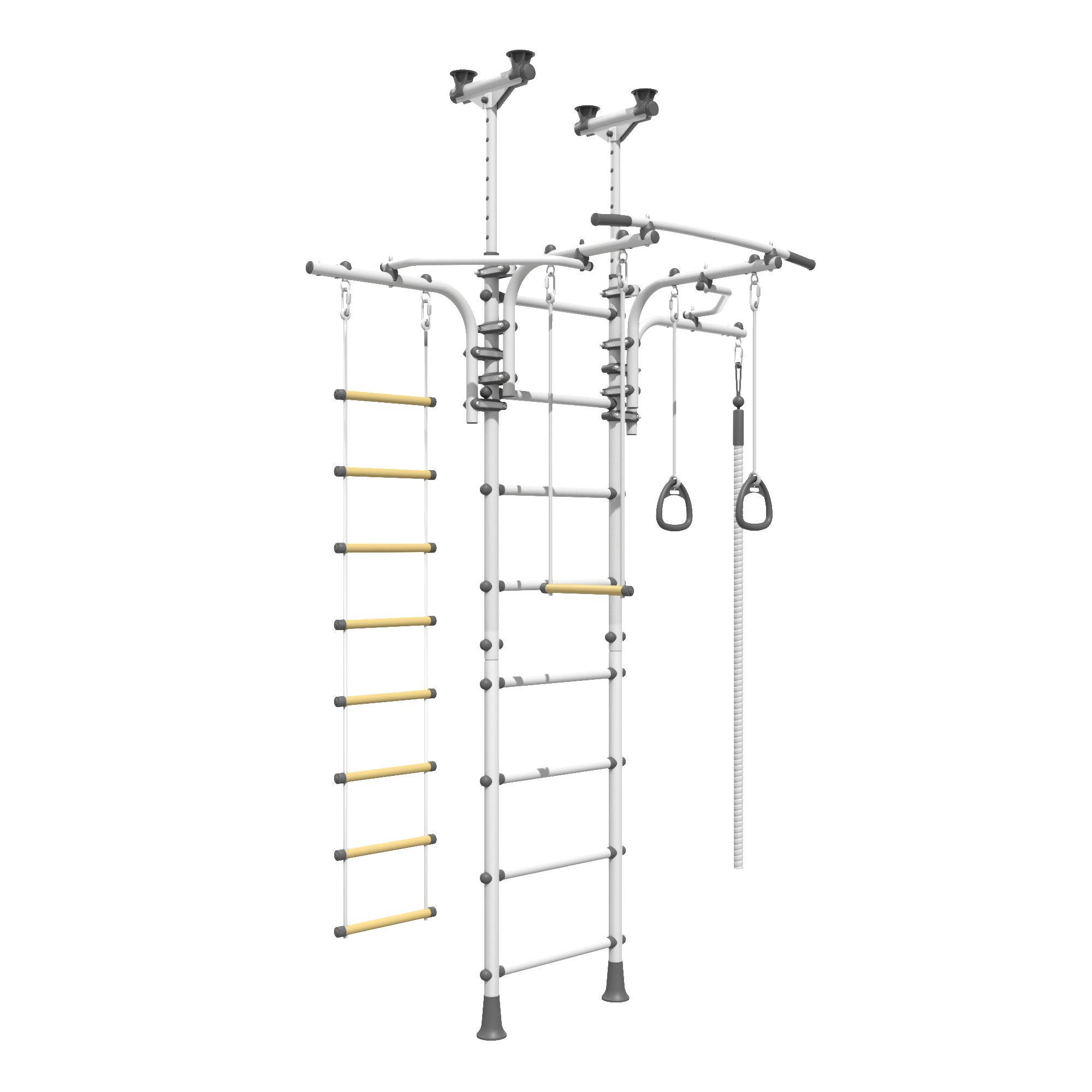

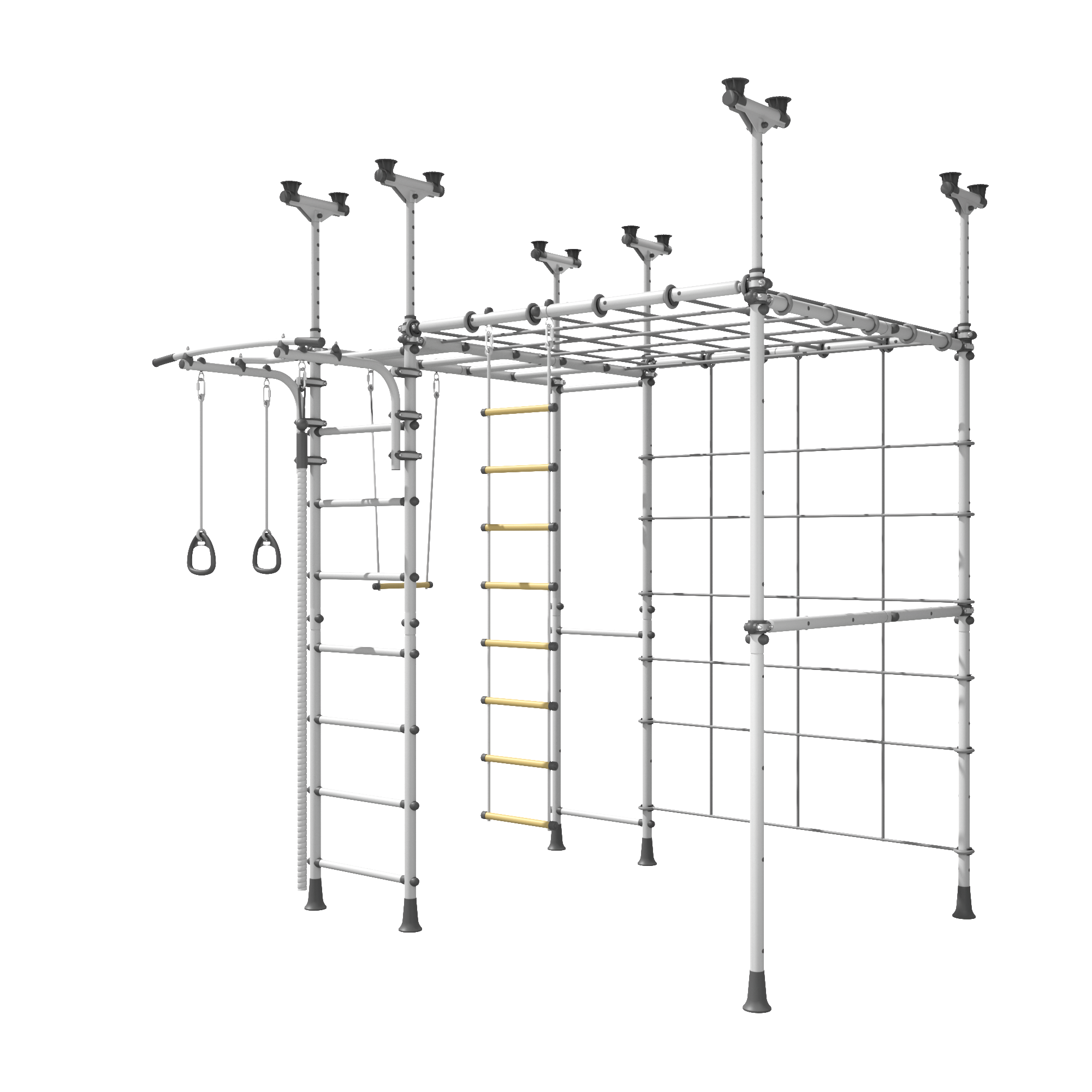
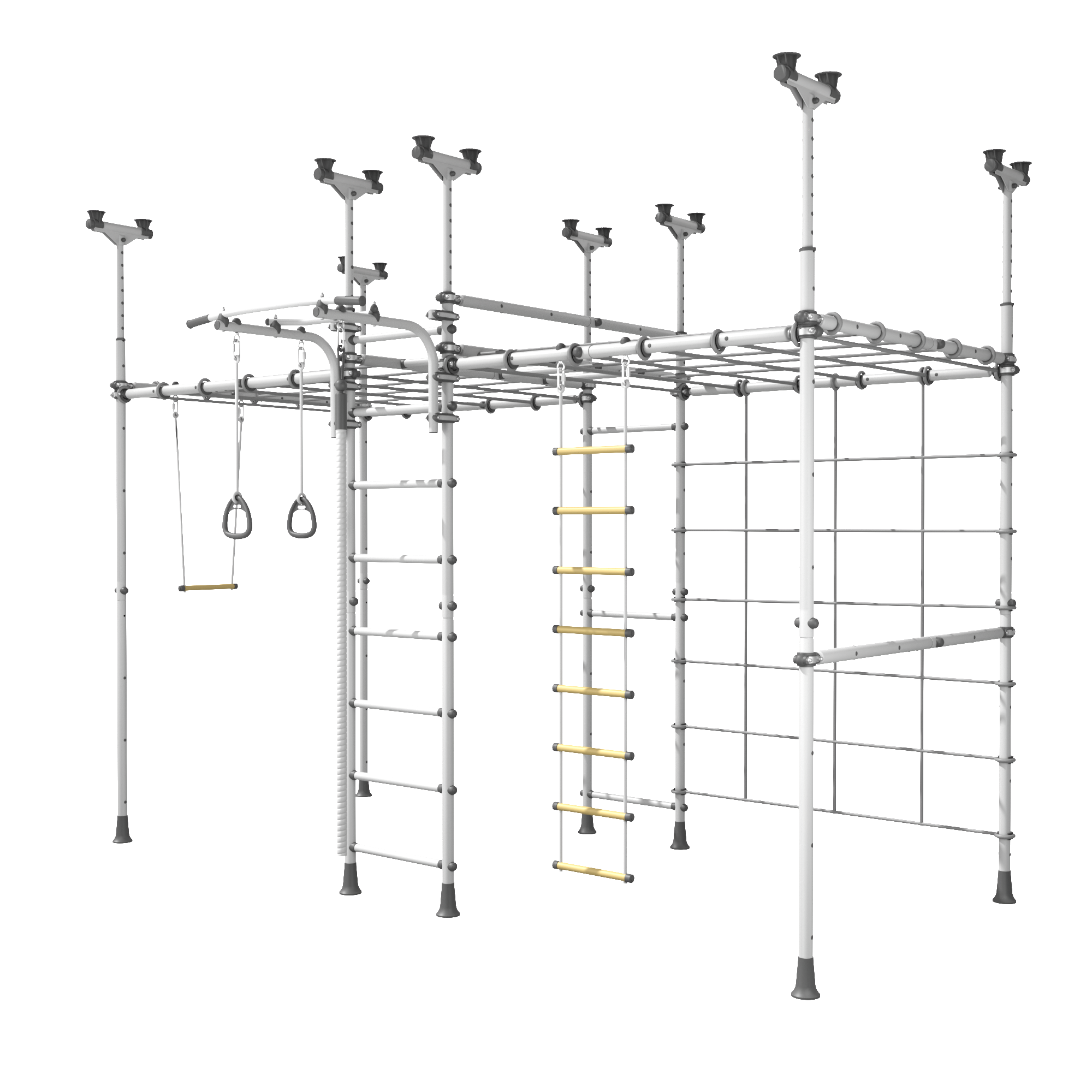
We also make lighter, lower-priced versions of the Spider V3, Spider Max and Mega Max. They're on the collection page.
Slanted, vaulted or A-frame ceiling? Wall-mounted it is.
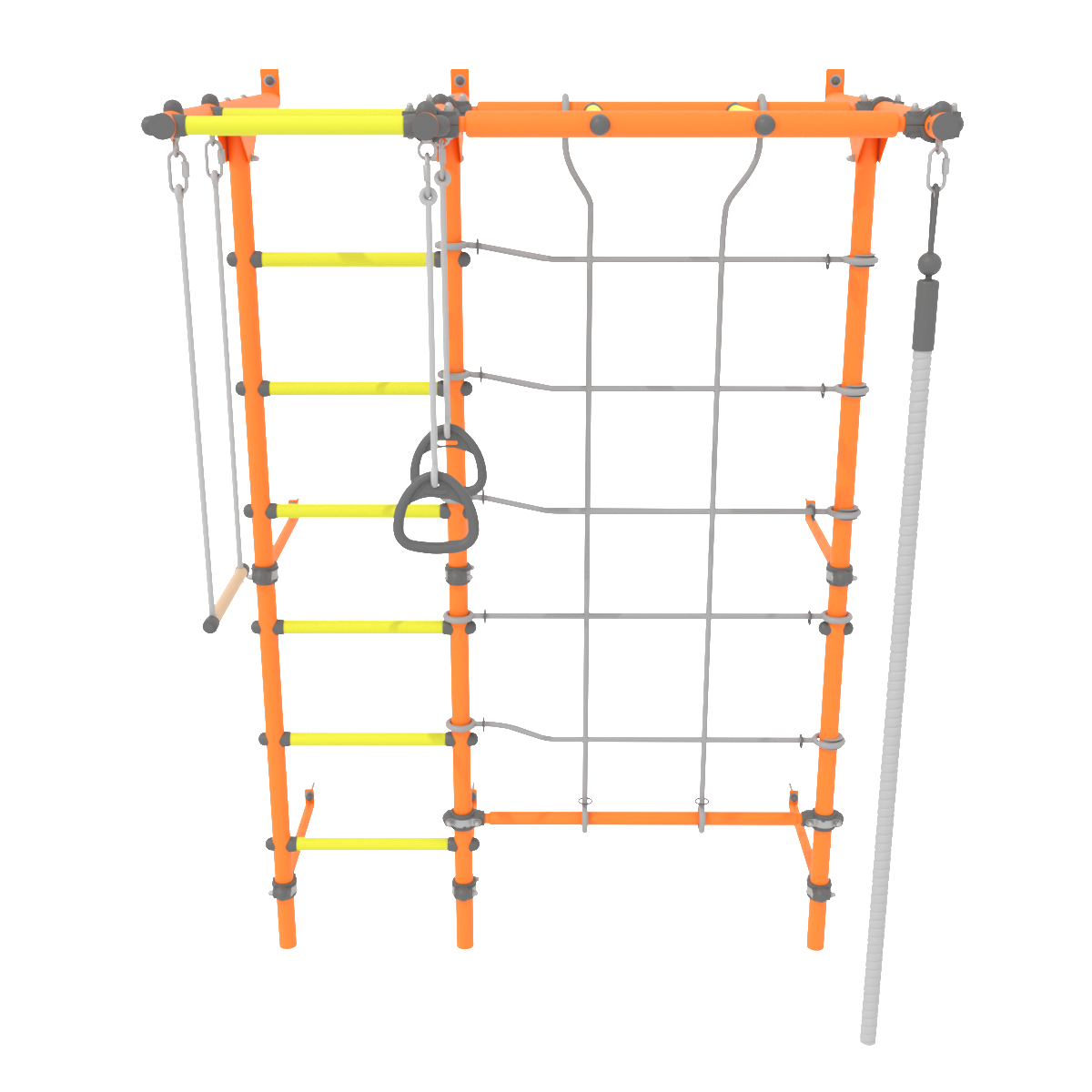
A tension frame needs a flat ceiling to push against. If yours slopes, the wall-mounted gym is your answer. It anchors into the wall studs, so the ceiling angle doesn't matter at all.
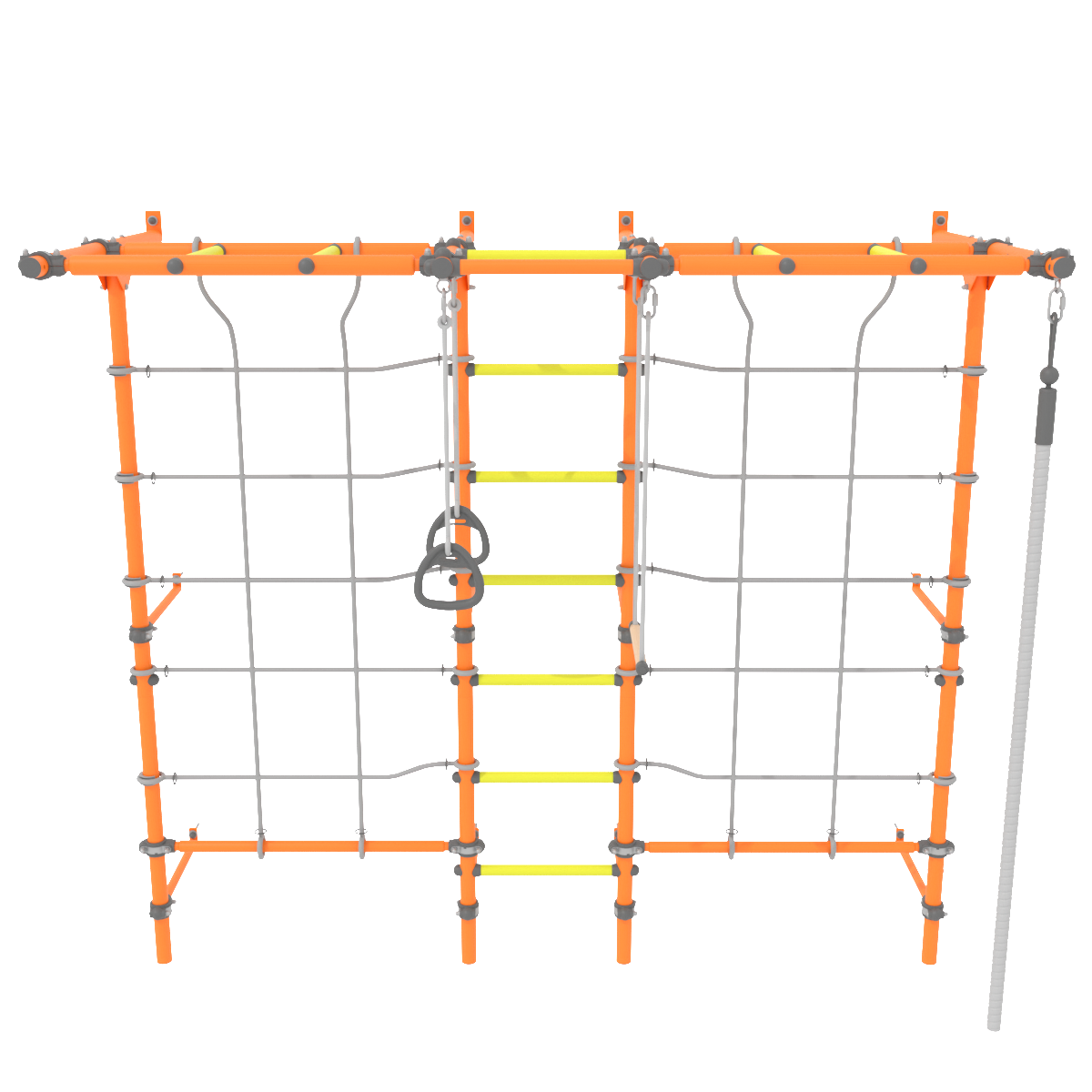
Be honest with yourself about the trade-off, though. Kids swing along the wall, in one direction. The frame stays where you bolt it. And the only upgrade path is from the W3 to the W3 Max, which adds one set of wall-mounted monkey bars. It's a great gym. It's just not a gym you rearrange.

Ceiling height: pick the closest, and don't panic
Tension-mounted gyms come in three heights, so the frame can press firmly against your ceiling. There's a version for lower basements, one for standard rooms, and a Tall version for high ceilings. The Tall version has an extension piece in the middle of each ladder. That's the whole difference.
Measured wrong? It happens all the time, and it's fixable. If your ceiling turns out to be higher than you thought, you add Extension Ladders to a standard gym and keep going. You don't return anything. You don't start over.

The three heights
Basement: 6'9" to 7'7"
Standard: 7'8" to 9'1"
Tall: 9'4" to 10'5"
Wall-mounted gyms fit any ceiling from about 7'8" up.
Number of kids: bigger buys more than space
This is the question parents underestimate. A bigger gym isn't just a wider gym. Three things change with each Monkey Bar Set you add.
- More places to hang things. Every set of bars is another spot for a swing, a rope, rings, a hammock or a sensory swing. Accessories are where the long-term fun lives.
- Separate zones for different ages. Your 7-year-old crosses the monkey bars while your 3-year-old sits in the swing on the other side. Nobody waits, nobody fights over the same spot.
- Longer monkey bars. Longer bars mean more rungs to cross. More rungs mean longer hangs, more pulls, and stronger hands and shoulders. The child who crosses eight rungs today crosses twelve in a month, because the gym gave them somewhere to go.
So the quiz sizes the gym to your kids, not your room. One child does beautifully on the smaller frames. Two or more kids, especially at different ages, need the extra zones more than parents expect.
Why two options, and why you shouldn't overthink it
Good Start is the smallest gym that genuinely fits your ceiling and your kids. Even Better is one Monkey Bar Set up. That's it. There's no wrong answer between them, because the smaller one can become the bigger one whenever you're ready.
If space is tight, take the Good Start. If budget is tight, take the Good Start. The only real mistake is waiting another year, because timing matters more than size.
Posture is built early. Hanging from a bar is one of the few things that straightens a child's spine and strengthens the muscles around it at the same time. Grip, shoulders, core and the small ligaments of the hands all develop through use, and a child who never hangs never builds them. Occupational therapists see it in handwriting by first grade.
The windows
Balance and body-awareness systems wire up first, in the early years. That's the input occupational therapists have prescribed since A. Jean Ayres. Fundamental movement skills, climbing, hanging, jumping and swinging, are learned most easily between about 2 and 7. Strength and endurance keep building through the school years, but only on top of what came before.
The best time to start was yesterday. The second-best time is today. A gym that arrives this month gets used this winter.
The other questions, and why we ask them
Financing
There are more ways to pay for a gym than most parents realize. Four interest-free payments with Shop Pay or Sezzle. HSA and FSA cards, when a provider writes a Letter of Medical Necessity for sensory, ADHD or developmental needs. State disability waiver programs in all 50 states. Each one has its own guide:
- Is a play gym HSA/FSA eligible? The 2026 guide
- Letter of Medical Necessity: template and what your provider needs to write
- State waiver programs that fund sensory equipment, state by state
The financial assistance request
We're a small family business, and we'd rather help a family than lose one. So the quiz has a short request form. Every month we go through it, first come, first served, and reach out to a few families with a better deal. Sometimes it's an open-box gym. Sometimes it's a return we can pass along. Sometimes it's just a discount. If there's a way to get a gym into your home, we'll try to find it.
Where you live
Simple reason. If you're near one of our warehouses, shipping costs us less, and we'd rather pass that saving to you than keep it.
Content creators
Our marketing budget is tiny on purpose. Every dollar we don't spend on ads keeps the gyms more affordable. But we always need great photos, real videos and honest reviews. We don't script anything. We want your honest take, filmed well enough to use on our website, in emails and in ads. If you can shoot and edit well, we offer a discount in exchange. Missed that question in the quiz? Email info@brainrichkids.com.
Buying with friends
One more thing the quiz doesn't ask, because it's already long enough. If three to five families you know are ready to buy together, tell us. Group orders ship smarter, and we can usually put together a better offer for everyone.
We're approachable. Reply to any email, text us, or call. A real person answers, usually me.
Want to run it again?
Sixty seconds, a few taps, and your two options. Change an answer and see what moves.