

Updated September 2026 · 9-minute read · by the Brainrich Kids team
Let's say the important thing first: nothing beats a real day outside. Fresh air, uneven ground, a hill to roll down — the research is unanimous that outdoor play is one of the best things a childhood can contain, and we will never tell you otherwise. But you already know the problem, because you live it. Some days the outside simply isn't an option. It's -4° and the poles at the park are frozen. It's 98° and the metal slide could burn a hand. It's the fourth straight day of rain, or the thirtieth straight day without sun. On those days the enemy was never the outdoors. The enemy is the couch, the screen, and the long gray stretch between breakfast and bedtime. Here is how families in our community fill it — with real movement, indoors, on the worst-weather days of the year.
The quick answer: children need a lot of daily movement — health authorities put it at roughly 3 hours a day for preschoolers and at least 60 active minutes for school-age kids. Weather doesn't lower that target; it just makes it harder to hit. The fix isn't one big "exercise session," it's stacking short bursts of active play through the day: climbing and swinging, an obstacle course, animal-walk races, a freeze-dance party, and fort-building that turns into an hour of imagination. Below are five that actually work indoors, anchored by the one piece of equipment that makes the active choice the easy choice on repeat: a home climbing gym.
Jump to: Why winter is hard on kids · 1. Anchor the day with a climb · 2. Build an obstacle course · 3. Animal walks & heavy work · 4. Freeze-dance party · 5. Fort & pretend play · Rainy day activities by age · Build a routine · FAQ
Why a house-bound day is harder on kids than it looks
When the weather traps a child indoors, it doesn't just make them bored. It quietly withholds something their body is built to need. Every major health authority on earth has landed on strikingly similar movement targets, and they're bigger than most parents realize:
| Age | Daily movement target | Who says so |
|---|---|---|
| 1–4 years | 180 minutes of activity spread through the day (≥60 of it energetic for 3–4s) | WHO (2019) |
| 6–17 years | 60+ minutes of moderate-to-vigorous activity every day, plus muscle- & bone-strengthening play ≥3 days a week | CDC / WHO |
That's a tall order on a sunny Saturday, let alone a January Tuesday. And here's the part that makes it urgent rather than just aspirational: movement isn't only about burning energy. A single bout of active play has been shown to sharpen children's attention and impulse control within the hour — in one study, a bout of activity improved kids' focus-test accuracy measurably right afterward. Researchers also link regular whole-body movement to balance, coordination, spatial awareness, and confidence. The developing brain treats climbing, swinging, and spinning as primary input, not a bonus.
"10-minute remote-school breaks aren't enough time to bundle up — but they are enough time for the gym."
– SARAH ROSEN FINK, BRAINRICH OWNER
There's an international footnote worth knowing here. A 2025 study tracked six decades of Japanese children's motor skills and found they peaked in the 1980s and then declined — and researchers link part of that drop to the removal of iron bars and climbing frames from redesigned city parks. When the daily chance to climb disappeared, so did some of the skill. The takeaway for a snowed-in family is oddly hopeful: you don't need a park. You need a reliable reason to climb, indoors, every day. Here are five.
1. Anchor the whole day with a daily climb
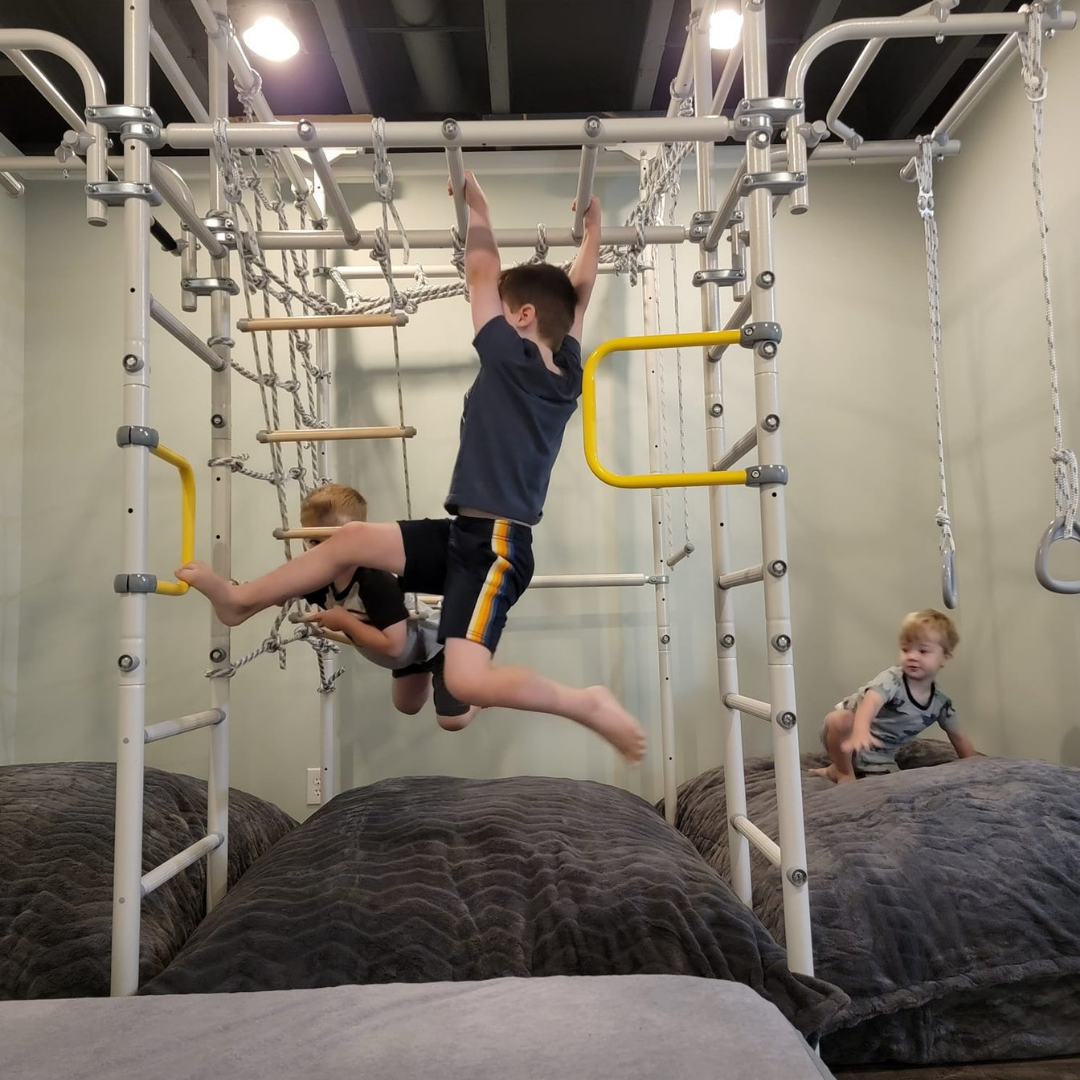
Start here, because it's the one that carries the other four. Everything below works better when there's a fixed, always-available thing to climb, swing, and hang from in the middle of your home. Climbing is one of the richest movements a child can do: it trains grip and core strength, and it's one of the few activities the CDC lists by name as muscle-strengthening for children. Add a swing and you get the single most concentrated dose of vestibular input — the balance-and-head-position sense — available in ordinary play, the system that reaches adult-level function only around age 15 and takes roughly all of childhood to build.
🧗 CLIMBING
Motor planning, grip, and core strength in one move. The CDC counts it as muscle-strengthening — a home gym quietly checks a box the guidelines actually ask for.
🌀 SWINGING
Vestibular input that can either wind a child up or calm them down. Slow, rhythmic swinging tends to soothe — useful on a stir-crazy afternoon.
🐒 HANGING
Builds grip and shoulder strength and decompresses the spine — the postural foundation that later supports sitting and handwriting.
The magic of a home gym isn't any single session — it's that it's there at 7 a.m., between school subjects, and at that 5 p.m. witching hour when the walls start closing in. Owners in our community report their kids use it in short, self-directed bursts all day, which happens to be exactly how kids are meant to bank activity: accumulated in bursts, not scheduled in a block.
"We love using our gym to keep us active during our cold MN winters! ... People sell because they MOVE. Not because of boredom."
– EMILY FOGEL, BRAINRICH OWNER (MINNESOTA)
Want the full science on why this one activity does so much? We wrote it up in The Science Behind the Play Gym.
2. Build an obstacle course (a.k.a. "the floor is lava")
An obstacle course is a motor-planning puzzle disguised as chaos. To get from the couch to the kitchen without touching the "lava," a child has to sequence moves three steps ahead, judge distances, and adjust mid-stride — the same whole-body error-correction that builds coordination. It costs nothing but couch cushions, painter's tape, and a laundry basket.
A 5-minute course, no special gear:
➊ Crawl under a row of dining chairs (proprioception + cross-lateral coordination)
➋ Balance-walk a line of painter's tape on the floor (vestibular calibration)
➌ Jump from cushion to cushion, "lava" in between (bone-strengthening + force control)
➍ Climb & hang across the monkey bars if you have a gym — the natural finish line
➎ Crash-land onto a pile of pillows or an impact mat (the best part, obviously)
Re-theme it daily to keep the novelty alive — today it's a spy course, tomorrow it's the floor-is-lava, next week it's a timed race against a sibling. If you own a climbing gym, run the course to it and through it: the gym becomes the centerpiece, and the tape-and-cushions become the on-ramps.
3. Race through animal walks and "heavy work"
Bear crawls, crab walks, frog jumps, and wheelbarrow races look like pure silliness. They're actually one of the most efficient ways to deliver proprioceptive input — the body-awareness sense that comes from pushing, pulling, and loading the muscles and joints. Occupational therapists call this kind of resistance activity "heavy work," and parents of energetic and sensory-seeking kids in our community swear by it for settling a wound-up child.
Proprioception comes online remarkably early — by about 10–12 weeks of fetal development — and it's trained by exactly this: pushing, pulling, hanging, climbing, and carrying. It's the sense that eventually lets a child move through a crowded room without crashing, and pour a cup without looking. Animal walks are proprioception practice dressed up as a game.
Make it a race, a relay, or a "walk like the animal I call out" game. No equipment required — though a climbing gym adds the heaviest heavy-work of all: pulling their own body weight up a net or across the bars. Many families we hear from first bought their gym precisely because a high-energy kid was climbing the furniture anyway.
"Before our gym my daughter drove me crazy with her jumping and climbing. Now she has her own area to do it and won't break any of my stuff."
– JENNA ROSE, BRAINRICH OWNER
4. Throw a freeze-dance party
Never underestimate a living-room dance party as a winter workout. Cranking music and dancing hard is genuine cardio, and the "freeze" version — where kids stop dead when the music cuts — sneaks in a real dose of inhibitory control: the ability to slam the brakes on an impulse, which is one of the foundations of classroom attention. It's the same skill a bout of active play has been shown to sharpen within the hour.
Freeze dance
Stop-on-a-dime practice for impulse control, wrapped in a giggle.
Spin & stop
A few safe spins deliver alerting vestibular input — then balance the wobble out.
Copy-the-move
Motor planning and memory as they mirror a silly sequence back to you.
Best of all, it's the easiest one to join — and when a parent gets up and moves, the kids reliably follow. One mom in our group put it simply: on the gym or on the dance floor, "if you use it, the kids will use it." Ninety seconds of "just one song" almost always turns into ten minutes.
5. Build a fort and let the story take over
The quietest activity on this list might be the most developmentally loaded. When a child turns a blanket-draped structure into a pirate ship, a rocket, or a cozy den, they're doing what the psychologist Lev Vygotsky called mature make-believe: holding an imaginary situation, taking on a role, and following the rules that role demands. That role-follows-rules discipline is, in his framing, the seed of self-regulation — the first arena where a child voluntarily governs their own behavior. Research links rich pretend play to gains in cognitive flexibility, working memory, and impulse control, especially when it's social and a caregiver joins in.
This is the sleeper hit of home climbing gyms, too. When we ask owners which feature gets used most, the answer surprises even them: it's not the swings or the monkey bars. It's the fort.
"I thought they would use the swings most... but they actually use the fort the most. They put nuggets up there and play house."
– KAIT SEIFFERT, BRAINRICH OWNER (KIDS AGES 4 & 6)
Whether it's couch cushions on the living-room floor or a loft platform up in the gym, the recipe is the same: give kids an open-ended space and low-realism props — cloths, boxes, pillows — and get out of the way. The less the toy dictates, the more the child has to imagine. Marrying a fort to a climbing structure hits the movement and the make-believe in one footprint.
Rainy day activities for kids, by age
A rainy Tuesday and a snowed-in Saturday ask for the same thing: a plan that fits the child in front of you. Here is how the five ideas above scale by age, so a 3-year-old and a 9-year-old can burn real energy in the same room, with a parent close by.
| Age | Rainy day activities that work | The gym move |
|---|---|---|
| 2-3 (a parent's hands close by) | Animal walks, cushion islands, a blanket fort, freeze dance with big arm moves | Lowest rungs only, gentle swinging with you holding the swing; keep it low and slow |
| 4-6 | Tape-line obstacle course, crawl tunnels, frog jumps, a fort with a story | Ladder climbs, first monkey-bar hangs, rings, ten minutes of swinging |
| 7-10 | Timed course, harder lava jumps, a dance-off, the fort as a reading nook | Full monkey-bar crossings, rope climbs, first pull-ups, a hammock swing for the wind-down |
| 11+ | Circuit rounds on the course, sibling challenges, coaching the younger ones | Pull-up bar sets, climbing rope, rings; the same steel frame is rated 220 lb, so it is still their gym |
Rainy day activities for kids do not need to be new every time. The families who get through a wet week without a screen marathon rotate the same five ideas and change the theme, the timer, or the finish line. Keep the gear where the kids can reach it, and keep the climbing in the same room as you.
Have a toddler and a cancelled evening trip to the park? Our guide to rainy day toddler activities without screens has 15 no-prep ideas for ages 1 to 3 and a simple plan for the hour before dinner.
How to string them into an active indoor day
You don't need to run all five like a gym class. The trick that makes bad-weather days survivable is accumulation, not scheduling. Kids bank their activity in short bursts, so twenty five-minute climbs, races, and dance breaks scattered across a day beat one forced "workout" every time. The research on home environments is refreshingly practical here: the biggest predictor of whether kids use active equipment is simply how available and accessible it is. Proximity beats willpower.
Available all day → used in bursts → energy spent → calmer kid → repeat
This only works if the active option is right there in the living space, on the days going outside isn't on the table.
That's the case for a home climbing gym as the anchor of the whole routine. It's not a replacement for the park, the yard, or a snowy afternoon of sledding — those days will always be better. It's the reliable default for the days they're off the table, so "go move" stays a real option even when the thermometer, the rain, or the calendar says no. And notably, it's the option kids tend to choose over a screen.
"I love that they choose this activity over iPads! And my most favourite part is my girls work together as a TEAM."
– KELLY SCHROTH, BRAINRICH OWNER
Which gym fits your family? Take the 60-Second Quiz →
The bottom line
Outdoor play wins every time it's available — keep chasing it. But the calendar hands every family a stack of days when it simply isn't: the deep-freeze week, the heat-wave month, the endless gray of a rainy season. On those days the choice isn't outside-versus-inside. It's active-inside versus the screen. Five simple activities — a daily climb, an obstacle course, animal-walk races, a freeze-dance party, and a fort that becomes a whole world — are how thousands of families keep movement, imagination, and sanity alive until the weather turns. And the piece that quietly makes all five easier is a structure built to be climbed every single day, right in the middle of your home.


Weatherproof your kids' movement year-round
Fits ceilings from 6'9" to 10'5", assembles in an afternoon, and is covered by a 30-day money-back guarantee.
Frequently asked questions
What are good rainy day activities for kids? The ones that move the whole body: a daily climb on a home gym, a couch-cushion obstacle course, animal-walk relays, a freeze-dance party, and a blanket fort that turns into pretend play. Scale them by age (see the table above), keep the equipment within reach, and stack short bursts through the day rather than one long session.
How much physical activity do kids actually need each day? Health authorities converge on a lot. The WHO recommends about 180 minutes of activity a day for children 1–4 (with at least an hour of it energetic for 3–4-year-olds), and the CDC and WHO recommend 60+ minutes of moderate-to-vigorous activity every day for kids 6–17, plus muscle- and bone-strengthening play at least three days a week. Bad weather doesn't lower the target — it just makes hitting it indoors the challenge.
Isn't outdoor play better than any of this? Yes, and we'd never argue otherwise — outdoor play is one of the best things a childhood can have. These indoor activities aren't a replacement for the park or the backyard. They're for the days when heat, cold, rain, or a packed schedule take the outdoors off the table, so "go move" stays a real option instead of defaulting to a screen.
What indoor activities burn the most energy on a rainy day? Anything that gets the whole body climbing, jumping, and hanging. A daily climb on a home gym, a couch-cushion obstacle course, animal-walk relays (bear crawls, crab walks), and a hard-charging freeze-dance party all reach genuinely active intensity. Active indoor play burns far more energy than sitting in front of a screen — the point is simply to keep them moving.
Does indoor climbing really help kids develop? Research links whole-body climbing, swinging, and hanging to gains in balance, coordination, grip and core strength, and spatial awareness, and the CDC specifically names climbing as a muscle-strengthening activity for children. A single bout of active play has also been shown to sharpen attention and impulse control within the hour. It's a genuine developmental input — not a therapy or a guarantee, but a real one.
My child climbs the furniture when they're stuck inside. What do I do? That's not misbehavior — it's a developmental drive running on the wrong equipment. Kids are wired to seek height and heavy work. The most effective fix families in our community describe is giving that urge a dedicated, safe home: a climbing structure they're allowed to use, so the couch, counters, and door frames stop being the target.
Won't a home gym just get ignored after a few weeks? It's the top pre-purchase fear, and long-term owners push back hard on it. Because a home gym is available every day and gets folded into obstacle courses, fort play, and energy dumps, families routinely report daily use for years. As one owner put it, kids sell their gyms because they move house, "not because of boredom."
Sources
World Health Organization (2019). Guidelines on physical activity, sedentary behaviour and sleep for children under 5 years of age. · U.S. Centers for Disease Control and Prevention. Physical Activity Basics: Children (6–17) & Preschoolers. · Yogi, R. (2025). Changes in Motor Skill Performance of 13-Year-Old Japanese Boys and Girls: A Cross-Sectional Study over Six Decades (1964–2023). Sports (Basel). · Vestibular development & cognition review. The Vestibular System and Its Role in Child Development. Children (Basel), 2024. · Acute exercise, BDNF & inhibitory control in children (n=47). PMC9139511. · Role-play & executive function in preschoolers. PMC9743294. · Brussoni, M. et al. (2015). What is the relationship between risky outdoor play and health in children? A systematic review. Int. Journal of Environmental Research and Public Health. · American Academy of Pediatrics. Media and Children.
Share: