

Updated August 2026 · 12-min read · by the Brainrich Kids team
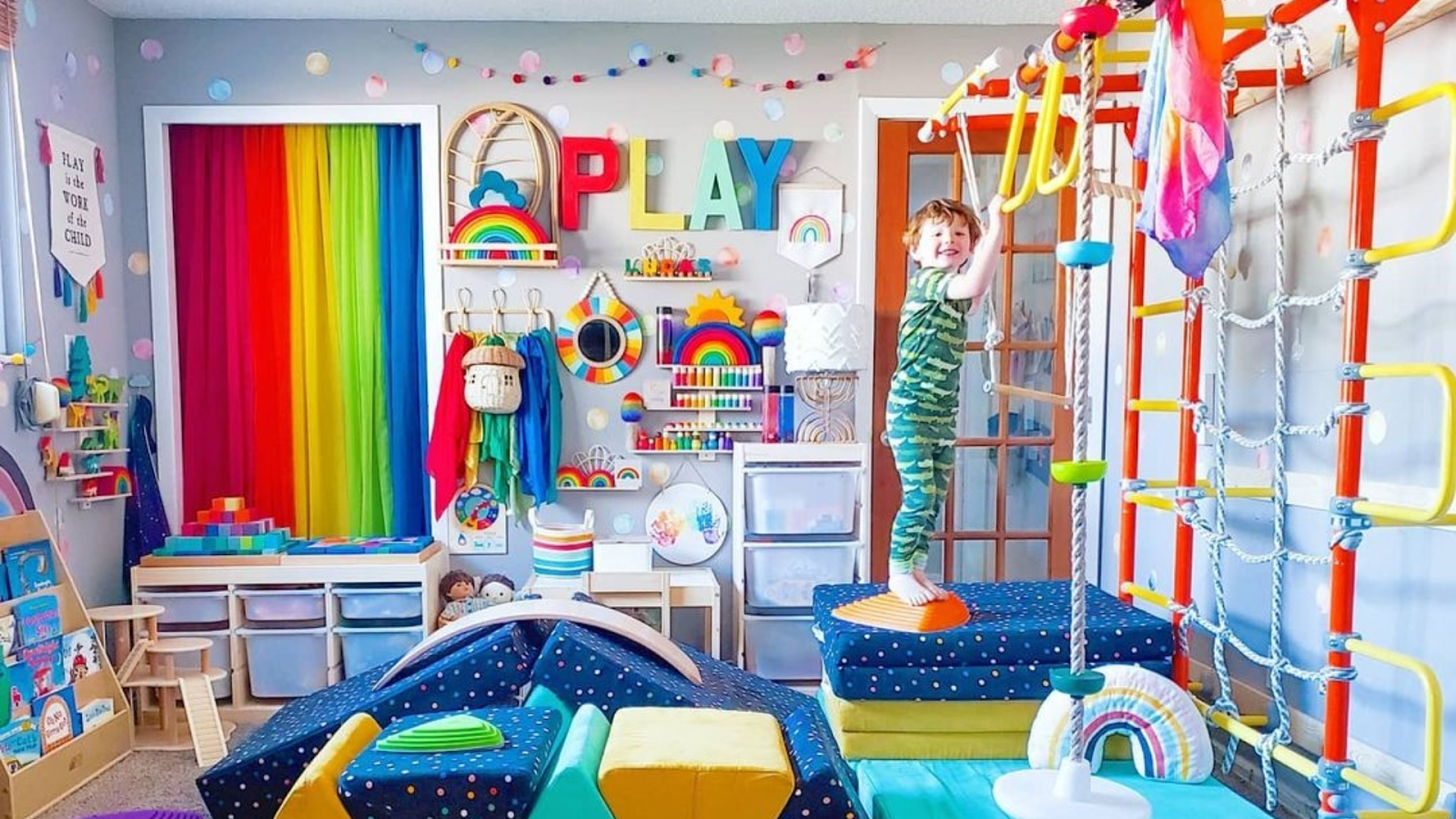
Most families do not have a playroom AND a homeschool room. They have one room, and every September it hosts a quiet turf war: the math books want the table, the blocks want the floor, and by October the toys usually win. The combo room is not a compromise you settle for. Done right, it is the best-performing homeschool room layout we know, because the thing a playroom does best (moving a child's body) is the exact thing a homeschool day needs most.
The quick answer: a playroom-homeschool combo works when you give it one anchor and clear zones. Anchor the room with the biggest piece, ideally the play gym, then build a desk zone alongside it, keep toys in closed rotation bins so lessons never compete with an open toy wall, and give the youngest sibling a dedicated floor spot within sight of the desk. School happens next to the gym, recess is ten feet away, and the room switches modes with a two-minute reset instead of a renovation.
Jump to: One room, two jobs · The gym as anchor · Toy-rotation storage · Noise & siblings · Three layout blueprints · FAQ
One room, two jobs (and why combining beats separating)
Start with the surprising part: even families with a spare room often end up combining anyway. A separate homeschool room sounds disciplined, but it competes with wherever the toys live, and young kids drift to the fun room while the school room goes quiet and cold. Merge the two and the drift disappears, because there is nowhere better to be.
The deeper reason the combo works is rhythm. A homeschool day for a 4-to-9-year-old is not three solid hours of seat work; it is short lesson blocks separated by physical resets. Twenty minutes of phonics, ten minutes of climbing, twenty minutes of math. When the play half of the room is steps from the desk half, those resets cost zero transition time, no shoes, no herding, no losing the child to another floor of the house. The playroom stops being the enemy of the lesson and becomes its pacing mechanism.
What ruins combo rooms is never the play equipment. It is visual chaos: an open toy wall in the child's sightline during a lesson is a shelf full of invitations. The whole craft below comes down to one anchor, defined zones, and toys that disappear when it is school time.
One reframe before the blueprints: stop thinking of the play half as the part of the room school has to tolerate. Climbing, swinging, and hanging deliver the vestibular and proprioceptive input young nervous systems need to settle into focused work, and health authorities recommend a full 60 minutes of daily activity for school-age kids that a homeschool has to supply on purpose. In a combo room, that hour is built into the floor plan.
The gym as the room's anchor (desk zone alongside)
Every well-designed room has an anchor piece that organizes everything around it: the bed in a bedroom, the sofa in a living room. In a combo room, let the play gym be the anchor. It is the tallest, most-used object in the room, so fighting it for attention is pointless; placing it first and arranging the rest around it makes the layout almost draw itself.
Practical placement rules from hundreds of customer rooms:
🧗 GYM AGAINST A WALL OR CORNER
Frees the room's center, keeps swing clearance in one predictable arc, and leaves the window wall for the desk.
🪑 DESK FACING AWAY FROM THE GYM
The child looks at the wall or window during seat work, and the gym waits behind them as the reward, not in front of them as the temptation.
🟦 MATS MARK THE BORDER
Impact mats under the landing zones double as the visual line between "movement zone" and "work zone." Kids respect a border they can see.
Then run the day on a simple loop: lesson at the desk, body break on the gym, back to the desk. Climbing, swinging, and hanging are dense sensory work, the vestibular and proprioceptive input growing bodies actively seek, which is why ten minutes on the gym settles a wiggly learner better than thirty minutes of "just sit still." Our homeschool room ideas guide covers the movement-first philosophy room by room, and the setup checklist turns it into a step-by-step build.
One age note, because we are strict about it: Brainrich gyms are rated for independent climbing at ages 3+. In a combo room that also hosts a toddler, the gym is still the anchor, but the under-3 crowd uses it only hands-on with you, and the toddler's own zone (below) is where they spend the unsupervised minutes.
Toy-rotation storage: so lessons are not a toy battle
Here is the storage rule that makes the whole combo possible: open shelves for school things, closed bins for toys. School materials should invite; toys should wait their turn.
The research backs the instinct. In a University of Toledo study, toddlers given just four toys played longer and in more sophisticated, varied ways with each one than toddlers given sixteen; fewer available toys produced deeper play. Rotation gives you that effect on demand: most toys live in opaque bins out of reach or out of sight, one or two bins are "open" in a given week, and swapping bins takes five minutes on a Sunday. The out-of-rotation toys come back with the novelty of new ones, which quietly also cuts the toy budget.
In practice, the TROFAST-style bin tower is the combo room's workhorse: bins the child can pull out and put back alone, but with lids and label-free fronts so closed means closed. During school hours the rule is binary and easy for even a 4-year-old to follow: bins closed, gym open. Play is never banned during school time, it is channeled to the one outlet that regulates instead of scatters. After the last lesson, a bin opens and the room switches modes without anyone moving furniture.
For the broader playroom side of this system, our kids playroom ideas guide goes deep on storage, zones, and what to skip.
Noise and siblings: the toddler-plays-while-big-kid-works problem
The hardest hour in a multi-age homeschool is not teaching. It is occupying the 2-year-old while the 6-year-old does phonics. The combo room handles it better than any other layout because everyone is in one supervised space, but it needs three deliberate moves:
| Move | How it works |
|---|---|
| Give the toddler a zone, not the room | A rug with a rotating "toddler bin" (their own TROFAST bin, opened only during school hours) placed within your sightline but outside the older child's. Novel toys that appear only at lesson time buy 20 to 30 minute stretches. |
| Stagger the movement blocks | The big kid's gym break is the toddler's lap-time, and vice versa. Two kids taking turns between desk, floor, and gym is a schedule; two kids free-running one room is a wrestling match. |
| Manage sound, not silence | A big rug and impact mats absorb most play noise; a $20 pair of kids' ear-defenders on the desk handles the rest. Aiming for a silent room with a toddler in it is a plan to feel like a failure by 10am. Aim for "workable hum." |
And the note we give every parent of an under-3 in a climbing household: supervision near the gym is eyes-on and within reach. The 3+ rating is not decoration, it is the line between a toddler exploring with you and a toddler improvising alone. Toddlers who grow up watching an older sibling climb arrive at their own 3rd birthday with an expert demonstration library already loaded; if yours is between the Pikler stage and the big gym, what comes after the Pikler triangle maps that hand-off.
Three layout blueprints (small, medium, large)
Three proportions cover nearly every combo room we see in customer photos. In each one, the order of operations is identical: place the gym first, the desk second, the storage third, and let the leftover floor become the flexible zone. Measure your swing clearance before you commit the gym's wall, and keep the door's traffic lane clear of both mats and desk chairs.
"The room switches modes with a two-minute reset: bins close, desk clears, mats stay. School mode and play mode are the same furniture wearing different rules, and the kids learn the rules faster than the adults do."
– THE COMBO-ROOM PRINCIPLE, IN ONE SENTENCE
Small: the 10×10 bedroom-size room. Anchor a compact gym like the Model T3 in the corner farthest from the door, mats along its open side. Desk (a small child's table) under the window, facing the wall. One KALLAX-height shelf for school materials beside the desk, one closed bin tower beside the gym, toddler rug between desk and door. There is no spare floor, which is fine: the floor zone and the mat zone are the same real estate at different hours. If this is your situation, our small-space homeschool guide is the deep dive.
Medium: the 12×14 bonus room. This is the sweet spot for a mid-size gym like the Spider Max V3 along the long wall, with its two nets and monkey bars forming a genuine circuit. Desk zone on the opposite wall, facing away. Between them, an open floor lane that serves as reading rug, block-building site, and the toddler's territory. Closed toy storage lines the short wall. School and play run simultaneously without eye contact between zones, which is exactly the goal.
Large: the basement or bonus-room family setup. With 15+ feet of run, the gym can leave the wall and become a room divider: a Mega Max V3 placed perpendicular to the long wall splits the space into a school side (desks, shelves, floor rug) and a play side (mats, bins, toddler zone), no partition needed. Multiple kids climb simultaneously between lesson blocks, and the parent's chair sits at the seam with sightlines into both halves. This is the layout co-op host families end up with, because it absorbs four or five kids without the room dissolving.
Which gym anchors your combo room? Take the 60-Second Quiz →


One room. Both jobs. Zero turf war.
Every gym assembles in an afternoon and is covered by a 30-day money-back guarantee.
Frequently asked questions
Can a playroom and homeschool room really share one space? Yes, and for most families it outperforms two separate rooms. The key is structure: one anchor piece, a desk zone facing away from the play zone, toys in closed rotation bins during lessons, and a visible border (mats or a rug line) between the two halves. The play side then powers the school side by hosting the between-lesson movement breaks every young learner needs.
Won't the toys distract my child during school? Only if they are visible. The working rule is open shelves for school materials, closed opaque bins for toys, with "bins closed, gym open" as the school-hours default. Research on play supports it: toddlers offered fewer toys at once played longer and more deeply with each one, which is exactly what rotation bins engineer.
Where should the play gym go in a combo room? Against a wall or in a corner in small and medium rooms, freeing the center and keeping swing clearance predictable, with the desk on the opposite side facing away. In large rooms (15+ feet of run), a big gym like the Mega Max V3 can sit perpendicular to the wall as a room divider, splitting school side from play side without a partition.
How do I keep a toddler busy while an older child does lessons? Give the toddler a dedicated rug zone within your sightline but outside the student's, stocked from a toddler-only rotation bin that opens exclusively during school hours, and stagger movement breaks so one child is at the desk while the other moves. For under-3s, gym time is always hands-on with an adult; independent climbing starts at age 3+.
How big does the room need to be? A 10×10 bedroom fits the full system with a compact gym like the Model T3 in a corner. A 12×14 bonus room comfortably runs a Spider Max V3 plus desk zone plus toddler floor lane. The layout matters more than the square footage: anchor first, zones second, storage closed.
Does the noise make lessons impossible? Aim for a workable hum, not silence. Rugs and impact mats absorb most play sound, kids' ear-defenders at the desk handle focus-heavy tasks, and staggered turns keep the loudest activity (two kids on the gym at once) out of lesson time.
📚 Keep reading in the Decision Guide
Kids Playroom Ideas · Homeschool Room Ideas: 25 Spaces That Actually Get Used · Small-Space Homeschooling · Homeschool Room Setup: The Checklist · What Comes After the Pikler Triangle
Sources
Dauch, C. et al. (2018). The influence of the number of toys in the environment on toddlers' play. Infant Behavior and Development. · CDC. Physical activity guidelines for children and adolescents (60 minutes daily).
Share: