

Published September 2026 · 9-minute read · by Yegor Nadvornyy, founder of Brainrich Kids
The bookshelf. The kitchen counters. The back of the couch, the dresser, the fence, you. If you're parenting an autistic child who treats gravity as a suggestion, you've probably heard every theory from "no fear" to "attention seeking." The real explanation is better news than either: the climbing is purposeful, it's meeting a real neurological need, and it redirects beautifully once you understand what it's for.
The quick answer: climbing is one of the densest sensory activities that exists. Every pull loads muscles and joints (proprioceptive input, the great organizer of the nervous system) while height changes and tilts feed the inner ear (vestibular input). Many autistic kids under-register one or both, so they seek them hard, and the furniture is simply the tallest equipment in the house. The fix is not to extinguish climbing (the need remains and finds worse routes); it is to out-compete the furniture: give the climbing a dedicated, safer, more interesting home and put the boring stuff off-limits.
Jump to: What the climbing is doing · The affirming lens · The redirect playbook · Safety rules · FAQ
What the climbing is actually doing
Watch closely and the "reckless" climb resolves into a nervous system running errands:
- Proprioceptive supply. Hauling body weight upward is maximal muscle-and-joint work, the input that organizes and calms the nervous system more reliably than anything else. The child who climbs constantly and settles afterward is self-medicating with gravity, effectively.
- Vestibular supply. Height, tilt, and the little balance corrections at the top feed the inner-ear motion system that many autistic kids crave in large doses.
- A movement stim, sometimes. Repetitive climb-descend-climb loops can function like rocking or spinning: rhythmic, predictable input on demand. Our stimming guide covers why that's regulation, not misbehavior.
- Pressure-seeking's tall cousin. Wedging into the gap above the wardrobe or perching high in tight spots often pairs climbing with the enclosed-space seeking common in sensory seekers.
- A body-map builder. Motor differences are common in autism, and climbing is one of the few activities that trains strength, planning, and coordination simultaneously, with instant physical feedback and zero social judgment.
One caution inside the good news: sensory-seeking climbers can genuinely misjudge hazards, so the answer is safe supply plus supervision, never unsupervised faith.
The affirming lens: need, not naughtiness
Every consequence-based approach to furniture climbing eventually collides with the same fact: you cannot discipline away a sensory need. Punish the climbing and the need re-routes: to less supervised moments, to riskier structures, or into the general dysregulation of a nervous system running on empty. The families who win this reframe the question from "how do I stop it" to "where do I want it to happen." That's the same redirect philosophy in our general guide to toddlers who climb everything, tuned here for the autistic child whose need is usually bigger, lasts longer past toddlerhood, and deserves equipment that takes it seriously. There's solid developmental company in that position: the research on climbing and risky play, covered in our controlled risky play guide, associates challenging climbing with gains in confidence, risk judgment, and motor skill.
The redirect playbook
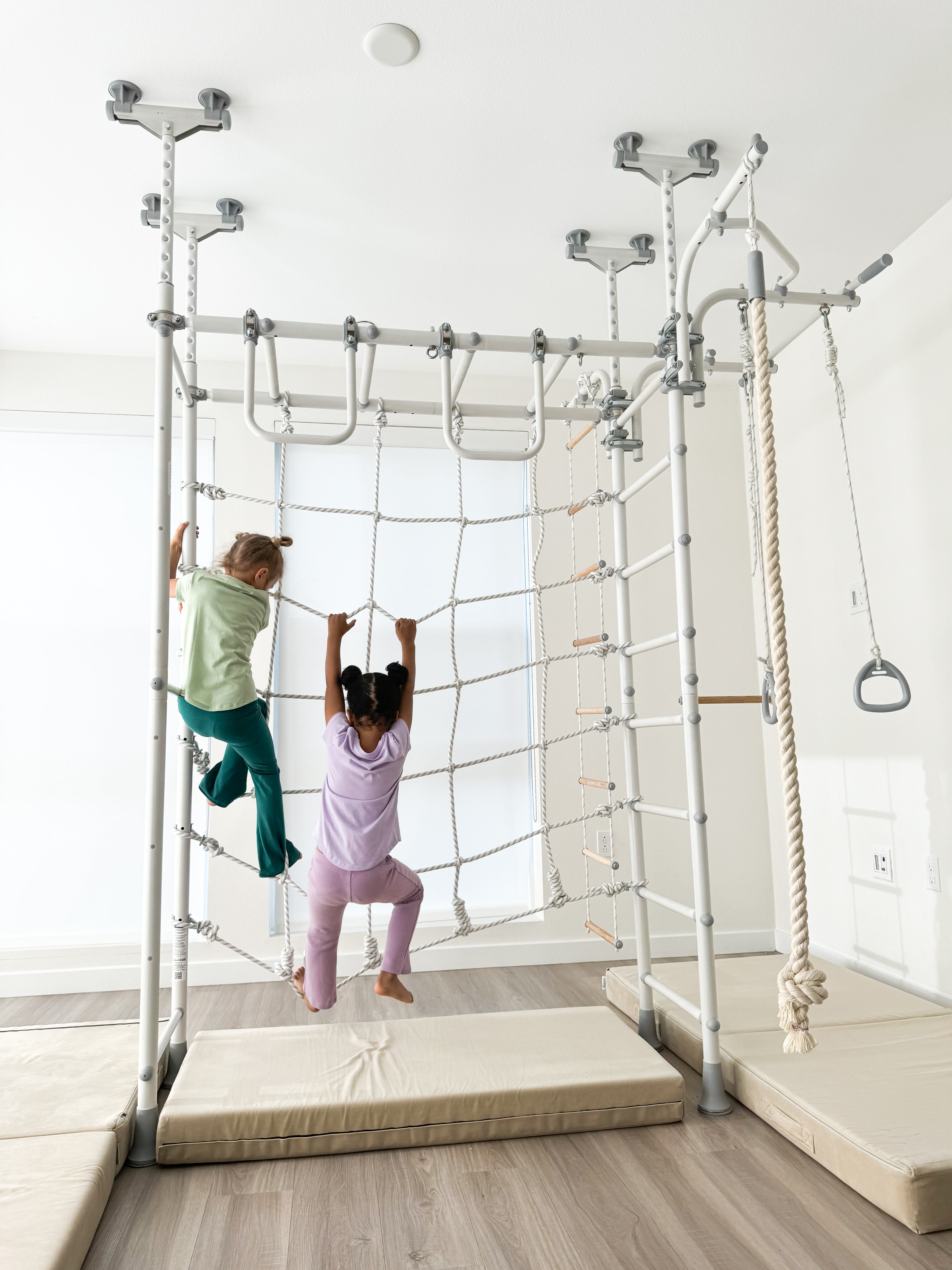
- Give the climbing a home that out-competes the furniture. The redirect only sticks if the sanctioned option is more interesting than the counters: taller, more varied, more challenging. A floor-to-ceiling frame with ladders, a net, rings, and a rope beats the bookshelf on every axis that matters to a seeker. Dedicated options live in our autism climbing equipment collection.
- Make the rule physical, not verbal. "Climbing happens on the gym" is enforceable; "stop climbing" is not. Anchor or block the furniture that must be off-limits (anti-tip straps regardless: furniture anchoring is basic safety for every seeker household), and walk the child to the sanctioned structure every single time, without commentary. Consistency does the teaching.
- Feed the need on schedule, not just on demand. Planned climbing doses before demands (school, homework, errands) shrink the freelance climbing dramatically. The architecture for that is a sensory diet, and climbing is its densest single ingredient.
- Add the descent skill. Many climbing incidents are really dismount incidents. Teach down as deliberately as up: feet-first, rung by rung, mat below. Competence is the safety feature that travels to playgrounds and grandma's house.
- Upgrade the challenge before boredom does. When the current setup gets easy, seekers go looking. Modular equipment helps here: rings, ropes, and a rope ladder rotate the challenge, and monkey bars add the hand-over-hand traverse (on our system, the Spider V3 comes with the monkey bars built in, and the Monkey Bars V3 add-on is for families that already own a Brainrich frame).
The safety rules that make yes possible
- Independent climbing starts at age 3+, and a parent stays in the same room for younger kids and new skills.
- Mats under everything. A thick mat under the climbing zone converts most falls into stories instead of ER visits.
- Rated equipment only. A structure holding a climbing child should publish its numbers: our steel frames carry a 220 lb working load, safety-tested to 440, which also means the frame doesn't wobble, and a wobble-free structure is itself a safety feature for kids still building their body map.
- Anchor the rest of the house. Anti-tip straps on dressers and shelves, always: redirect optimistically, anchor pessimistically.
- Supervise the seeker's judgment, not just their body. Celebrate height achieved on the right structure; keep the veto on wrong structures boring and absolute.
On paying for it: for a child with a qualifying diagnosis, climbing and sensory equipment may be HSA/FSA eligible with a Letter of Medical Necessity, and some state waiver programs fund sensory equipment directly.
Out-compete the bookshelf
Steel floor-to-ceiling climbing frames that give the need a taller, safer, more interesting home. Independent climbing at 3+, 220 lb working load, safety-tested to 440. No drilling, 30-day money-back guarantee.
Frequently asked questions
Why does my autistic child climb everything? Because climbing is one of the densest sources of the sensory input many autistic nervous systems under-register: proprioceptive input from muscles and joints working against gravity, and vestibular input from height and balance. The furniture is simply the tallest available equipment. The behavior is purposeful self-regulation, not defiance, and it redirects well onto dedicated climbing structures.
Should I stop my autistic child from climbing? Stop the location, not the climbing. The sensory need behind it cannot be disciplined away and will re-route to less supervised moments if suppressed. The working approach: provide a sanctioned climbing structure that's more interesting than the furniture, make the rule physical ("climbing happens on the gym"), anchor furniture with anti-tip straps, and schedule climbing time before demanding parts of the day.
What climbing equipment is best for autistic kids? Equipment that out-competes furniture: floor-to-ceiling frames with varied elements (ladders, nets, rings, ropes, monkey bars), published weight ratings, and a mat underneath. Rigidity matters: a frame that doesn't wobble supports kids still building their body map. Modular systems help long-term because the challenge can grow before boredom sends the child back to the counters.
Is climbing good for autistic kids? Climbing trains strength, motor planning, balance, and confidence simultaneously while delivering the proprioceptive and vestibular input that supports regulation, and research on risky play associates challenging climbing with better risk judgment. With rated equipment, mats, and age-appropriate supervision, it's one of the highest-value physical activities available at home.
📚 Keep reading in the Decision Guide
My Toddler Climbs Everything · Sensory Seekers: The Signs and the Science · The Science of Controlled Risky Play
Sources
Ayres, A.J. (1972). Sensory Integration and Learning Disorders. Western Psychological Services. · Kranowitz, C. (2005). The Out-of-Sync Child. Perigee. · Hanscom, A. (2016). Balanced and Barefoot. New Harbinger. · STAR Institute for Sensory Processing. sensoryhealth.org. · Brainrich Kids engineering specification: frame working load 220 lb, safety-tested to 440 lb.
Share: