

Updated September 2026 · 12-minute read · by the Brainrich Kids team
If you are searching "how much is KidStrong," you are probably a parent who has watched a trial class, seen your kid beam at the award ceremony, and then been handed a membership agreement. KidStrong is a good program, and this is not an article about why you should skip it. It is a price guide with real numbers from real locations, what parents say after six months, and a side-by-side with the other way families buy the same thing: a climbing gym in the living room. We make those gyms, so read our half of the comparison with that in mind. We have shown every number so you can check it.
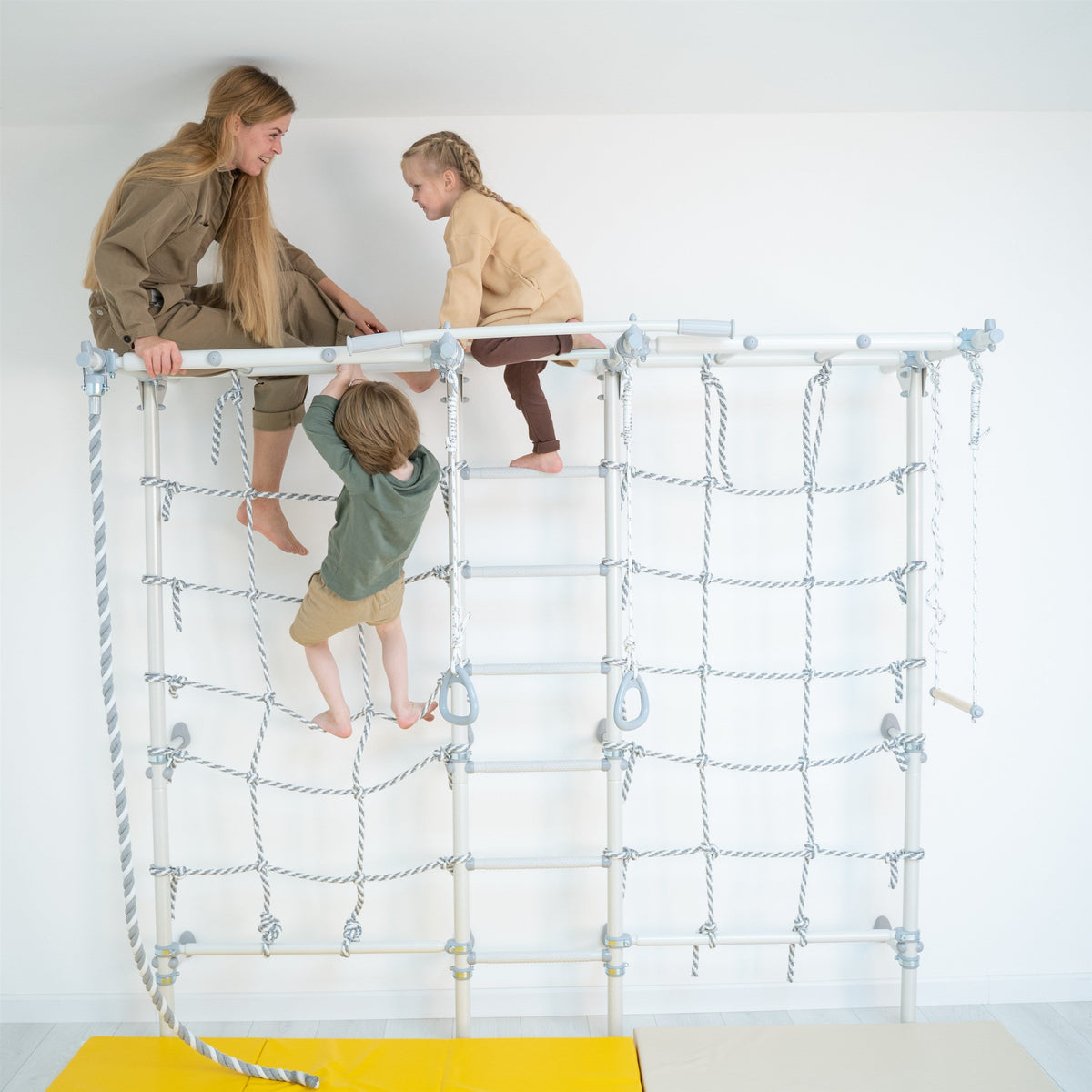
The quick answer: KidStrong does not publish national prices, but local listings put a membership at roughly $99 to $199 a month for one 45-minute class a week, plus a registration fee around $50 to $100, usually on a 6-month commitment with 30 days' written notice to cancel. Budget for sick weeks too: the AAP says most children have 8 to 10 colds in their first two years, more in daycare and in winter, and KidStrong's agreement says dues are payable "regardless of usage," so a class missed to a cold is still paid for. At $119 a month, one child costs about $1,478 in year one and $2,906 over two years. A Model T3 home gym costs $899 once and passes that spend in month 8; a Spider Max V3 ($1,899) passes it in month 16 (expected use 3 to 10 years; owners usually resell at 30% to 50% below the new price; our math uses 3 years and the 50% case, both conservative). Counting that resale, a T3 works out to about 41 cents a day over three years (conservative case), because it gets used daily; the membership stays $119 a month whether or not every class gets used. KidStrong wins on coaching, curriculum, and a room full of kids. A home gym wins on how often a child climbs: every day instead of once a week, in any weather, on sick weeks, with no drive. Many families will be happiest with both, used for different jobs.
Jump to: What KidStrong is · What it costs · What parents say · 12 and 24 months side by side · Weekly class vs daily play · Winter and sick season · The social question · When a home gym makes more sense · FAQ
What is KidStrong?
KidStrong is a franchise of indoor child-development centers founded in 2015 by Matt and Megin Sharp in Lexington, Kentucky. It describes itself as a "science-based kids training program that builds strong, confident and high-character kids," organized around three pillars: strong body, strong mind, strong character. By July 2026 it was approaching 200 open centers in the US and Canada, with more than 65,000 kids attending each week.
Classes are for members, run 45 minutes, and are grouped by age: BabyStrong for crawlers and early walkers, then walking to 2, 2 to 4, 4 to 7, and 7 to 11. Parents join on the floor for kids under 4. A class moves through set blocks (an affirmation, a social greeting, foundations, a milestone skill, movement and learning games, a competition, and an award ceremony), and kids "rank up" roughly every 10 classes, earning a new jersey and title such as Alpha, Titan, or Hero along the way.
What KidStrong sells is not only movement. It is a coach, a curriculum, and a room of peers: kids practice eye contact, a handshake, speaking in front of a group, and taking turns under a trained adult. KidStrong's own parent survey reports that 96% of parents saw more self-confidence and 88% saw better social skills. It is a company survey with no published method, so treat it as what parents told KidStrong, but it lines up with the most common praise in independent reviews.
How much does KidStrong cost?
KidStrong sets no national price. Each center is independently owned and sets its own dues, so the most useful answer is a set of real examples with dates attached:
| Location | Published price | Source, date |
|---|---|---|
| Creve Coeur (St. Louis), MO | $119 a month, sibling discounts available | St. Louis Magazine, updated Feb 2025 |
| Noblesville / Carmel, IN | Basic $119 a month (4 classes); Premier $199 a month (2 a week); Flex add-on $55 | Indy with Kids guide |
| Pike Creek (Wilmington), DE | $109 a month on a 6-month contract or $129 month-to-month, each with one makeup class a month; enrollment fee "typically $50" | Center listing, Aug 2024 |
| Frisco, TX | About $135 month-to-month, or $109 plus a $50 registration fee | Parent answer on Yelp, about 2021 |
| Industry roundups | $99 to $199 a month; registration $50 to $100 | The Franchise King and ThePricer, 2026 |
Prices change and vary by center. Call your local center for its current rate before you budget.
How much is KidStrong per month? For one child at one class a week, plan on about $110 to $140 a month at most centers we found, and around $199 for a twice-a-week plan. At $119 a month and about 4.3 classes a month, that works out to roughly $27 per 45-minute class.
The terms matter as much as the price. In KidStrong's own replies to Better Business Bureau complaints, the company quotes its membership agreement: membership "is payable regardless of usage or change of circumstance," and rates are "not prorated for holidays or bad weather closings." Cancelling takes 30 days' written notice, and billing continues through that window, which usually means one more month of dues after you decide to stop. Many centers sell a 6-month commitment at a lower monthly rate than month-to-month. None of this is unusual for a membership business, but it is the part of the agreement parents most often say they wish they had read first.
🤧 Before you sign: put sick weeks next to the contract
How often young kids get sick. The CDC notes that adults average two to three colds a year and children usually have more; the American Academy of Pediatrics puts it at around 8 to 10 colds in the first two years, with more for kids in childcare and in winter.
Kids share germs, and sick kids stay home. Whenever young children share a room, there is some risk of passing a bug around, which is why the AAP counts more colds for kids in childcare or with school-age siblings. A class full of other kids is a shared room too. The usual cycle: a child plays with other kids, catches something, and then stays home for the next class or two. In a national Mott Children's Hospital poll, 62% of parents said illness kept their child out of childcare at least once in a year, and 38% said it happened three or more times.
What the membership says. KidStrong's agreement, as quoted in its own BBB replies, says dues are payable "regardless of usage or change of circumstance" and are "not prorated for holidays or bad weather closings." Parents on the BBB describe being billed through a child's illness or injury. Some centers include a makeup class each month (Pike Creek, Delaware lists one), so ask yours how makeups work.
What a home gym does on those weeks. Nothing changes: it is in the living room on the day the fever breaks, on snow days, and on holidays, with no class to reschedule.
Other costs to know: birthday parties run about $299 to $499 depending on the center and membership, Parents Night Out about $35 to $45, and many centers run day camps.
KidStrong reviews: what parents like and what they don't
Read enough KidStrong reviews across Google, Yelp, Reddit, and the BBB and a clear pattern appears. The praise is about people; the complaints are about billing.
WHAT PARENTS LIKE
Coaches. Even many unhappy reviewers say the coaches were great. Confidence and manners: parents describe shy kids speaking up, making eye contact, and shaking hands. Structure: ranks and jerseys give kids a goal they can see. Inclusion: several parents of neurodivergent kids say their child was welcomed.
WHAT PARENTS DISLIKE
Cancellation and billing: the extra month during the 30-day notice, charges that continued through an injury or illness, and cancelling through an app. Price for one class a week. Sales pressure at the trial. Busy toddler classes where little ones wander. Consistency: as a franchise, one reviewer noted, "practices vary widely."
The BBB profile for KidStrong's corporate entity (which covers the company and its corporate centers, not every franchise) showed an F rating with 37 complaints over three years when we checked in September 2026, most of them about the notice period and billing. That profile does not cover every franchise, and many local reviews are glowing about the coaches. A Noblesville parent on Reddit summed up the common view: the coaches are great, but read the contract and cancellation policy. That is fair advice for any membership.
KidStrong vs a home play gym: 12 and 24 months side by side
Here is the cost comparison for one child, using $119 a month (the most common figure we found) and $199 a month (a twice-a-week plan), with a $50 registration fee counted once:
| After 12 months | After 24 months | Sessions in 24 months | |
|---|---|---|---|
| KidStrong, 1 class a week ($119/mo) | $1,478 | $2,906 | About 104 classes (78 hours) |
| KidStrong, 2 classes a week ($199/mo) | $2,438 | $4,826 | About 208 classes |
| Model T3 | $899 | $899 | Whenever your child wants: before breakfast, after school, on snow days |
| Spider V3 | $1,499 | $1,499 | |
| Spider Max V3 | $1,899 | $1,899 |
MONTH WHEN MEMBERSHIP SPEND PASSES THE GYM'S PRICE
Model T3 ($899)
Spider V3 ($1,499)
Spider Max V3 ($1,899)
At $119 a month for one child, $50 registration included. At $199 a month the crossover comes in months 5, 8, and 10. Gym prices shown before resale (expected use 3 to 10 years; owners usually resell at 30% to 50% below the new price; our math uses 3 years and the 50% case, both conservative).
What a gym costs per day of use
A membership is paid by the month, whether your child makes every class or misses three weeks to a cold. A home gym is paid for once and used every day, so per day is the fair way to count it. Families use a Brainrich gym for anywhere from 3 to 10 years, depending on how many children they have and how old the first one was at the start, and then pass it to a younger sibling, a cousin, or the next generation, or resell it. Owners who sell usually list at 30% to 50% below the new price, because powder-coated steel still looks close to new after years of daily use. The table uses the conservative end of both: 3 years of use and a 50% resale price (conservative case):
| Gym | Price | Net cost after ~50% resale | Per day over 3 years (conservative case) |
|---|---|---|---|
| Model T3 | $899 | About $450 | About $0.41 (before resale $0.82) |
| Spider V3 | $1,499 | About $750 | About $0.68 (before resale $1.37) |
| Spider Max V3 | $1,899 | About $950 | About $0.87 (before resale $1.73) |
| Mega Max V3 | $2,399 | About $1,200 | About $1.10 (before resale $2.19) |
3 years = 1,095 days. Kept for 5 or 10 years, or shared by siblings, the per-day cost drops further. For comparison, a KidStrong membership in our examples is $119 a month for one weekly class, $199 a month for two, per child.
A few things this table leaves out, and which way each one cuts:
- Second child. A membership roughly doubles for two kids (minus any sibling discount). A home gym costs the same for one child or three.
- Driving. One class a week is about 52 round trips a year. If the drive, parking, and check-in add 40 minutes, that is roughly 35 hours a year in the car on top of the 39 hours of class.
- The gym keeps its value. Families use one for 3 to 10 years, then pass it down or resell it, usually at 30% to 50% below the new price, since the steel still looks close to new.
- What KidStrong includes that a gym does not: a trained coach, a curriculum, peers, and the ceremony. A fair comparison counts those, and we come back to them below.
A weekly class vs daily play: why frequency matters for skills
Climbing, hanging, and swinging are skills, and skills are built by repetition. The CDC recommends that children 6 to 17 get 60 minutes of activity every day, including muscle-strengthening play such as climbing at least three days a week. A single 45-minute class, however well coached, covers a small share of a week that asks for seven hours.
Hand strength on a monkey bar, the timing of a swing, and the confidence to try the next rung come from small doses repeated often: five minutes before breakfast, ten while dinner cooks, twenty on a rainy Saturday. Maria Montessori saw movement and learning as inseparable, and pediatrician Emmi Pikler built her approach around children practicing movement freely, at their own pace, every day. A class teaches a skill; daily access is where the skill gets practiced until it is automatic. You can read more in does a home climbing gym help kids? and our guide to controlled risky play.
"Their most used toy by FAR, like by a landslide. They use it every day for hours."
LEISA L., MOM OF 3, BRAINRICH OWNER
A home gym also removes the two things that most often cancel a class: the weather and the calendar. It is available when a sibling is napping, when a parent works late, when the car is in the shop, and on the 7:40 a.m. mornings when a child needs to move before school. KidStrong's own agreement says rates are not prorated for weather closings. A gym in the living room does not close.
Winter, colds, and missed workdays
Every parent of a small child knows the season. The American Academy of Pediatrics says most children have around 8 to 10 colds in their first two years, and more if they spend time in childcare or have school-age siblings, especially in winter. The CDC notes that flu most often peaks between December and February and that RSV season starts in fall and peaks in winter, and that RSV can survive for many hours on hard surfaces.
Research on group settings points the same way. A Finnish study of 2,568 children found that kids in daycare centers had a 69% higher risk of the common cold than kids cared for at home, and Danish researchers found respiratory viruses widespread on shared toys and linens in nurseries. Two fair caveats: no study we could find has measured illness in kids' activity classes specifically, and long-term studies show the extra colds from group care tend to come earlier rather than adding up to more over childhood. For the most common cold virus, researchers find the air in a shared room matters more than shared surfaces, so the room itself is the exposure, not the mat.
The cost to parents is not small. In a national C.S. Mott Children's Hospital poll, 42% of parents of young children in childcare had missed work in the past year because their child was sick. A 2022 KFF survey found that when parents stay home with a sick child, 53% of mothers and 49% of fathers are not paid for that time, and the Bureau of Labor Statistics reports that about 1 in 5 private-sector workers has no paid sick leave at all.
Whenever children play together, there is some chance of bringing a bug home, and a class is no exception, however well it is run. A home gym is not a health product, but this is a practical point for cold-season planning: a child catches a cold from a playmate, misses the next class or two while recovering, and the membership bills the same. Every weekly group activity in December is one more shared room, and a child home on a sick week, or a sibling's sick week, still pays dues at most memberships. Playing at home in winter involves no car seats, no shared room, and no missed class to write off. We love outdoor play in every season, and a cold, bright January afternoon outside is one of the best things a child can do. The home gym covers the dark 5 p.m. hours and the week everyone is recovering.
"But my child needs other kids"
This is KidStrong's strongest argument, and we agree with it. Children learn turn-taking, patience, and courage from peers in ways a parent cannot teach alone. A coach who is not Mom or Dad can get a child to try something new.
A home gym does not replace the room full of kids. But friends can come to it. Try a play party at home: two or three friends over after school, a rotation between the swing, the rope ladder, and the monkey bars, and a snack on the floor afterward. The kids who come over are the same friends your child will see at school next week, which is how lasting friendships form. It costs nothing, fits your schedule, and grows the friendships your child already has. You set the size of the group, which also helps in cold season.
A home gym also needs a parent in the same room, and toddlers need your hands close by. It is not a drop-off class, and it will not run a curriculum for you. If you want someone else to teach, coach, and cheer, that is what a program like KidStrong is for.
When a home gym makes more sense
🏠 CHOOSE A HOME GYM WHEN
Your child needs to move every day, not once a week. You have more than one child. Weather, work, naps, or the drive keep cancelling plans. You want something that lasts from toddler years through the teens, with adults using the pull-up bar.
Choose both when you can. The home gym handles the daily climbing, and the class becomes an occasional treat instead of the only outlet. Many families do a season of KidStrong, a camp, or a party, and let the gym carry the rest of the year. Since KidStrong classes are for members, "once in a while" usually means a free trial, a camp, a party, or a shorter season of membership.
If you are weighing space, our small-space play gyms fit apartments, and every tension-mounted frame braces floor to ceiling with no drilling. For the same comparison against drop-in play centers, see home vs commercial indoor playground.
Which gym fits your ceiling? Take the 60-second quiz


A climbing gym that never closes
Steel play gyms used by more than 10,000 families, used for 3 to 10 years and then passed down or resold, rated for 220 lb, no drilling, and backed by a 30-day money-back guarantee.
Frequently asked questions
What is KidStrong? KidStrong is a franchise of indoor child-development centers, founded in 2015 in Lexington, Kentucky, with close to 200 locations as of mid-2026. Members attend a weekly 45-minute coached class grouped by age (walking to age 11, plus BabyStrong for crawlers), built around physical skills, brain games, and character habits, with ranks earned about every 10 classes.
How much is KidStrong per month? Prices are set by each location. Published examples range from about $99 to $199 a month; one class a week is commonly $109 to $140 (for example $119 in Creve Coeur, Missouri and Noblesville, Indiana), and twice-a-week plans run around $199. That is roughly $27 per class at $119 a month.
Does KidStrong charge an enrollment or registration fee? Most centers do, typically $50 to $100, though centers often discount it during promotions.
How much does a KidStrong membership cost for a year? At $119 a month plus a $50 registration fee, one child costs about $1,478 in the first year and $2,906 over two years. At $199 a month (twice a week), about $2,438 and $4,826.
Is there a KidStrong contract, and how do you cancel? Many centers offer a 6-month commitment at a lower rate, then month-to-month. KidStrong's membership agreement requires 30 days' written notice to cancel, and billing continues during that period. Ask your center for its written cancellation and freeze policy before signing.
Does KidStrong refund classes missed because a child is sick? Generally no. KidStrong's membership agreement, as quoted in its replies to BBB complaints, says dues are payable regardless of usage and are not prorated for holidays or weather closings. Some centers include a monthly makeup class, so ask your center how makeups work. With young children averaging 8 to 10 colds in their first two years (AAP), plan for missed weeks, especially in winter.
What do KidStrong reviews say? Parents consistently praise the coaches and the confidence and social skills their kids build. The most common complaints are about the 30-day cancellation notice, charges during injury or illness, price, and sales pressure. KidStrong's corporate BBB profile showed an F rating and 37 complaints in three years as of September 2026; that profile does not cover every franchise location.
Is KidStrong worth it? It can be, if you want a coached program with peers, have a center nearby, and can reliably make the weekly slot. If your goal is daily climbing and movement practice, a home play gym gives far more sessions for the money: a $899 Model T3 costs less than eight months of a $119 membership and is available every day. Used for 3 years and resold at half price (both conservative; most owners resell at 30% to 50% off), it works out to about 41 cents a day, while the membership stays $119 a month whether or not every class gets used. Many families do both.
How long is a KidStrong class and what ages does it serve? Classes are 45 minutes, usually once a week, for children from walking age to 11, with a BabyStrong class for crawlers and early walkers. Parents join on the floor for kids under 4.
Can my child go to KidStrong once in a while instead of joining? Regular classes are for members, but most centers offer a free trial class, and many run camps, birthday parties, and Parents Night Out events that non-members can book.
Does a home play gym replace a class like KidStrong? Not entirely. A home gym gives daily practice at climbing, hanging, and swinging in any weather, with a parent in the same room. It does not come with a coach or a curriculum. Families who want both often use the gym every day and a class for a season.
📚 Keep reading in the Decision Guide
Home vs Commercial Indoor Playground · Indoor Activities for High-Energy Kids · Best Indoor Play Gym for Kids Under 5 · Is a Play Gym HSA/FSA Eligible?
Sources
KidStrong's published pricing, Sep 2026. · 1851 Franchise (Jul 2026). KidStrong midyear 2026 growth. · St. Louis Magazine (updated Feb 2025). KidStrong opens in Creve Coeur. · Indy with Kids. KidStrong Noblesville. · Macaroni KID New Castle (Aug 2024). KidStrong Pike Creek summer special. · The Franchise King (2026). KidStrong franchise costs. · ThePricer (Mar 2026). How much does a KidStrong membership cost? · Better Business Bureau. KidStrong Inc. complaints and company responses (accessed Sep 29 2026). · American Academy of Pediatrics, HealthyChildren.org (2025). Children and Colds. · CDC. Flu Season; How RSV Spreads; Physical Activity Guidelines for Children. · Louhiala, P. et al. (1995). Form of day care and respiratory infections among Finnish children. American Journal of Public Health. · Ibfelt, T. et al. (2015). Presence of pathogenic bacteria and viruses in the daycare environment. Journal of Hospital Infection. · de Hoog, M. et al. (2014). Impact of early daycare on healthcare resource use related to upper respiratory tract infections during childhood. BMC Medicine. · C.S. Mott Children's Hospital National Poll on Children's Health (2012). Sick kids, struggling parents. · KFF (2022). Workplace benefits and family health care responsibilities. · U.S. Bureau of Labor Statistics (Sep 2026). Employee Benefits in the United States, March 2026. · Brainrich prices as listed on brainrichkids.com, September 2026. KidStrong is a trademark of KidStrong, Inc.; Brainrich Kids is not affiliated with KidStrong.
Share: