

Updated August 2026 · 10-minute read · by the Brainrich Kids team
Here is the homeschool secret nobody warns you about: you did not just take over math and reading. You also took over recess, PE class, and the walk between classrooms, and those were doing more work than they got credit for. By 10 a.m. on a hard day, the wiggles win. The fix is not more discipline at the table. It is a real PE program, and at home you can build a better one than most schools run, in about 15 minutes a day of planning, ever.
The quick answer: the CDC recommends 60 minutes of moderate-to-vigorous activity a day for school-age kids, and homeschoolers hit it best by splitting it up: short movement blocks between subjects instead of one big session. Build a simple weekly template (below), pick games by age, and give the program an anchor, a piece of equipment that makes movement instant, so PE never depends on weather or willpower. Then grade it the fun way: hang-time, climb-time, and monkey-bar crossings as personal records instead of report cards.
Jump to: Why PE matters at home · The weekly plan · Games by age · The anchor: recess on demand · PE "grades" kids love · FAQ
Why PE matters at home (the 60-minute rule)
Start with the number. The CDC's guideline for children and adolescents ages 6 to 17 is at least 60 minutes of moderate-to-vigorous physical activity every day, with muscle-strengthening and bone-strengthening activity, think climbing and jumping, at least three days a week. Preschoolers need even more, spread across the whole day. A traditional school day sneaks up on that hour through recess, PE class, hallway miles, and playground time after the bell. Remove the building and, unless you rebuild the movement on purpose, a homeschool day can quietly become the most sedentary schooling there is: couch, table, couch.
The payoff for rebuilding it goes well past fitness. The CDC's own summary credits regular activity with better attention, memory, and classroom behavior, and a 2025 review in Brain Sciences by Guzmán-Muñoz and colleagues links physical activity in children to stronger executive functions: working memory, inhibitory control, attention. For a homeschool parent, that list reads differently than it does for a gym teacher. Those are the exact capacities your reading block runs on. PE is not a subject competing with academics for time. It is the subject that buys the other subjects their focus.
And homeschoolers hold one structural advantage no school can match: you do not have to serve the 60 minutes as one casserole. You can plate it in 10-minute movement blocks between subjects, exactly when a young brain needs the reset anyway. That is the whole architecture of the plan below.
The weekly movement plan (steal this template)
Five days, one theme per day, three slots per day: a morning wake-up, movement blocks between subjects, and an afternoon main event. Total planning effort: picking the theme.
| Day | Theme | Between-subject blocks (5–10 min) | Afternoon main event (20–30 min) |
|---|---|---|---|
| Mon | Strength | Animal walks, wall pushes, dead hangs from the bar | Heavy-work circuit: hauling, pushing, climbing laps |
| Tue | Balance | Heel-to-toe lines, one-foot timers, freeze dance | Floor-is-lava course rebuilt by the kids each week |
| Wed | Hang & swing | Hang-time challenges, ring swings, skin-the-cat attempts | Monkey-bar practice day: crossings, skipped rungs, turnarounds |
| Thu | Games | Simon Says with exercises, balloon keep-up | Age-mixed game from the list below, siblings together |
| Fri | Records | Free play, kid's choice | Test day: hang-time, climb-time, crossings, log the personal records |
Two rules make the template survive real life. First, the between-subject blocks are not optional; they are the transition, the way school hallways were. Math ends at the ladder, and reading starts after ten monkey-bar seconds. Second, movement is never a punishment and never withheld as one. The fastest way to kill a PE program is to make burpees the price of a bad attitude.
Indoor movement games by age
AGES 3–5: MOVEMENT DRESSED AS PRETEND
Bear, crab, and frog walks across the room. "Groceries" (haul weighted bags to the pretend store). Traffic-light stop-and-go. Low climbs and slides with you within reach. Sessions of 5 to 10 minutes, many times a day, is developmentally exactly right.
AGES 6–9: CHALLENGES WITH A CLOCK
Obstacle courses they design and you time. Spelling-word hopscotch (movement plus review, quietly). One-minute stations: jumping jacks, wall sits, net climbs. First full monkey-bar crossings live here, and so does the pride that follows.
AGES 10–12: TRAINING, NOT GAMES
This age wants progress, not pretend. Bodyweight circuits, jump-rope intervals, hang-time and pull-up progressions on the bar, and a personal-record sheet they own. Let them program one family PE day a week; coaching is its own curriculum.
The common thread across all three: resistance and climbing work, what occupational therapists call heavy work, is the most valuable minute-for-minute movement in the mix, building strength and settling the nervous system at the same time. Our full menu of heavy work activities for kids slots straight into the weekly template.
The anchor: recess on demand, two steps from the math table
Every homeschool PE plan we have ever seen fail failed the same way: it depended on something, weather, a drive to the park, a parent with free hands. The plans that survive all share one feature instead: an anchor, a permanent piece of equipment that makes the movement block instant. No setup, no driving, no negotiation with the sky in January or a Florida July.
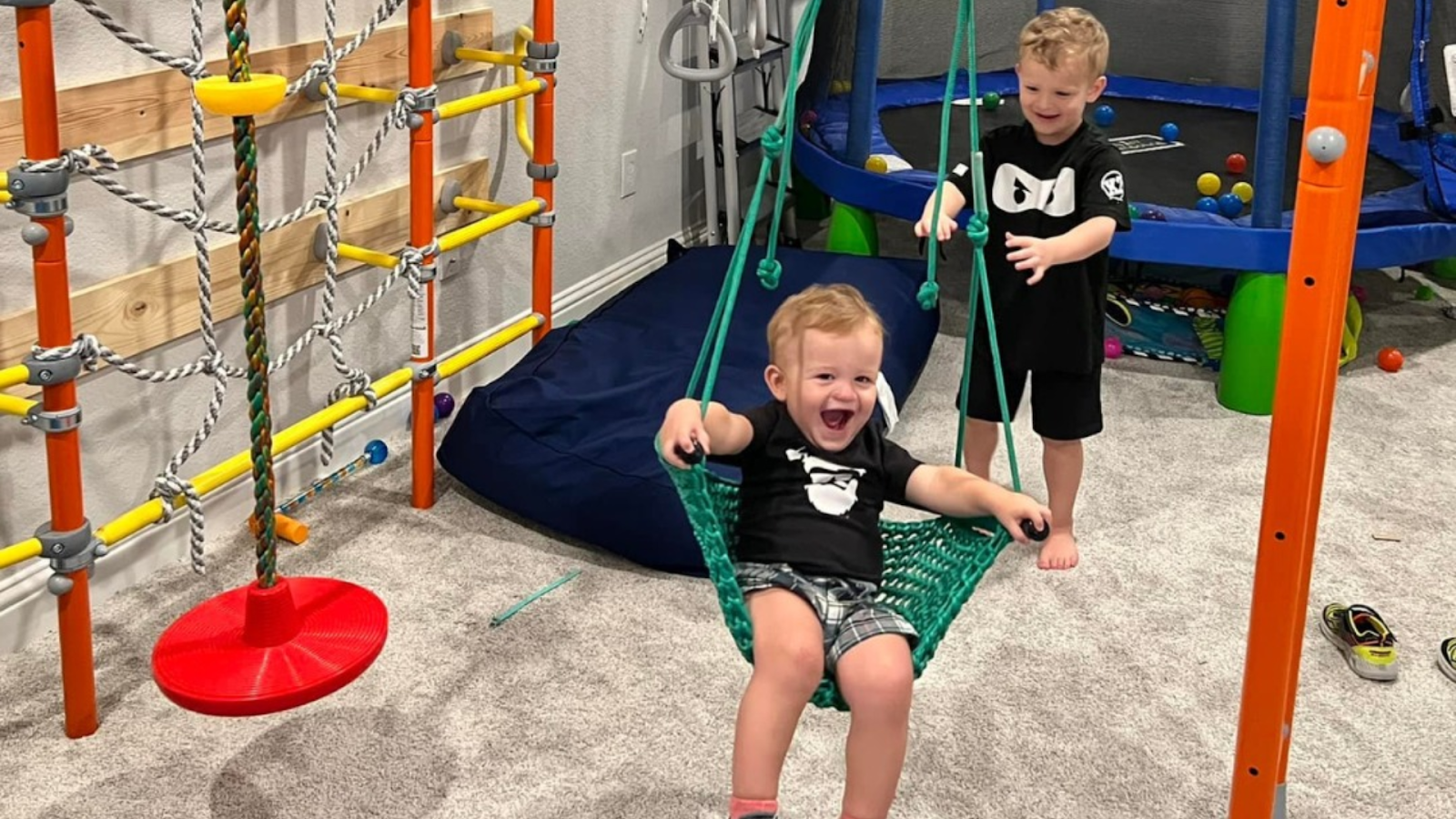
This is the exact job an indoor climbing gym does in a homeschool. It stands in the corner of the school room, always ready, so "go do your ten crossings" is a 15-second transition rather than an expedition. It is recess on demand: between math and reading, mid-meltdown, or at 7 a.m. before the pencils come out. Steel frame rated 220 lb and tested to 440 lb, so it holds the whole sibling group plus the occasional parent demonstrating a dead hang; safe for independent play from age 3, so the movement block does not require you to stop teaching; rungs are rubber-coated and non-toxic, and the whole kit arrives in multiple boxes and goes together like a big Lego set.
One station on the gym earns special mention for PE purposes: the monkey bars, the densest strength-and-coordination tool in the whole program, grip, shoulders, core, rhythm, and courage in every crossing. We wrote a whole piece on why monkey bars earn their place, but for the weekly plan it is enough to know they are Wednesday, and half of Friday's records.
"Their most used toy by FAR, like by a landslide. They use it every day for hours."
– LEISA L., MOM OF 3, BRAINRICH OWNER
"Every day for hours" is a parent describing fun. It is also, run through a PE teacher's eyes, a child clearing the CDC's 60-minute bar daily without anyone scheduling it. That is what an anchor does: it turns the program into the default.
Which gym fits your school room? Take the 60-Second Quiz →
PE "grades" kids actually want: the record board
Schools grade PE with rubrics. Homeschools get to grade it the way kids keep score naturally: personal records. Put a sheet of paper next to the gym, and every Friday, test and log:
| Record | How to measure | What it is really tracking |
|---|---|---|
| Hang-time | Longest dead hang from the bar, in seconds | Grip and shoulder strength, the base of everything else |
| Climb-time | Floor to top of the net and back, timed | Full-body coordination and motor planning |
| Monkey-bar crossings | Crossings in a row without dropping | Strength-endurance, rhythm, and grit |
| Stillness bonus | One-foot balance, eyes closed, in seconds | The vestibular system, quietly leveling up |
Three coaching notes. Compare each child only to last month's self, never to a sibling; the record board should have one name per column for a reason. Watch how motivating the numbers become: a child who shrugs at "go exercise" will fight for two more seconds of hang-time. And keep the log, because it doubles as your PE documentation in states that require homeschool records: dates, activities, measurable progress, done.


Ready to anchor your homeschool PE?
Steel frames, non-toxic powder coat, multi-box shipping that assembles like a big Lego set, and a 30-day money-back guarantee. HSA/FSA-eligible with a Letter of Medical Necessity, which can save up to about 30%.
Frequently asked questions
How much PE does a homeschooled child need? The CDC recommends at least 60 minutes of moderate-to-vigorous activity daily for ages 6 to 17, including muscle- and bone-strengthening activity like climbing at least three days a week. Preschoolers should be active throughout the day. Split into short blocks between subjects, the hour is easier to hit at home than at school.
Does homeschool PE have to happen in one session? No, and it usually works better when it doesn't. Three to five short movement blocks between subjects plus one 20-to-30-minute afternoon event add up past the guideline while doubling as attention resets for the academic blocks.
What counts as PE without equipment? Animal walks, obstacle courses from furniture, dance, jump rope, balance games, stair intervals, and heavy work like hauling and pushing all count. Equipment's real contribution is consistency: an always-ready station removes weather, driving, and setup as failure points.
How do I log PE hours for state homeschool requirements? A simple weekly log of dates, activities, and minutes satisfies most reporting needs; check your state's specifics. A Friday record board (hang-time, climb-time, crossings) adds measurable progress to the file with zero extra paperwork.
What age can kids use a climbing gym independently during school breaks? Brainrich gyms are rated for independent play from age 3, with younger siblings joining under hands-on supervision. The frame is rated 220 lb and tested to 440 lb, so mixed-age sibling recess, and the occasional parent, is exactly what it is built for.
How do I motivate a kid who hates exercise? Stop calling it exercise. Give them records to beat instead of workouts to finish, let them design the obstacle course, and keep sessions short enough to end while they still want more. A child indifferent to "go exercise" will campaign hard for two more seconds of hang-time.
Is indoor PE every day okay? Yes. The guideline cares about minutes and intensity, not location. Indoor anchors keep the program alive through winter, heat waves, and rainy weeks; add outdoor days freely whenever the sky cooperates.
📚 Keep reading
Heavy Work Activities for Kids · Top 5 Reasons You Need Monkey Bars · Find Your Gym: the 60-Second Quiz
Sources
Centers for Disease Control and Prevention (2024). Health Benefits of Physical Activity for Children. Physical Activity Basics, including the 60-minute daily guideline for ages 6 to 17. · Guzmán-Muñoz, E. et al. (2025). Physical Activity and Its Effects on Executive Functions and Brain Outcomes in Children: A Narrative Review. Brain Sciences.
Share: