

Updated August 2026 · 12-min read · by the Brainrich Kids team
Every parent has watched it happen: a playroom full of toys, and a child who wanders in, touches three things, and wanders back out asking for a screen. The room is full. The play is empty. Here is what the inspiration boards skip: the difference between a playroom kids ignore and one they disappear into for hours is not the budget, the square footage, or the wallpaper. It is the design system underneath. This guide is that system: five zones, one planning table, and a toy-curation method you can run this weekend.
The quick answer: an open-ended playroom is a play space organized around what children do (move, build, pretend, create, read) instead of what they own. The working formula: divide the room into 4–5 activity zones, keep roughly 8–12 toys visible at a time and rotate the rest out of sight, choose mostly open-ended materials (blocks, art supplies, loose parts) over single-outcome toys, and anchor the whole room with one piece of movement equipment kids return to daily. Researchers link this kind of self-directed, unstructured play to stronger executive function, creativity, and longer, deeper play sessions.
Jump to: What it is · The 5 zones · The movement zone · Toy curation · Montessori setup · Small spaces · Get inspired · FAQ

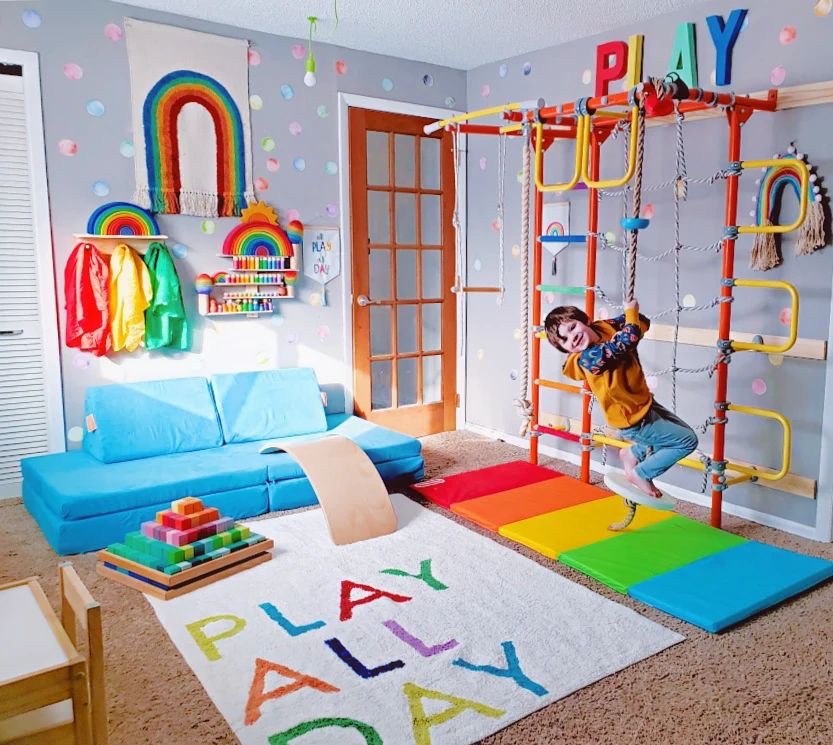
A movement-anchored open-ended playroom. Photo: @chaos.and.rainbows
What is an open-ended playroom, exactly?
An open-ended playroom is a room designed so that the child, not the toy, decides what happens next. The materials in it have no single correct outcome: blocks can be a tower, a zoo, or a phone; a climbing net can be a mountain, a ship's rigging, or a race against a sibling; a scarf can be a cape, a river, or a picnic blanket. Compare that to a single-outcome toy, which performs its one trick, gets applause, and goes quiet in a bin for the rest of its life.
This is not just a design preference. The American Academy of Pediatrics' clinical report The Power of Play describes play as so central to healthy development that pediatricians are encouraged to prescribe it, linking child-driven play to executive function, language, math skills, self-regulation, and the ability to manage stress. The key phrase is child-driven. A room where the child directs the action is a room doing developmental work every single day.
There is a second study every playroom designer should know. In 2014, researchers at the University of Colorado tracked how 6- and 7-year-olds spent their time and found that children who spent more hours in less-structured activities showed stronger self-directed executive function, the ability to set a goal and pursue it without an adult steering. More structured time predicted the opposite. An open-ended playroom is, in practical terms, a machine for producing high-quality unstructured hours, the exact ingredient that study measured.
And to be clear about what an open-ended playroom is not: it is not a beige minimalist aesthetic, not an anti-toy purge, and not a replacement for the backyard or the park. Outdoor play stays irreplaceable. This is the system for the other twelve hours, the rainy Tuesdays, the 6 a.m. Saturdays, and the long winters, when the play has to happen inside.
What zones should an open-ended play space have?
The single most useful idea in playroom design is borrowed from preschool classrooms, which have organized space this way for decades: stop arranging the room around furniture and start arranging it around activities. Children's play falls into a handful of recognizable modes, and each mode wants its own territory. When every mode has a home, kids move through the room in self-directed loops for an hour or more. When everything shares one pile in one space, modes collide, and play collapses into dumping bins.
Here is the five-zone system, sized for real homes rather than showrooms. You do not need five rooms; most of these zones are the size of a rug.
| Zone | What happens there | Minimum footprint | Core pieces | Typical budget |
|---|---|---|---|---|
| Movement zone | Climbing, swinging, hanging, wrestling, crashing | ~6.5 × 6.5 ft incl. clearance | Indoor play gym, impact mat | $950–$2,500 |
| Creation zone | Drawing, painting, dough, crafts | ~4 × 4 ft | Child-height table & chairs, chalkboard, supply shelf | $100–$300 |
| Building zone | Blocks, magnetic tiles, tracks, small worlds | A flat rug, ~4 × 6 ft | Low-pile rug, open shelf, 2–3 construction sets | $75–$400 |
| Pretend zone | Role play, dress-up, kitchens, stores | ~3 × 3 ft | Dress-up basket, loose props, play kitchen (optional) | $50–$250 |
| Quiet zone | Books, puzzles, rest, calming down | ~3 × 3 ft corner | Reading nook, soft seating, front-facing book display | $60–$200 |
Three placement rules make the zones actually work:
1. Separate loud from quiet
The movement zone and the quiet zone go on opposite sides of the room, or opposite corners. A reading nook next to a swing is a reading nook nobody reads in.
2. Give movement its clearance
The movement zone needs empty floor around it, not shelving. Furniture crowding the landing area is the most common layout mistake we see in owner photos.
3. Store where the play happens
Blocks live on the shelf beside the building rug. Art supplies live at the art table. When cleanup means carrying things across the room, cleanup stops happening.
Involve your child in the zoning decisions, which colors, which corner for reading, which bin for which toys. A child who helped design the room treats it as theirs, and ownership is half of independent play.
Why does the movement zone anchor the whole room?
If you rank the five zones by hours of actual use, movement wins, and it is not close. There is a simple reason: physical play is the mode children cannot skip. U.S. physical activity guidelines call for preschoolers to be active throughout the day, and school-age kids to get at least 60 minutes of moderate-to-vigorous activity daily. That energy is on the schedule whether your home has a place for it or not. A playroom without a movement zone does not produce calm children; it produces couch-jumping, hallway sprints, and a bookshelf with suspicious footholds.
The movement zone is also what keeps the other four zones alive. Kids naturally cycle: climb hard for twenty minutes, then settle into blocks; swing until they're regulated, then draw. Occupational therapists build entire sensory diets around this rhythm of vestibular and proprioceptive input followed by focused work, and we cover that angle in depth in our guide to building a sensory gym at home. Without the movement outlet, the cycle breaks, and the quiet zones get used as launching pads instead.
What belongs in the zone? One anchor piece that offers many movements, not one: climbing, hanging, swinging, brachiating. That is the entire design philosophy behind our steel modular gyms. A structure like the Spider V3 packs a climbing net, rings, a swing, and a trapeze into about a 6.5-foot square, rated for ages 3+ and built to hold climbers well past a hundred pounds, so one footprint serves a 3-year-old and her 9-year-old brother at the same time. Under it goes a proper impact play mat, which doubles as the crash-and-tumble surface the zone needs anyway.
One boundary note: this guide covers design. For wall clearances, mat coverage, and the step-by-step safe setup of the movement zone, we keep a dedicated guide: Kids' Playroom Ideas: Setting Up a Safe Play Gym Area. Read them as a pair.
A budgeting note many parents miss: Brainrich play gyms are HSA/FSA eligible, so the anchor piece of your playroom can often be paid for with pre-tax dollars.
How do you curate toys for an open-ended play space?
Here is the counterintuitive part of the guide, and the part with the strongest data behind it: the fastest upgrade to your playroom is removing toys, not adding them.
Researchers at the University of Toledo gave toddlers a room with either 4 toys or 16 toys and watched what happened. With only 4 toys available, children played with each toy roughly twice as long, and in richer, more varied ways, than children surrounded by 16. The study's conclusion: an abundance of toys created distraction, while fewer toys produced deeper, more sophisticated play.
DAUCH ET AL., INFANT BEHAVIOR AND DEVELOPMENT, 2018 · READ THE STUDY
The practical system built on that finding is toy rotation: roughly 8–12 toys visible and reachable at any time, everything else in lidded bins out of sight, and a swap every week or two, or whenever play goes stale. Rotation day feels like new-toy day to a child, at a cost of zero dollars. What earns a permanent spot on the shelf? Materials that pass the "ten ways" test: if you can name ten different things a child might do with it, it stays out.
Every item on this list passes the ten-ways test. This tracks with Eastern Connecticut State University's long-running TIMPANI toy study, where simple, open-ended toys consistently score highest for the quality of thinking and interaction they draw out of preschoolers, year after year, beating flashier electronic competitors.
The original version of this guide named five organizational must-haves, and after four years of owner photos we stand by all five. Upgraded with what we've learned:
- Storage bins, lidded and movable, but with a twist: opaque bins for the rotation stash (out of sight is out of mind), open baskets for the active toys.
- A child-height table and chairs, the heart of the creation zone, sized so feet touch the floor. Paint, dough, and slime stay at the table when the table belongs to the child.
- A chalkboard or art wall, one sanctioned vertical surface, which is the single best insurance policy the rest of your walls will ever have.
- Low, open shelves, waist-height for the child, with the current rotation displayed a few items per shelf rather than crammed. If the child cannot see it and reach it, it does not exist.
- A reading nook, bean bag or floor cushions plus a front-facing book display, positioned as far from the movement zone as the room allows.
For the deeper case on why these materials outperform single-outcome toys, and our full list of favorites, keep reading with the benefits of open-ended play and the most fun toys for open-ended play.
Is this the same as a Montessori playroom setup?
Close cousins, not twins, and knowing the difference helps you borrow the best of both. A Montessori playroom setup is built on Maria Montessori's "prepared environment": child-scaled furniture, a place for everything, materials displayed individually on low open shelves, and a limited number of choices at a time. If that sounds familiar, it should, because the open-ended playroom borrows all of it. The shelf strategy, the less-is-more curation, and the child-height rule above are straight from the Montessori playbook.
Where the two diverge:
| Classic Montessori playroom | Open-ended playroom |
|---|---|
| Materials often have a specific purpose and a built-in "control of error" (the puzzle only fits one way) | Materials deliberately have no fixed outcome; the child invents the purpose |
| Fantasy and pretend play are traditionally de-emphasized for the youngest children | The pretend zone is a first-class citizen; capes and play kitchens welcome |
| Gross-motor equipment is usually small-scale (a Pikler triangle, a balance board) | The movement zone anchors the room, with equipment that grows to age 8–9 and beyond |
| Emphasis on order, sequence, and completing a "work cycle" | Emphasis on flow between zones; a block castle can stay up overnight |
Most families we talk to land on a blend: Montessori shelves and curation discipline, open-ended materials and a serious movement zone. If you already run a Montessori home, the five-zone table above drops into it cleanly: the movement zone is simply the next step once the Pikler triangle is outgrown, around age 3, exactly when children are ready for a full climbing gym.
How do you build an open-ended play space in a small home?
You do not need a bonus room. The zone system scales down because zones are activities, not rooms, and three moves make almost any space work:
1. Shrink zones before cutting them. A quiet zone can be one cushion and a book ledge behind a couch. A pretend zone can be a single basket of props. Five tiny zones beat two big ones, because it is the variety of modes, not the acreage, that keeps play cycling.
2. Go vertical. Wall-mounted shelves, a chalkboard on the back of a door, and a climbing gym that uses height instead of floor. A compressed-fit steel gym occupies about the footprint of an armchair while delivering climbing, swinging, and hanging in the air space above it, the one dimension small homes have in abundance.
3. Let the playroom share a room. A corner of the living room zoned with a rug and a low shelf is a real play space. The rug is the border; children read borders fluently when the borders are visible. Many of the best rooms in our owner community are living-room corners, not dedicated playrooms.
A sample 10 × 10 ft layout that fits all five zones: gym and mat in the far corner (movement), low shelf and rug beside it (building), small table on the near wall (creation), prop basket under the table (pretend), cushion and book ledge in the opposite corner (quiet). Total cost, anchored by a starter gym: from about $1,100.
Which gym fits your space? Take the 60-Second Quiz →
Get inspired: real open-ended playrooms
The best proof the zone system works is watching real families run it. These rooms from our owner community range from dedicated basements to apartment corners, and every one is organized around a movement anchor with quieter zones orbiting it.

Owner playrooms from the Brainrich community. Tap for more on Instagram.
"Their most used toy by FAR, like by a landslide. They use it every day for hours."
– LEISA L., MOM OF 3, BRAINRICH OWNER
That sentence is the whole thesis of this guide measured in hours. A room built around what children do gets used the way furniture built around adults never is: daily, by choice, for years.


Ready to anchor your playroom?
Every gym is HSA/FSA eligible, assembles in an afternoon, and is covered by a 30-day money-back guarantee.
Frequently asked questions
What is an open-ended playroom? A play space organized around activities rather than possessions: materials with no single fixed outcome (blocks, art supplies, climbing equipment, loose parts) arranged into distinct zones so children direct their own play. Researchers link this kind of child-driven, unstructured play to stronger executive function, creativity, and longer play sessions.
What zones should a playroom have? Five cover nearly all play modes: a movement zone (climbing, swinging, crashing), a creation zone (art table and chalkboard), a building zone (blocks and tiles on a rug), a pretend zone (props and dress-up), and a quiet zone (books and soft seating). Keep loud and quiet zones apart, and most zones need only a rug's worth of floor.
How many toys should be out at once? Roughly 8–12, with the rest stored out of sight and rotated every week or two. In a University of Toledo study, toddlers given only 4 toys played with each about twice as long, and more inventively, than toddlers given 16, because fewer visible options produced deeper engagement.
Is an open-ended playroom the same as a Montessori playroom? They share the low open shelves, child-height furniture, and limited-choice curation. They differ on materials and movement: Montessori materials often have one intended purpose, while open-ended materials have none, and the open-ended playroom gives gross-motor equipment a much larger role as the room's anchor.
How much space does an open-ended play space need? A 10 × 10 ft room, or an equivalent living-room corner, fits all five zones: a compact play gym with a mat occupies about 6.5 × 6.5 ft, and the remaining zones each need only a few square feet. Zones are activities, not rooms, so they shrink gracefully.
What makes a toy open-ended? The ten-ways test: if you can name ten different things a child might do with it, it qualifies. Blocks, magnetic tiles, play silks, animal figures, art supplies, and climbing structures all pass. A toy with one button and one trick does not.
Why put a play gym in a playroom instead of relying on the playground? Because daily access changes what the equipment does. Indoor movement equipment absorbs the climbing and swinging energy that otherwise lands on couches and bookshelves, feeds the movement-then-focus cycle that powers the other zones, and stays available in winter, in rain, and at 6 a.m. It complements outdoor play rather than replacing it.
Are indoor play gyms HSA/FSA eligible? Brainrich play gyms are HSA/FSA eligible with a Letter of Medical Necessity, so the movement-zone anchor, typically the largest single purchase in a playroom at $899–$2,399, can often be paid for with pre-tax dollars. Check with your plan administrator for your account's specifics.
📚 Keep reading
Kids' Playroom Ideas: Setting Up a Safe Play Gym Area · The Benefits of Open-Ended Play · How to Build a Sensory Gym at Home
Sources
Yogman, M. et al. (2018). The Power of Play: A Pediatric Role in Enhancing Development in Young Children. Pediatrics, American Academy of Pediatrics clinical report. · Dauch, C., Imwalle, M., Ocasio, B. & Metz, A.E. (2018). The influence of the number of toys in the environment on toddlers' play. Infant Behavior and Development, 50, 78–87. · Barker, J.E. et al. (2014). Less-structured time in children's daily lives predicts self-directed executive functioning. Frontiers in Psychology, 5, 593. · U.S. Department of Health and Human Services (2018). Physical Activity Guidelines for Americans, 2nd edition. · Eastern Connecticut State University, Center for Early Childhood Education. TIMPANI Toy Study.
Share: