

Updated July 2026 · 10-minute read · by the Brainrich Kids team
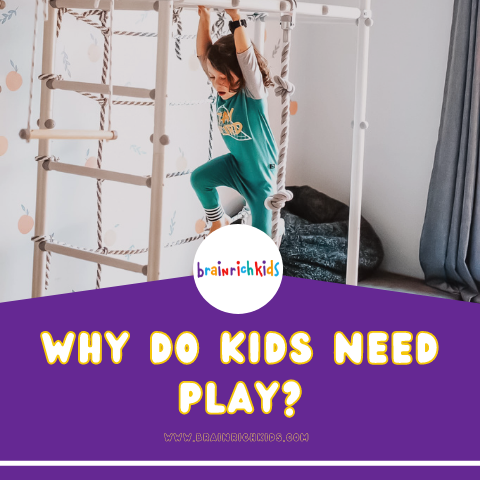
Somewhere in the last generation, "go play" quietly became a luxury. Screens got stickier, schedules got fuller, and the weather always seems to be doing something that keeps everyone inside. And yet the science of why children need to move and pretend has only gotten stronger and more specific. It turns out play is not the reward a child earns after the important developmental work is done. Play is how the important work gets done. Here is what the research actually says, and why the countries raising the world's most capable kids all quietly agree.
The quick answer: for a young child, moving is thinking practice and pretending is self-control practice. Modern neuroscience has collapsed the old wall between "the body" and "the brain": the same structures that plan and correct a wobble also run attention, memory, and self-regulation. Whole-body play (climbing, swinging, hanging) feeds the vestibular and proprioceptive systems that screens cannot reach, and make-believe play is where children first learn to follow a rule they set for themselves. Research links this kind of active, imaginative, unstructured play to better attention, stronger motor skills, richer language, and calmer emotional regulation. It's not optional enrichment. It's the primary input a developing brain is built to expect.
Jump to: Movement builds the brain · The eight senses · Why pretend play matters · How much kids need · What the world's most active kids do · The real obstacle · Bringing it home · FAQ
Movement isn't a break from brain-building. It is brain-building.
The old picture treated the brain as the thinking organ and the body as the thing it ordered around. Modern neuroscience has thrown that picture out. The cerebellum, long dismissed as a pure motor-coordination center, is now understood to drive both movement and higher cognition, through two-way loops with the prefrontal cortex, the brain's planning-and-self-control hub. Every time a child misjudges a rung and corrects, that error-correction circuitry fires, and it is the very same circuitry a child later leans on to sit still, hold an instruction in mind, and switch between tasks.
In other words, the climb and the classroom run on shared hardware. Whole-body, constantly-adjusting movement, exactly what climbing, swinging, and hanging demand, is how that hardware gets its reps.
🌱 EXERCISE FEEDS PLASTICITY
Physical activity is associated with higher BDNF, one of the key molecules of neuroplasticity that supports the growth and wiring of neurons. A 2025 systematic review of five randomized trials in children found structured exercise may enhance it, with neuromotor activities showing particular promise.
⚡ THE PAYOFF IS FAST
You don't wait months. In one study of 9-year-olds, a single bout of activity improved accuracy on a test of inhibitory control, the ability to resist a distraction, by nearly 6%. A child who moves is measurably better at paying attention within the hour.
Among preschoolers, motor coordination, fitness, and thinking move together as a package. In a study of 713 three-to-six-year-olds, better-coordinated, fitter children scored higher across every measured cognitive function, from working memory to cognitive flexibility. The researchers are careful, and so are we: this is a snapshot, not proof of cause. But the mechanism is real and well-mapped, and the direction is unmistakable. A structure that pulls a child into daily climbing and swinging is running this machinery every single day.
Your child has eight senses, and three of them only develop through movement
Most of us can name five senses. Children actually develop through eight sensory systems, and the three least-famous ones are precisely the ones that active, whole-body play builds and a screen can never touch.
⚖️ THE VESTIBULAR SENSE
Balance and head position, housed in the inner ear. It's the master sense for movement, and its central pathways keep maturing for years through childhood, a long window in which movement genuinely shapes the system. Swinging is the single most concentrated form of vestibular input in ordinary play.
🧭 PROPRIOCEPTION
Body awareness, the sense of where your limbs are without looking. It's trained by pushing, pulling, hanging, climbing, and carrying, and it's what eventually lets a child write, pour a glass, and cross a room without crashing into it.
💗 INTEROCEPTION
The sense of the body's internal signals, hunger, thirst, a racing heart, the physical feeling of an emotion. It underpins self-regulation: a child who can feel "my heart is pounding" has taken the first step toward managing a big feeling.
The vestibular sense in particular is a linchpin of cognition, not just of not-falling-over. Its signals reach a broad cortical network, including the brain's memory and spatial-mapping core, and it contributes to spatial memory, object recognition, and even numerical cognition, because early number sense has roots in how we move through space. The vestibular system also sets a child's arousal level: fast, unpredictable movement energizes, while slow rhythmic rocking calms. It's why a swing can either wake a sleepy child up or settle an overwhelmed one down.
There's a flip side worth stating plainly, because it's well-supported: reduced movement means reduced vestibular stimulation, and during key developmental windows that can delay motor milestones and postural control. Sedentary childhood isn't neutral. It withholds a genuine developmental input the brain evolved to expect. The science behind the play gym goes deeper on exactly how this works.
Make-believe is secretly self-control training
Physical play builds the motor-cognitive engine. Pretend play builds the social and self-regulating mind. And the very best childhood play fuses the two: a climbing frame becomes a pirate ship, a rocket, a mountain to be conquered before dinner.
The insight belongs to the developmental psychologist Lev Vygotsky, and it's one of the most durable ideas in the field. Mature make-believe, he argued, has three parts: an imaginary situation, children acting out roles, and, crucially, following the rules those roles dictate. A child playing "firefighter" chooses to act as a firefighter would, subordinating impulse to the role. Play is the first arena where a child voluntarily follows an internal rule, which is the seed of self-regulation and executive function.
Vygotsky observed that in play a child operates "a head taller" than in ordinary life. The classic example: a child who can barely sit still for a few minutes at story time will stay focused far longer while playing school. Play doesn't just occupy a child. It scaffolds them up to their next level of ability.
LEV VYGOTSKY · THE ZONE OF PROXIMAL DEVELOPMENT
The evidence backs him up. A seven-week role-play program with 199 preschoolers produced significant gains in cognitive flexibility, working memory, and inhibitory control. And there's a useful nuance: gains in inhibitory control were linked specifically to social pretend play, the kind with siblings, friends, and parents, not solitary play. An engaged adult who plays along and gently extends the story ("what happens next?") gets more out of it than simply leaving a child to it. This is why a structure that invites two or three kids to climb, invent, and negotiate the rules of the game together does double duty: gross-motor benefit and social-cognitive benefit, in the same joyful half hour.
How much movement does a child actually need?
Parents ask a simple question, "how much is enough?", and nearly every major health authority on earth has landed on strikingly similar answers. Here's the short version, by age.
| Age | Daily movement target | Screens |
|---|---|---|
| 1–2 years | At least 180 min of activity of any intensity, spread through the day (WHO) | None at age 1; under 1 hr at age 2 |
| 3–4 years | At least 180 min, of which 60+ is energetic (WHO) | No more than 1 hr, less is better |
| 5–17 years | 60+ min of moderate-to-vigorous activity daily, plus muscle- & bone-strengthening play 3+ days a week (WHO, CDC) | Cap recreational screens (≤2 hr, CSEP) |
Two details are worth their weight in gold. First, kids bank activity in short bursts all day long, so a setup that invites twenty five-minute climbs beats one forced "exercise session" every time. Second, the CDC explicitly names climbing as a muscle-strengthening activity for children and jumping as bone-strengthening, which means a climbing structure is, by the government's own definition, hitting two of the three required activity types. The real problem isn't that the targets are unknown. It's the gap between these numbers and how the average child actually lives, especially on the many days weather or schedule keep everyone indoors.
What the world's most active kids have in common
Zoom out to the global scorecard. The Active Healthy Kids Global Alliance grades child physical activity across dozens of countries, and the same handful wins every edition: Denmark, Finland, Japan, and Slovenia led the most recent Global Matrix (2022), which spanned 57 countries and 682 experts. Meanwhile, worldwide, only an estimated 1 in 3 children moves enough.
What do the leaders do differently? They don't rely on a single sport or a gadget. They engineer daily, self-directed movement into ordinary life. Japanese children walk to school from age six, a custom rooted in national policy, and have done a short morning calisthenics routine together for roughly ninety years. Nordic and German kids spend their days on varied, climbable terrain in forest kindergartens. Finland added movement breaks to the school day on purpose and reports it improved not just fitness but learning.
"I didn't grow up strong & fearless. My children are. I love anything that helps with that."
– ZAKIA P., HOUSTON MOM, BRAINRICH OWNER
And the counter-evidence proves the rule, in the most on-point way imaginable. A six-decade study of Japanese 13-year-olds found their motor skills peaked in the 1980s and then declined, and researchers link part of that drop to a specific change: the removal of "iron bars and climbing frames" from redesigned urban parks. Take the climbing away, and children's bodies notice. The researchers call the attribution inferential rather than proven, but the signal points exactly where every other thread in this article does.
Here's the takeaway. Outdoor play in varied, real terrain is wonderful, and nothing here argues against it. Most families simply can't relocate to a Danish forest or a Japanese walk-to-school suburb, and even those who live somewhere beautiful face stretches of heat, cold, rain, and dark when the outdoors closes for the day. The one portable ingredient, daily, self-directed climbing and swinging, is the part you can bring indoors.
The real obstacle isn't the outdoors. It's the screen.
Let's be clear about the villain in this story, because it isn't the backyard. The American Academy of Pediatrics frames screens as the thing that displaces the movement, sleep, and face-to-face interaction children need, and that displacement is the quieter, least-disputable harm. Every hour on a screen is an hour not climbing, pretending, moving, or sleeping.
There's an emerging brain-imaging signal too, and we'll state it carefully because the careful version is still persuasive. In one small study of preschoolers, higher screen use was associated with less mature, less organized myelination in white-matter tracts that support language and emerging literacy. It's a single cross-sectional study, an association and not proof of cause, so we hold it lightly. But it rhymes with the larger, sturdier point: pre-scripted media does the imagining for the child, which is exactly the muscle we want a child to exercise.
Every parent already feels this. The goal isn't a screen-free household achieved through daily combat. It's making the active choice the easy choice, so that on a rainy Tuesday the path of least resistance leads to a climb instead of a couch.
Bringing it home
Turning all of this into what a parent does on an ordinary week comes down to a few durable principles, drawn straight from the research above.
Environment beats willpower
Proximity and availability are the biggest predictors of whether kids use active equipment. A structure in the living space makes movement the default, especially on the days outdoor play collapses.
Prioritize the high-value moves
Climbing, hanging, and swinging deliver vestibular input, proprioception, and real strength in a single activity. No worksheet or screen supplies them.
Allow good risk
Aim for "as safe as necessary, not as safe as possible." Mastering a scary-but-manageable climb is how a child builds the belief "I can handle hard things." More on controlled risky play →
Join in, and re-theme
Adult-extended pretend play outperforms pure solo play for building executive function. Change an accessory, add a story ("today it's a rocket"), invite a friend.
This is exactly what a home climbing gym is for. Not to replace the park, the forest, or a sunny afternoon outside, all of which we'd cheer for, but to make the one active ingredient the world's most capable kids share, daily self-directed climbing, available on your schedule, in your living room, no matter what the sky is doing. It's a piece of "prepared environment," to borrow Montessori's term, that lets a child self-direct the precise movement their development is calling for. A structure that grows with the child stays in the just-right challenge zone for years, which is the whole point, because the benefit comes from consistency.
Which gym fits your family? Take the 60-Second Quiz →


Give play a permanent home.
Tension-mounted, no drilling, fits ceilings 6'9" to 10'5". Every gym assembles in an afternoon and is covered by a 30-day money-back guarantee.
Frequently asked questions
Why is play so important for brain development? Because for a young child, moving and pretending are the developmental work, not a break from it. Active play trains the cerebellar and prefrontal circuits behind attention and self-control, feeds the vestibular and proprioceptive systems that build balance and body awareness, and is associated with higher levels of BDNF, a molecule central to neuroplasticity. Pretend play, meanwhile, is where children first learn to follow a rule they set for themselves, the foundation of self-regulation.
How much physical activity does my child actually need each day? Health authorities converge closely: toddlers and preschoolers need about three hours of movement a day (at least one of it energetic), and school-age children need at least 60 minutes of moderate-to-vigorous activity daily, plus muscle- and bone-strengthening play like climbing and jumping on three or more days a week. The CDC explicitly counts climbing as muscle-strengthening.
Isn't unstructured free play just... doing nothing? The opposite. Unstructured, open-ended play is when a child has to invent the game, negotiate the rules, solve the physical problem, and self-direct the challenge, which is precisely why it builds executive function and creativity in ways a pre-scripted toy or app cannot. The less a plaything dictates, the more the child's own developing mind has to supply.
Does a home climbing gym replace playing outside? No, and we'd never suggest it should. Outdoor play in real, varied terrain is fantastic and we're all for it. A home gym is the answer for the many days when heat, cold, rain, dark, or a packed schedule make the outdoors impractical, so that daily self-directed climbing, the one ingredient the world's most active kids share, is always available indoors.
What kinds of movement matter most? Climbing, hanging, and swinging are unusually high-value because each delivers several developmental inputs at once: swinging is the most concentrated vestibular (balance) input in ordinary play; hanging and climbing build grip strength, shoulder stability, and proprioception; and every route up a net is a fresh motor-planning problem. These are exactly the movements a screen or worksheet can't provide.
My child would rather watch a screen. What can I do? You're not alone, and the most effective lever isn't willpower, it's environment. Research shows availability and proximity are the biggest predictors of whether kids use active equipment. When the active choice is the easy choice, sitting right there in the living space, the rainy-day default quietly shifts from the couch to the climb. Capping screens to the guideline limits and keeping them out of the play zone helps too.
Sources
World Health Organization (2019). Guidelines on physical activity, sedentary behaviour and sleep for children under 5 years of age. · U.S. Centers for Disease Control and Prevention. Physical Activity Basics: Children and Adolescents. · IBRO Neuroscience Reports (2024). The cerebellum in motor and cognitive function. · Life (2025). Physical exercise and BDNF in children: a systematic review. · Acute exercise, BDNF and inhibitory control in children. · Frontiers in Public Health (2026). Motor coordination, fitness and cognition in preschoolers. · Children (Basel). The vestibular system and child development. · Bodrova & Germeroth, American Journal of Play. Play and self-regulation: lessons from Vygotsky. · Aubert et al. (2022). Global Matrix 4.0 Physical Activity Report Card Grades. J. Physical Activity & Health. · Yogi (2025). Changes in motor skill performance of 13-year-old Japanese children over six decades. Sports (Basel). · Hutton et al. (2020). Associations between screen use and brain white matter integrity in preschoolers. JAMA Pediatrics. · American Academy of Pediatrics. Media and Children guidance.
Share: