

Updated October 2026 · 12-minute read · by the Brainrich Kids team
Every playground has the same scene. A four-year-old grabs the first rung of the monkey bars, hangs for two glorious seconds, and drops into the mulch. An eight-year-old breezes past, skipping every other rung. And a parent stands underneath wondering the same three things: when will my child be able to do this, what is it actually doing for them, and how worried should I be about that drop? This guide answers all three with numbers you can check, because monkey bars happen to be one of the best-studied pieces of play equipment on earth, for reasons both encouraging and sobering.
The quick answer: most children can hang from a bar for a few seconds around age 3 to 4, cross a few rungs with help around 4 to 5, and complete a full traversal on their own around 5 to 6, with fancy variations (skipping rungs, turning around, going backwards) arriving around 6 to 8. The limiting factors are grip strength and shoulder stability, not courage, and both are trainable years earlier. That is why adjustable indoor bars that start at chest height change the timeline: a 3-year-old who can practice hanging daily builds the exact strength that playground bars will demand at 5.
Jump to: What age · Milestones table · Benefits · Age-by-age progression · Safety · Indoor monkey bars · FAQ
What age can kids do monkey bars?
Monkey bars are unusual among playground skills because they have a hard physical gate: the child must support their entire body weight from their hands, then move that weight rung to rung. No amount of enthusiasm substitutes for the strength, which is why the milestones cluster later than parents expect:
Around 3 to 4, most children can grip a bar and hang briefly. A benchmark pediatric therapists use: by roughly age 4 to 5½, most children can hold an overhand dead hang for 5 seconds or longer. Around 4 to 5, many children start transferring one hand to the next rung with an adult supporting their hips. Around 5 to 6, the pieces come together and most kids manage their first unassisted full traversal. This matches how the equipment itself is designed: the CPSC's Public Playground Safety Handbook treats overhead horizontal ladders as equipment for ages 4 and up, and caps their height at about five feet for preschoolers versus about seven feet for school-age children.
Monkey bar milestones by age
The whole road fits in one table, from the newborn grip to the first solo crossing. Ages are typical ranges, not deadlines, and they line up with the sizing chart in our complete monkey bars guide.
| Milestone | Typical age | What it looks like | What it builds on |
|---|---|---|---|
| Grasp reflex (not a skill yet) | Birth to about 6 months | A newborn's hand closes automatically around a finger, sometimes hard enough to hold their own weight for a moment. The reflex fades by about 6 months. | Nothing to practice. Never hang a baby from a bar. |
| First supported hang | About 18 months to 3 | Holds a low bar for a second or two with a parent's hands at the waist and feet near the floor. | Pikler triangle, low ladder rungs, lots of climbing on and off |
| First solo hang | 3 to 4 | Feet leave the mat for 2 to 5 seconds, then a drop on purpose. | A bar at chest height they can reach themselves |
| First swing | About 4 | Kicks the legs forward and back while hanging, building momentum. | Hangs of 5 seconds or longer |
| First rung | 4 to 5 | Moves one hand to the next rung, first with an adult supporting the hips, then alone. | Swinging hangs and shifting weight side to side |
| Full crossing, unassisted | 5 to 6 for many, common by 7 | Crosses end to end with no help. | Daily practice on the first rung |
| Variations | 6 to 8 and up | Skips rungs, turns around, crosses backward, hangs by the knees. | A bar raised as they grow |
Public playground overhead ladders are rated for ages 4 and up (CPSC Handbook). The earlier stages belong on low bars over mats, with a parent's hands close.
Is it impressive for a 5-year-old to cross the monkey bars alone?
Yes. A 5-year-old crossing without help is on the early side of normal: the CPSC treats 4 as the youngest age for overhead ladders, and many children get their first full crossing somewhere between 5 and 6. So it is ahead of plenty of classmates, but not rare. What it tells you is that the child has spent many hours hanging. Grip and shoulder strength come from repetition, so a 5-year-old who crosses alone has usually practiced far more than one who can't yet. If your 5-year-old isn't there, nothing is wrong. Another year of hanging usually closes the gap.
When can babies hang from a bar?
Newborns have a grasp reflex strong enough to hold their own weight for a moment, and it fades by about 6 months (StatPearls). That is a reflex, not strength, so it is not something to test. Hanging on purpose comes much later: most toddlers start holding a low bar for a second or two somewhere between 18 months and 3 years, with a parent's hands at their waist, and a solo hang with feet off the floor usually arrives between 3 and 4.
Age, though, is the least useful part of the answer, because the spread is enormous and completely normal. Some 3-year-olds are natural brachiators; some 7-year-olds are just warming up to the idea. What matters is the readiness checklist:
If your child checks all four, they are ready to start the progression below, whatever their birth certificate says.
One more reframe worth keeping: a child who hangs and drops a hundred times before their first crossing is not failing at monkey bars. Hanging is the curriculum. Crossing is the graduation.
Monkey bars benefits: what the OT community sees
The technical term for monkey-bar movement is brachiation: swinging the body forward from one overhead hold to the next. Pediatric occupational therapists prize it because it trains four systems at once, several of which are surprisingly hard to reach any other way:
💪 GRIP STRENGTH
Supporting full body weight from the hands is the most efficient grip workout childhood offers. OTs note that hand and finger strength built on bars carries over to pencil grip, scissors, and every fine-motor task that follows.
🏋️ SHOULDER STABILITY
Hanging loads the shoulder girdle through its full range, building the stable base that therapists look for before fine motor skills can mature. Weak shoulders show up at the writing desk; bars are where they get fixed.
🧩 MOTOR PLANNING
Every traversal is a sequenced plan: release, swing, reach, grip, repeat, alternating sides in rhythm. That release-and-reach pattern crosses the midline and demands the bilateral coordination OTs work hard to build in clinic.
🧭 CORE & BODY AWARENESS
The trunk works the whole time to stop the swing from taking over, while joints and muscles stream position data to the brain. That proprioceptive feedback is how a child learns where their body is without looking.
There is also a calming angle that surprises parents. Hanging and swinging deliver deep pressure through the joints and muscles, the kind of input therapists call heavy work, and it is one of the most reliable ways to help a wound-up child regulate. If that concept is new to you, our guide to heavy work activities for kids covers it in depth; monkey bars sit near the top of the list.
Researchers who study this kind of vigorous, mildly thrilling play also link it to benefits beyond muscle: Ellen Sandseter's foundational 2007 research on risky play puts height-based challenge in the category children seek out most, and pediatric bodies now associate that graded challenge with confidence, persistence, and better risk judgment. Monkey bars are graded challenge in its purest form: the next rung is always visible, always optional, and always earned.
The age-by-age monkey bar progression
Skills arrive in a reliable order even when the ages wobble. Here is the progression we see across thousands of families, with the ages as loose guides, not deadlines:
| Stage | Typical age | What it looks like | How to help |
|---|---|---|---|
| 1. Hanging | 2–4 | Grips a low bar, feet leave the ground for 2 to 5 seconds, drops on purpose | Set the bar at chest height so they mount it themselves. Count the seconds out loud. Celebrate the drop, it is a skill too |
| 2. Assisted traverse | 4–5 | Transfers hand to the next rung while an adult lightly supports the hips | Support at the hips, never the feet, so they keep their own weight. Reduce your help rung by rung |
| 3. Full traverse | 5–6 | Crosses end to end alone, usually with a big swing and a bigger grin | Stand by, stay quiet, let them repeat it fifty times. Repetition here is the whole point |
| 4. Variations | 6–8+ | Skips rungs, turns around mid-bar, travels backwards, hangs by knees | Raise the bar height as they grow. Invent challenges together, they will out-invent you fast |
If your climber is still a toddler, do not rush stage one. The pathway that leads to monkey bars starts much earlier, on triangles, ramps, and low rungs; our guide to what comes after the Pikler triangle maps that road from 18 months to the first dead hang.
Are monkey bars safe? The numbers, without the panic
Let's put the real data on the table, because this is where a fair guide has to slow down. The U.S. Consumer Product Safety Commission reports that emergency departments treat more than 200,000 playground-related injuries in children every year, and the CPSC's own analysis found that roughly three quarters of injuries on public playground equipment come from falls, primarily falls to the surface. Within that picture, monkey bars stand out: a 2020 study in Injury Epidemiology covering a decade of U.S. emergency-department data found that 49.8% of playground-equipment extremity fractures happened on monkey bars or climbing gyms, more than any other equipment type.
The part that matters for your decisions: those numbers are not really about the bars. They are about two variables: how far the child falls, and what they land on. Public playground bars sit up to seven feet high, are used by unfamiliar crowds of mixed ages, and stand over surfacing that ranges from excellent to worn-out. The CPSC's core mitigation advice is those two levers: keep fall heights appropriate, and put impact-absorbing surfacing rated for the equipment's fall height underneath, never concrete or asphalt.
THE RISK (keep it)
The challenge of the next rung: visible, chosen, matched to the child's strength. This is the part doing the developmental work, and the child doses it themselves.
THE HAZARDS (remove them)
Bars far taller than the child's skill, hard ground underneath, worn or wobbly equipment, crowds bumping mid-swing. The child never chose any of these.
This risk-versus-hazard distinction comes from the pediatric risky-play literature, and it is the most useful safety idea a parent can own; we unpack it fully in our guide to controlled risky play. Applied to monkey bars, it produces a short, practical rulebook:
Match the height to the child, low enough that a controlled drop lands on their feet. Put rated impact mats under the full length of the bars, not blankets or pillows, which shift. One child on the bars at a time, collisions cause the falls nobody plans for. Spot at the hips, not the feet, so the child keeps ownership of their weight. Never lift a child onto bars they cannot reach themselves, a child who got there on their own has the strength to be there. And stay within arm's reach for children under 5, present but quiet.
None of this is an argument against playgrounds, which give children space, speed, and friends that no living room can. It is an argument for controlling the two variables wherever you can, and there is one place you control both completely.
Indoor monkey bars for kids: controlling both variables
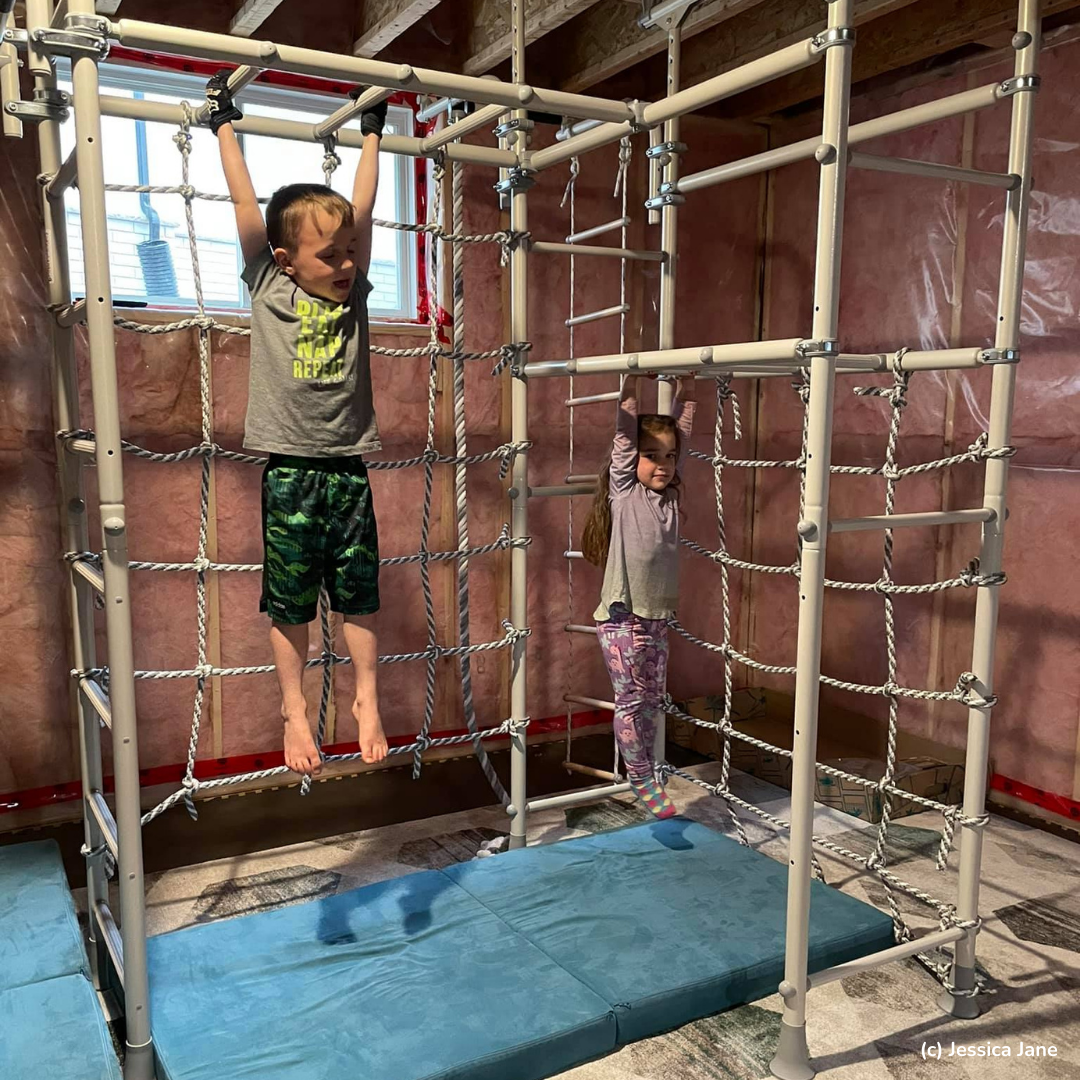
An indoor setup flips the injury math because the two levers the CPSC cares about, fall height and landing surface, become settings you choose instead of conditions you inherit. On a Brainrich gym, the monkey bars are a rung ladder that mounts to the steel frame at any height, starting at your child's chest. A 3-year-old practices dead hangs where their feet barely leave the mat. A 6-year-old traverses at a height where a drop is a hop. The bars rise only as the skill does, which is precisely the graded challenge the research keeps recommending, and underneath the whole run sit proper impact mats on a floor you picked.
There is also the repetition effect. A weekly playground trip offers a handful of attempts on crowded bars. Bars at home are available before breakfast, during the witching hour, and all through a January cold snap, and daily attempts are how hanging becomes crossing. Families consistently tell us the monkey bars are the accessory their kids race to first.
What we control on our side: every Brainrich frame is built from powder-coated steel, rated for 220 lb and safety-tested at 440 lb, double the rating, so a parent can hang next to a child and the structure is never the question. The frame pressure-fits between floor and ceiling with no drilling, the rungs are smooth steel with no splinters and no joints that loosen, and the bar height adjusts in minutes as your climber grows.
Practical fit notes before you buy: measure your ceiling height first, standard 8-foot ceilings work for every model, and basements are often the perfect spot as long as you check for ducts, soffits, and low beams along the bar run. Leave clear floor space past both ends of the bars for dismounts, keep furniture out of the swing arc, and plan mat coverage for the full traverse line, not just the middle. The monkey bars with climbing net attach to any Brainrich gym, and complete gyms run $899 to $2,399, are designed for ages 3 and up, and are HSA/FSA eligible with a Letter of Medical Necessity, since they support exactly the motor development those accounts exist to fund.
Which gym fits your family? Take the 60-Second Quiz →


Ready to bring the bars home?
Every gym assembles in an afternoon and is covered by a 30-day money-back guarantee.
Frequently asked questions
Are monkey bars safe for kids? They are safe when two variables are controlled: fall height and landing surface. CPSC data shows most playground injuries come from falls to the surface, and a 2020 Injury Epidemiology study found about half of playground extremity fractures happen on monkey bars or climbing gyms, typically from full-height bars over inadequate surfacing. Bars set near the child's own height, over rated impact mats, with one child crossing at a time and an adult nearby, remove the hazards while keeping the challenge that builds strength and judgment.
What age can kids do monkey bars? Most children can hang from a bar around age 3 to 4, cross with an adult supporting their hips around 4 to 5, and complete a full traversal independently around 5 to 6. Readiness is really about strength, not age: a child who can dead-hang for 5 or more seconds and shift weight side to side is ready to start learning, whenever that happens.
Can a 3 year old do monkey bars? A typical 3-year-old cannot traverse playground monkey bars, and full-height bars are not the place to try; the CPSC recommends overhead ladders for ages 4 and up. What a 3-year-old can do brilliantly is hang. On bars set at chest height over mats, a 3-year-old builds grip and shoulder strength safely, with feet inches from the landing, which is the preparation that makes traversal come easier at 5 or 6.
Is it impressive for a 5 year old to cross monkey bars unassisted? Yes, and it is on the early side of normal. The CPSC treats 4 as the youngest age for overhead ladders, and many children make their first full crossing between 5 and 6, so a 5-year-old crossing alone is ahead of plenty of classmates but not rare. It usually means lots of practice hanging, which is what builds the grip and shoulder strength.
When can babies hang from a bar? Newborns have a grasp reflex strong enough to hold their weight for a moment, but it fades by about 6 months and is not something to test. Hanging on purpose starts later: most toddlers hold a low bar for a second or two between 18 months and 3 years with a parent's hands at their waist, and hang alone with feet off the floor between 3 and 4.
What muscles do monkey bars work? Nearly everything above the waist: the hands and forearms (grip), the shoulders and upper back (hanging and swinging), the arms (pulling and reaching), and the core, which works constantly to control the swing. Occupational therapists add that bars also train motor planning, bilateral coordination, and proprioception, the body-awareness sense, which is why brachiation shows up so often in pediatric therapy programs.
How high should indoor monkey bars be? Start at your child's chest height, so they can grab the bar with feet on the ground and a drop is trivial. Raise the bars only when the current height is mastered, keeping the rule that a controlled drop should land the child on their feet on a mat. For contrast, the CPSC caps public overhead ladders at about five feet for preschoolers, and those assume engineered playground surfacing underneath.
How do I teach my child to do the monkey bars? Follow the progression: hanging first, until 5 to 10 seconds is easy; then single hand-transfers with you supporting their hips, never their feet, so they carry their own weight; then reduce help one rung at a time until the first solo crossing. Keep sessions short and frequent, daily beats weekly, and resist narrating with "be careful," which interrupts concentration right when they need it.
What if my child is afraid of the monkey bars? Lower the stakes, literally. Fear at seven feet over mulch is reasonable; the same child usually experiments freely at chest height over a mat. Let them hang, drop, and repeat with zero pressure to cross, and let them watch siblings or friends. Risky-play researchers describe this self-dosed approach as how childhood fears resolve naturally: the child raises the challenge themselves, one small step at a time.
Are indoor monkey bars HSA/FSA eligible? Brainrich play gyms, including the monkey bars attachment, are HSA/FSA eligible with a Letter of Medical Necessity, since they support gross motor development, strength, and sensory regulation. Complete gyms run $899 to $2,399, are designed for independent climbing at ages 3 and up, and frames are rated for 220 lb and safety-tested at 440 lb, so adults can join the hang.
📚 Keep reading in the Decision Guide
Are Climbing Gyms Safe for Kids? The Science of Controlled Risky Play · Heavy Work Activities for Kids · What Comes After the Pikler Triangle? · Monkey Bar Sets for Home
Sources
U.S. Consumer Product Safety Commission. Public Playground Safety Handbook (Publication 325). · Sadeghian, A. et al. (2020). Playground equipment-related extremity fractures in children presenting to US emergency departments, 2006–2016. Injury Epidemiology. · Sandseter, E.B.H. (2007). Categorising risky play: how can we identify risk-taking in children's play? European Early Childhood Education Research Journal. · Beaulieu, E. & Beno, S. (2024). Healthy childhood development through outdoor risky play. Canadian Paediatric Society position statement. · Falkson, S.R. & Bordoni, B. Grasp Reflex. StatPearls (updated 2025). · Shaw, K.G. et al. (2020). Monkey bar dimensions associated with pediatric upper extremity fractures show deviations from United States Product Safety Commission recommendations.
Share: