

Updated August 2026 · 9-minute read · by the Brainrich Kids team
Type "sensory room" into a search bar and you get dim lights, bubble tubes, and beanbags. Type "sensory gym" and you get kids swinging from ceiling-mounted equipment and cannonballing into crash mats. Both are called sensory. They are close to opposites: a sensory room turns input down, a sensory gym turns input up. Here is what each one actually does, which one your child is asking for, and why the best answer for most families is a corner of each.
The quick answer: a sensory room is a calming, controlled environment: dim light, soft textures, slow and predictable stimulation, the tradition schools and clinics call a multi-sensory or Snoezelen room. A sensory gym is an active input environment: climbing, swinging, hanging, and crashing, the tradition of the occupational therapy clinic. Most kids need both modes across a single day, which is why the practical home answer is not choosing. It is two zones: a calm-down corner you can put together for under $200, and an active input zone built around a frame with a swing and monkey bars. Both together land under $2,000, a fraction of what institutions pay for either one.
Jump to: What a sensory room is · What a sensory gym is · Which one your kid needs · The two-zone build · The budget reality · FAQ
What a sensory room is, and where the idea comes from
A sensory room is a space engineered to give a child less to process, and to make what remains gentle and predictable. The classic version has dimmed lighting, a bubble tube or fiber-optic strands to watch, soft seating that hugs the body, quiet or slow music, and nothing that startles. The point is not entertainment. The point is that a nervous system taking in too much, from a loud classroom, a bright store, a long day, gets a place where the volume of the world drops low enough to settle.
The tradition has a name: Snoezelen, the multi-sensory environment approach developed in the Netherlands in the 1970s and adopted since by schools, therapy centers, and care facilities around the world. If you have seen a "calm down room" in a special education classroom or a multi-sensory room at a children's clinic, you have seen this lineage. Many families first meet the idea through autism support programs, which is why "sensory room" and autism show up together so often in search results, but the calming mechanics apply to any child who gets overwhelmed, which at some point in some settings is every child.
Notice what a sensory room does not do: it does not give a child anywhere to put energy. There is no climbing, no swinging, no jumping. That is by design, and it is exactly half the picture.
What a sensory gym is, and why OT clinics look like playgrounds
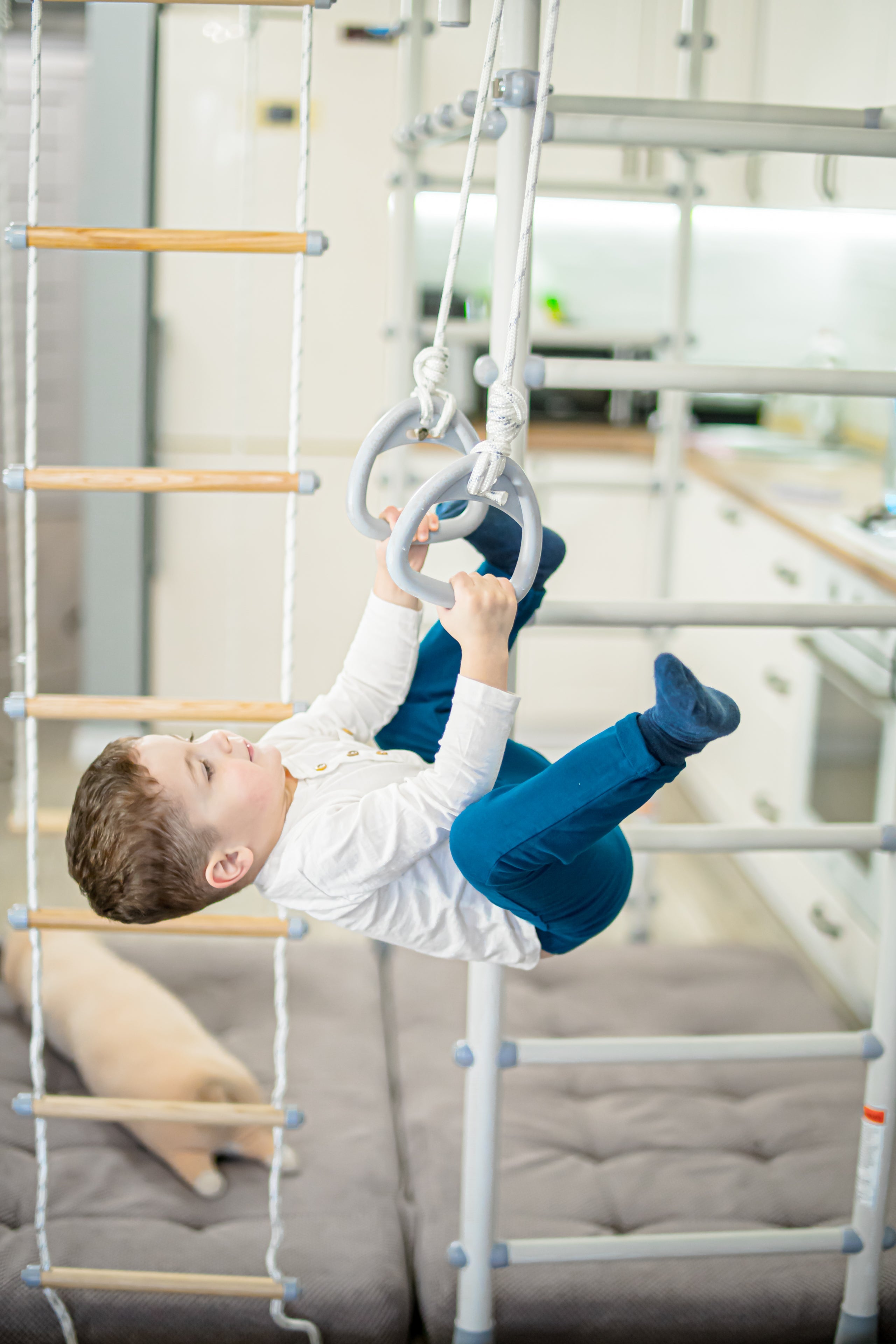
A sensory gym runs the opposite direction. Walk into a pediatric occupational therapy clinic and you will find swings hanging from the ceiling, ladders and monkey bars, ropes, balance beams, and crash pads everywhere, a room built to deliver input rather than remove it. Two kinds of input above all: muscles and joints working against resistance, the "heavy work" of climbing and hanging that OTs describe as organizing and calming (proprioceptive input), and the head moving through space on swings and bars, the input that builds balance (vestibular input).
That vocabulary comes from A. Jean Ayres, the occupational therapist and neuropsychologist who built sensory integration theory across the 1950s to 1970s and wrote the parent-facing classic Sensory Integration and the Child. The equipment-filled clinic gym descends directly from her practice, and the home versions, a frame with a swing, monkey bars, and a mat, are the same idea scaled to a corner of a playroom. The full case for one lives in our home sensory gym guide.
And notice what a sensory gym does not do: it does not give an overloaded child a place to hide from input. Which is the whole argument of this article.
Which one does your kid actually need?
The question assumes a child is one thing all day. Occupational therapist Patricia Wilbarger, who coined the term "sensory diet," made the opposite point: a child's day alternates between needing input and needing calm the way it alternates between meals and rest. Carol Stock Kranowitz's The Out-of-Sync Child, the book that taught a generation of parents the words "seeker" and "avoider," makes the same observation: most kids are not purely one or the other, and the same kid can seek at 9 am and avoid at 5 pm.
So the real question is which zone to build first, and the answer depends on the pattern you see most:
| The pattern | What you see at home | Build first |
|---|---|---|
| The seeker | Crashes into the couch instead of sitting on it, climbs furniture, hangs from doorframes, spins without getting dizzy, ramps up in the evening instead of winding down. | Gym first. This child is self-prescribing input on the wrong furniture. Give the need its own equipment, then add a small calm corner as the landing pad after big movement. |
| The easily overwhelmed kid | Covers ears, avoids messy textures, melts down in loud busy places, cautious about swings and heights, recovers slowly after stimulating days. | Room first. Build the calm corner, then introduce movement gently and on the child's terms. A slow, linear swing is often the bridge between the two worlds. |
| The kid who swings between both | Wired at breakfast, overloaded by dinner. Seeks crashes one hour, hides under a blanket the next. | Zone both from day one. This is the most common profile, and it is why the either-or question has a both answer. |
Treat the table as a conversation starter, not a clinical tool. If daily regulation is genuinely hard, an occupational therapist who knows your child is the right partner, and everything below still applies: home equipment is what turns an OT's once-a-week session into a daily rhythm.
The two-zone build: a corner of each
Here is the practical version. Not a dedicated room for either, just two zones in the spaces you already have, ideally in the same room or on the same floor so a child can move between modes without a negotiation.
The calm-down corner. A pop-up tent, bed canopy, or even the gap between the couch and the wall. Inside: floor cushions or a beanbag, a body sock or a heavy blanket, string lights or a dim color-changing lamp, noise-reducing headphones, and a small bin of quiet fidgets. Total cost lands under $200, and most families already own half of it. The tent matters more than the contents: a physical boundary that says the world stays outside.
The active input zone. This is where equipment earns its cost, because the input that regulates seekers, hanging, swinging, climbing, crashing, needs hardware rated for it. Two routes:
Small space or narrow room: the wall-mounted Model W3 ($850) is a steel frame that anchors to wall studs, sits just 9 inches off the wall, and is certified to 220 lb. It takes a small hammock swing (linear swinging only, no spinning) and TRX-style resistance bands, and it fits rooms where a floor-standing gym cannot brace, including slanted ceilings.
Full setup: the Spider V3 ($1,499) is the floor-to-ceiling route, a tension-mounted steel frame with monkey bars built in, plus rings, rope, trapeze, and a swing hanging from the same structure. Monkey bars come built into the Spider V3, Spider Max V3, and Mega Max V3; if you already own a Model T2 or T3, the Monkey Bars V3 attachment adds the span to your existing frame. Either way, a thick play mat goes under everything before the first climb.
THE TWO-ZONE HOUSE RULES
✓ The calm corner is never a time-out spot. The child enters by choice and leaves by choice, or it stops working.
✓ The gym zone gets a mat before it gets a swing.
✓ A parent is in the same room whenever the climbing zone is in use.
✓ Big input first, calm after: ten minutes of hanging and crashing, then the tent. That ordering is the whole sensory diet idea in one line.
✓ The playground and the backyard still count. The zones exist for the hours outdoors is not an option, not to replace it.
The budget reality: institutions pay 10x for this
Professional sensory room installations for schools and clinics, the bubble-tube-and-interactive-panel kind, are routinely quoted in the $5,000 to $25,000+ range, and clinic sensory gyms carry commercial equipment budgets to match. The home version of both zones does not need any of that:
| Zone | What goes in it | Realistic cost |
|---|---|---|
| Calm-down corner | Tent or canopy, cushions, body sock, dim lights, headphones, fidget bin | Under $200 |
| Active zone, small space | Wall-mounted W3, play mat, small hammock swing | About $1,100 |
| Active zone, full setup | Spider V3 with built-in monkey bars, play mat, swing | About $1,800 |
Two ways to bring even that number down. First, sensory and gross-motor equipment can qualify for HSA/FSA dollars when a clinician documents the need; our HSA/FSA eligibility guide and the Letter of Medical Necessity walkthrough cover exactly how families do it. Second, build in stages: calm corner this month, frame next quarter. Everything frame-mounted, swings, bars, mats, accessories, lives in the sensory gym equipment collection.
FAQ
What is a sensory room?
A sensory room is a controlled, calming environment, dim lighting, soft textures, gentle and predictable stimulation, designed to reduce the amount of sensory input a child has to process so an overwhelmed nervous system can settle. The approach descends from the Snoezelen multi-sensory rooms developed in the Netherlands in the 1970s and is now common in schools, clinics, and therapy centers.
What is a sensory gym?
A sensory gym is the opposite tool: an active environment built around climbing, swinging, hanging, and crashing, the equipment-filled room you see in pediatric occupational therapy clinics. It delivers the heavy-work and movement input many kids seek, the input associated with better regulation and balance. A home version is a steel frame with a swing, monkey bars, and a crash mat.
Can I build a sensory room for autism at home?
Yes, and it does not require a dedicated room: a tent or canopy corner with cushions, dim light, headphones, and a body sock delivers the core of it for under $200. Two things to hold onto: a calm corner is a support, not a treatment, so if your child has an autism diagnosis, build it alongside your OT's plan rather than instead of one. And most autistic kids also need the input side, which is why OT clinics have both swings and quiet corners.
How much space do the two zones actually take?
The calm corner fits in about 3x3 feet, a literal corner. The wall-mounted W3 protrudes just 9 inches from the wall, and a tension-mounted gym like the Spider V3 needs a ceiling between 6'9" and 10'6" plus a mat's worth of floor. Families run both zones in one average playroom, and plenty run them in a living room.
What age are the zones for?
The calm corner works from toddlerhood on. Independent climbing on the gym side is for ages 3 and up, with a parent in the same room; younger siblings join only with a parent's hands close by. Adjustable rungs and bars let the equipment start at chest height and grow with the child.
Share: