

Updated August 2026 · 11-minute read · by the Brainrich Kids team
Type "sensory room equipment" into a search bar and you will meet a wall of products: tubes that glow, panels that spin, tents, tiles, tunnels, and a thousand things that squish. The catalog makes it look like a sensory room is a shopping problem. It is not. Ask an occupational therapist what belongs in one and the answer gets short, because a working sensory room covers four kinds of input, and most of the catalog is a variation on equipment you only need once. Here is the list organized the way therapists actually think, what earns its floor space, and what to skip.
The quick answer: a sensory room has four jobs. Vestibular input, movement of the head through space, which is a swing. Proprioceptive input, muscles and joints working under load, which is climbing equipment and a crash-worthy mat, the "heavy work" OTs describe as organizing. Tactile variety, which is mostly bins and textures you can assemble for very little. And a calming corner: an enclosed, dim, quiet spot to come down in. One sturdy frame that holds a swing and takes climbing, a thick mat, a bin of textures, and a small tent covers all four jobs in roughly the footprint of a loveseat. Everything else on the market is a nice-to-have.
Jump to: The four jobs · Vestibular: the swing · Heavy work: climb, hang, crash · Tactile · The calming corner · The master list · What to skip · FAQ
Buy by input, not by item
The reason the catalog feels endless is that it is organized by product. Therapists organize by input: which sensory channel a piece of equipment feeds. That vocabulary, vestibular, proprioceptive, tactile, sensory integration itself, comes from A. Jean Ayres, the occupational therapist and neuropsychologist who developed sensory integration theory across the 1950s to 1970s and wrote the parent-facing classic Sensory Integration and the Child. Her framework is still how OT clinics are furnished, and it collapses the 400-item catalog into four short columns.
THE FOUR JOBS A SENSORY ROOM DOES
✓ Vestibular: moves the head through space. Swinging, spinning, hanging upside down.
✓ Proprioceptive: loads muscles and joints. Climbing, hanging, pushing, crashing.
✓ Tactile: varied touch. Textures, bins, deep pressure.
✓ Calming: a low-stimulation spot to regulate back down. Dim, enclosed, quiet.
One more idea shapes the list: the "sensory diet," a term coined by occupational therapist Patricia Wilbarger for scheduling doses of sensory input across the day the way meals are scheduled. A sensory diet is the argument for building this at home rather than relying on a weekly clinic hour: the input works best little and often, and equipment ten steps from the kitchen gets used daily. With the four jobs in mind, here is what actually fills them.
Vestibular: one good swing
If a sensory room buys nothing else, it buys a swing, and which swing matters less than parents fear because the motion, not the fabric, does the work. The useful distinction is between swing styles, and our sensory swings guide walks through all of them:
Pod and cocoon swings wrap the body while it sways, adding gentle pressure to the movement. Slow, linear, back-and-forth swinging is the style OTs generally describe as calming, which makes the pod swing the default first pick for kids who run hot in the evenings.
Platform and disc swings ask the body to balance while moving, which turns the swing into work as well as regulation. These are the swings kids stand on, kneel on, and invent games around.
Hammock swings split the difference: laze-in-it comfort with enough sway to count.
The real decision is not the swing, it is what holds the swing. Doorway clamps and single ceiling hooks carry weight-rating fine print and put holes in the ceiling joists. A floor-to-ceiling steel frame holds the swing from its monkey-bar span, no drilling, and the same frame feeds the second input below. One caveat from our own line: the wall-mounted Model W3 sits just 9 inches off the wall, which is exactly why it fits rooms nothing else fits, but that proximity means one-direction swinging with a small hammock only. Spinning and nest swings need a free-standing frame with clearance on all sides.
Proprioceptive: the climb-hang-crash station
Proprioception is the sense fed by muscles and joints working against resistance, and it is the input most kids are running lowest on. Pediatric occupational therapist Angela Hanscom made the case in Balanced and Barefoot that modern childhood has quietly subtracted the climbing, hanging, and hauling that earlier generations got by default, and that the subtraction shows up in wiggly, crashy, dysregulated behavior. The sensory room's answer is a station built for what OTs call heavy work:
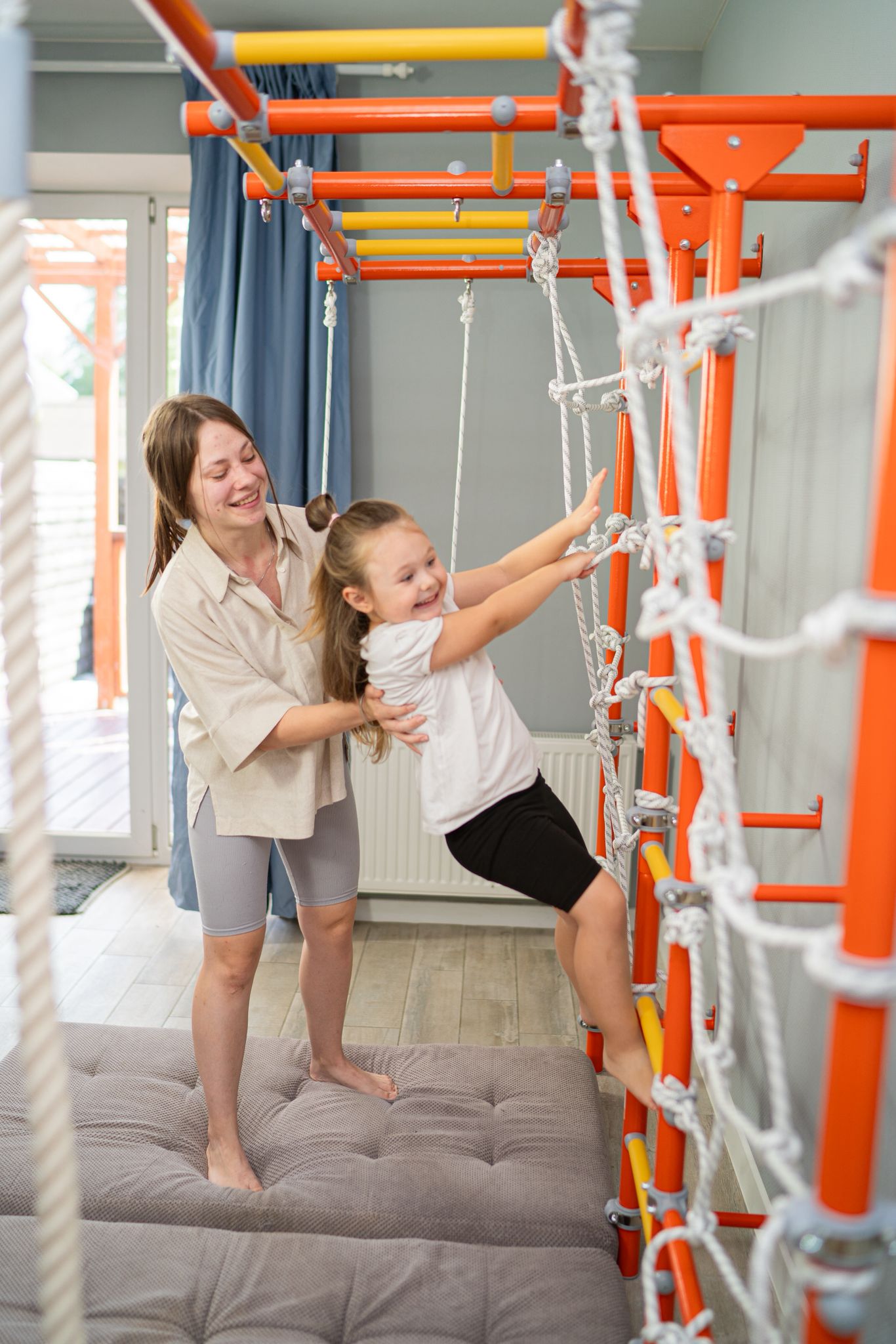
Something to climb. A ladder or climbing wall loads the whole body against gravity, the densest heavy work there is. Steel frames with rubber-coated rungs take daily traffic from age 3 and up without loosening the way furniture-grade climbers do.
Something to hang from. Hanging decompresses the shoulders under body weight and builds the grip that screen-heavy childhood erodes. Monkey bars are the densest single piece of sensory equipment in the room because they deliver heavy work and vestibular input at once. On our line, the monkey-bar span comes built into the Spider V3, Spider Max V3, and Mega Max V3; families who already own a Model T2 or T3 add the Monkey Bars V3 attachment, one vertical ladder plus one horizontal crossbar, to the frame they have.
Something to crash into. A thick, purpose-built mat turns drops into input instead of injury. A 4.5-inch play mat under the frame does double duty as the landing zone and the crash pad; couch cushions slide apart at exactly the wrong moment.
This station is also where safety lives or dies, so state the numbers plainly: every Brainrich frame is steel with non-toxic powder coating, the wall-mounted line is certified to 220 lb, and climbing is independent from age 3 with younger siblings joining only with a parent's hands close by, in the same room, always.
Tactile: the cheapest column on the list
Here is the budget-friendly secret of the whole project: the tactile column costs almost nothing. Carol Stock Kranowitz, whose book The Out-of-Sync Child introduced a generation of parents to sensory processing, filled her follow-up activity books largely with household-material ideas, and the pattern holds: touch input does not need engineering.
A bin of dry rice or beans with scoops and cups. A basket of fabric scraps with real contrast, burlap against silk against corduroy. Play dough or kinetic sand on a tray. A textured-surface path taped to the floor. A body sock or a lycra sheet for whole-body pressure. Rotate two or three of these at a time and the tactile job is done for the price of a grocery run. Spend the saved money on the columns that genuinely need equipment, the frame and the swing.
The calming corner
The fourth job runs opposite to the first three: after the input, a place to settle. The corner needs three properties, enclosed, dim, and quiet, and small equipment gets you all three:
A tent, canopy, or teepee creates the enclosure. Kids treat a fabric boundary as a real one; the point is a space that belongs to them and holds one child comfortably.
Soft, warm, controllable light. A dimmable lamp or a string of warm fairy lights beats any flashing gadget. The goal is less stimulation, and half the "sensory lighting" market sells more.
Deep-pressure comforts. A beanbag that swallows the sitter, a weighted lap pad sized with your OT's guidance, noise-reducing headphones for the kid who hears everything.
That is the whole corner. It should be the most boring real estate in the room, and that is precisely the job description.
The master list
Every item above in one table, with a candid verdict column. "Buy first" builds the room's spine; "nice to have" earns its place once the spine exists; "skip or wait" is explained in the next section.
| Equipment | Input it feeds | Verdict |
|---|---|---|
| Steel play gym frame (climbing + monkey bars + swing mount) | Proprioceptive + vestibular | Buy first. One purchase, three jobs, and the anchor the rest hangs from. |
| Pod or cocoon swing | Vestibular + deep pressure | Buy first. The default calming swing. |
| Thick play mat (4.5 in) | Proprioceptive + safety | Buy first. Landing zone and crash pad in one. |
| Tent or canopy | Calming | Buy first. The calm-down corner's walls. |
| Sensory bins and textures | Tactile | Make, don't buy. Household materials cover this column. |
| Platform or disc swing | Vestibular + balance | Nice to have. The second swing, once the first is a habit. |
| Body sock | Proprioceptive + tactile | Nice to have. Big input, small price, zero footprint. |
| Weighted lap pad | Deep pressure | Nice to have. Size it with your OT's guidance. |
| Noise-reducing headphones | Calming | Nice to have. Essential for some kids, unused by others. |
| Budget bubble tube | Visual | Skip or wait. See below. |
| Ball pit | Tactile | Skip or wait. Huge footprint, outgrown fast. |
| Single-purpose light-up gadgets | Visual | Skip. One input, no progression, novelty fades. |
What to skip, and the pattern behind it
No brands named here, because the problem is never one company, it is a category pattern. Three patterns cover almost everything worth skipping:
The budget bubble tube. The glowing column of water is the postcard image of a sensory room, and in a professionally installed multi-sensory environment it earns its keep. The under-$100 versions are a different product: a small air pump that hums at exactly the frequency a sound-sensitive child notices, water that needs cleaning and algae treatment, plastic that scratches and clouds, and a tall, tippable column in a room designed for crashing. A string of warm fairy lights and a lava-style lamp deliver the calm-visual job with none of the maintenance. If the tube is the dream, wait until the room's spine is built and buy a quality one, secured to the wall.
The single-purpose gadget. Spinning light wheels, plasma balls, flashing panels: each feeds one input, in one way, with no way to grow. A swing gets used differently at four and at eight; a blinking gadget does its one trick until the novelty runs out, usually within a season. The equipment that lasts is the equipment a child's own body powers.
The item they outgrow by summer. Toddler-scaled foam climbers, mini ball pits, and tiny tunnels look adorable in the catalog photos and get outgrown in months. Before buying anything structural, check the weight rating and the age range on the label, then picture your child two years from now. A frame rated for 220 lb is a frame an eight-year-old, a ten-year-old, and a demonstrating parent can all still use; equipment that maxes out at 50 lb is a countdown timer.
One more filter that costs nothing: whatever the category, look for a stated weight rating and a named safety certification before checkout. Reputable equipment states its numbers.
Before you buy: the funding note
If your child works with an OT or a pediatrician who recommends sensory equipment at home, some of this list may be coverable with pre-tax dollars. Swings, climbing frames, and crash mats are the categories families most often fund through an HSA or FSA with a Letter of Medical Necessity, and our guide to play gym HSA/FSA eligibility walks the whole path, letter template included. The movement-equipment side of this list, frames, swings, mats, and attachments, lives in our sensory gym collection.
FAQ
What equipment does a sensory room for an autistic child need?
The same four jobs, tuned to the child. Many autistic kids seek big doses of vestibular and proprioceptive input, which is why swings and hanging equipment anchor most OT clinics, and many also need the calming corner to be genuinely low-stimulation, which argues for skipping the flashing gadgets entirely. A sensory room is play equipment and a regulation tool, not a treatment; the OT who knows your child is the right partner for tuning the list, and their written recommendation is also the first step toward HSA/FSA funding.
Do I need a whole room?
No. The four jobs fit in a corner: a wall-mounted frame like the W3 or W3 Max protrudes just 9 inches from the wall, holds 220 lb, and handles the climbing and linear-swing jobs in rooms where a free-standing frame will not fit, including under slanted ceilings. Add a mat below, a bin on a shelf, and a tent in the corner and the "room" is done.
How much does a sensory room cost?
The true range is wide, so build in order: the tactile and calming columns cost very little, mostly household materials plus a tent and a lamp. The spine, a certified steel frame with a swing and a real mat, is the main investment, and it is the part that lasts a decade and the part HSA/FSA dollars most often cover. Start with the spine, add the rest as habits form.
What age is sensory room equipment for?
Bins, tents, and floor-level textures work from toddlerhood with a parent alongside. Independent climbing on our frames starts at age 3, with younger siblings joining only with a parent's hands close by. The equipment itself does not age out: V3 monkey-bar spans run about a foot longer than the previous generation with an added rung, so two kids can share, and 220 lb ratings mean the gear grows with the child instead of joining the outgrown pile.
Share: