

Published September 2026 · 9-minute read · by Yegor Nadvornyy, founder of Brainrich Kids
Search "Montessori play gym" and you get three different objects wearing the same label: a wooden arch with a mobile for a newborn, a folding triangle for a toddler, and a climbing wall for a five-year-old. All three can be Montessori. None of them is Montessori because of the wood. This guide sorts out what the word means for movement equipment, which piece belongs to which age, and how to fit one into a home with no spare room.
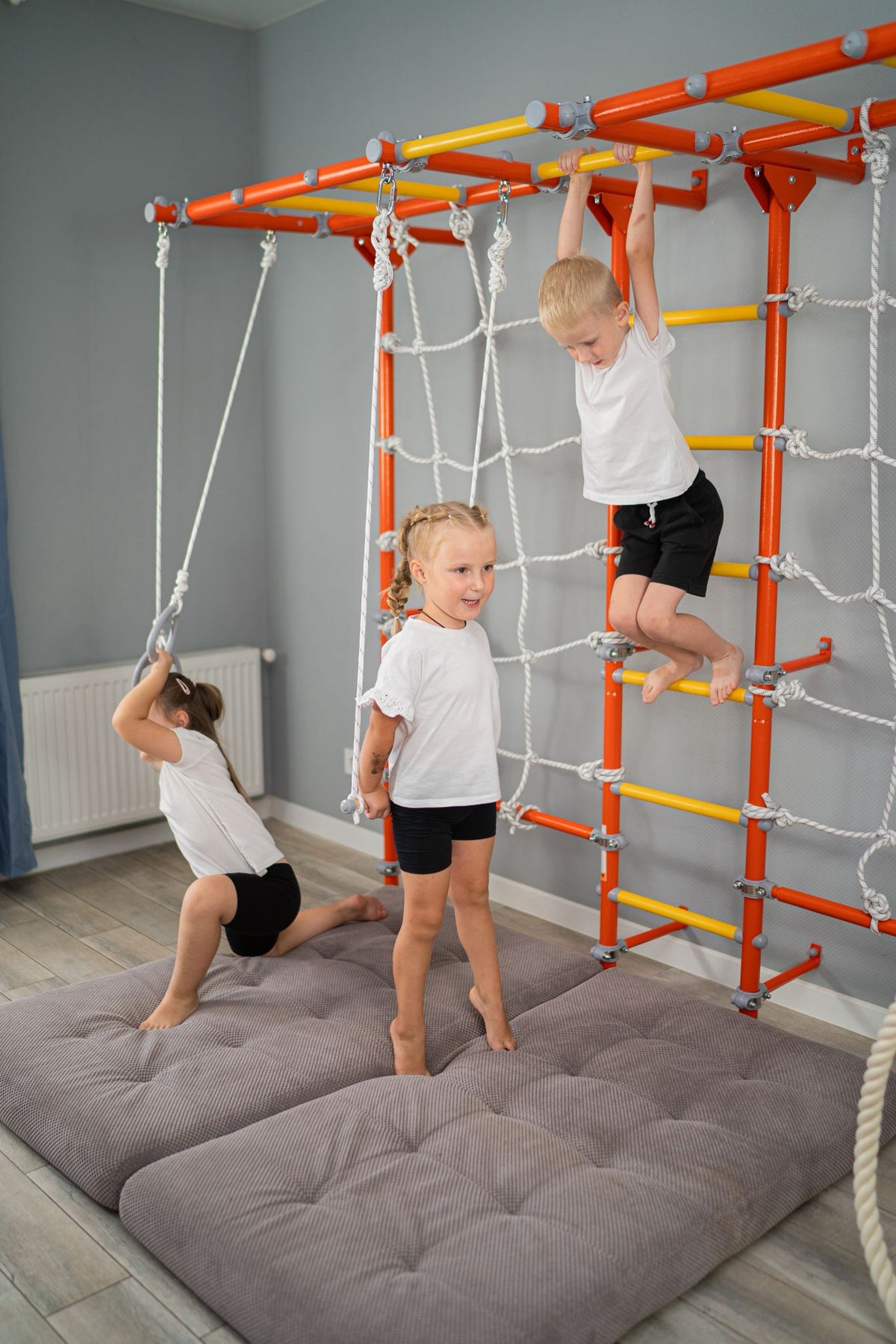
The quick answer: a Montessori play gym is any movement equipment that follows four rules: the child moves freely without being placed, strapped, or lifted; it is sized to the child; it is made of real materials; and it corrects the child's mistakes by itself. That gives you three pieces across childhood: an infant activity gym from birth to about 6 months, a Pikler triangle from crawling to about 3, and wall bars or a steel climbing gym from 3 onward, which is what a Montessori classroom's movement room actually uses. Our Model W3 is the home version of those classroom stall bars, and tension-mounted frames like the Model T3 do the same job without drilling.
Jump to: What "Montessori" means for movement · Three gyms, three ages · By-age table · The is/isn't filter · Pikler triangle vs wall bars · A movement area in a small home · Where Brainrich fits · FAQ
What "Montessori" actually means for movement equipment
Maria Montessori opened her first Casa dei Bambini in Rome in 1907. The word is not trademarked, which is why it ends up on plastic activity centers she would have carried out of the room. Applied to anything a child climbs, hangs from, or reaches for, the method comes down to four tests:
1. Freedom of movement
The child gets on, gets off, and gets up by their own effort. No straps, no seat that props a baby in a position they cannot reach alone, no adult lifting a toddler to the top. Montessori wrote that movement and thinking develop together; a body that is placed is not learning.
2. Child-sized
The first rung is where the child's hand lands. The mobile hangs at focusing distance. Rung spacing matches the reach of the age it is built for.
3. Real materials
Wood, steel, cotton rope, wool. Real weight, temperature, and texture, so the hand learns what things are. No lights, no sounds, no reward for pressing a button.
4. Self-correcting
Montessori called it "control of error." A foot that misses a rung tells the child immediately, and the child fixes it without a teacher. Climbing equipment is the purest control of error there is: the structure never lies about where the next hold is.
Color is not on the list. A red steel frame that passes all four is more Montessori than a pale wooden one the child has to be carried up. Montessori is a set of rules about how the child meets the object, not a finish.
Three gyms for three ages
Birth to about 6 months: the infant activity gym. A low arch over a firm floor mat. The baby lies on their back, later on their tummy, and looks, reaches, bats, and eventually grasps. In a Montessori home the arch carries the classic visual mobiles one at a time (Munari, octahedron, Gobbi, dancers), then tactile mobiles the baby can hit and hold. The American Academy of Pediatrics recommends supervised tummy time from the first days home, building to 15 to 30 minutes a day by around 7 weeks, and a mat under an arch is where most of it happens.
About 6 months to 3 years: the Pikler triangle. Emmi Pikler was a Hungarian pediatrician whose Budapest institute studied what infants do when nobody positions them. Her finding: children never placed in postures they cannot reach alone move with better balance and fewer falls. The triangle that carries her name is a folding wooden ladder, 30 to 36 inches tall, for pulling up, cruising, and climbing over. It is not Montessori by origin, but it obeys all four rules so completely that Montessori homes adopted it wholesale. By 3, most children climb it in one motion and look for something taller; our guide to what comes after the Pikler triangle covers that moment.
3 years and up: wall bars or a steel climbing gym. Walk into a Montessori movement room, or almost any European school gym, and the equipment on the wall is stall bars: a ladder of rungs bolted to the wall, sometimes 8 feet tall. They come from Swedish gymnastics, the system Pehr Henrik Ling built in the early 1800s. The child climbs, hangs, swings a leg over, and comes down by their own effort, and every rung is a control of error. A home wall bar set, or a floor-to-ceiling steel frame with ladder, net, rings, and rope, is the age-3-plus Montessori gym, and the only one of the three that is not outgrown: a kindergartner climbs it, a twelve-year-old does pull-ups on it.
Montessori movement equipment by age
| Age | What the child is working on | The Montessori piece | Years of use |
|---|---|---|---|
| 0 to 6 months | Focusing, tracking, reaching, grasping, tummy time, first rolls | Infant activity gym: wooden arch, floor mat, one mobile at a time, a low mirror | About 5 months |
| 6 to 18 months | Crawling, pulling to stand, cruising, first climbs | Pikler triangle, a low ramp, a sturdy bar at pull-up height | 1 to 2 years |
| 18 months to 3 years | Climbing over and down, carrying, balancing, first hanging | Pikler triangle with a board, a floor balance beam, a toddler swing seat on a supervised frame | About 18 months |
| 3 to 6 years | Vertical climbing, hanging, swinging, hand-over-hand, jumping down | Wall bars (stall bars) or a floor-to-ceiling steel gym with ladder, net, rings, rope | Through age 12 and beyond |
The last column is the argument for planning ahead. The first two pieces are outgrown in months; the third is not. Independent climbing on a Brainrich frame starts at 3 with a parent in the same room; younger siblings use it earlier in a swing seat, hands on.
The "is it Montessori?" filter
IT IS MONTESSORI IF
The child can start and stop using it alone. · The lowest hold is at the child's reach today, with a next hold above it. · It is wood, steel, rope, or cotton, and it is quiet. · A mistake is obvious to the child and fixable by the child. · It stays out and is available every day.
IT IS NOT MONTESSORI IF
The child has to be strapped in, propped, or lifted onto it. · It lights up, sings, or rewards a button press. · It holds a baby in a sitting posture before they can sit alone (activity centers, walkers, jumpers). · It is so padded that nothing gives feedback. · It gets put away after ten minutes.
Two things surprise parents here. First, the seat-style "activity gym" for babies fails the very first test: the baby is held in a position they did not earn. Second, steel passes: real material, real feedback, and stall bars have been made of it for a century. The only steel that fails is the kind that wobbles, because a frame that moves under the child is a hazard the child cannot read. That risk-versus-hazard line is the subject of our controlled risky play guide.
Pikler triangle vs wall bars
Parents search for this comparison around the third birthday. The answer: they are not competitors, they are consecutive.
| Pikler triangle | Wall bars / steel gym | |
|---|---|---|
| Best ages | 6 months to about 3 | 3 to 12 and up |
| Height | 30 to 36 inches | Floor to ceiling, typically 7 to 9 feet |
| Movements | Pull up, cruise, climb over, slide down a board | Climb, hang, swing, invert, traverse, pull up, drop and land |
| Load | Usually 50 to 130 lb, one child | Brainrich frames: 220 lb working load, safety-tested to 440 lb |
| Footprint | About 3 ft × 3 ft, folds flat | Wall bars: 9 inches off the wall. Tension-mounted frame: about 3 ft × 4 ft of floor |
| Outgrown | Around the third birthday | Not in childhood |
If your child is 2 and the triangle is still a challenge, keep it. If your child is 3 and climbs it in one motion, the triangle has finished its work. For the transition, see our children's climbing ladder guide and climbing toys by age.
How to set up a Montessori movement area in a small home
Montessori called the room the "prepared environment," and preparing one takes a corner, not a wing:
- Pick the room the family lives in. A movement area in a back bedroom gets used on weekends. One in the corner of the living room gets used 20 times a day.
- Claim about 6 by 6 feet. That holds a wall bar set or a tension-mounted frame with its mat, or a triangle with its board. Measure the ceiling: slanted ceilings point you to wall bars.
- Put the mat down first. A firm foam mat, not pillows or blankets, which slide. Our play mat is sized for the landing zone under a frame.
- One low shelf, few things. Three or four materials, rotated weekly. For infants, add an acrylic mirror at floor level beside the mat.
- Keep it out, always. A movement area that gets packed away is not one. Wall bars win here: 9 inches off the wall, floor still usable.
- Barefoot or grippy socks, then observe. Sit down. Do not say "careful." Let the child find the next rung.
"I grew up with wall bars in the school gym and a ladder frame at home. Nobody called it Montessori. The rule was the one Montessori wrote down: you climb what you can reach, and nobody lifts you. The W3 is the piece I climbed at 5, finished for an American living room."
– YEGOR NADVORNYY, FOUNDER OF BRAINRICH KIDS
Where Brainrich fits in a Montessori home
We do not make an infant arch or a Pikler triangle. We make the third piece, for age 3 and up, in two configurations that pass the four-rule filter.
Model W3: the classroom stall bars. A wall-mounted steel ladder in the Swedish tradition, bolted into studs, 9 inches off the wall, with hanging points for rings, a rope, and a small swing. It is the piece a Montessori movement room uses, and the answer for narrow rooms, slanted or tall ceilings, and families who want the floor clear.
Model T3 and the Spider family: the floor-to-ceiling gym. Two steel ladders braced between floor and ceiling, no drilling, with net, rings, and rope on the Model T3 and monkey bars built in on the Spider V3. Every bar is height-adjustable, so the challenge starts at chest height for a cautious 3-year-old and rises only when the child is ready.
Both carry a 220 lb working load, safety-tested to 440 lb, and neither has a slide: on a frame this tall, a slide would create a fall height the ASTM F1148 home playground standard is built to avoid.


Which piece fits your room and your child's age?
220 lb working load tested to 440, 30-day money-back guarantee.
Frequently asked questions
What is a Montessori play gym? Any movement equipment that follows Montessori's rules: the child uses it by their own effort without being placed or lifted, it is sized to the child, it is made of real materials like wood or steel, and it corrects mistakes by itself. For a newborn that is a low arch with a mobile over a floor mat; for a toddler, a Pikler triangle; for a child of 3 and up, wall bars or a floor-to-ceiling climbing gym.
Is a Pikler triangle Montessori? Not by origin. Emmi Pikler was a Hungarian pediatrician who worked separately from Maria Montessori, but her triangle obeys every Montessori principle, so Montessori homes and schools use it as standard equipment from about 6 months to 3 years.
What comes after the Pikler triangle? Vertical climbing equipment: wall bars (stall bars) or a floor-to-ceiling steel gym with a ladder, net, rings, and rope. Most children climb the triangle in one motion by age 3. A gym bought at 3 lasts through age 12 because the bars adjust.
Is a steel climbing gym Montessori, or does it have to be wood? Steel passes. Montessori's material rule is about real materials with real feedback, not a species of tree. The only frame that fails is one that wobbles, because movement the child cannot predict is a hazard rather than a self-correcting challenge.
How much space does a Montessori movement area need? About 6 by 6 feet in the room the family actually lives in. Wall bars stand 9 inches off the wall and keep the floor clear; a tension-mounted frame uses roughly 3 by 4 feet of floor plus a mat.
What age can a child climb wall bars independently? Brainrich frames are rated for independent climbing from age 3 with a parent in the same room and a mat underneath. Younger siblings use the frame earlier in a toddler swing seat with hands-on supervision, and climb the lowest rungs when they can reach them on their own.
📚 Keep reading in the Decision Guide
What Comes After the Pikler Triangle · Montessori Gifts by Age · Climbing Gyms for Babies and Toddlers · The Indoor Jungle Gym Buyer's Guide
New: deciding between a wooden climbing set and a steel frame for a toddler? Read Pikler Climbing Set vs Steel Play Gym, with 2026 prices and the age-5 question answered.
New: the method behind the toys: Montessori Parenting at Home, the four habits, the prepared home, and where movement fits.
Sources
Montessori, M. (1949). The Absorbent Mind. Association Montessori Internationale (AMI), prepared-environment guidance. · Pikler, E. (1971). Peaceful Babies, Contented Mothers; Pikler Institute (Lóczy), Budapest. · American Academy of Pediatrics, HealthyChildren.org. Back to Sleep, Tummy to Play. · Yogman, M. et al. (2018). The Power of Play: A Pediatric Role in Enhancing Development in Young Children. Pediatrics, AAP clinical report. · CDC. Physical Activity Guidelines for Children and Adolescents. · ASTM International. ASTM F1148, Standard Consumer Safety Performance Specification for Home Playground Equipment. · Brainrich Kids engineering specification: frame working load 220 lb, safety-tested to 440 lb.
Share: