

Updated August 2026 · 10-minute read · by the Brainrich Kids team
Search for the Doman Method and you will find two internets: one that treats it as the secret to raising a genius, and one that dismisses it entirely. Neither is much use to a parent who just wants to know what it actually is. This guide is the middle path: who Glenn Doman was, what each of the books covers, how the program works day to day, and the one idea from the whole tradition that modern parents, Doman families and skeptics alike, keep coming back to.
The quick answer: the Doman Method is the popular name for the programs of The Institutes for the Achievement of Human Potential (IAHP), founded by physical therapist Glenn Doman in 1955 in the Philadelphia area. It has two pillars: an intellectual program built on flash cards (word cards, red dot math cards, and "bits of intelligence") and a physical program built on movement from birth, from the infant crawling track to the overhead brachiation ladder. It asks a great deal of a family's daily time. Its most durable idea, and the one mainstream child development experts most readily echo, is that a movement-rich home environment matters enormously.
Jump to: Who was Glenn Doman · The books · The two pillars · What it asks of a family · What modern parents take from it · Montessori and Pikler · FAQ
Who was Glenn Doman
Glenn Doman was a physical therapist who, in 1955, founded The Institutes for the Achievement of Human Potential in the Philadelphia area. His starting point was clinical: working with brain-injured children, an experience he later wrote up for parents in What To Do About Your Brain-Injured Child. From that work The Institutes built a broader field they called child brain development, and extended their programs to all children on a simple premise: the years from birth to six are when the brain grows fastest, so that is when a home can do the most.
Two things about the man himself are worth knowing. First, he wrote for parents, not for academics: the books are warm, direct, and relentlessly encouraging about what mothers and fathers can do at home. Second, he reportedly disliked the phrase "Doman Method" and preferred to credit the staff of The Institutes as a whole. The name stuck anyway, because parents needed something to call it.
Today two organizations carry the work forward: The Institutes themselves (iahp.org) and Doman International (domaninternational.org), led by the family's next generation. The tradition has spread worldwide, with especially devoted followings in Latin America and Asia, where Doman-inspired schools and parent courses are a fixture of the early-education landscape.
The books, and what each one covers
Most families meet the method through one book and then collect the shelf. Here is what each one is actually about:
| The book | What it covers |
|---|---|
| How To Teach Your Baby To Read (1964) | The book that started it all. Whole words on large cards in big red letters, shown in seconds-long sessions, on the argument that babies can recognize written words long before they can work through phonics. |
| How to Teach Your Baby Math | Quantity before numerals: cards with red dots, from one to a hundred, so a child learns to perceive amounts directly, then equations built from those quantities. |
| How To Teach Your Baby To Be Physically Superb | The physical program: floor time and crawling from birth, creeping, walking, running, and the overhead brachiation ladder. The book behind every living-room ladder you have ever seen in a Doman home. |
| Fit Baby, Smart Baby, Your Baby (with Douglas Doman) | The modern, schedule-forward guide to the physical program, co-written with his son. Most families running the movement side today work from this one. |
| How Smart Is Your Baby | The infant stage: how to observe a newborn's development and set up early stimulation and movement opportunities in the first months. |
| What To Do About Your Brain-Injured Child | The clinical origin of the whole tradition, written for parents of children with brain injuries and describing The Institutes' home-based treatment philosophy. |
The two pillars: cards and movement
The intellectual pillar runs on flash cards, and the technique is the same across subjects: sessions of a few seconds, several times a day, always ending before the child wants to stop. Reading uses whole-word cards. Math uses the red dot cards. General knowledge uses what Doman called "bits of intelligence": large, clear images (a painting, a bird, a flag) paired with facts, grouped into categories. The tone matters as much as the materials: sessions are meant to feel like a game the parent and child are slightly obsessed with, never like a drill.
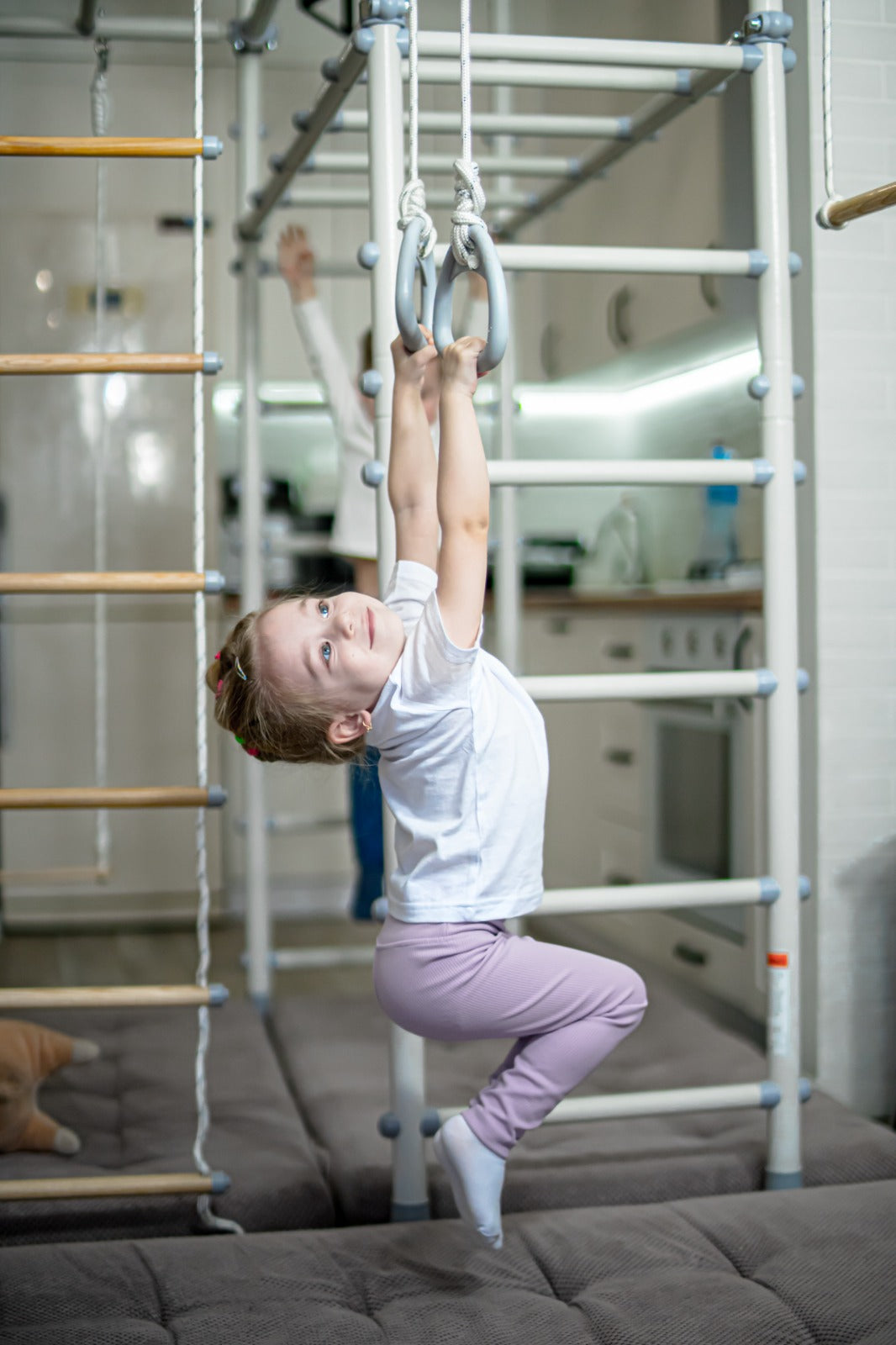
The physical pillar starts earlier than almost any other movement tradition: at birth. Newborns get generous floor time on their tummies and an inclined, padded crawling track that lets them practice the crawling reflex from the first weeks. From there the program progresses through creeping on hands and knees, walking, running, and gymnastics-style skills, with the centerpiece being the brachiation ladder: a horizontal overhead ladder the child crosses hand over hand, with a parent spotting every session. We wrote a full practical guide to that piece of the program, including the classic DIY build and its engineered alternatives, in The Brachiation Ladder: A Practical Guide for Doman-Method Families.
What the program asks of a family, day to day
Stated plainly: this is a lifestyle, not an activity. A family running the full program is doing many short sessions spread across every day, making and organizing card materials by hand, logging progressions, and treating the home as a small school that never closes. The books are upfront about this; the promise is built on frequency and consistency, and the parent, usually the mother in Doman's original telling, is the teacher. Families who thrive on it tend to be families who wanted a shared daily project with their child and found one they love. Families who burn out are usually the ones who tried to bolt the full schedule onto an already full life.
One note for completeness: parts of the clinical program, particularly some of its treatment applications for brain-injured children, have been debated in mainstream pediatrics over the years, and families exploring that side of the work will want to read both The Institutes' materials and their own pediatrician's perspective. The home enrichment side, cards and movement for healthy children, is a separate question, and it is the side this guide covers.
What modern parents take from it
Here is the interesting part. Even parents who never laminate a single card tend to walk away from the Doman books with the same conviction, and it happens to be the piece of the tradition that mainstream child development thinking most strongly supports: children need far more movement than modern indoor childhood gives them, and the home environment decides whether they get it.
Research across pediatrics and occupational therapy has linked abundant early movement, climbing, hanging, swinging, and balancing, to gains in strength, coordination, confidence, and the sensory processing that underpins attention. That is why the Doman living-room ladder, which looked eccentric in 1964, now looks a lot like what pediatric OTs set up in sensory gyms, and what playground designers have known forever: kids are drawn to overhead ladders because hanging and swinging feed the body systems that are hungriest in early childhood. The full case is in Indoor Monkey Bars Are Sensory Equipment.
So the modern translation of Doman's physical program, practiced by families who have never read him, is simply this: set up the home so that climbing, hanging, and swinging are available every single day, in any weather, and let daily access do the compounding.
One age note, stated plainly because we are a safety-first company: Doman programs begin in infancy, and Brainrich equipment does not. Our gyms are designed for ages 3 and up for independent climbing. For program specifics with babies and toddlers, the Doman organizations' own books and courses are the right source; our equipment picks the story up from age three, when a child is ready for real climbing, hanging, and monkey-bar work with a parent in the same room.
The sibling traditions: Montessori and Pikler
Parents researching Doman almost always end up comparing two other names, and the comparison is genuinely useful:
Maria Montessori built her pedagogy on the observation that movement and learning are inseparable: children learn through the hand and the body, in a prepared environment that invites purposeful activity. Montessori classrooms are child-paced where Doman sessions are parent-led, but both traditions reject the idea of a child sitting still while knowledge is poured in.
Emmi Pikler, the Hungarian pediatrician behind the Pikler triangle, argued for fully self-directed motor development: never place a baby in a position it cannot get into by itself, and let gross motor skills unfold without adult instruction. Pikler is in many ways Doman's philosophical opposite on the question of who leads, yet both arrived at the same practical conclusion: the home should be furnished for movement. We traced where that path leads as children grow in What Comes After the Pikler Triangle.
A family does not have to pick a team. Plenty of homes run Pikler-style freedom in the baby years, borrow Doman's conviction about daily overhead-ladder work in the preschool years, and land in a Montessori school at five. The common thread is the environment.
FAQ
What is the Doman Method?
The common name for the early-development programs of The Institutes for the Achievement of Human Potential, founded by physical therapist Glenn Doman in 1955. The programs pair an intellectual track (flash cards for reading, math, and general knowledge) with a physical track (movement from birth, crawling, and the overhead brachiation ladder), delivered by parents at home in many short daily sessions.
Who was Glenn Doman?
A physical therapist who began in rehabilitation work with brain-injured children, founded The Institutes in the Philadelphia area in 1955, and spent the following decades writing the parent-facing books the method is known for. He preferred crediting The Institutes' staff over having the work carry his name. Today the tradition is carried by IAHP and by Doman International, led by the family's next generation.
What are the Doman books, and where should I start?
The canon: How To Teach Your Baby To Read (1964), How to Teach Your Baby Math, How To Teach Your Baby To Be Physically Superb, Fit Baby, Smart Baby, Your Baby, How Smart Is Your Baby, and What To Do About Your Brain-Injured Child. Most families start with How To Teach Your Baby To Read because it explains the whole philosophy, then add the math book or the physical books depending on which pillar interests them. For the movement program specifically, Fit Baby, Smart Baby, Your Baby is the practical, schedule-driven guide.
Does the Doman Method work?
A fair answer has three parts. First, the program demands intense, sustained parental commitment, which makes outcomes hard to untangle from the sheer quantity of parent attention involved. Second, the clinical claims have been debated in mainstream pediatrics, and we do not repeat them as fact. Third, the core physical principle, that a movement-rich daily environment is linked to stronger motor, sensory, and cognitive development, is widely endorsed far beyond the Doman world. Families we hear from tend to value the shared daily rhythm as much as any milestone.
What equipment do Doman families use at home?
On the card side: homemade or purchased word cards, red dot cards, and bits-of-intelligence cards. On the movement side: an infant crawling track for the baby stage, and a brachiation ladder from toddlerhood on. The ladder is where equipment choices get interesting: some families build one from lumber, while others use an engineered monkey-bar gym with adjustable height, such as our Spider V3, Spider Max V3, or Mega Max V3, which come with the monkey-bar span built in (owners of a Model T2 or T3 can add the same span with the Monkey Bars V3 attachment), plus a thick play mat underneath. Remember the age split: Doman families start ladder work younger than our equipment is designed for, and Brainrich gyms are for ages 3 and up.
Share: