

Updated August 2026 · 10-minute read · by the Brainrich Kids team
Search "Montessori playroom" and you will drown in beige: rainbow stackers arranged by hue, linen teepees, shelves styled for the photo. Here is the problem: none of that is Montessori. Montessori is not an aesthetic. It is a job description for a room: a space your child can run without you in it. Maria Montessori called it the prepared environment, and preparing one at home costs less than the beige version, because the whole method is subtraction.
The quick answer: a Montessori play room is a prepared environment: everything at child height, one low open shelf with 6 to 8 complete activities on display, a single home for every object, and a dedicated movement area that grows from floor mat to climbing gym. The test of the room is one question: can your child start an activity, finish it, and put it away without asking you for anything? If yes, the room is doing its job, which is building independence while you drink your coffee.
Jump to: The prepared environment · Child-height everything · The shelf · A place for everything · The movement area · Independence rituals · Mistakes to skip · FAQ
The prepared environment: the room is the teacher
Montessori's central insight was that a young child's independence is mostly an environment problem, not a maturity problem. A three-year-old who "can't" pour water, choose an activity, or clean up is usually a three-year-old in a room where the pitcher is too heavy, the toys live in a chest-deep bin, and the shelf is above their head. Change the room and the same child becomes startlingly capable. The adult's job shifts from servant and referee to what Montessori actually asked of parents: prepare the space, then get out of the way.
The research on Montessori environments is worth knowing because it supports the room, not just the school. A longitudinal study led by Angeline Lillard found that children in Montessori preschools showed greater gains in executive function, reading, vocabulary, and social understanding than peers in conventional settings, with the gains holding across income levels. A 2024 analysis by Denervaud and Zanchi reported that children from Montessori environments showed stronger brain network connectivity in regions linked to motor control, attention, and executive functioning. These are associations, not guarantees, but they all point the same direction: the environment a child works in shapes how they learn to focus, choose, and follow through.
One scope note before we build. This article is about the Montessori-specific room: the prepared environment, done at home. If you want the general playroom architecture, our open-ended playroom guide owns that system, five zones, layouts by room size, and a side-by-side comparison of Montessori versus open-ended philosophy, so you can decide how strict you want to be. And if your question is which materials belong on the shelf, that is its own craft: our guide to what makes a toy Montessori covers it. Here, we are building the room itself.
Rule one: build the room at your child's height
The fastest way to audit a playroom is to sit on the floor in the middle of it. That is your child's eye level. From down there, most family rooms are a canyon of furniture bottoms and unreachable surfaces, a room built for giants that the child merely visits. The prepared environment flips every element down to the child's scale:
🪑 A CHILD-SIZED TABLE AND CHAIR
Feet flat on the floor, elbows at table height, light enough for the child to push in their own chair. This is where focused work happens.
🪞 A LOW MIRROR AND EYE-LEVEL ART
A mirror at floor level lets the child study their own movement. Hang one or two pieces of real art at their eye height, not yours.
🧥 HOOKS AND BASKETS THEY CAN REACH
A hook at shoulder height for their sweater, a basket for slippers, a spot for the floor cushion. Reachable storage is the price of "put it away yourself."
💧 A SELF-SERVE STATION
A small pitcher, a real glass, a sponge for spills. Yes, a real glass: a child handed only unbreakables never learns why careful exists.
Notice what this list does to the daily script. "Can you get my cup?" disappears. "Where does this go?" disappears. Every object the child can reach, use, and return is one fewer thing they need you for, and that arithmetic, repeated across a whole room, is where Montessori independence actually comes from. Not from a philosophy. From shelf height.
The shelf: low, open, and almost empty
The heart of the room is one piece of furniture: a low, open shelf at or below the child's chest height. No doors, no lids, no toy chest. And here is the part that feels wrong to every adult the first time: it should hold only 6 to 8 activities, each one complete on its own tray or in its own basket, with visible space around it.
The logic is attention. A toy bin offers a hundred options and therefore none: children rummage, dump, and drift. A nearly empty shelf offers a real choice among a few whole activities, and a whole activity invites a whole cycle of work: choose it, carry it to the table or mat, do it, return it. Research on Montessori settings keeps landing on this theme; a 2018 study by Lillard linked Montessori preschool experience in three-year-olds to stronger cognitive control, the attention and self-regulation muscles that a low-distraction environment gives daily practice. Fewer things out means each thing gets used deeper.
Everything else goes into closed storage your child cannot see, a closet, high cabinet, or lidded bins elsewhere, and rotates in every week or two. Rotation is your control knob: watch what your child ignores, swap it for something from storage, and the shelf feels new without a single purchase. What earns a spot on the shelf, real tools over pretend versions, one-purpose materials, natural textures, is exactly what our Montessori toys guide is for.
A place for everything: outer order, inner order
Montessori observed that young children pass through a sensitive period for order, roughly the first three years, when they crave sameness and predictability in their surroundings: the cup goes there, the shoes live there. Adults often read this as rigidity. Montessori read it as construction: the child is using the room's external order to build internal order, a mental map of how the world works and their place in it.
The prepared environment honors this with one blunt rule: every object in the room has exactly one home, and it returns there after every use. Practical moves that make the rule self-enforcing:
| Do | Skip |
|---|---|
| One tray, one activity, one spot. The tray is the activity's home; the shelf gap left behind is the "return here" sign. | The big toy bin. A bin is a place where everything lives, which means nothing has a place. It teaches dumping, not resetting. |
| Picture labels for pre-readers. A photo of the blocks taped where the blocks go turns cleanup into a matching game. | Resetting the room yourself after bedtime. You just took the most instructive job in the room and gave it to the least needy person in the house. |
| Finish the cycle before the next choice. The gentle house rule: one activity comes back before another comes out. | Treating cleanup as punishment. In Montessori, restoring the room is part of the play, the closing ceremony, not the fine. |
Give it two or three weeks of consistency and something surprising happens: the child starts defending the order. They notice when a tray is missing a piece. They correct you. That is the sensitive period doing its work, and it is the foundation the rest of the room stands on.
The movement area: "maximum effort" needs a home
Here is the piece most Pinterest playrooms leave out entirely, and it was central for Montessori: movement is not a break from learning; movement is how young children learn. She wrote at length about the toddler drive she called maximum effort: the compulsion to carry the heaviest watermelon, push the full laundry basket, climb the tallest thing available. A child working at the edge of their physical ability is not misbehaving. They are doing precisely the developmental work the environment should be inviting.
So a real Montessori play room reserves floor space for a movement area, and it evolves with the child:
0–12 months
A firm floor mat and low mirror, the same logic as the Montessori floor bed: the child moves freely instead of waiting to be lifted in and out.
1–3 years
A Pikler triangle, a low ramp, cushions to haul, baskets to carry. Small climbs, chosen and repeated hundreds of times.
3+ years
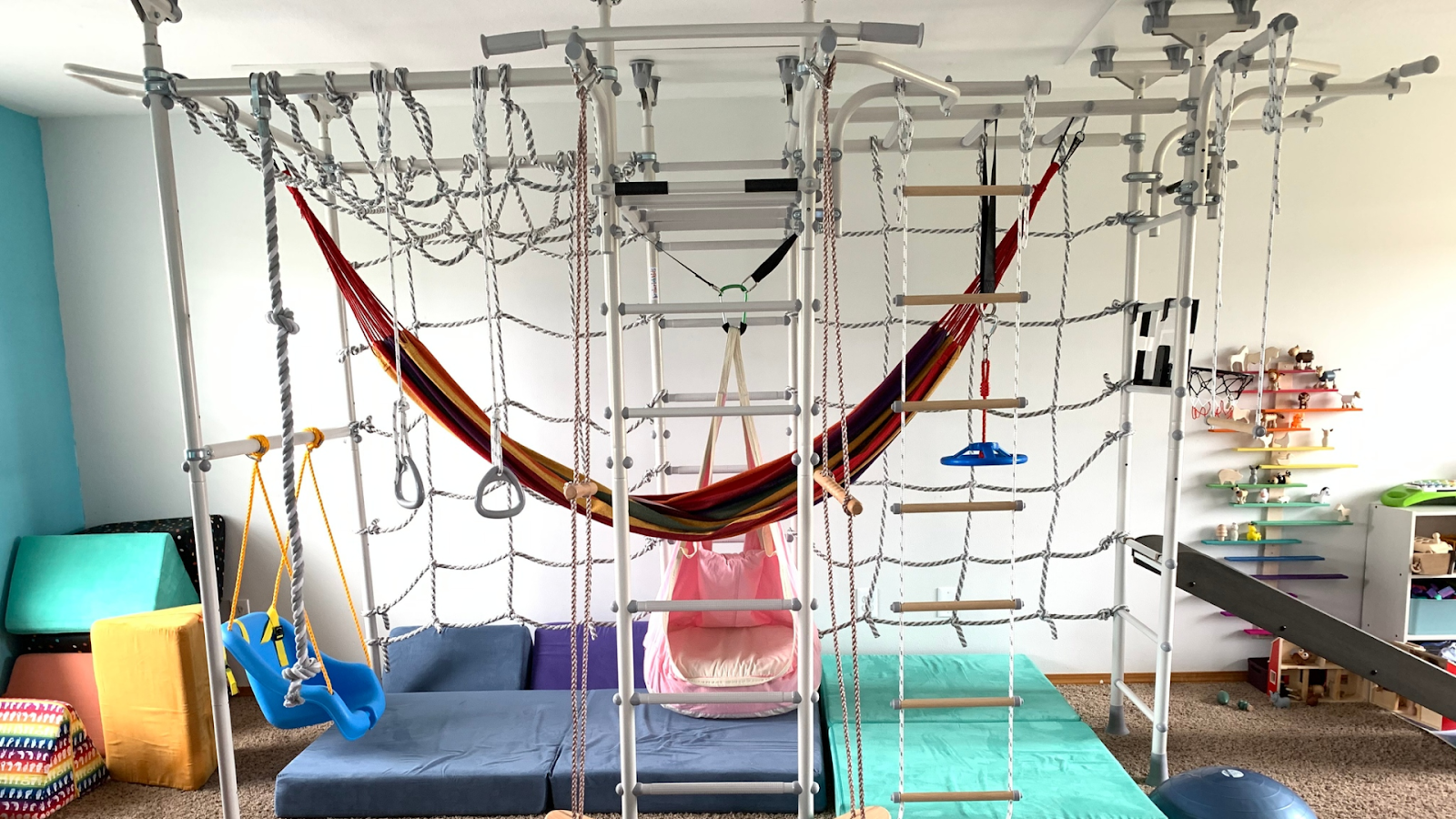
The Pikler is outgrown, but maximum effort is not. This is where a full climbing gym takes over: nets, rings, monkey bars, real hanging work.
That third stage is the one parents ask us about most, because it sneaks up: the triangle that ruled the toddler years suddenly takes a confident four-year-old about four seconds to summit. We wrote a full guide to what comes after the Pikler triangle, but the short version fits the Montessori logic exactly: the environment should always hold a challenge slightly bigger than the child. A steel climbing gym does that for the whole childhood, rated for 220 lb and tested to double that, built for independent climbing from age 3, with adjustable bars so the challenge starts low and rises only when the child is ready, which is graded difficulty, chosen by the child, on equipment that never wobbles. That is the prepared environment, applied to gross motor work.
"I didn't grow up strong & fearless. My children are. I love anything that helps with that."
– ZAKIA P., BRAINRICH OWNER
Which gym fits your movement area? Take the 60-Second Quiz →
Independence rituals: the room's operating system
The furniture is the hardware. The rituals are the software, and they are what turn a nice-looking room into a child who says the five Montessori words every parent is secretly working toward: "I did it by myself."
The child resets the room. Every session ends with trays back in their homes. You model it for weeks, then assist, then merely keep company. The reset is not a chore added to play; it is the last step of play.
Care of the environment is on the shelf. A tiny dustpan, a hand broom, a spray bottle of water and a cloth, presented exactly like the puzzles. Wiping the table they spilled on is, to a three-year-old, as satisfying as any toy, and it teaches the room belongs to them in both senses.
Watch before you help. The hardest ritual is yours: when the coat zipper sticks or the tray tilts, count slowly to ten before moving. Montessori's line on this was that unnecessary help is an obstacle to development. Most of the help we give young children is unnecessary; the room you just built is the proof.
Slow tours for new work. When a new activity rotates onto the shelf, present it once: slow hands, few words, then hand it over. From then on it belongs to them.
Five mistakes that quietly break the room
1. Keeping a "just in case" toy bin in the corner. One bin re-teaches dumping and undoes the shelf. Storage lives out of sight or it isn't storage.
2. Decorating for adults. Busy murals, alphabet borders, and mobiles above the work area all compete for the attention you are trying to protect. Soft, mostly bare walls are not unfinished; they are the point.
3. Skipping the movement area to fit more shelves. A room that feeds the hands but starves the body produces the 4 p.m. couch-climbing you were trying to design away. The gym corner is not the reward wing of the room; it is a peer of the shelf.
4. Rotating never, or rotating everything. A stale shelf gets ignored; a fully swapped shelf unsettles the order-loving child. Change 2 or 3 trays at a time and leave the favorites.
5. Building it once and freezing it. The prepared environment is prepared for someone, and that someone keeps growing. Every few months, sit on the floor again, look around at their eye level, and ask what they have outgrown.


Ready to build the movement corner?
Steel frames, non-toxic powder coat, ships as a multi-box kit that assembles like a big Lego set, and every gym is covered by a 30-day money-back guarantee.
Frequently asked questions
What makes a play room "Montessori"? Not the color palette. A Montessori play room is a prepared environment: everything at child height, a low open shelf with a small number of complete activities, one home for every object, and space to move. The defining test is whether the child can choose, do, and put away work without adult help.
How many toys should be out at once? Around 6 to 8 activities on the shelf, each complete on its own tray or basket. Everything else waits in closed storage and rotates in every week or two, a few trays at a time. Fewer choices out means deeper attention on each one.
Do I need a dedicated room? No. The prepared environment is a set of rules, not a square footage. A corner of the living room with one low shelf, a small table, and a movement mat follows every principle in this article. For zone-by-zone layouts in small spaces, see our open-ended playroom guide.
What is "maximum effort" in Montessori? Montessori's term for the toddler drive to work at the edge of physical ability: carrying heavy things, pushing, climbing. It is why a real Montessori room includes a movement area, and why the climbing challenge should grow with the child instead of disappearing after the toddler years.
Is a climbing gym Montessori-appropriate? The principles say yes: freely chosen, self-directed, real physical work with graded difficulty. A Pikler triangle serves ages 1 to 3; from age 3, a steel gym with nets, rings, and adjustable-height monkey bars continues the same progression on equipment rated 220 lb and tested to 440 lb, so it serves siblings and lasts the whole childhood.
What about a floor bed? The floor bed belongs to the bedroom, but it shares the play room's logic: the child enters and exits freely instead of waiting behind bars. In the play room, the equivalent is the movement mat and low mirror for babies, freedom of movement from the first months.
My child dumps everything and walks away. Is Montessori failing? Dumping usually means too many options or activities stored in bins. Cut the shelf to a handful of tray-complete activities, model the full cycle (choose, work, return) a few times, and hold the one-activity-at-a-time rhythm gently. Most children settle into the order within two or three weeks.
📚 Keep reading
The Ultimate Open-Ended Playroom Guide · What Are Montessori Toys? · What Comes After the Pikler Triangle
New: the method behind the toys: Montessori Parenting at Home, the four habits, the prepared home, and where movement fits.
Sources
Lillard, A.S. et al. (2017). Montessori preschool elevates and equalizes child outcomes: a longitudinal study. Frontiers in Psychology. · Lillard, A.S. (2018). Cognitive control in three-year-olds is linked to Montessori preschool experience. Frontiers in Education. · Denervaud, S. & Zanchi, C. (2024). The impact of educational experiences on brain development: insights from Montessori and traditional schooling. Springer Nature Communities. · Montessori, M. (1936). The Secret of Childhood; (1949) The Absorbent Mind, on the prepared environment, sensitive periods, and maximum effort.
Share: