

Updated August 2026 · 11-minute read · by the Brainrich Kids team
Every parent of a child with ADHD knows the scene: homework is waiting, or bedtime is looming, and your child is a live wire, wiggling, chattering, orbiting the table. So you say the two least effective words in parenting: "calm down." Here is the secret the therapy world has known for years: for most kids with ADHD, calm is not a decision. It is a body state, and you reach it through the body, not through instructions. This is the playbook: the downshifting activities, and the before-homework and bedtime routines that string them together.
The quick answer: the calming activities that work best for kids with ADHD are slow, rhythmic, and body-based: gentle back-and-forth swinging, deep pressure (pillow squishes, blanket burritos, weighted lap pads), hanging and slow stretching, quiet heavy work like carrying and pushing, and breathing exercises paired with movement instead of stillness. Used at fixed moments, ten minutes before homework and during the last hour before bed, they help a revved-up nervous system downshift so focus and sleep have somewhere to land. The counterintuitive rule: a wound-up child usually needs movement first, stillness second.
Jump to: Why "calm down" fails · The downshift menu · Before homework · The bedtime ramp · Read the signs · A calm corner · FAQ
Why "calm down" fails, and what actually works
Telling a dysregulated child to calm down is like telling a spinning top to stand still: the instruction is aimed at the wrong system. Attention and self-regulation ride on the state of the nervous system, and for many kids with ADHD that system runs hot, hungry for input, and slow to downshift on command.
The fix is not less input. It is the right input. Slow rhythmic motion, firm pressure on the body, and muscle work against resistance are the inputs occupational therapists reach for when they want to settle a child, because those are the channels the nervous system actually listens to. We wrote a whole article on this paradox, why a child who cannot sit still may need a pressure valve rather than a pep talk, in Why Kids With ADHD Need to Move.
The research points the same direction. A 2015 meta-analysis of randomized trials by Cerrillo-Urbina and colleagues linked exercise programs in children with ADHD not only to better attention but also to reductions in anxiety, one of the most common passengers riding along with ADHD. And in a 2009 study, Faber Taylor and Kuo found children with ADHD concentrated measurably better after a calm 20-minute walk in a park than after the same walk through busy streets: gentle movement in a low-stimulation setting, exactly the recipe this article scales down to your living room. None of this is a treatment or a promise. It is a pattern: regulated bodies come from regulated input, and you can build that input into the daily schedule.
With about 1 in 9 U.S. children carrying an ADHD diagnosis according to CDC researchers' analysis of 2022 national survey data, there are millions of households running this same evening experiment. Here is the menu that tends to win it.
The downshift menu: six calming activities that use the body
1. Slow, linear swinging. Swing direction and speed decide everything. Fast, spinning, or orbital swinging revs kids up; slow, straight, back-and-forth swinging is the settling kind, which is why therapy rooms use it before table work. A pod or nest swing that wraps around the child adds gentle pressure to the rhythm. Ten quiet minutes of lazy back-and-forth, lights low, is the closest thing we know to a reset button.
2. Deep pressure. Firm, distributed pressure on the body reads as safety to the nervous system, which is why so many kids burrow under couch cushions on hard days. Give it structure: the pillow sandwich (child between two cushions, you press gently and slowly on top), the blanket burrito (roll them snug, head always out), a weighted lap pad during reading, or long bear hugs with slow squeezes. Evidence on tools like weighted blankets is still mixed and developing, but deep pressure costs nothing to try, and many families see the difference within minutes. Follow your child's lead: it should always be wanted, never imposed.
3. Hanging and slow stretching. A dead hang from a bar delivers strong, organizing input through the arms, shoulders, and spine, and it is self-limiting: when the muscles are done, the child lets go. Pair three slow hangs with reach-for-the-ceiling stretches and a forward fold. This is the quiet cousin of the monkey-bar racing in our high-energy guide, same equipment, opposite tempo.
4. Quiet heavy work. Pushing, pulling, and carrying against resistance is the most reliable settling tool occupational therapists use, and it hides beautifully inside ordinary life: carrying the laundry basket, pushing chairs in, wall pushes ("help me hold this wall up"), rolling a sibling in a blanket. Slow and effortful is the goal, not fast and exciting. Our full sorted list lives in heavy work activities for kids.
5. Breathing paired with movement. Asking a wired child to sit and breathe usually fails in eleven seconds. Attach the breath to motion instead: inhale as the swing glides forward, exhale as it glides back. Inhale reaching up the ladder rung, long exhale hanging down. Blow an imaginary candle at the top of every wall push. The movement gives the breath a job, and the breath slows the movement, and the two spiral downward together.
6. The under-gym cave. Every child needs a den: a blanket draped over the climbing frame, cushions inside, one small light. A cave signals "no demands here," and pairing it with the swing or a book gives your child a self-serve retreat they can choose before the meltdown instead of after. Over time the spot itself becomes the cue to settle.
The opposite problem? If your child is redlining, crashing into furniture and vibrating with unspent fuel, calming input is usually step two, not step one. Burn the energy first with the activity list in our companion guide: The Best Indoor ADHD Activities for Kids. Then come back to this menu.
The before-homework downshift: ten minutes that buy thirty
The worst time to open the homework folder is the moment your child walks in the door, still carrying the whole school day in their body. Spend ten minutes on a downshift first and the desk time that follows is usually longer, quieter, and less negotiated. A sequence that works for many families:
| Minutes | Step |
|---|---|
| 0–3 | Snack plus one heavy-work job: carry the backpack upstairs, push the chairs in, ten wall pushes. Food and muscle work take the edge off arrival energy. |
| 3–8 | Slow swinging with paired breathing: inhale forward, exhale back. No screens, low voices, lights down if you can. |
| 8–10 | Three dead hangs, one big stretch, then straight to the desk while the body is settled. Keep the runway short: settle, then start. |
Two rules make the routine stick. First, same order, every day: predictability is itself regulating for ADHD brains, and a routine that never changes stops being a negotiation. Second, movement breaks stay available during homework: a mid-session hang or one minute of slow swinging beats twenty minutes of escalating pencil-tapping. A break is not a reward to earn. It is part of how the work gets done.
The bedtime ramp: the last hour decides the night
Sleep struggles and ADHD travel together in many households, and the pattern parents describe is consistent: the child is exhausted and accelerating at the same time, "tired but wired." The mistake is treating bedtime as a wall the day slams into. Treat it as a ramp instead, a predictable hour that steps the input down stage by stage:
| Before lights out | What happens |
|---|---|
| 60 minutes | Screens off, big lights off, lamps on. The last dose of quiet heavy work: help carry the laundry up, push the toy bin back, ten slow wall pushes. |
| 45 minutes | Bath, pajamas, teeth, and then the slow swing: five to ten minutes of gentle back-and-forth with paired breathing. Same swing, same length, every night. |
| 25 minutes | Deep pressure: the blanket burrito or pillow sandwich, then a firm back rub while you talk through one good thing from the day. |
| 15 minutes | Books in bed, voices low. The body has been swung, squeezed, and worked; now stillness has a chance. |
What to leave out of the last hour: racing games, tickle fights, rough-and-tumble, fast swinging, and anything competitive. All wonderful, all daytime tools. Evening intensity is the most common reason a good routine stops working.
Read the signs: when to reach for this menu
Calming activities land best before the storm, and most kids broadcast the forecast if you know the signals: the voice climbing in pitch and volume, fidgeting that spreads from hands to whole body, snappishness over tiny frustrations, covering ears or melting down over tags and textures, stalling and spinning out at every transition. Any of those is a green light for a downshift, offered as an invitation rather than a consequence: "swing break?" works better than "you need to calm down."
One distinction worth learning: a child seeking more input (crashing, squeezing, climbing) usually settles fastest through heavy work and deep pressure, while a child overwhelmed by input (hands over ears, hiding) usually needs the cave, dim light, and quiet first. When in doubt, offer both doors and let them pick. Kids are surprisingly accurate about what their body needs once the options exist.
A calm corner that runs itself
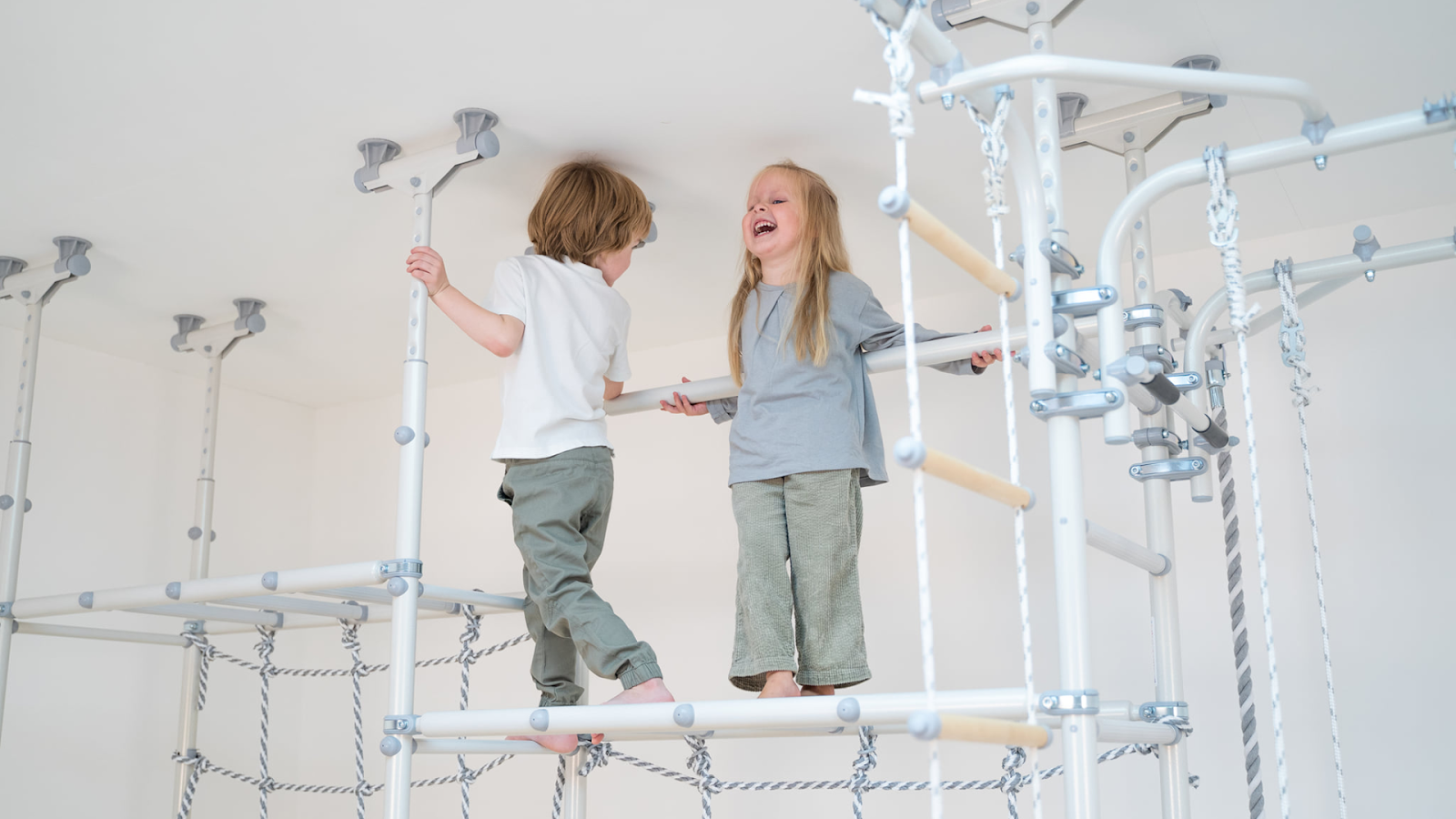
Every routine above gets easier when the tools live permanently in your home. That is the practical case for a climbing gym in a calming article: one frame holds the slow swing, the hanging bar, the stretch station, and the blanket cave, always assembled, always available, no setup standing between your child and the downshift. Families designing a full setup around sensory needs can follow our walkthrough in how to build a sensory gym at home.
What matters in the equipment itself: stability and trust. A settling tool cannot wobble. Brainrich frames are steel, rated to 220 lb and tested to 440 lb, with non-toxic powder coat, rubber-coated rungs, and phthalate-free materials, rated for independent use at ages 3 and up. Everything ships in several manageable boxes, more like a Lego set than one giant crate, and every gym carries a 30-day money-back guarantee.
Worth asking your pediatrician: ADHD is a textbook example of a qualifying need for which a doctor can write a Letter of Medical Necessity for sensory and exercise equipment. With an LMN, many families buy a Brainrich gym with pre-tax HSA/FSA dollars, an effective saving of up to about 30%.


Ready to build the calm corner?
Every gym ships in multiple easy boxes, assembles in an afternoon, and is covered by a 30-day money-back guarantee.
A note on scope: this article describes play and routine ideas, not medical care, and it is not medical advice. Calming activities complement, and never replace, the plan your child's clinicians have built. If your child's sleep, anxiety, or regulation struggles are persistent or severe, or before changing their routine, talk with your pediatrician.
Frequently asked questions
What is the fastest calming activity for a child with ADHD? For most kids, slow back-and-forth swinging or firm deep pressure (a pillow sandwich or long bear hug) shows an effect within about ten minutes. Speed comes from familiarity: a routine the child knows, in a spot they associate with settling, works faster than any novel technique.
Why does swinging calm my child down sometimes and wind them up other times? Direction and tempo. Slow, straight, back-and-forth motion tends to settle; fast, spinning, or unpredictable motion tends to energize. If the goal is calm, keep the arc gentle and rhythmic, dim the room, and add paired breathing: inhale forward, exhale back.
How long should a calming routine take before homework? About ten minutes is the sweet spot for most families: a heavy-work job, five minutes of slow swinging with breathing, a few hangs and a stretch, then straight to the desk. Longer wind-downs often drift into play and make the transition harder.
Are weighted blankets and deep pressure safe for kids? Deep pressure play like pillow squishes and blanket burritos is generally fine when the child wants it, can end it instantly, and the head stays free. Research on weighted products specifically is still mixed, and infants should never sleep under weighted items. For product choices and anything sleep-related, check with your pediatrician.
Do calming activities help kids with ADHD sleep? Many families report that a consistent movement-then-pressure-then-quiet ramp in the last hour, screens off, slow swing, blanket burrito, books, makes lights-out noticeably less contested. That is a routine effect, not a medical claim: if sleep problems are persistent, raise them with your pediatrician.
What if a calming activity gets my child more excited? Check the tempo and the timing. Any activity done fast, competitively, or with an audience becomes energizing, and a truly redlining child usually needs to burn energy before downshifting works. Run the high-energy list first, then return to the calm menu.
📚 Keep reading
Need the opposite? The Best Indoor ADHD Activities for Kids · Why Kids With ADHD Need to Move · Heavy Work Activities for Kids · How to Build a Sensory Gym at Home
Sources
Cerrillo-Urbina, A.J. et al. (2015). The effects of physical exercise in children with attention deficit hyperactivity disorder: a systematic review and meta-analysis. Child: Care, Health and Development. · Faber Taylor, A. & Kuo, F.E. (2009). Children with attention deficits concentrate better after walk in the park. Journal of Attention Disorders. · Danielson, M.L. et al. (2024). ADHD prevalence among U.S. children and adolescents in 2022. Journal of Clinical Child & Adolescent Psychology (CDC, 2022 National Survey of Children's Health). · Pontifex, M.B. et al. (2013). Exercise improves behavioral, neurocognitive, and scholastic performance in children with ADHD. Journal of Pediatrics.
Share: