

Updated October 2026 · 14-min read · by the Brainrich Kids team
The best activities for children with ADHD combine big-muscle movement with a clear goal and a quick finish: climbing, obstacle courses, monkey bars, swimming, martial arts, and heavy-work jobs like carrying and pushing. Use them before the hard parts of the day, then switch to slower, calming activities once the energy is spent.
It is 4:30 on a rainy afternoon. Your child has been off the couch, over the armrest, and into their sibling three times, and "settle down" has not worked once. Most lists of ADHD activities hand you crafts and board games at this point, which is a bit like handing a race car a parking ticket. A hyperactive child does not need less energy. They need somewhere to put it. This guide sorts the activities that work by energy level, place, and age, and tells you when to use each one.
The quick answer: the activities that tend to work best for kids with ADHD share four traits: big muscles, a clear goal, fast feedback, and a finish line.
🧗 To burn energy: climbing, obstacle circuits, monkey bars, animal-walk relays, swinging games.
🥋 Sports and outdoors: swimming, martial arts, gymnastics, cycling, a walk in a park.
🧩 To build focus: freeze games, building from instructions, cooking, fast card games.
🌙 To come down: slow swinging, deep pressure, heavy work, a quiet build.
Jump to: Why movement comes first · Match the energy level · Indoor activities · Sports and outdoors · Focus activities · By age · When to use them · A setup at home · FAQ
Why movement comes first for kids with ADHD
You are in large company. CDC researchers analyzing the 2022 National Survey of Children's Health found that about 1 in 9 U.S. children aged 3 to 17, roughly 7.1 million kids, have been diagnosed with ADHD at some point.
The research keeps pointing the same way: for many kids with ADHD, movement is the way into focus, not a distraction from it. In a 2013 study in the Journal of Pediatrics, Pontifex and colleagues had children with ADHD do 20 minutes of moderate exercise before testing them. Compared with 20 minutes of seated reading, the children answered more accurately and scored better on reading and arithmetic afterward. A 2015 meta-analysis of randomized trials (Cerrillo-Urbina and colleagues) linked exercise to moderate to large improvements in attention, along with benefits for hyperactivity, impulsivity, and anxiety.
Pediatric occupational therapist Angela Hanscom, author of Balanced and Barefoot, has made a related argument for years: many children who cannot sit still simply have not moved enough that day. None of this makes exercise a treatment. It makes it a tool you control, every day, for free.
That gives every good ADHD activity the same formula. Vague instructions ("go play") fade in seconds. Concrete missions ("beat yesterday's ladder record") hold. If you want the longer version of why the body leads, read why kids with ADHD need to move.
Match the activity to the energy level
Occupational therapists often teach children to picture their body as an engine that can run too fast, too slow, or just right. Read the engine before you pick the activity:
| Energy level | What you see | What to reach for |
|---|---|---|
| Full speed | Crashing into furniture, wrestling the dog, maximum volume | Big burners: climbing, obstacle circuits, relays, swinging games |
| Restless | Fidgeting, circling you while you cook, "I'm bored" on repeat | Heavy work: carrying, pushing, pulling, hanging |
| Tired but wired | Past the point where more excitement helps | Calming input: slow swinging, deep pressure, breathing, a quiet build |
The common mistake runs in both directions. A child at full speed handed a calm-down activity usually escalates, and a sleepy child handed a relay race is up until ten. Burn first, calm second. The calming half has its own guide: Simple Calming Activities for ADHD.
Indoor activities for a hyperactive child
These work in a living room or hallway, which matters because the hardest hours (after school, rainy days, winter evenings) are usually indoor hours. Each one has a goal the child can count.
1. Ladder laps. Up the ladder, across, down the other side, tag the wall. That is one lap. Count out loud and write the daily record somewhere visible. Chasing yesterday's number turns climbing into a mission.
2. The obstacle circuit. Under the coffee table, over a cushion mountain, three frog jumps, up the climbing frame, ring a bell. Let your child help design the course, because planning the order is half the exercise, then time each lap. Racing the clock works better than racing a sibling.
3. The monkey-bar count. How many rungs before the drop? Two rungs is a big day at four; a full crossing and a turn-around is a big day at eight. Bars ask for grip, shoulders, core, and a hand-over-hand rhythm all at once. Our monkey bars guide covers bar height by age.
4. Swing and land. Twenty big pumps on a swing, a jump onto a crash mat, back in line. Fast swinging is strong input to the vestibular (balance and motion) sense. Which swings rev a child up and which settle them is covered in sensory swings for ADHD.
5. Animal-walk relays. Bear crawl to the kitchen, crab walk back, frog jump to the couch. Animal walks load the arms, legs, and core far harder than running, so they burn more energy per hallway. Call out the next animal mid-relay to add a listening challenge.
6. Freeze games. Freeze dance, red light green light, musical cushions. These practice stopping on cue, the skill many kids with ADHD find hardest: go, go, go, then stop.
7. Balloon volleyball. The balloon cannot touch the floor. It is fast enough to hold attention and gentle enough for the last ten minutes, when you want the intensity to taper.
8. Pillow-fort engineering. Build a fort big enough for two, with a door and a window. Dragging cushions and blankets is heavy work in disguise, and building to a plan is a focus task.
Keep it set up. Many kids with ADHD struggle to start a task, even a fun one. A movement corner that is always ready, visible from the couch, removes the starting step. The best activity is the one your child can begin in the few seconds the urge lasts.
Heavy-work jobs for the restless (not wild) hours
For the restless state, occupational therapists reach for heavy work: muscles pushing or pulling against resistance, which feeds the body's position sense (proprioception). Parents often report it takes the edge off without winding kids up.
💪 Push and pull
Ten hard wall pushes, a laundry basket of books pushed across the floor, towel tug-of-war.
📦 Carry
Real jobs beat drills: grocery bags, the recycling, a heavy laundry basket upstairs.
🙌 Hang
Dead hangs from a bar work the whole upper body, and most kids hang far longer than they would do any exercise you name.
🐻 Crawl
Bear crawl with a cushion balanced on the back, army crawl under a row of chairs.
The full menu, sorted by age and space, is in our guide to heavy work activities for kids.
Sports and outdoor activities for kids with ADHD
We love outdoor play, and for kids with ADHD there is a specific reason to get out when you can. In a 2009 study, Faber Taylor and Kuo found that children with ADHD concentrated better after a 20-minute walk in a park than after the same walk in a downtown area or a neighborhood. Green space seems to help.
For organized activities, many families find that a child with ADHD does best where they are moving most of the time and get feedback right away:
🏊 Swimming
Constant whole-body movement, deep pressure from the water, and a coach giving short, clear instructions.
🥋 Martial arts
Bow, listen, move, stop. A 2004 school study by Lakes and Hoyt (a general classroom sample, not an ADHD study) linked martial arts training to better self-regulation and classroom conduct.
🤸 Gymnastics and climbing
Short turns, real challenge, and skills you can see improving week to week.
🚲 Cycling and scooters
Balance, speed, and a destination. A ride to the park is a burn and a plan in one.
Sports with long waits, such as standing in the outfield, tend to be harder: the child is asked to stay alert with nothing to do. That does not rule them out, it just helps to know why a season might be rough.
Focus activities that are quiet but not passive
Not every activity needs to be loud. These give the brain a job with fast feedback, which is what holds attention for many kids with ADHD. Use them after a burn, not instead of one.
1. Building from instructions. Lego sets, magnetic tiles copied from a picture card, a marble run built to a plan. Each step is small and finished quickly.
2. Cooking together. Measuring, cracking eggs, stirring, timing. Real tools and a snack at the end keep it going.
3. Fast card games. Spot It, Uno, Snap. Short rounds and quick wins beat long strategy games for most younger kids.
4. Simon says and memory games. Listening, holding an instruction in mind, then acting on it. It is practice in disguise.
5. Drumming and music. A beat to match gives the body something to do and the ear something to follow.
ADHD activities by age
| Age | Burn energy | Build focus |
|---|---|---|
| Toddlers (with a parent's hands close) | Low climbing, crawling tunnels, pushing a toy cart, dancing | Stacking, simple puzzles, songs with actions |
| 3 to 5 | Obstacle circuits, animal walks, first hangs on a bar, swinging | Freeze dance, sorting games, helping in the kitchen |
| 6 to 8 | Monkey bars, ladder laps, swimming, martial arts, bike rides | Lego from instructions, card games, simple recipes |
| 9 to 12 | Climbing challenges, pull-ups, team or solo sports, timed circuits they design | Model kits, coding games, cooking a full meal |
Ages are rough guides. Many kids with ADHD are ahead physically and need more structure for the quiet tasks, so mix columns freely.
When to use them: the same activity lands differently at 8 a.m. and 8 p.m.
Timing is where the research is most practical. In a 2015 randomized trial, Hoza and colleagues gave young children about 31 minutes of before-school physical activity every school day for 12 weeks. The activity group showed greater improvement in inattention and moodiness than children in a classroom-based sedentary program. A typical day might look like this:
| When | What to do |
|---|---|
| Before school | A 15 to 20 minute burn before the backpack goes on: ladder laps, a circuit, monkey bars. |
| Before homework | Twenty minutes of hard movement, then straight to the desk. Mid-homework, swap nagging for ten monkey-bar rungs or ten wall pushes. |
| Late afternoon | The pre-dinner meltdown is usually a full engine with nowhere to go. Run the obstacle circuit before you start cooking, not during the meltdown. |
| The last hour before bed | No more burners. Slow swinging, deep pressure, a bath, a quiet build. See Simple Calming Activities for ADHD. |
Homeschooling? The same idea, built into a full day, is in Homeschooling a Child With ADHD and The ADHD Homeschool Schedule.
Setting up for movement at home
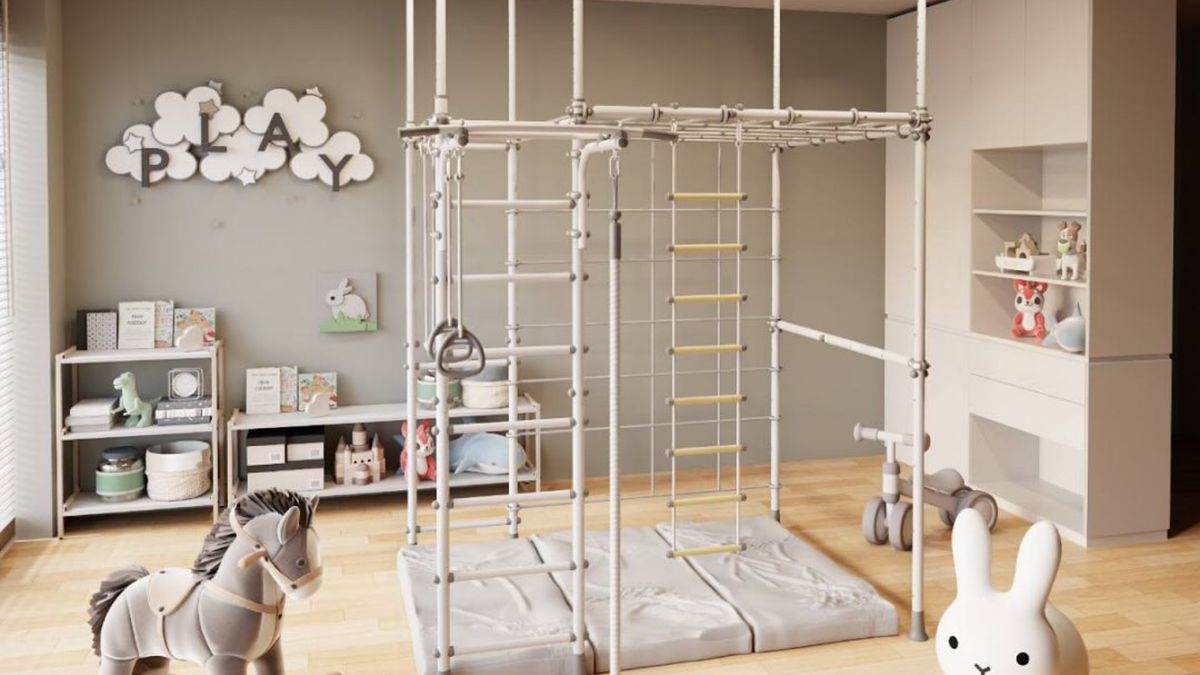
Everything above works with cushions and a hallway. Families who use movement every day often add a dedicated climbing setup for one practical reason: it is always ready. No weather, no drive, no negotiation, no screen. A child who feels the surge can be climbing seconds later, in the same room as you.
Strength that shrugs off intensity. High-energy play is when flimsy equipment becomes a hazard. Brainrich gyms are powder-coated steel, rated for 220 lb and tested to 440 lb, with rubber-coated rungs. They stand between floor and ceiling with no drilling.
Variety on one frame. A ladder alone gets mastered. A ladder plus monkey bars, rings, a swing, and a climbing net keeps producing new missions for years, from toddlers climbing with a parent's hands close to teens doing pull-ups. More than 10,000 families use one. If you are planning a whole movement corner, see how to build a sensory gym at home.
The HSA/FSA note many parents miss: ADHD is a common reason doctors write a Letter of Medical Necessity for exercise and sensory equipment. With an LMN, many families buy a Brainrich gym with pre-tax HSA/FSA dollars, a saving of up to about 30%. Ask your pediatrician or plan administrator whether your child qualifies.


Give that energy somewhere to go
Every gym arrives in several manageable boxes, assembles in an afternoon, and comes with a 30-day money-back guarantee.
A note on scope: this article is about play and daily routines, not medical care. Movement supports a child's care plan and never replaces it. If you have questions about your child's attention, energy, sleep, or development, talk with your pediatrician.
Frequently asked questions
What are the best activities for a child with ADHD? Activities that combine big-muscle movement, a clear goal, and a quick finish: climbing and monkey bars, obstacle courses, swimming, martial arts, gymnastics, bike riding, and heavy-work jobs like carrying and pushing. Research links even one 20-minute session of moderate exercise to better attention and schoolwork afterward in children with ADHD, so timing matters as much as the activity: put a burst of movement before the hard parts of the day.
What activities help a hyperactive child calm down? Start with movement, not stillness. A hyperactive child usually needs to burn energy first (a climbing round, an obstacle lap, wall pushes), then shift to slower heavy work and calming input such as slow swinging, deep pressure, or a quiet build. Asking a child at full speed to sit still tends to backfire; a short burn followed by a downshift works far more often.
What sports are good for kids with ADHD? Many families do well with individual or small-group sports that keep a child moving and give constant feedback: swimming, martial arts, gymnastics, climbing, track, and cycling. Sports with long waits, such as standing in the outfield, are often harder. A 2004 school study of martial arts training (a general classroom sample, not an ADHD study) found gains in children's self-regulation and classroom conduct.
How much physical activity does a child with ADHD need each day? There is no ADHD-specific quota. General U.S. guidance is about 60 minutes of moderate to vigorous activity a day for children 6 to 17. The ADHD studies cited here used sessions of roughly 20 to 30 minutes placed before demanding tasks, so many families plan two or three bursts a day plus equipment that is always set up.
Do these activities replace ADHD treatment? No. Studies describe exercise as associated with better attention and behavior alongside whatever care a child already receives, not instead of it. Treat movement as a daily support and keep your pediatrician involved in the bigger plan.
Why does my child get more wound up after exercise? It is usually a matching problem. Fast, competitive games push an already revved child higher, especially in the evening. Use heavy work (carrying, pushing, hanging) when a child is restless but not wild, and save calming input for the last hour before bed.
Is a home climbing gym safe for an impulsive child? Equipment quality matters most for impulsive kids. A steel frame rated for 220 lb and tested to 440 lb, rubber-coated rungs, impact mats under the landing zones, and an adult in the same room remove the hazards while keeping the challenge that makes climbing worth doing.
📚 Keep reading
Simple Calming Activities for ADHD · Why Kids With ADHD Need to Move · Sensory Swings for ADHD · Homeschooling a Child With ADHD · The ADHD Homeschool Schedule · Heavy Work Activities for Kids
Sources
Danielson, M.L. et al. (2024). ADHD prevalence among U.S. children and adolescents in 2022: diagnosis, severity, co-occurring disorders, and treatment. Journal of Clinical Child & Adolescent Psychology. · Pontifex, M.B. et al. (2013). Exercise improves behavioral, neurocognitive, and scholastic performance in children with attention-deficit/hyperactivity disorder. Journal of Pediatrics. · Cerrillo-Urbina, A.J. et al. (2015). The effects of physical exercise in children with attention deficit hyperactivity disorder: a systematic review and meta-analysis of randomized control trials. Child: Care, Health and Development. · Hoza, B. et al. (2015). A randomized trial examining the effects of aerobic physical activity on attention-deficit/hyperactivity disorder symptoms in young children. Journal of Abnormal Child Psychology. · Faber Taylor, A. & Kuo, F.E. (2009). Children with attention deficits concentrate better after walk in the park. Journal of Attention Disorders. · Lakes, K.D. & Hoyt, W.T. (2004). Promoting self-regulation through school-based martial arts training. Journal of Applied Developmental Psychology. · U.S. Department of Health and Human Services. Physical Activity Guidelines for Americans, 2nd edition. · Hanscom, A. (2016). Balanced and Barefoot. New Harbinger.
Share: