

Updated July 2026 · 9-minute read · by the Brainrich Kids team
Ask a room full of parents what they want a toy to "do," and you'll get a list: teach letters, build a specific skill, keep the kids busy for twenty minutes. But the play that does the most for a developing child is the play that does the least on its own: the play with no script, no single right answer, and no off-switch that says "you've finished." It has a name, open-ended play, and it happens to be the thing our own community reaches for again and again to describe why a climbing gym earns its place in the living room. This is the philosophy behind everything we build, and here is the science under it.
The quick answer: Open-ended play is child-led play with no fixed goal or ending, like the block that becomes a castle, then a boat, then a wall. Because the child supplies the story and the rules, this kind of play is where imagination, executive function, and self-regulation get built. Developmental research links open-ended, make-believe play to gains in cognitive flexibility, working memory, inhibitory control, and self-regulation, and the deepest thinker on it, Lev Vygotsky, argued that pretend play is secretly a child's first practice at following their own rules. A climbing gym is one of the purest open canvases you can own: a structure that becomes a ship, a mountain, a stage, or a fort, and something different every day.
Jump to: What open-ended play is · The Vygotsky secret · What the research shows · The closed-toy problem · The gym as open canvas · Grow it at home · FAQ
What "open-ended play" actually means
The simplest way to understand open-ended play is to picture its opposite. A closed-ended toy has one job and tells you what it is: a puzzle is finished when the pieces fit; an app rewards one correct tap; a battery-powered truck drives when you push the button. The play ends when the goal is met, and the toy did most of the deciding.
An open-ended object hands the deciding back to the child. A wooden block, a cardboard box, a length of cloth, a climbing frame, none of them "know" what they are. The child has to supply the idea, the story, the rules, and the ending. That extra work is not a flaw. The less a toy dictates, the more the child has to imagine, and imagining is the muscle we most want them to exercise.
One of our owners reached for the same distinction on her own:
"We have been trying to transition to play spaces instead of play things, and our gym creates such a playful mood for our play place!"
– LAURA F., BRAINRICH OWNER (CHATTER GROUP)
Play spaces instead of play things. And when another mom in the same community was asked why she loves the idea of an indoor gym, her entire answer was two words that we've quietly adopted as a brand philosophy: "Open-ended play."
The Vygotsky secret: make-believe is self-control practice
The most durable insight in this whole field is nearly a century old and belongs to the developmental psychologist Lev Vygotsky. His counterintuitive claim: pretend play, the seemingly frivolous business of "you be the dragon and I'll be the knight," is where a young child first learns self-control.
In Vygotsky's account, mature make-believe has three ingredients: an imaginary situation, children taking on roles, and, crucially, following the rules those roles demand. A child who decides to "be a firefighter" voluntarily acts the way a firefighter would, subordinating their impulse of the moment to the logic of the role. Play, in other words, is the first arena where a child chooses to follow an internal rule instead of a whim, which is the seed of everything we later call self-regulation and executive function.
🌱 "A head taller than himself"
Vygotsky observed that in play, a child operates above their ordinary level, his famous "zone of proximal development." The classic example: a child who can barely sit still for a few minutes at story time will stay focused far longer while playing school. The pretend frame scaffolds the child up to their next stage. Open-ended play doesn't just occupy a child; it stretches one.
This is why researchers who study self-regulation keep coming back to play. As Bodrova and Germeroth put it in their review of Vygotsky's work for the American Journal of Play, it's the role-and-rule relationship inside make-believe that makes self-regulated behavior possible in the first place.
What the research links to open-ended play
The evidence here is associational, and we'll keep the language careful, but it points consistently in one direction: children who get more rich, imaginative, child-led play tend to score better on the very skills parents care about most.
Executive function
A 7-week role-play program with 199 preschoolers was associated with significant gains in cognitive flexibility, visual working memory, and inhibitory control.
Self-regulation
Across 454 children, a child's level of play and their self-regulation were significantly correlated: the more developed the play, the stronger the self-control.
Impulse control
In one study, the amount of social pretend play predicted gains in inhibitory control, while solitary pretend play did not. Playing together does extra work.
That last finding carries a useful nuance. The biggest returns from open-ended play show up when it's social and when a caring adult is nearby to gently extend it. In experimental work, simply leaving children to free play with no adult involvement was not enough on its own to build executive function, compared with play a warm adult was part of. So "just leave them to it" isn't the whole story. The richest version is child-led, but not adult-absent.
The trouble with toys that already know what they are
None of this makes structured toys bad. Puzzles, board games, and building sets all have real value, and a healthy childhood has room for all of it. The concern is one of balance, and what happens when the closed-ended end of the shelf takes over the whole day.
The most closed-ended "toy" of all is a screen. It doesn't just occupy a child; it does the imagining for them. A show or a game arrives with the characters, the plot, the rules, and the ending already decided, leaving nothing for the child to invent. So the case for open-ended play isn't about counting screen minutes. It's about keeping enough time in the day for the child's own imagination to lead. It's telling that in our community, the two things parents most often name in the same breath are open-ended play and less time on the iPad.
And to be clear about the real gold standard: the outdoors wins. A backyard, a forest, a creek, and a tree to climb are open-ended play in its richest form. As Richard Louv, who coined the phrase "nature-deficit disorder," observed of children who play outside, kids in nature "more often invent their own games and play cooperatively." We are cheerleaders for every minute of it. The problem open-ended play runs into isn't the outdoors. It's the heat, the cold, the rain, the early dark, and the pull of the screen that shrink how many of those minutes actually happen. Which is exactly the gap a home structure is built to fill.
"If you create the right environment in the child's room from the first days, you won't have to think about exercises." The idea is older than any of us. In the early 1800s the Swedish gymnastics pioneer Per Henrik Ling built his system around the wall bars, which is why they are still called Swedish walls today. Much later, engineer Vladimir Skripalev, who wrote the line above, took the same idea into family homes: give a child a rich environment and they will invent their own movement, no drills required. It's the same instinct behind open-ended play, and the science has since caught up to it.
THE SWEDISH WALL-BAR IDEA BEHIND BRAINRICH
Why a climbing gym is the ultimate open canvas
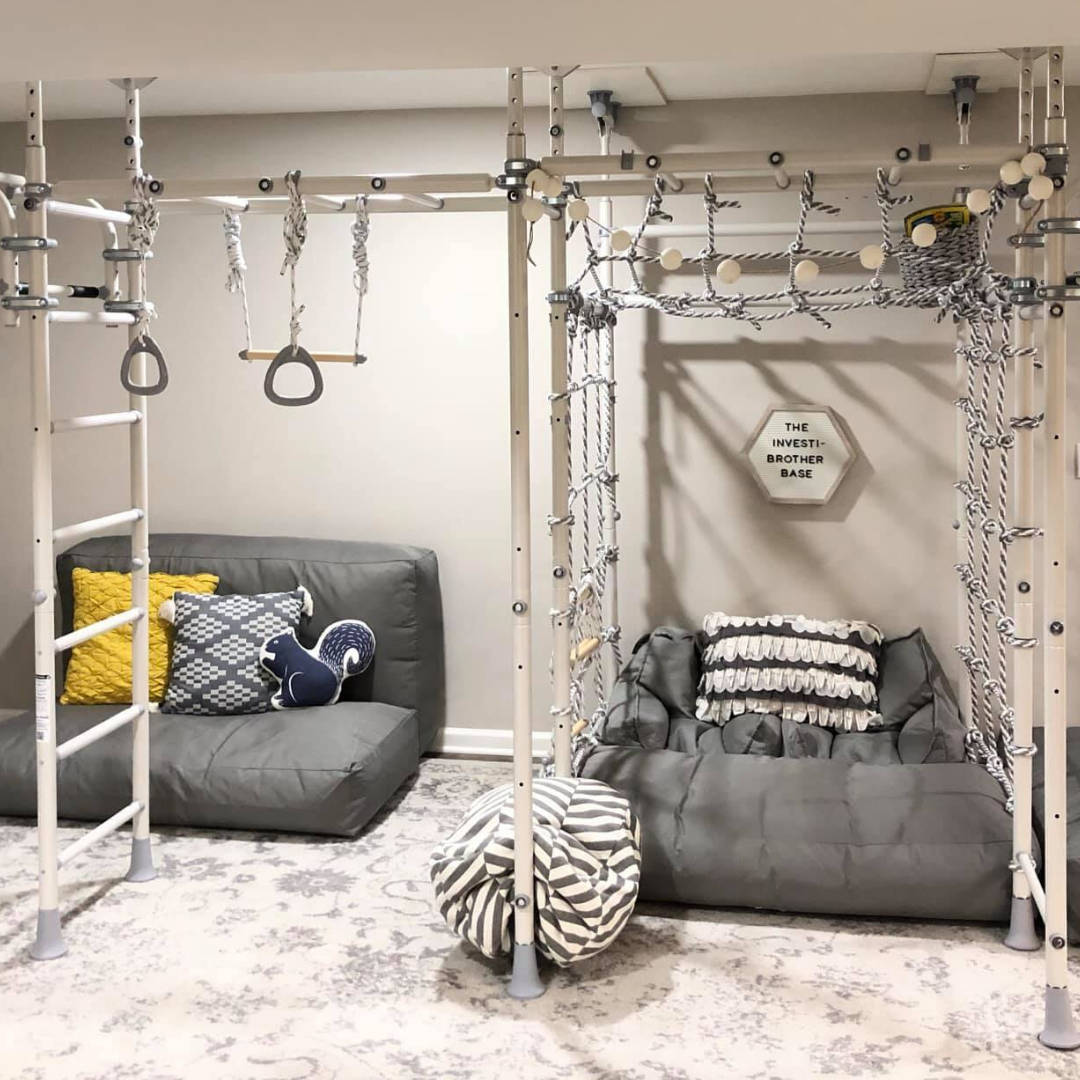
Here is where open-ended play meets the thing we make. A climbing gym looks like exercise equipment, and it is, but its quieter superpower is that it doesn't tell the child what to do with it. It has no button, no level, no correct way to win. It's a blank stage that happens to be built out of steel and nets.
So it becomes a pirate ship's rigging on Monday, a mountain to summit on Tuesday, a fort with cushions hauled up top on Wednesday, and, in the words of one of our owners, "a stage for concerts and plays" by the weekend. This is the marriage the research keeps hinting at: whole-body movement and imaginative story, running at the same time. The child is climbing (building coordination, grip, and balance) and narrating a world (building executive function and self-regulation) in a single game. Two developmental systems, one afternoon.
"It's not just climbing and swinging. The kids use their imaginations and are getting physically active. It's a 'toy' that all 3 of my kids can equally enjoy despite age differences."
– NIKAE C., MOM OF 3, BRAINRICH OWNER
Notice the last line, because it's the hidden gift of an open canvas: it grows with the child and works across ages at once. A closed toy is usually pitched at one narrow developmental window and then outgrown. But when the child supplies the meaning, a two-year-old and a nine-year-old can play on the same structure on the same day and each find their own "just-right" game. It's a big part of why owners describe the gym as, in one mom's words, "their most used toy by FAR, like by a landslide," and why families report it still gets climbed every day years after purchase, long after novelty would have killed a single-purpose toy. Boredom is a closed-toy problem. An open canvas is never "finished."
This same open-endedness is also what makes a gym such a natural home for healthy, child-chosen challenge, the "how high do I go today?" of controlled risky play. And the movement itself is doing quiet developmental work behind the story, which we cover in depth in the science behind the play gym.
How to grow open-ended play at home
Open-ended play is a skill children build, not a switch you flip, and the adult's role is subtle: present and encouraging, without taking over the story. Here's what the research suggests works, and what gets in the way.
| Do | Skip |
|---|---|
| Offer open-ended "loose parts." Cushions, cloths, boxes, simple figures near the gym. The less each object dictates, the more the child invents. | Over-directing the game. "Now build a zoo." A prompt is fine; a script ends the imagining you were hoping to start. |
| Play along and extend. Take a role, then ask "what happens next?" and follow their lead. Adult-joined play outperforms pure solo free play for executive function. | Hovering as a referee. Correcting and managing isn't playing. Be a fellow character, not a supervisor. |
| Protect unhurried stretches of time. Deep pretend play needs runway, not a ten-minute gap between activities. | Packing the calendar. Every slot filled with a structured activity leaves no room for the open kind to unfold. |
| Invite a sibling or friend in. Social pretend play is the version linked to inhibitory-control gains. Two imaginations compound. | Defaulting to the screen for "quiet." It fills the time but does the imagining for them, and imagining is the one muscle we're trying to build. |
| Keep the canvas in reach. A structure in the living space makes the imaginative, active choice the default, especially on the days weather keeps everyone indoors. | Treating outdoor and indoor play as rivals. They're teammates. The gym is for the days a yard or a park isn't in the cards, not a replacement for them. |
Find your family's open canvas: take the 60-second quiz →


Give their imagination a place to climb.
Every gym fits ceilings from 6'9" to 10'5", assembles in an afternoon with no drilling, and is backed by a 30-day money-back guarantee.
Frequently asked questions
What is open-ended play? It's child-led play with no fixed goal, script, or ending, where the child decides what an object is and what happens next. A block becomes a phone, then a car, then a wall. It's the opposite of closed-ended play (a puzzle, an app, a single-purpose toy), where the toy defines the goal and the play ends when that goal is met.
Why is open-ended play considered so important? Because the child has to supply the imagination, the story, and the rules, open-ended play is where imagination, executive function, and self-regulation get exercised. Developmental research associates rich, make-believe play with gains in cognitive flexibility, working memory, inhibitory control, and self-regulation, and Vygotsky argued that following the "rules" of a pretend role is a child's first practice at self-control.
Are structured toys or screens bad, then? No. Puzzles, games, and building sets have real value, and a good childhood includes all of it. The concern is balance. Screens are the most closed-ended option because they do the imagining for the child: they arrive with the characters, plot, and ending already decided. So the case for open-ended play is really a case for protecting the time a child's own imagination gets to lead.
Isn't the outdoors the best open-ended play of all? Absolutely. A yard, a forest, and a tree to climb are open-ended play in its richest form, and we're all for every minute of it. A home gym isn't a replacement for outdoor play; it's the backup for the days heat, cold, rain, early darkness, or a packed schedule keep the outdoor version off the table.
How is a climbing gym "open-ended"? It has no button, level, or correct way to use it, so the child supplies the meaning: it's a ship, a mountain, a fort, or a stage, differently every day. That's why it works across a wide age range at once and why owners report it stays in daily use for years. An open canvas is never "finished," so it resists the boredom that ends single-purpose toys.
Should I just leave my child to play alone? Not entirely. Open-ended play should be child-led, but the research suggests the biggest benefits come when a warm adult is nearby to join and gently extend the story, and when play is social. Take a role, ask "what happens next?", and follow their lead: be present without taking over.
Sources
Bodrova, E., Germeroth, C. & Leong, D.J. Play and Self-Regulation: Lessons from Vygotsky. American Journal of Play (The Strong National Museum of Play). · Role-play intervention & executive function in 199 preschoolers: PMC9743294. · The role of adult involvement in developing executive functions through play: PubMed 34938243. · Play level and self-regulation across 454 children: Frontiers in Psychology (2023). · Louv, R., Last Child in the Woods, quoted in Edutopia, "Early-Childhood Education Takes to the Outdoors" (2009). · Heritage: Per Henrik Ling and the Swedish gymnastics system (early 19th century); V. Skripalev, "Our Family Stadium" (1986). Developmental claims are associational; a home play gym supports movement and imaginative play and is not a medical or therapeutic device.
Share: