

Updated July 2026 · 9-minute read · by the Brainrich Kids team
Every parent wants to raise a capable, curious, resilient kid, which is exactly why the "smarter kids" corner of the internet is so loud, and so full of gadgets, flashcards, and $400 subscriptions promising a genius by kindergarten. Here is the quieter truth the research keeps landing on: the levers that actually matter for a developing brain are old, cheap, and unglamorous. They are the things children have always needed. We pulled the peer-reviewed evidence together and it points, again and again, at six of them, and not one requires an app.
The quick answer: the six best-supported levers for a young child's development are daily physical movement, imaginative play, protected sleep, sensible screen limits, reading and rich language, and age-appropriate risk-taking. None of them is a magic pill, and none replaces the others. But research links every one to stronger attention, self-regulation, motor skill, and confidence, and the encouraging part for busy families is that a single active, playful home environment can quietly serve almost all six at once.
Jump to: 1. Move every day · 2. Let them pretend · 3. Guard sleep · 4. Tame the screens · 5. Read & talk · 6. Allow healthy risk · FAQ
1. Move every day (movement is brain-building)
The old picture treated the body as the thing the brain commands. Modern neuroscience collapsed that divide. The cerebellum, once dismissed as a pure motor-coordination center, is now understood to drive both movement and higher cognition through loops with the brain's planning-and-self-control hub. In practical terms, the same circuitry a child uses to correct a wobble is the circuitry behind sitting still and holding instructions in mind. For a young child, moving is thinking practice.
The payoff can be surprisingly immediate. In one study of children around age 9, a single bout of physical activity was associated with a measurable jump in attention-test accuracy (about +5.67% on a standard inhibitory-control task). Exercise also appears to turn up BDNF, one of the brain's own growth-and-wiring signals, though the evidence there is promising rather than settled, so we say "may enhance," not "boosts for certain."
How much movement? Every major health authority has converged on strikingly similar numbers.
| Age | Daily movement | Sleep |
|---|---|---|
| 1–2 yrs | 180 min of any intensity, spread through the day | 11–14 hrs (incl. naps) |
| 3–4 yrs | 180 min total, of which ≥60 min energetic | 10–13 hrs |
| 5–17 yrs | ≥60 min moderate-to-vigorous, plus muscle- & bone-loading play ≥3 days/week | 9–11 hrs (5–13 yrs) |
Targets per WHO (2019), CDC / U.S. Physical Activity Guidelines, and the Canadian 24-Hour Movement Guidelines (CSEP).
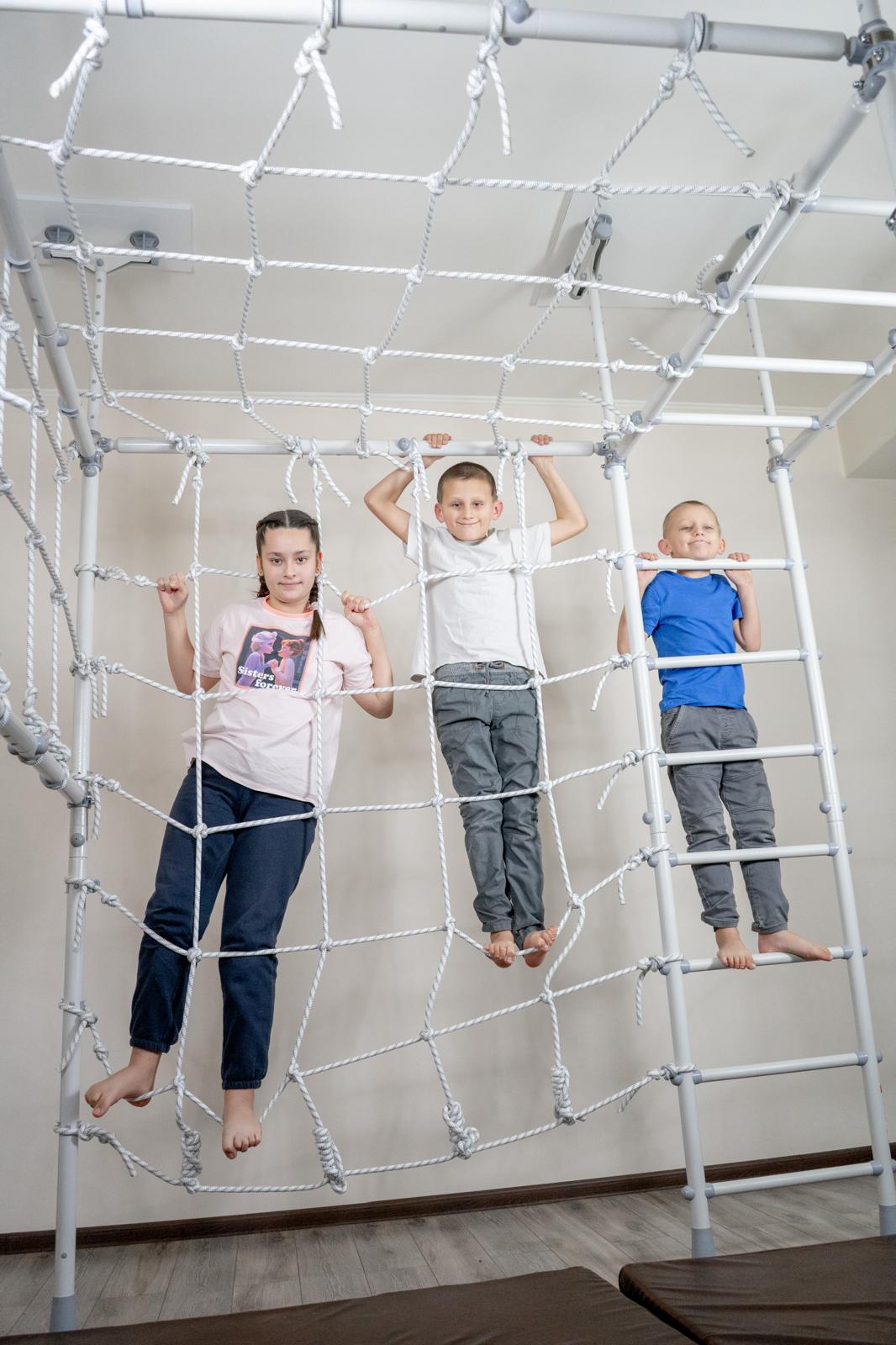
Notice the CDC specifically lists climbing as a muscle-strengthening activity for children, and jumping and running as bone-strengthening. And the way to hit these targets isn't one forced "exercise session," it's short bursts all day. That's the real magic of an active home: on the many days when heat, cold, rain, or a packed schedule keep the outdoors off the table, a structure in the living room turns twenty five-minute climbs into a movement habit. We'll always cheer the trip to the park; this is simply what fills the gaps.
2. Let them pretend (make-believe is secret self-control training)
Lev Vygotsky's most durable insight is that mature make-believe play is self-regulation in disguise. A child playing "firefighter" voluntarily acts as a firefighter would, subordinating impulse to the role. Play is the first arena where a child chooses to follow internal rules, the seed of executive function. Vygotsky observed that in play a child operates "a head taller" than in ordinary life.
The evidence has caught up to the theory. A 7-week role-play program with 199 preschoolers produced significant gains in cognitive flexibility, working memory, and inhibitory control. Interestingly, the inhibitory-control gains in the research trace specifically to social pretend play, the kind that includes siblings, friends, or a parent, not solitary play. One nuance worth keeping: "just leave them to it" isn't the whole story; pretend play delivers most when an engaged adult occasionally plays along and gently extends it.
🏰 The best props are the ones that become anything
Low-realism, open-ended props, boxes, cloths, a climbing frame, force the child to do the imagining. This is exactly why owners in our community tell us the fort becomes a playhouse: a structure that is "the ship's rigging" one hour and "the mountain" the next marries gross-motor benefit with narrative play in a single toy.
"I thought they would use the swings most... but they actually use the fort the most. They put nuggets up there and play house."
– KAIT S., MOM OF A 4- AND 6-YEAR-OLD, BRAINRICH OWNER
3. Guard sleep (the third of the day where learning sticks)
Sleep is not downtime. It is when the day's learning consolidates, and it is a full third of the "24-hour" framework the movement guidelines are built around, which is why the table above pairs activity targets with sleep targets. The numbers are generous: toddlers need roughly 11–14 hours, preschoolers 10–13, and school-age children about 9–11.
The three levers are also connected in a way parents can use. Children who move hard during the day tend to sleep more soundly at night, and the pediatric guidance is consistent that screens, especially in the hour before bed and in the bedroom, are one of the surest ways to erode sleep. In other words, the more a child climbs, pretends, and unplugs by day, the easier the single most restorative brain-building activity of all becomes at night.
4. Tame the screens (protect what they crowd out)
Screens aren't the villain of childhood, and we're not here to shame a rainy-day movie. But the American Academy of Pediatrics frames the issue in the clearest possible way: the real cost of excess screen time is displacement. Every hour on a screen is an hour not moving, not pretending, not talking, not sleeping, the exact ingredients on this list. The AAP suggests roughly one hour a day of high-quality, co-viewed programming for ages 2–5, screen-free zones like bedrooms, and screen-free times like meals and the hour before bed.
There is early neuroscience here too, and it deserves careful language. In one small study of preschoolers, higher screen use was associated with less-organized patterns in white-matter tracts that support language and early literacy. That's a single cross-sectional study, an association and not proof of cause, so we hold it loosely. The strongest, least-disputable case against too much screen time remains the simplest: it's what those hours could have been instead.
"I love that they choose this activity over iPads! And my most favourite part is my girls work together as a TEAM."
– KELLY S., BRAINRICH OWNER
That's the quiet trick behind reducing screens: you rarely win the fight by taking something away. You win it by making the active choice the easy choice, and letting a more interesting option out-compete the tablet.
5. Read and talk (and let the body join in)
Rich language is one of the most powerful predictors of later learning, and the mechanism is beautifully low-tech: reading aloud, narrating the day, and back-and-forth conversation build the vocabulary and literacy foundations a child carries into school. This lever leans on time and attention far more than on any product.
Here's the surprising cross-over with movement, though. The steady visual tracking that reading requires rests on postural control and eye stability, the very systems that swinging, balancing, and hanging help train. A body that can hold itself steady frees the eyes to do the fine work of following a line of text. And plenty of families blur the line on purpose: one of our favorite parent habits is the audiobook climb, story going, kids moving, language and motor development running at the same time.
"If I turn on an audiobook my kids just climb and listen." One sentence, and it captures the whole idea: a child doesn't have to choose between a story and a body in motion. The best environments let both happen in the same ten minutes.
– AUDRA P., BRAINRICH OWNER
6. Allow healthy risk (a little danger is a developmental feature)
A generation of research now argues that a reasonable amount of risk in play isn't a bug to engineer away, it's a feature to protect. Norwegian professor Ellen Beate Hansen Sandseter identified categories of "risky play" children seek out on their own, with play at great heights, climbing, hanging, balancing up high, right at the top of the list. When your toddler scales the bookshelf, that isn't defiance. It's a developmental program running on the wrong equipment.
In 2015, Dr. Mariana Brussoni's team systematically reviewed 21 studies and found risky outdoor play associated with more physical activity, better social behavior, and, counterintuitively, no higher rate of serious injury. Sandseter's work also points to an anti-phobic effect: facing manageable fear, a height, a speed, and mastering it is how children build the belief "I can handle scary things," while overprotection is linked to more anxiety later on.
🧗 The rule that reorganizes the whole conversation
Pediatric bodies frame the goal as "as safe as necessary, not as safe as possible." Keep the developmentally valuable challenge (the height, the speed) and remove the genuine hazards (loose joints, hard landings, unsafe-for-age heights). A well-built structure with proper matting is how a parent says "yes" to good risk while controlling the bad. We go deeper in our full guide to controlled risky play.
"I didn't grow up strong & fearless. My children are. I love anything that helps with that."
– ZAKIA P.-C., HOUSTON, BRAINRICH OWNER
The through-line: one environment, most of the list
Look at the countries raising the world's most active kids, Denmark, Finland, Japan, and one pattern jumps out. They don't rely on a sport or a gadget; they build daily, self-directed movement into ordinary life. Japanese children famously walk to school. And a six-decade Japanese study found that as climbing frames were removed from redesigned parks, children's motor skills declined, with researchers linking the drop, in part, to that lost everyday climbing.
Most families can't relocate to a Danish forest or a walk-to-school suburb. But you can bring the one active ingredient, daily climbing, balancing, pretending, and risk-taking, into your own home, for the days the weather or the calendar won't cooperate. That's the entire idea behind a home play gym: not a replacement for the park, but an environment that quietly serves five of these six levers at once, on your schedule, all year. Curious how the science fits together? Our page on the science behind the play gym connects every dot.
Move → pretend → sleep → fewer screens → read → healthy risk
Six levers, one habit loop. The families who win aren't the ones with the most gadgets. They're the ones who made the active, playful choice the default, every single day.
Which gym fits your family? Take the 60-Second Quiz →


Bring the active choice home
Every gym is tension-mounted with no drilling, assembles in an afternoon, and is covered by a 30-day money-back guarantee.
Frequently asked questions
Can these six things really make my child "smarter"? We'd put it differently: research consistently associates daily movement, pretend play, good sleep, limited screens, rich language, and healthy risk with better attention, self-regulation, motor skill, and confidence. The mechanisms are real and well-mapped. But development has many inputs, so these are genuine levers to pull, not guarantees, and never a substitute for everything else that shapes a child.
How much physical activity does a young child actually need? Health authorities converge closely: toddlers and preschoolers need roughly three hours of movement across the day (at least one hour of it energetic), and school-age kids need at least 60 minutes of moderate-to-vigorous activity daily, including muscle- and bone-loading play such as climbing and jumping on three or more days a week.
Is an indoor gym meant to replace playing outside? Not at all, and we'd never frame it that way. Outdoor play is fantastic and worth protecting. A home gym is for the days outdoor play isn't feasible, brutal heat, freezing cold, rain, mud, or a schedule with no park window, so movement doesn't simply stop. It's the backstop, not the substitute.
Does a home play gym help with more than just exercise? It can serve several levers at once. Climbing and swinging deliver daily movement; the fort and open-ended frame invite imaginative play; hard physical play tends to support better sleep; and an inviting active option can out-compete the tablet. It's one environment doing several developmental jobs.
What about screen time, realistically? The pediatric guidance emphasizes quality, co-viewing, and keeping screens out of bedrooms and the hour before bed, mainly because screen hours displace movement, sleep, and conversation. The most effective approach most families find isn't confiscation; it's giving kids a more compelling active option so the screen loses by default.
Isn't letting kids take risks dangerous? The research points the other way when risk is age-appropriate and hazards are controlled: risky play is associated with more activity and better social health without higher serious-injury rates, and it's linked to lower anxiety. The guiding principle is "as safe as necessary, not as safe as possible", keep the challenge, remove the genuine hazards, and add proper matting.
Sources
World Health Organization (2019). Guidelines on physical activity, sedentary behaviour and sleep for children under 5 years of age. · CDC. Physical Activity Basics: Children. · Canadian Society for Exercise Physiology. Canadian 24-Hour Movement Guidelines. · IBRO Neuroscience Reports (2025). The cerebellum in motor control and cognition. · Systematic review: structured exercise and BDNF in children (Life, 2025). · Acute exercise, BDNF and inhibitory control in children. · Role-play intervention and executive function in preschoolers. · American Academy of Pediatrics. Media and Children. · Hutton, J.S. et al. (2020). Screen-based media use and brain white matter in preschoolers. JAMA Pediatrics. · Sandseter, E.B.H. (2007). Categorising risky play. European Early Childhood Education Research Journal. · Brussoni, M. et al. (2015). Risky outdoor play and health: a systematic review. · Aubert, S. et al. (2022). Global Matrix 4.0 physical activity report. J. Physical Activity & Health. · Yogi (2025). Six decades of change in Japanese children's motor skills. Sports (Basel).
Share: