

Updated August 2026 · 11-minute read · by the Brainrich Kids team
Search "sensory room" and you will find photos of clinic installations with bubble tubes, fiber-optic ceilings, and five-figure invoices. Then you look at the corner of your living room and close the tab. Here is the thing those photos hide: a sensory room is a set of jobs, not a price tag, and every one of those jobs can be done at home. Below are three real setups, priced at $200, $500, and $1,200-2,000, plus the one design rule that makes any of them actually work.
The quick answer: a working sensory room at home needs two zones, not one. A calm-down corner (enclosure, dim light, deep pressure) helps a child regulate down, and an input-up zone (swinging, climbing, hanging, crashing) feeds the movement senses that build regulation in the first place. You can build the calming corner for about $200, add movement equipment for about $500 total, and anchor a full active sensory room for $1,200-2,000 with a steel frame that handles swinging, climbing, and monkey bars in one footprint. Every tier below works in an apartment.
Jump to: The two-zone rule · The $200 corner · The $500 half-room · The $1,200-2,000 active room · Small spaces and apartments · Paying for it · FAQ
The two-zone rule: calm down and input up
Most DIY sensory rooms fail the same way: they are all calm and no input. String lights, a teepee, a bin of fidgets, and then the surprise that the child still bounces off the walls at 7 pm. The framework that explains why comes from A. Jean Ayres, the occupational therapist and neuropsychologist who built sensory integration theory across the 1950s to 1970s and wrote the parent classic Sensory Integration and the Child. In her account, regulation is not the absence of stimulation. It is the nervous system getting the right input: deep pressure and heavy muscle work (proprioception) and movement of the head through space (vestibular input), the two channels OT clinics are built around.
That is why every setup below has two zones, even the $200 one:
THE TWO ZONES, IN ONE LINE EACH
Calm-down corner: enclosed, dim, heavy. A place to shrink the world when it gets too loud.
Input-up zone: swing, climb, hang, crash. A place to feed the movement hunger instead of fighting it.
OT Patricia Wilbarger, who coined the term "sensory diet," framed the schedule side of it: movement input works best in regular doses across the day, like meals, not as one weekend binge. A sensory room is simply the place where those doses live. None of this replaces the playground or the backyard, which we love; it covers the hours when outdoors is not an option and the after-dinner window when regulation matters most.
The $200 corner: a calm-down zone plus a starter input kit
This is the budget sensory room, and it is a real one, not a consolation prize. Carol Stock Kranowitz's The Out-of-Sync Child, the book that introduced a generation of parents to sensory processing, is full of exactly this kind of low-cost, high-impact equipment. Claim one corner, about 4 by 4 feet, and build:
| Item | The job it does | About |
|---|---|---|
| Pop-up tent or canopy den | Enclosure. Shrinks the visual field and gives the child a space that is theirs to retreat to. | $35 |
| Body sock | Full-body deep pressure plus resistance to push against, calming and heavy work in one piece of lycra. | $25 |
| Weighted lap pad | Portable deep pressure for reading, car rides, and homework. Follow the weight guidance on the label. | $30 |
| Floor cushions or a beanbag | Soft landing for flopping and crashing, which is a sensory behavior, not bad manners. | $50 |
| Dimmable string lights or a color-change bulb | Takes the overhead glare out of the corner. Dim, warm light reads as "wind down" to most kids. | $20 |
| DIY calm-down basket | A few fidgets, a squeeze ball, a chewy if your child uses one, a small hourglass timer. Rotate the contents so it stays interesting. | $25 |
The toddler version of this corner has its own tradition. Maria Montessori treated movement as inseparable from learning, and Hungarian pediatrician Emmi Pikler, the namesake of the Pikler triangle, built her whole philosophy on self-directed movement: keep everything low, reachable, and child-operated, so the child chooses the input rather than having it done to them. That principle scales up. Even in the $2,000 room below, the equipment a child can start using without asking permission is the equipment that actually gets used.
What the $200 corner cannot do is feed the movement senses at real intensity. There is no swinging and no climbing, and for a lot of kids, especially the ones who crash into couches and hang off doorframes, that is the input they are hunting for. Which is what the next two tiers add.
The $500 half-room: add crash and consider the swing
Keep everything from the corner and add roughly $300 of movement:
A real crash mat (about $80-120). A folding gym mat or crash pad turns "stop jumping on the couch" into "go crash on your mat." Crashing is proprioceptive input at high dose, and giving it a legal target is the single cheapest behavior change in this article.
A tactile station (about $30-50). A shallow bin with rice, kinetic sand, or water beads, plus scoops. Messy, yes. Also the easiest way to add the touch channel for kids who seek it, and quick to close with a lid when you need the floor back.
Light projection (about $30). A star or ocean-wave projector does most of what a clinic bubble tube does for a fraction of the price: something slow and predictable for the eyes to rest on.
And then the swing question. A sensory swing is the single most requested piece of home equipment for a reason: slow linear swinging is calming vestibular input, and rotary swinging is the alerting kind, and no amount of tents and fidgets substitutes for either. The catch is mounting. A ceiling hook must go into a joist, properly rated, and stays there forever; a doorway bar comes with weight-rating fine print and blocks the doorway. This is the point where many families stop treating a frame as a luxury and start treating it as the mounting solution, because a free-standing steel frame carries the swing without a single hole in the ceiling, and it also happens to be climbable. That realization is the bridge to tier three.
The $1,200-2,000 active sensory room: anchored by a frame
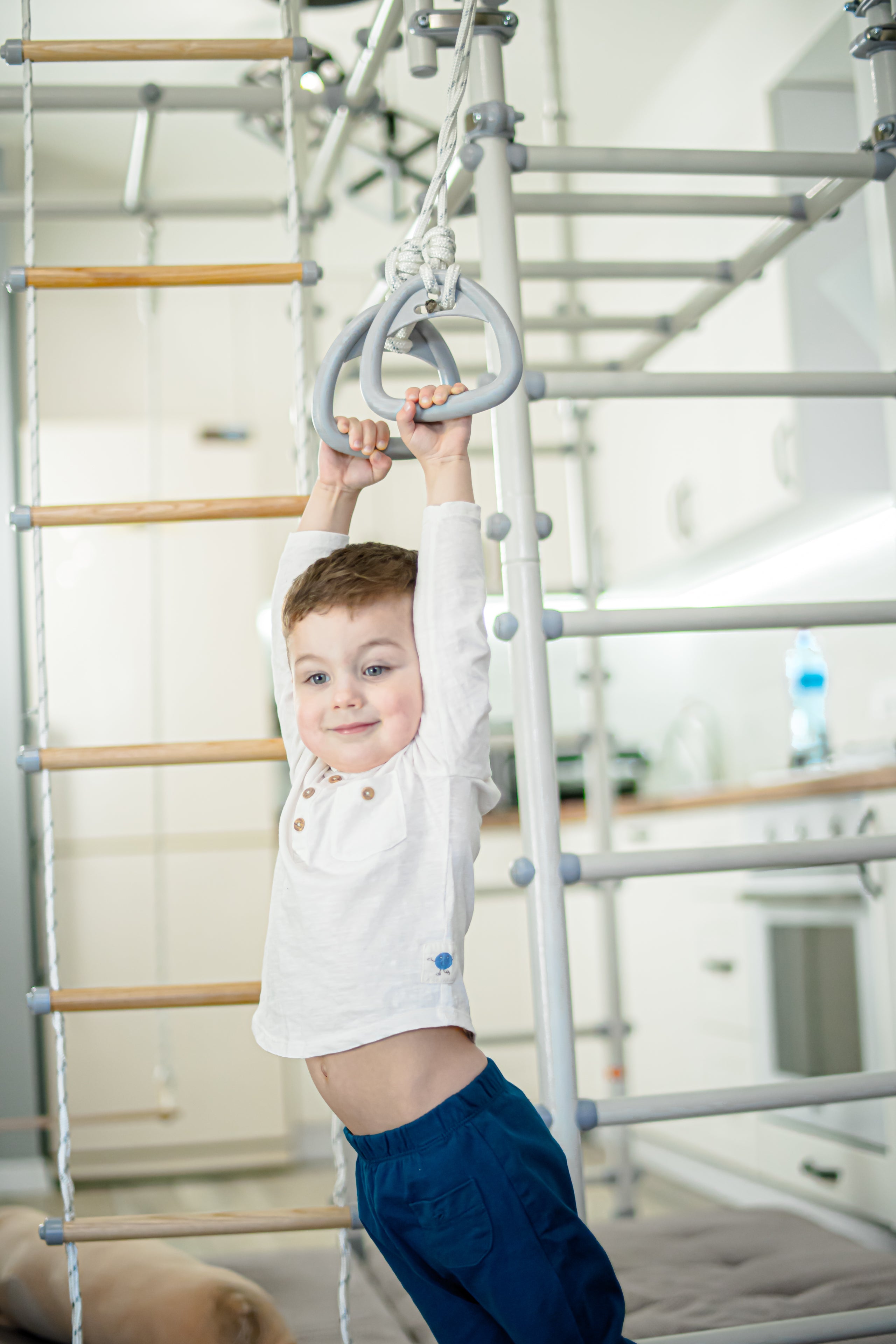
This is the tier where the input-up zone stops being a mat and becomes actual equipment: swinging, climbing, hanging, and crashing in one corner of the room. Pediatric OT Angela Hanscom, whose book Balanced and Barefoot argues that modern kids get a fraction of the climbing, hanging, and spinning their development is asking for, is the best short answer to "why would a child need all this at home": because the daily dose matters, and daily only happens when the equipment lives where the child lives.
The anchor is a steel frame, and there are two ways to do it depending on your room:
| Setup | What you get | Best for |
|---|---|---|
|
Wall-mounted room, about $1,200 total (Model W3, $850, plus mat and corner) |
A steel gym that anchors to wall studs, protrudes just 9 inches from the wall, and is certified to 220 lb. Climbing rungs, a small hammock swing on a linear path, and TRX-style resistance bands, with the floor in front left open for the crash mat and the calm corner. | Small rooms, slanted or very tall ceilings, and anyone who wants the room back when play is done. |
|
Full active room, about $1,700-2,000 total (Spider V3, $1,499, plus mat and corner) |
A floor-to-ceiling steel gym with a monkey-bar span built in: climbing ladders, hanging, brachiating, and a proper swing bay that takes a nest swing and 360° spinning. Braces between floor and ceiling with no drilling. Its bigger siblings, Spider Max V3 and Mega Max V3, come with the same built-in span and more of it. | Families with standard flat ceilings who want the full clinic-style input menu, swings included, in one footprint. |
Add a 4.5-inch play mat under the frame as the crash zone, keep the $200 calm corner from tier one on the opposite side of the room, and you have both zones at full strength. Two rules keep it safe: a parent stays in the same room during play, and independent climbing starts at age 3 and up, with younger siblings joining only with a parent's hands close by. Falls from climbing height are managed the same way playgrounds manage them, with padding under the equipment and height earned gradually; our guide to controlled risky play covers why that beats banning the climb.
The full equipment walkthrough, swing types and accessory rotation included, lives in How to Build a Sensory Gym at Home, with the piece-by-piece shopping list in the sensory room equipment list, and everything frame-related in one place in the sensory gym equipment collection. If monkey bars are the part your child hunts for, the indoor monkey bars guide goes deep on what the bars deliver.
Small sensory room ideas: apartments, corners, and slanted ceilings
The most common reason families stop at the fidget basket is not budget, it is square footage. Three facts change that math:
A sensory room does not need to be a room. Every setup above fits in a corner. The calm zone is 4 by 4 feet; the wall-mounted frame is 9 inches deep. A shared bedroom, the end of a hallway, or the dead corner of a living room all qualify. What matters is that the zones are consistent, so the child's nervous system learns what happens where.
The wall solves what the floor cannot. The W3 anchors to wall studs, never touches the ceiling, and sits 9 inches off the wall, which is exactly what slanted-ceiling attic rooms, tall-ceiling lofts, and narrow apartment rooms need. It is certified to 220 lb, so a parent can demonstrate every move. The trade-off is stated plainly: it is not height-adjustable, and swinging is one-direction only, a small hammock rather than a nest swing, with no spinning. If rotary swinging is the input your child seeks most, that is the case for the floor-to-ceiling frame instead.
Renters can do tier three. The floor-to-ceiling frames brace between floor and ceiling with tension, no drilling into joists, and disassemble when the lease ends. The wall-mounted line needs stud anchoring, so for strict no-holes rentals the tension-mounted route is the one to take.
Paying for it: HSA, FSA, and waiver dollars
BEFORE YOU PAY OUT OF POCKET
If your child has a diagnosed sensory, developmental, or attention-related need, the active tier of a sensory room may not have to come out of the grocery budget:
✓ Is a play gym HSA/FSA eligible? How families use pre-tax dollars for sensory equipment, and what the rules actually say.
✓ The Letter of Medical Necessity guide: the document that unlocks HSA/FSA spending, and how to ask your provider for one.
✓ State disability waiver programs: state-by-state programs that can fund sensory equipment outright.
FAQ
How much does a home sensory room cost?
A working calm-down corner runs about $200, a corner plus crash-and-tactile equipment about $500, and a full active sensory room with a steel frame anchor lands between $1,200 and $2,000. Clinic installations cost many times that; the home advantage is not matching their equipment list, it is daily access to the input that matters for your specific child.
What are good calming sensory room ideas for an autistic child?
Start with the calm-down corner: enclosure, dim warm light, deep pressure, and low visual clutter, then add the movement input your child actually seeks, because many autistic kids regulate through swinging, climbing, and heavy work rather than through stillness. Every child's profile is different, and if regulation is genuinely hard day to day, an OT who knows your child is the right partner for choosing input. Sensory equipment is play equipment, not a treatment.
If an OT does recommend home equipment, the Letter of Medical Necessity guide covers how families fund it.
Can I build a sensory room in a small apartment?
Yes. The calm corner needs 4 by 4 feet, and the wall-mounted W3 sits 9 inches off the wall without touching the ceiling, which suits apartments, slanted ceilings, and shared bedrooms. Tension-mounted floor gyms need no drilling at all, which is what strict rentals usually require.
Do I really need a swing?
Swinging is the one input the budget tiers cannot fake: slow linear swinging is broadly calming and rotary swinging is alerting, and both come up constantly in OT practice. The mounting is the real obstacle at home, which is why a free-standing or wall-mounted frame that carries the swing without ceiling holes is usually the deciding upgrade.
What age is a sensory room for?
The calm-down corner works at any age. Independent climbing on frames starts at age 3 and up, with a parent in the same room; younger siblings join only with a parent's hands close by. For the under-3 crowd, a Pikler-style low climber and floor-level input carry the same philosophy at toddler scale.
Share: