

Updated October 2026 · 11-minute read · by the Brainrich Kids team
The cushions are on the floor again. You put them back twenty minutes ago. Your child has climbed the armrest, launched, landed, and climbed back up for another go, and you have said "stop jumping on the couch" so many times it has stopped sounding like words. If this is your living room, take a breath. A child who keeps jumping on the furniture is usually looking for a specific kind of input their body needs, and once you know what it is, you can give it to them somewhere better than your sofa.
The quick answer: kids jump on couches and crash into cushions because pushing, landing, and squeezing give their muscles and joints strong feedback, called proprioceptive input or "heavy work." It helps them feel where their body is and often helps them settle. Saying "stop" rarely works because the need does not go away; it just moves to the bed or a sibling. What helps: make the room safe, give the jumping a designated place, schedule heavy work before the moments your child needs to be calm, and redirect with a choice instead of a no. If the seeking is intense, constant, or comes with other concerns, a pediatric occupational therapist can assess it.
Jump to: Why kids do it · Signs of input seeking · Why "stop" doesn't stick · The 5-step plan · Couch swaps · When to see an OT · A permanent spot for it · FAQ
Why kids jump on the couch
Your body has a sense most of us never learned about in school. Proprioception is your sense of where your body is and how hard it is pushing, built from receptors in your muscles and joints. It is how you can touch your nose with your eyes closed, or carry a full cup without staring at it.
Those receptors fire hardest when muscles work against resistance: pushing, pulling, carrying, hanging, and landing. A jump off the armrest onto a soft cushion is one of the biggest doses a child can find in a living room. The impact compresses the joints, the muscles brace, and the brain gets a clear, loud signal about where the body is in space.
Occupational therapist A. Jean Ayres built sensory integration theory around this idea in the 1960s and 70s, and OTs still use her vocabulary today. Many kids find that strong input organizing. It can bring an overexcited child down and wake up a sluggish one. So when your child crash-lands on the couch for the fortieth time, they are often doing what their nervous system is asking for, with the only equipment in reach.
Timing matters too. Kids seek this input most after long stretches of sitting, like a school day or a car ride, when they are tired, or right before they are expected to be still, like dinner or bedtime. If the couch launches cluster at certain times of day, that pattern is useful information.
Signs your child is seeking this kind of input
Almost every young child jumps on furniture sometimes. A child who is actively seeking heavy input tends to show several of these, often and on purpose:
🛋️ At home
Crashes into cushions on purpose, jumps off beds and armrests, builds pillow piles to dive into, climbs the back of the sofa.
🤸 With people
Loves rough play and tight hugs, leans on others, wrestles siblings, bumps into people more than other kids do.
⏱️ When it shows up
Peaks after school or long car rides, before bed, or when asked to sit still. Stomps, chews sleeves, can't stay in a chair.
None of these is a diagnosis on its own. Plenty of high-energy kids do all of them and are simply active, curious children. For the fuller picture, including the difference between kids who seek input and kids who avoid it, see our guide to sensory seekers.
Why "stop jumping on the couch" doesn't stick
A rule can stop a behavior for a minute. It can't switch off the need behind it. When the couch is banned and nothing replaces it, most kids find the next best source: the bed, the coffee table, or the nearest sibling.
The repeated "no" also costs you. It turns the late afternoon into a standoff, and your child hears that the thing their body wants is wrong. The approach that works keeps the boundary (the couch is for sitting) and gives the need a better home. Pediatric OT Angela Hanscom makes a related case in Balanced and Barefoot: many children today get far less climbing, hanging, and rough physical play than their bodies need, and the restlessness shows up indoors.
A 5-step plan that actually helps
Save this section. It works best when you do all five, in this order.
1. Make the room safe today
Move glass-topped and sharp-cornered tables out of the launch zone. Anchor dressers, bookshelves, and TVs to the wall, because a child who climbs the couch will eventually try something taller. A child is treated in a U.S. emergency room for a furniture, TV, or appliance tip-over about every 53 minutes, and tables are the most common culprit, behind 38% of those child injuries (CPSC, 2024). Our guide for toddlers who climb everything walks through anchoring room by room.
2. Give the jumping a yes-place
Pick one spot where crashing is allowed. A pile of old cushions against a wall, a folded gym mat, or a twin mattress on the floor all work. Then use a two-part rule your child can repeat back: "The couch is for sitting. The crash spot is for crashing." A clear yes makes the no much easier to hold.
3. Move first, sit second
Schedule 10 to 15 minutes of heavy work right before the moments your child needs to be calm: after school, before dinner, before homework, before bed. OT Patricia Wilbarger coined the term "sensory diet" for this kind of planned input through the day. Good options: wheelbarrow walks, carrying the laundry basket, pushing a box of books across the floor, bear crawls, wall pushes, and hanging from a bar. Our list of heavy work activities has 32 more by age, and the sensory diet guide shows a full sample day.
4. Redirect with a choice, not a no
When the launch starts, name the need and offer two good options: "Your body wants to crash. Crash spot or pillow pile?" A choice keeps your child in charge of something, which cuts the standoff short. Say it calmly and walk them there the first dozen times. It becomes automatic faster than you'd think.
5. Make big movement a daily habit
The WHO recommends at least 180 minutes of physical activity a day for children aged 3 to 4, including 60 minutes of moderate to vigorous play, and an average of 60 minutes of moderate to vigorous activity a day for ages 5 to 17. Kids who get big movement in several short blocks across the day usually need the couch less. A walk to the park counts. So does ten minutes of climbing before dinner.
Couch swaps: what to offer instead
Match the swap to what your child is actually doing. The input is similar; the furniture survives.
| If your child is... | They're seeking... | Offer this instead |
|---|---|---|
| Jumping off the armrest | Landing impact | Jumping from a low, stable step onto a thick mat; frog jumps across the room |
| Crashing into cushions | Full-body pressure | A crash spot of cushions or a mattress; a "sandwich" squeeze between two pillows |
| Climbing the back of the sofa | Climbing and height | A ladder, climbing net, or rope designed for climbing |
| Hanging off furniture or door frames | Pulling and hanging | Monkey bars, a pull-up bar, or rings at a safe height |
| Wrestling a sibling | Pushing against resistance | Wall pushes, tug of war with a towel, pushing a laundry basket of books |
| Spinning and flopping | Movement through space | A swing, with an adult in the room |
For more ideas on long indoor days, see indoor activities for high-energy kids.
When to talk to an occupational therapist
Most couch jumping is ordinary childhood energy, and the plan above is enough. Consider asking your pediatrician about a pediatric occupational therapy evaluation if:
- The seeking is constant and gets in the way of meals, school, sleep, or play with other kids
- Your child gets hurt often because they don't seem to register bumps or falls
- Nothing helps them settle, even after plenty of movement
- It comes with other concerns, like strong reactions to noise, clothing, or touch, speech or motor delays, or big sleep problems
An OT can look at how your child processes movement and touch and build a plan for your home. Carol Stock Kranowitz's The Out-of-Sync Child is the classic parent book if you want to read more first. Our proprioceptive input guide covers the science in more depth.
Give the movement a permanent spot
We love the park, the backyard, and every hour kids spend outside. But many days, outside isn't on the table: it's dark at 5, it's pouring, or it's 98 degrees. And even on good days, a child who needs big movement needs it more than once.
"Kids need the big movement throughout the day — not just an hour block at the park... You can't go to the park several times a day."
Kristen, a Brainrich owner, in our parents' group
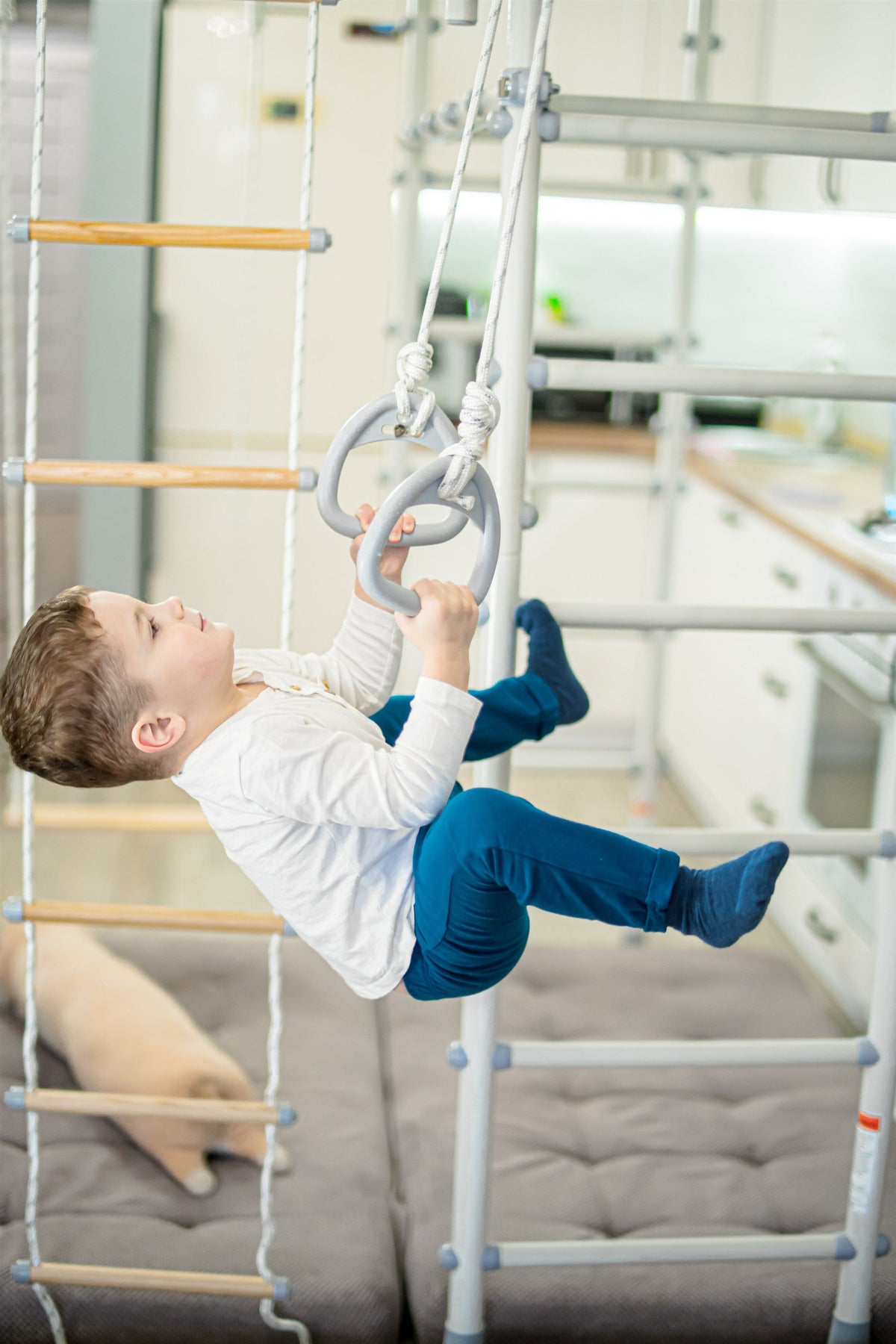
An indoor play gym turns the yes-place from step 2 into something kids want to use. Climbing, hanging, and swinging give the same muscle-and-joint input as couch launches, with a mat underneath and a structure built for it. Our gyms press between floor and ceiling, so there's no drilling. They're rated for 220 lb, and the bars adjust as kids grow. More than 10,000 families have one at home, and occupational and physical therapists in our owner community recommend them. Kids still need an adult in the room, but the couch cushions can stay on the couch.
For small rooms, the wall-mounted Model W3 sits just 9 inches off the wall. Plan on about 3 feet of clear floor in front of it, so kids have room to swing and hop off safely. For the most climbing in the least floor space, start with the Model T3 and add monkey bars later.


Give the jumping a better home
Every gym ships as an easy multi-box kit, assembles in an afternoon, and comes with a 30-day money-back guarantee. HSA/FSA-eligible with a Letter of Medical Necessity, a savings of up to about 30%.
Frequently asked questions
Why does my child keep jumping on the couch? Usually because jumping and landing give strong feedback to the muscles and joints, called proprioceptive input. Many kids find it calming or organizing, so they seek it most after sitting for a long time, when tired, or before they need to be still.
How do I stop my kids from jumping on furniture? Keep the rule, and give the need a better place. Make the room safe, set up a crash spot where jumping is allowed, schedule 10 to 15 minutes of heavy work before calm times, and redirect with a choice: "Crash spot or pillow pile?"
Is jumping on furniture a sign of autism or ADHD? Not on its own. Most children jump on furniture at some point. Talk to your pediatrician about an occupational therapy evaluation if the seeking is constant, causes frequent injuries, never seems to satisfy your child, or comes with other concerns like delays or strong reactions to noise or touch.
Why does my child crash into things on purpose? Crashing gives full-body pressure, one of the strongest forms of proprioceptive input. Offer a safe version: a pile of cushions, a mattress on the floor, or a thick mat under a climbing structure.
What is heavy work for kids? Activities where muscles push or pull against resistance: carrying, pushing, pulling, climbing, and hanging. OTs use heavy work to help kids feel calmer and more focused. Examples include carrying groceries, wheelbarrow walks, wall pushes, and climbing.
Is it bad to let kids jump on the couch? The bigger risks are falls onto hard edges and kids learning that furniture is for climbing, which matters around dressers and bookshelves. A clear rule plus a better place to jump keeps the boundary without fighting the need.
📚 Keep reading in the Decision Guide
Sensory Seekers: Signs and How to Feed the Need · 32 Heavy Work Activities for Kids · Proprioceptive Input, Explained · What Is a Sensory Diet? · Toddler Climbing on Everything?
Sources
Ayres, A.J. (1972). Sensory Integration and Learning Disorders. Western Psychological Services. · Kranowitz, C. (2005). The Out-of-Sync Child. Perigee. · Hanscom, A. (2016). Balanced and Barefoot. New Harbinger. · Yogman, M. et al. (2018). The Power of Play: A Pediatric Role in Enhancing Development in Young Children. Pediatrics, American Academy of Pediatrics. · World Health Organization (2019). Guidelines on physical activity, sedentary behaviour and sleep for children under 5 years of age; WHO (2020) Guidelines on physical activity and sedentary behaviour (ages 5 to 17). · U.S. Consumer Product Safety Commission (2024). Product Instability or Tip-Over Injuries and Fatalities Associated with Televisions, Furniture, and Appliances, summarized at AnchorIt.gov. · STAR Institute for Sensory Processing, sensoryhealth.org.
Share: